 Skip to content

A serious accident can change your life in seconds, but you don't have to face it alone. You may be sitting in an emergency room after an Uber or Lyft crash, trying to understand why your neck hurts, who will pay for treatment, and whether the driver's insurance or the rideshare company's policy applies. Those questions become harder when several insurers point at one another.
Texas rideshare claims turn on details that ordinary car accident claims often don't have. The driver's app status at the moment of impact, the trip records, the identity of every potentially responsible party, and the timing of your medical care can all affect recovery. This guide explains what to do, what evidence to preserve, how Texas fault rules work, and when a rideshare accident lawyer Texas can protect your claim.
What Happens Right After a Rideshare Crash in Texas
A Saturday night on I-45 can become frightening without warning. You're riding in a rideshare minivan when an uninsured pickup strikes the vehicle. Your body jolts forward, airbags deploy, your phone flies across the cabin, and a sharp pain begins in your neck. Sirens approach, but your mind keeps returning to one question: who pays for this?
The driver may say the app was active. The app may show that a trip had already been accepted. The pickup driver may deny fault. Meanwhile, you're dealing with shock, pain, and questions about whether Uber or Lyft has even received a report. The answer often depends on electronic records, not just what someone says at the roadside.
Houston's traffic danger makes fast action especially important. Houston recorded 312 fatal crashes in 2021, causing 327 deaths and 6,930 severe and minor injuries, according to Houston rideshare accident statistics. That data doesn't determine fault in your case, but it shows why a serious collision requires prompt investigation.
The first question is app status
Texas uses different coverage tiers depending on whether the driver was offline, waiting for a request, traveling to pick up a rider, or carrying a passenger. An adjuster may focus on the lowest available layer unless someone secures the trip data and examines the sequence carefully.
You don't need to solve the insurance dispute from the shoulder. You do need to protect your health, document what happened, and avoid statements that could later be taken out of context. The steps below provide a practical order of action for injured riders, drivers, pedestrians, and families.
Immediate Steps to Protect Your Health and Your Claim
Your first decisions should protect your body and create a reliable record. Follow these steps in order when you can, and ask a trusted person to help if you're hospitalized or too shaken to manage them yourself.
Start with safety and medical care
Move away from traffic if you can do so safely. Call 911 and wait for police and emergency medical personnel. Don't refuse transport simply because the pain seems manageable. Adrenaline can hide serious injuries, and symptoms may become clearer over the next several days.
Give medical providers a complete history. Tell the ER or treating clinician about every symptom, including headache, neck pain, back pain, numbness, dizziness, anxiety, or difficulty sleeping. Follow-up care matters because a gap between the crash and treatment gives an insurer an argument that the injury came from something else.
Identify everyone involved. Obtain the rideshare driver's name, license plate, vehicle information, and trip confirmation. Collect information for passengers, other drivers, and witnesses. If you can't do this safely, ask an officer, family member, or lawyer to help.
Document the scene before vehicles move. Photograph vehicle positions, damage, deployed airbags, road conditions, traffic signs, lighting, skid marks, and visible injuries. Take wide images that show the roadway and close images that show impact points.
Report the ride, then protect your statements
Report the crash through the Uber or Lyft application and request the trip receipt by email. Save every message, claim number, and notification. The receipt can help establish the trip, driver, route, and timing.
Don't give a recorded statement to an insurer before you understand the policies involved. You can report basic facts, but you don't need to guess about speed, fault, medical prognosis, or how the crash happened. A Car Accident Lawyer in Texas may help drivers and passengers injured in Texas car accidents evaluate those communications and preserve the legal record.
Practical rule: Seek treatment, save the trip information, and avoid signing a release while your injuries and coverage remain unclear.
How Texas Rideshare Insurance Coverage Actually Works
The headline $1 million policy doesn't apply to every moment a rideshare driver is using the app. Texas coverage changes with the driver's status, so identifying the precise phase is the first technical task in a claim.
| App Status | Liability Limit | UM/UIM Coverage | Who Pays First |
|---|---|---|---|
| App off | Personal auto policy applies | Depends on applicable personal policy | Driver's personal insurer |
| App on, no ride accepted | $50,000 per person, $100,000 per accident, and $25,000 for property damage in contingent liability coverage | Coverage may depend on the applicable policy and dispute | Personal or contingent rideshare coverage, depending on the claim |
| Ride accepted or passenger onboard | At least $1 million in primary liability | Potential rideshare UM/UIM coverage may apply, subject to policy terms | Rideshare insurer generally addresses primary liability |
These limits and phases are described in Texas rideshare liability coverage guidance. The important point is not just the amount. It's whether the records prove which tier applied at impact.
Why the middle phase causes disputes
When the app is on but no ride has been accepted, the available contingent layer is much lower than the active-ride layer. That gap can leave an injured person facing medical bills, lost income, and long-term care needs while insurers debate whether the driver had accepted a trip.
When an uninsured pickup truck causes the crash, or when the at-fault driver carries too little insurance, the issue becomes more complicated. You may need to examine uninsured and underinsured motorist coverage, including whether benefits exist through your own policy or a rideshare policy. Read this guide to uninsured and underinsured coverage before assuming the rideshare company's policy will cover every loss.
Texas Transportation Code provisions governing transportation network companies work alongside insurance agreements maintained by Uber and Lyft. Those agreements don't eliminate the need to determine negligence, causation, policy priority, and available benefits. An insurer's first position isn't necessarily the final answer.
Evidence You Need to Preserve in the First 72 Hours
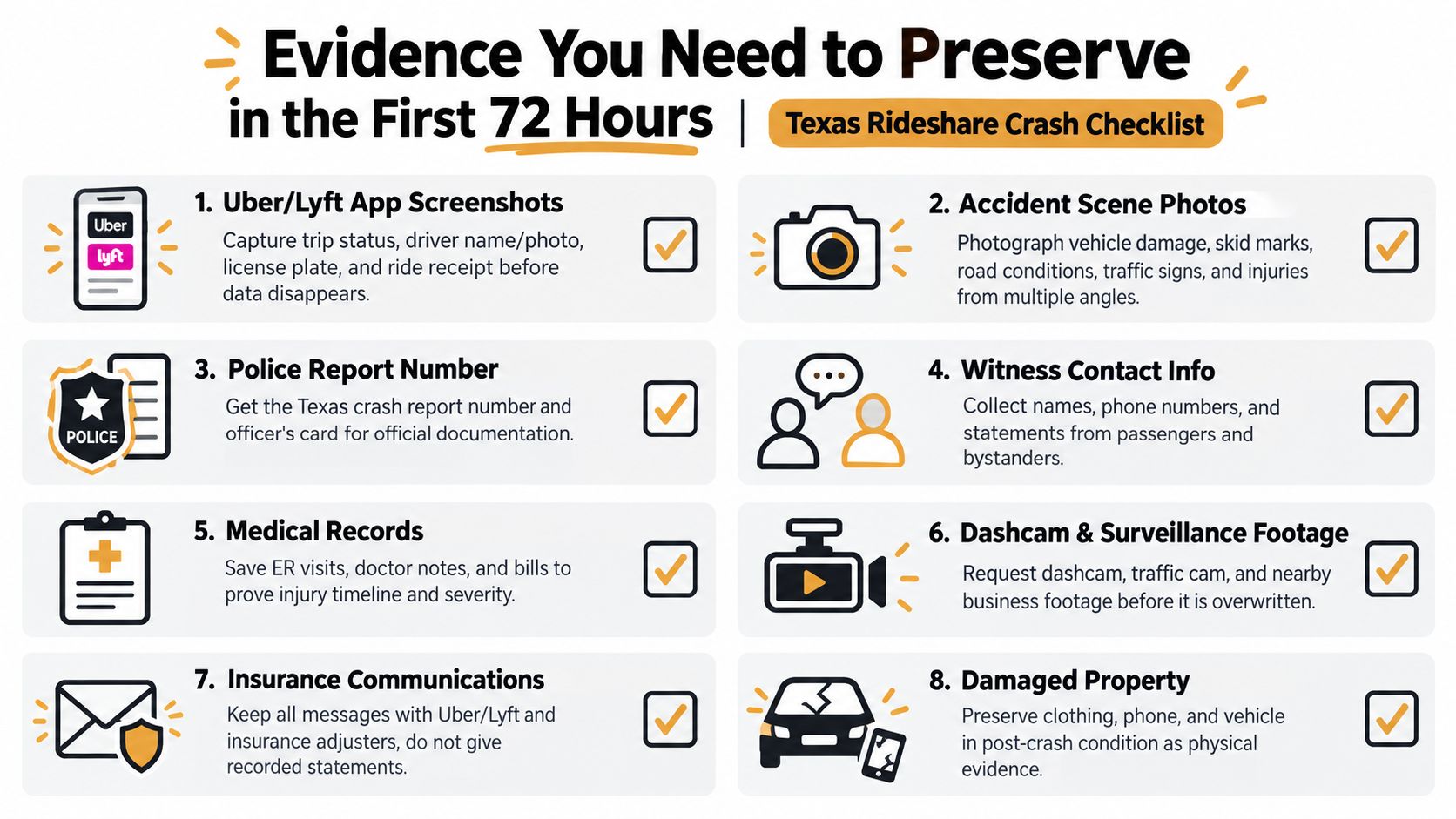
Treat the first 72 hours as an evidence-preservation window, as explained in Texas rideshare evidence guidance. You may be in pain or receiving hospital care, but electronic records and witness memories can become harder to obtain quickly.
Capture the electronic trail
Take screenshots showing the driver's name and photo, license plate, route, trip status, receipt, and timestamps. Save the in-app help report and every email from Uber or Lyft. Don't assume the company or insurer will volunteer the complete trip history.
Get the official Texas crash report number and the officer's information. Preserve the EMS run sheet, ER records, diagnostic testing, prescriptions, bills, and work records. Photograph your clothing, damaged phone, luggage, child seat, or other property without altering the condition.
Ask witnesses for names, phone numbers, and a short description of what they saw. Request available dashcam, traffic-camera, and nearby business footage promptly. Accident data resources such as Vektracer accident data can also help you understand how crash information is documented, but they don't replace the official report or case-specific investigation.
Build a simple preservation file
Create one folder, physical or digital, containing:
- Crash documents: Police report information, tow records, insurance cards, and claim numbers.
- Trip records: Screenshots, receipts, driver information, route details, and app messages.
- Medical proof: EMS records, hospital notes, bills, prescriptions, and follow-up appointments.
- Scene evidence: Photographs, videos, witness contacts, and vehicle damage images.
- Communication history: Emails, letters, texts, and notes about calls with insurers or rideshare companies.
If evidence may be lost, a lawyer can send a preservation notice, sometimes called a spoliation letter. Learn more about spoliation of evidence in Texas before an insurer or company has an opportunity to discard relevant material.
For a visual explanation of the investigation process, you can also review the following accident video:
Who Is Liable for a Texas Rideshare Accident
A rideshare claim may involve more than one defendant. The driver, the rideshare company, another motorist, a vehicle manufacturer, or an owner responsible for maintenance may each require separate investigation. Liability follows the evidence, not the logo on the vehicle.
The driver remains a central defendant
The rideshare driver may be responsible if distraction, speeding, unsafe lane changes, fatigue, or another negligent act caused the collision. The driver's app status affects insurance, but it doesn't excuse careless driving.
The driver's personal insurer may be involved when the app was off. When the driver was logged in without an accepted request, a contingent policy may apply. When a ride had been accepted or a passenger was onboard, the primary rideshare liability layer becomes more significant.
Uber or Lyft may be part of the coverage dispute
Rideshare companies often characterize drivers as independent contractors. That classification can affect a vicarious-liability theory, but it doesn't prevent an investigation into insurance coverage, company records, safety procedures, app data, or other evidence relevant to the claim.
A lawyer may examine whether the company's insurer received accurate information about the driver's status. The investigation can also include the trip record, driver communications, available incident reports, and whether the company retained materials that matter to causation or coverage. Don't assume the company's policy is automatically primary, and don't assume the company has no role just because the driver is called an independent contractor.
Other drivers and manufacturers can share responsibility
If another motorist caused the crash, that motorist's insurer may be the first target for a liability claim. If that driver was uninsured or underinsured, your own UM/UIM coverage may become important. Multiple denials don't erase the claim. They signal that the policies and facts need to be reviewed together.
A defective tire, faulty brake component, or dangerous vehicle condition may also support a claim against a manufacturer, distributor, maintenance provider, or vehicle owner. If a commercial truck contributed to the wreck, preserve the evidence and consider a truck crash lawyer Houston who understands how liability can extend beyond the person behind the wheel.
Comparative responsibility can decide recovery
Texas follows a modified comparative responsibility rule. Under Texas law, an injured person can recover if they are 50% or less responsible, but the award is reduced by that person's percentage of fault. If the claimant is found more than 50% responsible, recovery is barred. See Texas Civil Practice and Remedies Code Section 33.001.
A jury may assign fault among the rideshare driver, another motorist, and the injured person. Lane position, speed, phone use, traffic signals, witness accounts, vehicle damage, and roadway evidence can affect those percentages.
| App Status | Potentially Liable Parties | Texas Comparative Fault Impact |
|---|---|---|
| App off | Driver, another motorist, vehicle owner, manufacturer, or maintenance provider | Your recovery depends on each party's proven share of responsibility |
| App on, no ride accepted | Driver, rideshare insurer, another motorist, and potentially an owner or manufacturer | A disputed coverage phase can combine with a fault dispute |
| Ride accepted or passenger onboard | Driver, rideshare insurer, another motorist, company-related defendants, or manufacturer | Evidence must protect the claim against shared-fault arguments |
The filing deadline is not negotiable
Texas generally gives an injured person two years from the accident date to file a personal injury lawsuit, as described in Texas personal injury deadline guidance. The same general two-year framework can apply to wrongful death claims, although the person entitled to bring the claim and the date rules may differ. Minors and delayed-discovery situations can involve legal exceptions, so don't assume the ordinary deadline answers every question.
The deadline is for filing suit. It isn't a deadline to finish treatment or negotiate indefinitely with an insurer. A practical timeline looks like this:
- First 24 to 72 hours: Preserve app data, report the crash, obtain medical care, and identify witnesses.
- Following one to two weeks: Follow medical instructions, document symptoms, notify relevant insurers, and avoid recorded statements.
- Later treatment period: Gather records, bills, employment documentation, and opinions about future care.
- Before the deadline approaches: Decide whether a lawsuit must be filed, rather than waiting for an insurer's promise to resolve the claim.
Waiting can cost more than time. Witnesses become difficult to locate, video may be overwritten, vehicles may be repaired, and an insurer may argue that delayed treatment proves the injury was minor.
Damages You Can Recover and How Insurers Respond
A Texas rideshare injury claim should account for the full effect of the crash, not just the first hospital bill. Depending on the evidence, recoverable damages may include emergency care, hospital treatment, rehabilitation, prescriptions, future medical care, lost income, reduced earning capacity, pain, and suffering.
Match every loss to proof
Medical records connect the injury to the collision and show the treatment required. Billing statements document expenses. Employment records can support missed work and reduced earning capacity. A doctor's opinion may be necessary when you need ongoing treatment or have lasting limitations.
Pain and suffering are personal, but they still require evidence. Keep a symptom journal, record restrictions on daily activities, and tell medical providers how the injury affects sleep, mobility, concentration, and ordinary tasks. Emotional effects deserve attention too, especially when fear or anxiety changes how you travel or work.
Expect the adjuster to test the claim
An adjuster may ask for a recorded statement, broad medical authorization, or an early release. Those requests can seem routine, but they may give the insurer information it can use to argue that another condition caused your symptoms or that you accepted too little money before understanding your prognosis.
Use this response plan:
- Report the crash accurately: Give basic notice without guessing about disputed facts.
- Track symptoms: Record appointments, limitations, medication, and changes in pain.
- Save receipts: Keep treatment, transportation, medication, and property-loss records.
- Document work impact: Preserve attendance records, wage information, and written restrictions.
- Review releases carefully: Don't accept a settlement until you understand all policy layers and future care needs.
Your recovery can also be reduced by your percentage of responsibility under Texas comparative fault rules. That makes scene evidence and consistent medical documentation important even when the other driver appears clearly responsible.
When and How to Hire a Rideshare Accident Lawyer in Texas
You should speak with a lawyer promptly when you have serious injuries, hospitalization, disputed fault, multiple vehicles, an uninsured or underinsured driver, a denied claim, or pressure to sign documents. You don't need to wait until an insurer rejects the claim. Early legal review can identify the app phase, preserve electronic records, and prevent a low settlement from closing claims you haven't fully evaluated.
Choose experience that fits the dispute
Look for a Texas personal injury lawyer who understands rideshare companies, layered insurance, commercial coverage, UM/UIM disputes, and comparative responsibility. Ask how the lawyer will determine app status, who will request trip records, how medical treatment will be documented, and whether the firm is prepared to file suit if negotiations fail.
Communication matters. You should know who will handle your questions, how updates will be provided, and what information the firm needs from you. Fee terms should be written clearly. Most personal injury attorneys work on contingency, meaning legal fees are generally paid from a recovery, although clients may still be responsible for case expenses.
The broader legal-services industry has also drawn attention to personal injury lead generation 2026, which makes it sensible to ask directly whether you're speaking with the law firm that will handle your case and who will be responsible for communication.
Use the consultation to get specific answers
A free consultation should address:
- The driver's app status at the moment of impact.
- The likely defendants and available policy layers.
- Uninsured or underinsured motorist options.
- Missing evidence and preservation steps.
- Your medical outlook and documentation needs.
- The Texas filing deadline and lawsuit strategy.
- Immediate communications you should avoid.
Read this guidance on when to contact a lawyer after an accident in Texas if you're unsure whether your situation is serious enough for legal advice. A consultation doesn't force you to file suit. It gives you a clearer view of the risks before an insurer controls the process.
If a loved one died in the collision, contact a wrongful death lawyer Texas families can trust without delay. If the injuries affect the brain, spine, mobility, or ability to work, ask about a catastrophic injury claim. A Houston car accident attorney can also evaluate the case when the rideshare vehicle was only one part of a larger freeway collision.
The Law Office of Bryan Fagan, PLLC can investigate app status, preserve rideshare evidence, handle insurers, and pursue compensation for medical care, lost income, pain, and future needs. Visit Law Office of Bryan Fagan, PLLC to schedule a free consultation and discuss your Texas rideshare crash with a legal team that represents injured people and families. Recovery is possible, and you don't have to manage the insurance dispute alone.


