Skip to content
A serious accident can change your life in seconds—but you don’t have to face it alone. When you get hurt on someone else's property, you're often left wondering who is responsible and what your next steps should be. Premises liability is the area of law that holds property owners accountable for injuries caused by unsafe conditions.
Simply put, if a property owner's negligence led to your injury, Texas law gives you the right to seek compensation for what you've lost. This guide is designed to provide clear, compassionate answers about your rights and how a dedicated Texas personal injury lawyer can help you on the road to recovery.

A Property Owner's Fundamental Duty
Whenever you walk into a grocery store, visit a friend's apartment, or enter a local business, you have a reasonable expectation of safety. Premises liability law transforms that expectation into a legal duty. Property owners must take reasonable steps to keep their property safe and protect visitors from foreseeable harm.
An unexpected injury can leave you facing a mountain of medical bills, lost wages, and a painful recovery process. Understanding your rights is the first step toward regaining control.
When Does This Legal Duty Apply?
A property owner's responsibility kicks in when they knew, or should have known, about a dangerous condition on their property but did nothing to fix it or warn you about it. This isn't about creating a perfectly risk-free world; it's about preventing predictable accidents rooted in negligence.
Think about these all-too-common scenarios in Texas:
- A Houston grocery store manager knows about a leaky freezer but fails to put up a "wet floor" sign, causing a customer to fall and break their hip.
- An Austin apartment complex ignores tenants' complaints about a broken light in a stairwell, leading a resident to trip in the darkness and suffer a serious head injury.
- A Dallas business owner lets a large crack in the sidewalk at their entrance go unrepaired for months, creating a trip hazard that causes a visitor to fall and fracture their wrist.
In each of these cases, the owner’s failure to act created the danger. If you were injured in a similar situation, it’s critical to understand that the law is on your side. You can learn more about how this applies to specific incidents, such as in our guide to slip and fall accidents.
The road to recovery is possible, and The Law Office of Bryan Fagan, PLLC is here to help you find it.
How Your Visitor Status Impacts Your Claim
In Texas, a property owner’s legal responsibility to keep you safe hinges almost entirely on why you were on their property. The law places every visitor into one of three categories, and figuring out which one applies to you is a critical first step in any personal injury claim.
This classification determines the level of care the owner was required to provide and is the foundation on which your case for compensation is built. An experienced premises liability lawyer can help you establish your status and hold the property owner accountable to the correct legal standard.
Invitees: Owed the Highest Duty of Care
An invitee is someone on a property for a mutual benefit, which usually means for a business reason. This is the category most people fall into when they get hurt in a commercial or public space.
You are considered an invitee when you're:
- Shopping at a grocery store in Dallas or a mall in Houston.
- Dining at a restaurant in San Antonio.
- Staying as a paying guest at an Austin hotel.
- Living as a tenant in an apartment complex. A property owner's duties are often spelled out in a formal contract like a rental agreement, which clearly defines responsibilities for both landlord and tenant.
Property owners owe invitees the highest duty of care. This means they must not only fix dangers they know about but also actively inspect their property to find and address hidden hazards that could cause harm.
Licensees: A Lower Duty of Care
A licensee is someone who enters a property with the owner's consent but for their own purposes, not for a business transaction. The most common example is a social guest.
For example, if you're invited to a friend’s backyard barbecue in Fort Worth, you are a licensee. You’re there for your own enjoyment, and your friend isn't conducting business.
The owner’s duty to a licensee is lower. They must warn you about or make safe any dangers they actually know about. However, unlike the standard for an invitee, they do not have a legal obligation to regularly inspect their property for dangers they aren't aware of.
Trespassers: The Lowest Duty of Care
A trespasser is someone on a property without any legal right or permission from the owner. For adult trespassers, Texas property owners owe an extremely minimal duty of care.
Generally, an owner is only liable if they injure a trespasser through intentional harm or gross negligence—which means acting with a conscious and extreme disregard for the person's safety. They have no duty to make their property safe for someone who isn't supposed to be there.
The major exception involves children. Under the "attractive nuisance" doctrine, property owners must take reasonable steps to protect children from things that might draw them onto the property, like an unfenced swimming pool.
Common Premises Liability Accidents in Texas
When you hear "premises liability," it might sound like complex legal jargon. But in reality, these cases arise from everyday situations where a property owner's negligence leads to devastating, life-altering injuries.
At The Law Office of Bryan Fagan, PLLC, our team of Texas personal injury lawyers has seen firsthand how a moment of carelessness—a wet floor left unmarked, a broken stair ignored—can shatter a person's life. Premises liability law is about accountability. It ensures that property owners who fail in their duty to keep their spaces safe for visitors, from big-box stores in Houston to apartment complexes in Dallas, can be held responsible.
Slip-and-fall accidents are a significant part of these cases, making up around 17% of all personal injury claims nationwide. For older Americans, falls can be particularly catastrophic, leading to an estimated $50 billion in annual medical costs for non-fatal injuries. The impact of these incidents is clear in reports on top premises liability settlements.
Slip and Fall or Trip and Fall Accidents
These are by far the most frequent premises liability claims we see. They can happen anywhere—a high-end boutique in Dallas, a grocery store in San Antonio, or a local restaurant. A "slip and fall" usually involves a slippery substance, while a "trip and fall" is caused by an obstacle or an uneven surface.
Common hazards include:
- Wet or Slippery Floors: From a spilled drink, a freshly mopped floor without a warning sign, tracked-in rainwater, or a leak from a freezer unit.
- Uneven Surfaces: Cracked sidewalks, torn carpeting, loose floorboards, and parking lots with potholes are all common trip hazards.
- Cluttered Aisles and Walkways: Merchandise, boxes, or electrical cords left in a walking path create an obvious and easily preventable danger.
Negligent or Inadequate Security
Property owners have a duty to protect people from foreseeable criminal acts, not just physical hazards. This is especially true for places like apartment buildings, parking garages, hotels, and nightclubs, particularly if there's a known history of crime in the area.
For example, if a Houston apartment complex has experienced a string of car break-ins, the management is on notice. They may have a duty to install better lighting, security cameras, or controlled-access gates. If they fail to take action and a resident is assaulted in a poorly lit parking garage, the complex could be held liable for the resident's injuries.
When property owners fail to provide adequate security, they leave tenants and visitors vulnerable. This failure is a form of negligence, and victims of assault, robbery, or other crimes may have a valid claim for the damages they suffered.
Swimming Pool Accidents
With our long Texas summers, swimming pools are everywhere—in backyards, at hotels, and in community centers. While they offer relief from the heat, they also pose serious dangers, especially for children. Property owners have a clear responsibility to secure their pools to prevent accidental drownings and other injuries.
Key safety measures include:
- Installing self-latching fences tall enough to keep young children out.
- Keeping rescue equipment, like life rings and shepherd's hooks, easily accessible.
- Properly maintaining pool drains to prevent powerful suction that can trap a person underwater.
A tragic accident in an unsecured pool can destroy a family. When that tragedy happens because a property owner ignored basic safety rules, they must be held responsible. If you have lost a loved one in such a terrible event, a compassionate wrongful death lawyer in Texas can help you fight for the justice your family deserves.
Proving Your Premises Liability Case in Court
After a serious accident, it’s natural to feel powerless. But Texas law provides a clear path to hold a negligent property owner accountable.
Winning a premises liability claim isn’t just about pointing fingers. It’s about methodically building a case to prove the owner failed in their legal duty to keep you safe. To succeed, your legal team must establish four key elements of negligence. Think of these as the four pillars supporting your case—if even one is weak, the entire claim can collapse.
The Four Elements of Negligence
To get the compensation you deserve, we must successfully prove the following four elements:
- Duty: The property owner had a legal obligation to keep their property reasonably safe for you. This duty changes depending on whether you were an invitee, licensee, or trespasser.
- Breach: The owner failed to live up to that legal duty. This could mean not cleaning up a spill, failing to repair a broken handrail, or not warning you about a known danger.
- Causation: This is the critical link. We must show that the owner's specific failure—their breach of duty—is the direct cause of your injury.
- Damages: You suffered real harm as a result of the injury. This includes measurable costs like medical bills and lost wages, as well as non-economic losses like your physical pain and emotional suffering.
This visual shows how these events often unfold in common premises liability accidents.
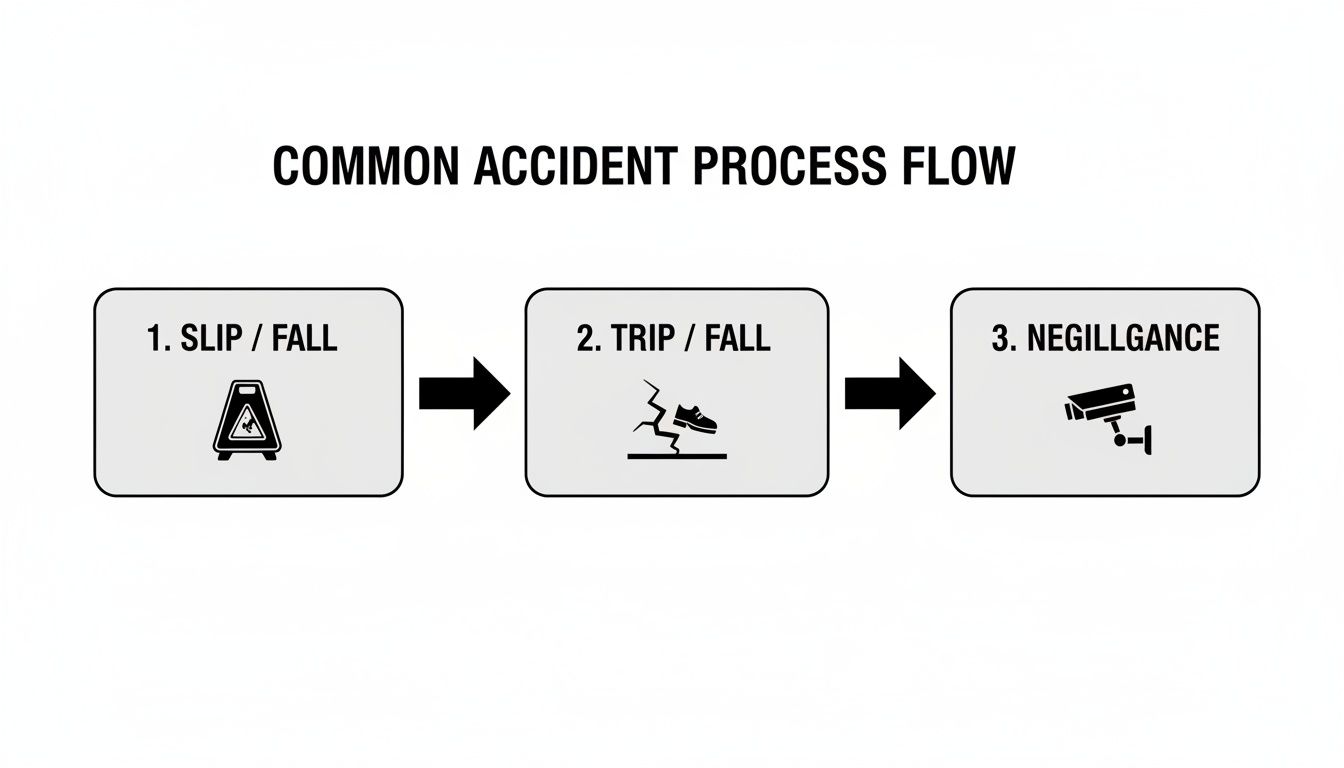
As you can see, a simple hazard like a wet floor or a cracked sidewalk directly leads to an injury. That injury then becomes the basis for a legal claim rooted in the property owner's negligence.
A Real-World Example in San Antonio
Let’s put this into practice. Imagine you’re a delivery driver dropping off materials at a construction site in San Antonio. As a business visitor, or invitee, the site manager owes you the highest level of care.
While walking along a marked pathway, you trip on a bundle of discarded electrical conduit left in the walkway. The fall is severe, and you end up with a broken ankle that requires surgery. Security footage later shows the conduit had been sitting there for hours.
To build your case, we would establish:
- Duty: The site manager had a clear duty to keep designated walkways free of hazards for visitors like you.
- Breach: They breached that duty by allowing the conduit to block the path and failing to remove it in a timely manner.
- Causation: Tripping over that specific bundle of conduit directly caused your broken ankle.
- Damages: You now have medical bills, lost income from being unable to work, and are dealing with significant pain and suffering.
Proving what a property owner “knew or should have known” about a hazard is often the most challenging part of a premises liability case. This is where solid evidence is essential. Things like security footage, maintenance logs, and witness statements can make or break a claim, but owners aren't always eager to hand them over. It is crucial to prevent property owners from destroying this type of information, a topic we cover in our article on what is spoliation of evidence.
Texas Laws and Deadlines You Cannot Afford to Miss
Understanding the law is one thing, but acting on it is what truly matters. In Texas, your right to seek compensation after an injury is governed by strict deadlines and rules. If you miss them, you could lose your chance to recover anything—no matter how clear it is that the property owner was at fault.
Two of the most important rules you need to know are the statute of limitations and the state's comparative fault law.
How Long Do You Have to File a Claim in Texas?
In Texas, you generally have two years from the date of your injury to file a personal injury lawsuit. This deadline is called the statute of limitations. If you let this two-year window close without filing your claim, the court will almost certainly dismiss your case, and you will be barred from seeking compensation forever.
Two years might sound like a long time, but it passes quickly, especially when you are focused on healing. Your legal team needs this time to conduct a thorough investigation, gather crucial evidence like security footage and witness statements, deal with insurance companies, and prepare all the necessary legal paperwork.
Waiting only jeopardizes your claim. Evidence can be lost, surveillance videos are often deleted, and peoples' memories fade. To learn more about this critical deadline, take a look at our guide on the Texas statute of limitations for personal injury.
How Comparative Fault Can Affect Your Compensation
Texas follows a rule called modified comparative responsibility, sometimes known as the “51% bar rule.” This law applies when there's a question of whether you, the injured person, were also partially to blame for the accident.
Put simply, you can still recover damages as long as you are not found to be 51% or more at fault.
However, your final compensation will be reduced by your percentage of fault.
For example: Imagine a jury awards you $100,000 for injuries from a fall in a poorly lit Houston parking lot. If the jury decides you were 20% at fault because you were looking down at your phone while walking, your award would be reduced by that 20%. You would receive $80,000 instead of the full amount.
Insurance companies frequently use this rule to their advantage. They will argue you weren't paying attention or were somewhere you shouldn't have been—anything to shift blame and reduce their payout. This is why having an experienced Houston personal injury attorney is so important. We anticipate these tactics and fight back to protect your right to full and fair compensation.
How a Premises Liability Lawyer Strengthens Your Claim
Understanding the basics of premises liability law is a good first step, but taking decisive action is what truly protects your future. After an injury, facing a property owner and their insurance company alone can feel like an impossible battle. An experienced premises liability lawyer from The Law Office of Bryan Fagan, PLLC, is the ally you need to level the playing field and build a powerful claim.

From the moment you hire us, we get to work protecting your rights. We immediately launch our own investigation, knowing that critical, time-sensitive evidence can disappear in a matter of days or even hours.
Our Commitment to Your Recovery
Our process is designed to build the strongest case possible, allowing you to focus completely on your healing. We take over every legal detail so you don't have to.
Our work includes:
- Securing Evidence: We move quickly to preserve crucial proof that property owners might otherwise "lose" or destroy, such as surveillance videos, maintenance logs, internal incident reports, and witness statements.
- Calculating Your Full Damages: We meticulously document every loss you've suffered—not just the obvious medical bills. This includes calculating current and future medical needs, lost income, any impact on your future earning capacity, and the very real toll of your physical pain and suffering.
- Fighting the Insurance Companies: Insurers are notorious for using tactics designed to deny, delay, or undervalue legitimate claims. We know their playbook and fight back aggressively to ensure they treat you fairly and offer the full compensation you deserve.
You should not have to worry about how to pay for a lawyer while you are already struggling with medical bills. That's why we work on a contingency fee basis. This means there are absolutely no upfront costs for you, and you will not pay us a single dime unless we win your case.
Don't let a negligent property owner and their insurer dictate your future. The path to justice starts with one simple step. Our team is ready to stand by your side and fight for the resources you need to rebuild your life.
Recovery is possible, and expert legal help is available. We invite you to contact the Law Office of Bryan Fagan, PLLC, for a free, no-obligation consultation. Let us listen to your story, explain your rights in clear terms, and show you exactly how we can help.
Frequently Asked Questions About Premises Liability Claims
After a sudden injury on someone else's property, your mind is likely racing with questions. It's a confusing and stressful time, and getting clear answers is the first step toward regaining control. We've gathered some of the most common questions we hear from clients to help you understand your rights.
What If the Dangerous Condition Was Obvious?
This is a common concern for injured victims. In Texas, there is a legal concept known as the "open and obvious" doctrine. The defense will argue that if a hazard was so obvious that a reasonable person should have seen and avoided it, the owner had no duty to warn you.
However, that is not the end of the story. Just because a hazard was visible doesn't automatically defeat your claim. We can argue that while the hazard may have been visible, you were legitimately distracted—perhaps you were carrying groceries, looking for an address, or the lighting was poor. Never assume you don’t have a case just because the danger seems obvious in hindsight. Let an experienced lawyer evaluate the specific details first.
How Much Is My Premises Liability Case Worth?
There is no magic formula or online calculator that can provide a reliable number. The value of your case is tied directly to the unique losses you suffered. Every injury and every recovery is different.
Generally, we fight to recover compensation for two main categories of damages:
- Economic Damages: This includes all of your medical bills (past and future), lost wages, and any damage to your ability to earn a living in the future.
- Non-Economic Damages: This is compensation for the human cost of the injury—your physical pain, mental anguish, scarring, and loss of enjoyment of life.
Our team at The Law Office of Bryan Fagan, PLLC, works diligently to calculate the true, full cost of your injury to ensure the compensation you receive covers everything you have lost.
What Should I Do If the Owner's Insurance Company Contacts Me?
You must be very careful. The insurance adjuster who calls you may sound friendly and concerned, but their job is to protect their company’s profits, not to help you. It is fine to confirm basic information like your name and contact details, but that is all.
You should politely but firmly refuse to give a recorded statement, sign any medical authorizations, or accept a quick settlement offer before you have spoken with an attorney.
The adjuster is trained to get you to say things that can be used to devalue or deny your claim later. The best response is simple: "I am hiring an attorney who will be in touch with you." This single sentence protects your rights and signals that you will not be taken advantage of.
A serious injury can feel like your entire life has been put on hold. At The Law Office of Bryan Fagan, PLLC, we are here to help you move forward. Your physical and financial recovery is our priority, and our team of dedicated Texas personal injury lawyers is ready to fight for you.
Contact us today for a free, no-obligation consultation to discuss your case. Let us listen to your story, explain your rights, and show you how we can pursue the justice and compensation you deserve. Visit us at https://texaspersonalinjury.net or call us now to get started.