A serious crash can begin with an ordinary drive home. You hit standing water that should have drained, or your tires catch a sharp pavement drop-off with no warning, and within seconds your life looks very different.
Many people blame themselves first. They replay the moment and ask whether they braked sooner, turned differently, or should have spotted the danger. That reaction is human. It is also not always accurate.
Sometimes the road itself helped cause the wreck.
That matters because a road-condition case is different from a typical insurance claim against another driver. When poor maintenance, missing warnings, unsafe drainage, broken pavement, or another roadway defect played a role, the party responsible may be a government entity. In Texas, that means your case can run straight into the Texas Tort Claims Act, a law with strict rules and a short notice deadline that trips up injured people far too often.
The six-month notice requirement is often the first real obstacle. It works like an alarm clock you do not get to snooze. Miss it, and a valid claim can become much harder to pursue, even when the road hazard was serious and the harm was preventable.
The good news is that these cases can be won. With quick action, clear evidence, and a careful look at who controlled the road, you may have a path to recovery and accountability.
Your Accident May Not Have Been Your Fault
You drive the same route for years without a problem. Then one night your tires catch a sharp pavement edge with no warning sign, or your car slides across water that should have drained off the roadway, and the crash is blamed on “driver error” before anyone studies the road itself.
That happens more often than people realize.
A road-condition case starts with a simple but powerful question. Did you cause this wreck by yourself, or did a dangerous road defect help set it in motion? In plain terms, the road can become part of the story. Broken pavement, poor drainage, missing warning signs, bad lighting, loose gravel, uneven shoulders, and hazards left behind in Texas work zones after a crash can all contribute to a collision.
Weather and darkness do not automatically excuse a dangerous roadway. Rain is common in Texas. Night driving is common too. A public entity or contractor may still have a duty to address a known hazard or warn drivers about it. The law does not require roads to be perfect. It does require reasonable safety measures when a condition creates a foreseeable risk.
That idea confuses many injured people, so here is the practical way to look at it. If a store owner leaves water on the floor long enough for someone to slip, the question is not just whether the customer was walking carefully. The question is also whether the dangerous condition should have been fixed or clearly warned about. Road cases work in a similar way, except the rules are tougher because claims against a government entity face special protections and short notice requirements.
You may still have a claim even if another driver hit you. A missing stop sign can help cause an intersection crash. A deep pothole can trigger a rollover. Poor drainage can turn a routine lane change into a hydroplaning wreck. Surface failures in private areas can matter too, which is why property owners often rely on a parking lot maintenance checklist to catch hazards before someone gets hurt.
The first step is not guessing. It is preserving evidence before it disappears. In these cases, the road condition often changes quickly. Water drains away. Crews patch the hole. Signs go back up. Skid marks fade. If the road played a role, recognizing that early can make the difference between a case that can be proved and one that becomes much harder to document.
And in Texas, that early recognition matters for another reason. If a city, county, or state agency may be involved, the clock on a formal notice claim may already be running.
Who Is Responsible for Dangerous Roads in Texas
The first challenge is figuring out who controlled the road where the crash happened. That sounds simple, but it often isn't. The answer changes everything, including where a claim goes and what deadlines apply.

Public roads can belong to different entities
A road-condition claim usually starts with the road's classification.
- State highways and interstates often fall under TxDOT. If the crash happened on I-10, I-45, or another state-controlled highway, the state may be the entity that maintained the roadway.
- County roads are often handled by the county, especially outside city limits.
- City streets usually fall under the municipality. That can include local intersections, neighborhood roads, and many downtown streets.
- Construction areas may involve a private contractor, even when the road itself is public.
- Utility work zones can create a separate layer of responsibility if repairs, trenching, or surface restoration created the hazard.
After a Houston-area crash, for example, a pothole on a city street may point to the city. A dangerous condition in an active work zone may point to both the public agency and the contractor that set up the site.
Why this question matters so much
Filing against the wrong party can waste precious time. That's especially dangerous when a government deadline may be running.
Texas roadway claims also need strong proof because defendants often argue the driver caused the wreck. That's why investigators focus on physical evidence, not just memory. Objective proof matters when roads are crowded and crashes are frequent. Texas recorded 4,150 traffic deaths and 251,977 injuries in 2024, with a reportable crash about every 57 seconds, as noted in these Texas roadway crash figures. In a road-condition case, that context helps explain why lawyers and reconstruction experts pay close attention to potholes, poor drainage, and missing signs.
Here's a simple way to think about responsibility:
| Road condition example | Possible responsible party |
|---|---|
| Large pothole on an interstate | TxDOT |
| Flooded city underpass with drainage problems | City |
| Broken rural bridge approach | County |
| Unmarked lane shift in work zone | Private contractor, possibly with public entity involvement |
| Uneven pavement after utility repair | Utility company or contractor |
If the crash happened on private property, liability may look more like a premises case than a road-agency case. For readers trying to understand how maintenance failures can create vehicle hazards outside highways, a practical parking lot maintenance checklist can help show the kinds of defects that should be documented early.
Work zones deserve special attention because responsibility is often shared. If your wreck happened near cones, barriers, lane closures, or pavement changes, this guide on most work zone crashes may help you spot issues that matter.
The Biggest Hurdle The Texas Tort Claims Act
A lot of people call us after a crash on a flooded road, a broken shoulder, or an unmarked drop-off and say the same thing: “I thought you just file an insurance claim.” With a government road case in Texas, it rarely works that way.
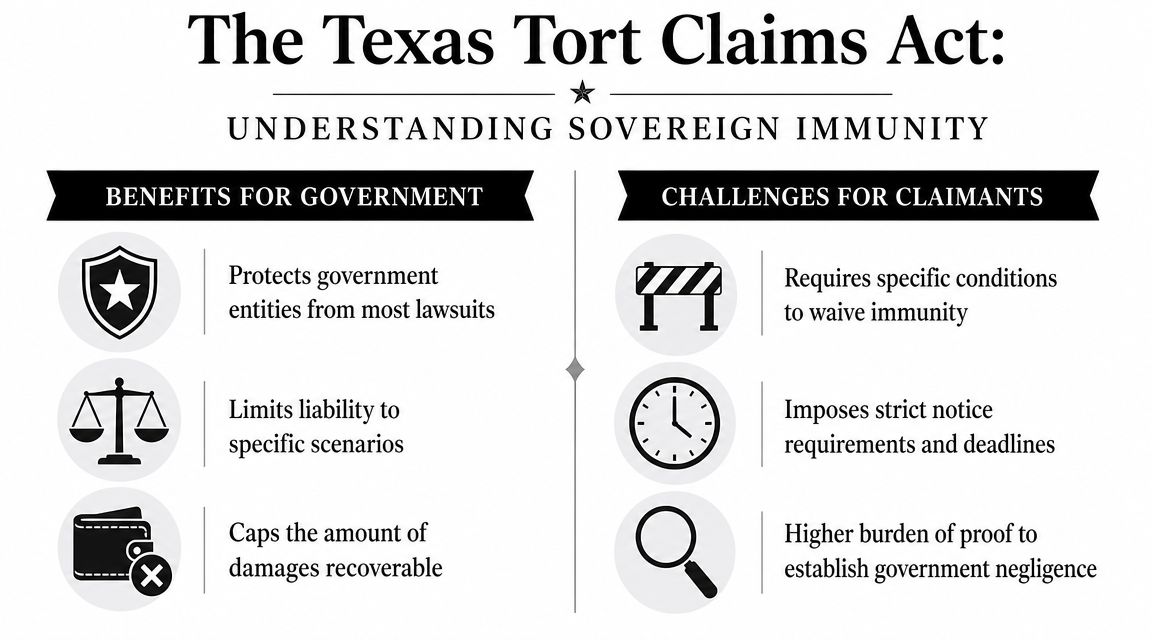
When a city, county, or state agency may be at fault, you run into sovereign immunity. In plain English, that rule means you usually cannot sue the government unless Texas has said you can. The Texas Tort Claims Act is the narrow doorway that allows some of these cases to go forward, but only if you fit through that doorway exactly.
Why these cases feel harder than ordinary wreck claims
In a typical crash claim, the dispute is often about who made the driving mistake. In a road-condition case against a public entity, the fight usually starts earlier. Was the government legally responsible for this kind of hazard at all? Did it know about it? Was the condition serious enough under Texas law?
Those questions are why road cases can feel technical. They often depend on how the law classifies the defect.
Texas courts often separate roadway hazards into premises defects and special defects. Those are legal labels, but they work a lot like different locks on the same door. The label affects what duty the government owed you and what evidence you need to prove notice and fault.
Premises defect and special defect in plain language
A premises defect is usually a dangerous condition on public property that may create a risk, but not one the law sees as highly unusual for ordinary travel. Uneven pavement, worn surfaces, or a maintenance problem may fall into this category depending on the facts.
A special defect is closer to an unexpected and unusually dangerous hazard in the roadway itself. A major excavation, a sudden collapse, or a severe unmarked drop-off is more likely to be treated this way.
That distinction can shape the whole value of the case.
Practical rule: The more sudden, unusual, and dangerous the condition was for a driver using the road in an ordinary way, the stronger the argument that the hazard should be treated as a special defect instead of routine poor maintenance.
Notice is often the battleground
Even if the road was plainly unsafe, a strong claim usually needs to prove several separate pieces:
- Control of the roadway so the correct public entity is identified
- Notice of the hazard through prior complaints, inspection records, work orders, repeated incidents, or obvious long-term deterioration
- Failure to repair or warn within a reasonable time
- Causation showing the condition helped cause the crash
- Damages such as medical bills, lost wages, pain, impairment, or wrongful death losses
Notice is where many valid claims get stuck. A pothole that appeared an hour before the crash raises a different legal question than a drainage failure neighbors had reported for months. In other words, the case is often less about whether the condition was bad and more about whether the government had a fair chance to fix it or warn people.
A Texas road safety study found that crash severity in Southeast Texas is associated with factors such as weather, lighting, crash time, speed limit, road class, surface condition, and driving risk factors. The study also reported that Texas had 559,402 traffic accidents in 2023, including 4,289 deaths, 18,753 serious injuries, and that speeding accounted for 25.7% of crashes that year. Those figures are from 2023, while earlier sections discussed 2024 statewide totals, so the years should not be compared as the same data set.
The defense may say the driver's speed, the darkness, or the rain caused everything. Your job is to show the road hazard materially increased the risk. Poor drainage, slick pavement, missing warnings, or visibility problems can change traction, stopping distance, and lane stability in ways that make a crash more predictable and more preventable.
And there is one more trap. Cases against government entities run on a much shorter legal countdown clock for injury cases than many people expect. That deadline issue is often the hardest part of an otherwise winnable road-condition claim.
Critical Deadlines You Cannot Afford to Miss
If a city, county, or state agency may be involved, time can hurt your case before anyone argues about fault.
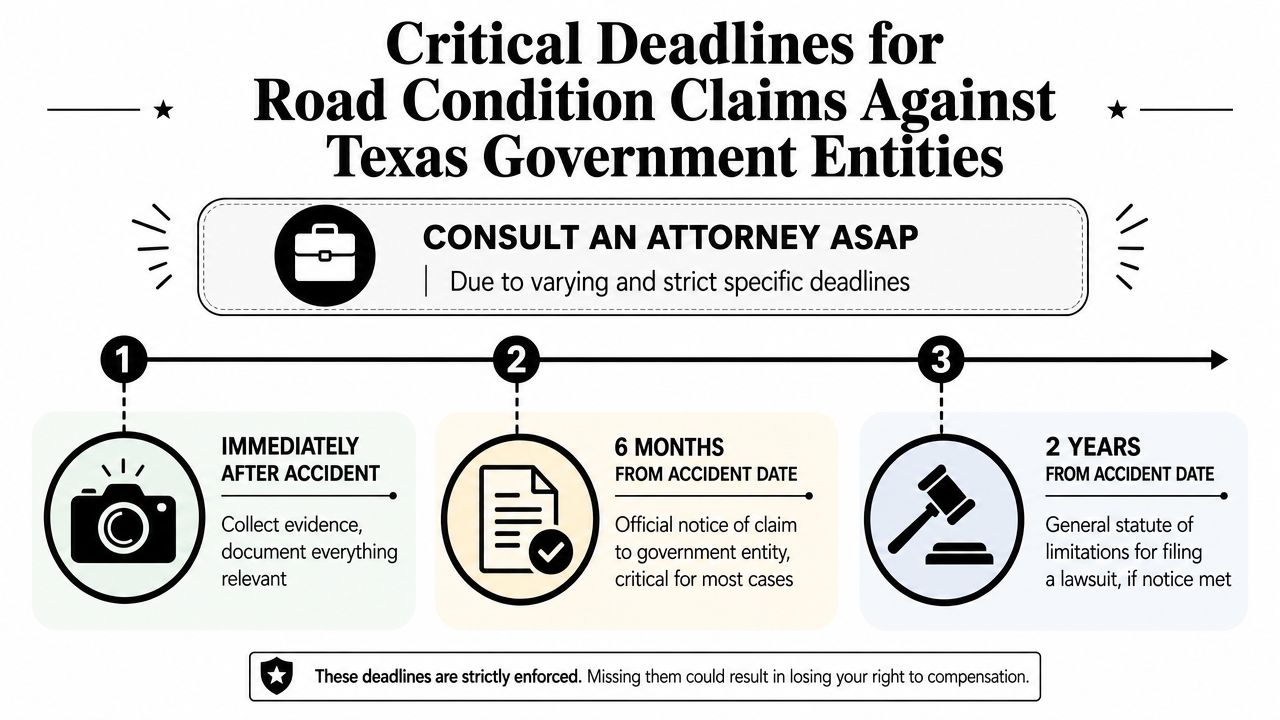
For many injury claims in Texas, people know about the 2-year statute of limitations. That deadline is important, but it can create a dangerous misunderstanding in road-condition cases. Government claims often require a separate formal notice far sooner.
A short video can help frame why timing matters so much in injury claims:
The deadline people miss most often
Under the Texas Tort Claims Act, victims often must provide a formal notice of claim within 6 months, which is much shorter than the usual 2-year limitations period for ordinary injury cases. Missing that notice period can mean losing the right to sue before a lawyer even has the chance to fully evaluate the claim, as explained in this discussion of Texas bad road and truck accident claims.
That's the single biggest trap in these cases.
The calendar starts running soon after the crash, not after your treatment ends, not after the insurance company responds, and not after you decide you're ready.
What should you do right away
You don't need to know every legal detail on day one, but you do need to treat the deadline as urgent.
- Identify the road owner quickly so notice goes to the right entity.
- Preserve the location details including the exact road, lane, direction of travel, and nearest cross street or marker.
- Get legal help early if the facts suggest a public road defect, because the notice has to be timely and accurate.
- Keep every document from the crash, including medical records, repair estimates, towing records, photos, and the crash report.
If you want a plain-language overview of how injury deadlines can affect a case, this legal countdown clock for injury cases is a helpful general resource.
Why waiting is so risky
Roads get patched. Water drains away. Temporary signs disappear. Construction setups change overnight. Government agencies and contractors also control many of the records you may need, such as maintenance logs, prior complaints, inspection records, and repair histories.
The sooner your case is reviewed, the better your chance of preserving proof before it vanishes.
What if I Was Also Partially at Fault
This is one of the first worries clients bring to my office.
Maybe you were tired. Maybe you were driving a little too fast for the rain. Maybe you braked late because traffic changed suddenly. People assume those facts destroy their case. In many situations, they don't.
Texas uses a form of comparative negligence, often called proportionate responsibility. That means fault can be divided among multiple people or entities. If the road condition and a driver's conduct both contributed, the case doesn't automatically end.
How blame gets divided
A familiar example helps. Say you're driving in the rain and approaching a flooded low area. You may have some responsibility if you didn't slow enough for conditions. But if the city knew the underpass repeatedly flooded because of poor drainage and failed to fix it or warn drivers, the city may still bear a significant share of the blame.
That's why “it was just bad weather” is often a defense argument, not the final answer.
Texas-focused guidance notes that victims can still recover when they were partly at fault, and that insurers often blame weather even when a roadway defect such as poor drainage is the stronger legal cause of the crash. This overview of weather conditions and car accident liability in Texas is useful on that point.
A rainstorm doesn't excuse a dangerous road design. It may reveal it.
Why this matters in real cases
Road-condition crashes are often multi-cause crashes. A pothole can trigger a swerve, but another driver may also have been following too closely. A missing sign can contribute to a wrong-way movement, but limited lighting may have made the danger worse. A truck may lose stability on a broken shoulder, and the trucking company may also face questions about speed or driver judgment.
In other words, Texas law doesn't require your driving to be perfect before you can ask for compensation.
A jury or insurer may assign percentages of fault. Your recovery may be reduced by your share of responsibility, but partial fault is very different from no claim at all. If you're trying to understand how that rule works in plain terms, this explanation of comparative fault definition can help.
Don't let an insurer simplify the story
Insurance companies like simple narratives. “Driver error.” “Wet road.” “Couldn't stop in time.” Those phrases can sound final, but they often skip over what caused the road to be unsafe.
A better question is whether the roadway condition materially increased the danger for an ordinary driver using reasonable care under the circumstances. If the answer is yes, your case may still be very much alive.
Building Your Case Evidence to Collect After the Crash
Road-condition claims are won with evidence, not assumptions.
Texas collects crash data through the CR-3 peace officer report system, and investigators use that information along with roadway and injury data to connect a specific defect or maintenance issue to crash mechanics and injury severity. That's why objective proof matters so much in these cases, as explained on TxDOT crash data and records resources.
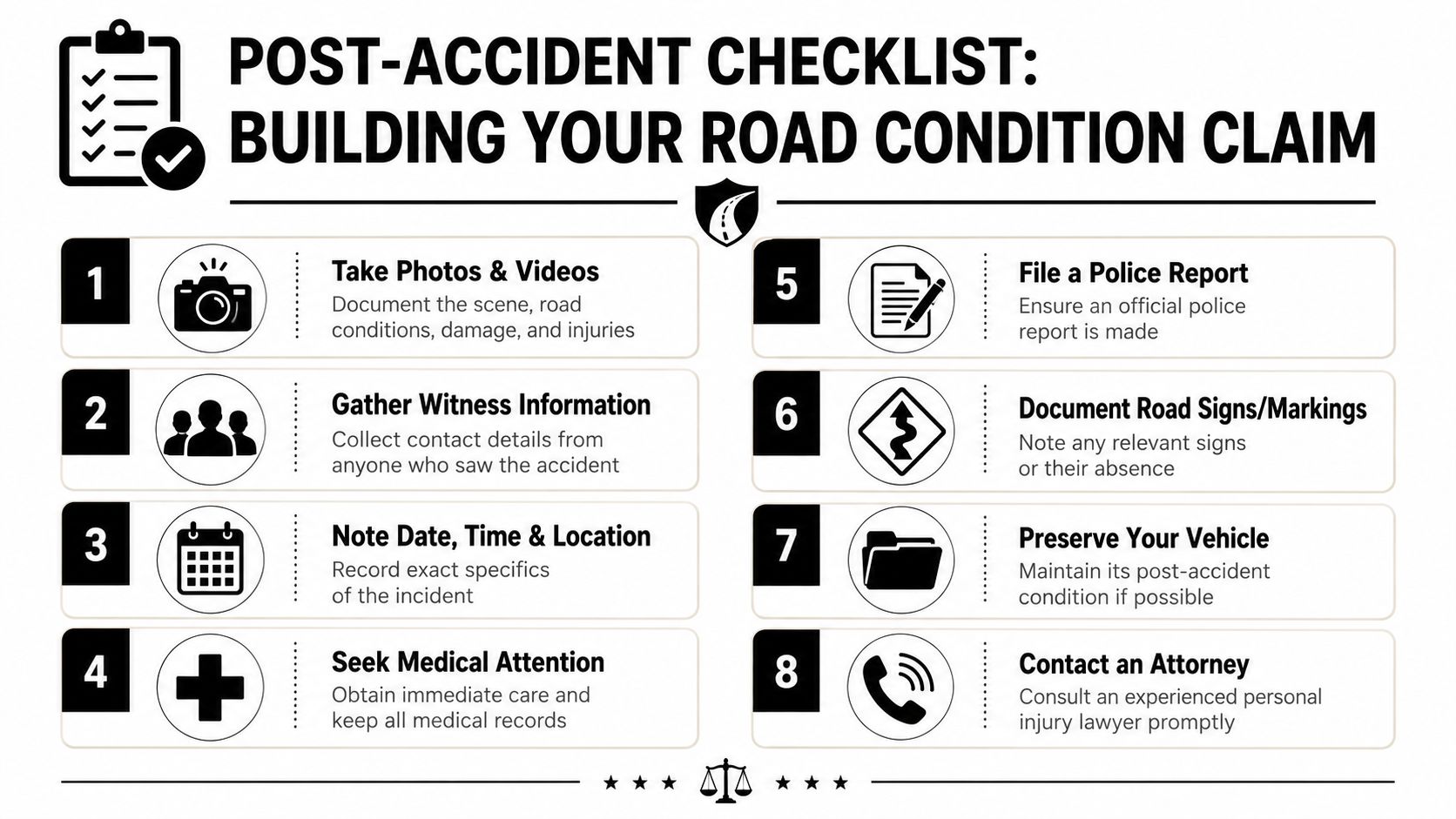
What to document at the scene if you can do so safely
If you're physically able and it's safe, gather facts before the scene changes.
- Photograph the defect itself. Get wide shots and close-ups. If it's a pothole, include an everyday object for scale, such as a shoe or water bottle.
- Capture the surrounding area. Take photos of lane markings, standing water, shoulder drop-offs, guardrails, signals, and any missing or blocked signs.
- Record time and conditions. Make note of rain, darkness, glare, fog, or construction activity.
- Photograph vehicle damage and tire marks. These images can help a reconstruction expert understand how the vehicle reacted.
- Get witness names and numbers. A nearby driver, passenger, or business owner may have seen the hazard before your crash.
The police report matters more than people realize
Ask the responding officer to document the road condition if possible. You can't control what goes into the report, but you can calmly point out the hazard.
If the officer notes standing water, surface failure, missing signs, or debris, that can become an important part of the record. The report won't prove the whole case by itself, but it can anchor the time, place, and initial observations.
What to say at the scene: “Officer, the road condition may have caused or contributed to this crash. Please note the pothole, drainage issue, missing sign, or pavement defect if you can.”
Evidence your lawyer may seek next
A strong Texas personal injury lawyer won't stop with your phone photos. The next layer of proof often includes records you can't access on your own.
That may include:
- Maintenance logs showing when the road was inspected or repaired
- Prior complaints that may show the agency had notice
- Work orders and contractor records from construction or utility projects
- Road design and drainage information when flooding or lane geometry is at issue
- Crash history at the location if it helps show a recurring hazard qualitatively
- Medical records connecting the crash forces to your injuries
For a broader look at supporting documents in Texas injury cases, this guide on what evidence is needed for an injury claim in Texas is a useful starting point.
If your crash involved catastrophic harm, preserve everything. Don't rush to repair or dispose of the vehicle until you've spoken with counsel. A bent wheel, damaged tire, undercarriage scrape, or electronic vehicle data may help explain exactly how the road defect affected the crash.
How a Texas Personal Injury Lawyer Can Help
A road-condition case against a Texas government entity is not like an ordinary insurance claim. It works more like a case with two clocks running at once. One clock tracks the evidence that can disappear fast, such as standing water, missing signs, skid marks, repair activity, or witness memory. The other tracks the notice deadline under the Texas Tort Claims Act, and missing that deadline can end a claim before the facts are ever fully heard.
A lawyer's job is to get control of both clocks early.
A Texas personal injury lawyer can sort out who owned or maintained the roadway, identify whether a city, county, state agency, contractor, or private party may share fault, and prepare the formal notice a government claim may require. That sounds procedural, but it often decides whether the case survives. In many road-defect cases, the six-month notice issue is the single biggest barrier, not whether the crash was serious.
Lawyers also build the story of causation in a way that makes sense to insurers, agencies, and, if needed, a jury. That matters because road-condition crashes are easy for the other side to oversimplify. They may say it was just rain, just speed, or just driver error. A good case presentation shows the full chain of events. For example, pooled water may have reduced tire contact, a lane drop-off may have pulled the vehicle sideways, or a missing warning sign may have taken away the time needed to react safely.
That same approach can matter in a passenger-vehicle case, a commercial-vehicle claim involving a truck crash lawyer Houston families may need after a serious wreck, or a fatal case where survivors need guidance from a wrongful death lawyer Texas families can call for answers.
A lawyer also protects you from avoidable mistakes in early communications. A short recorded statement can leave out the road hazard, the prior complaints, or the way the defect changed visibility or vehicle control. Once a partial version of events gets repeated in a claim file, it can be hard to correct. Counsel helps make sure the explanation is accurate, complete, and supported by records.
In a Houston freeway case, that may mean pulling together photos, the CR-3 report, witness statements, maintenance records, drainage information, and reconstruction analysis. In a city-street case, the focus may be prior notice and delayed repairs. In a work-zone or truck case, the investigation may also examine traffic control devices, contractor conduct, and whether the roadway was returned to a reasonably safe condition.
The Law Office of Bryan Fagan, PLLC handles Texas motor vehicle injury matters, including car wrecks, truck collisions, catastrophic injuries, and wrongful death claims.
You do not have to figure out the Tort Claims Act on your own while you are healing. A good Houston car accident attorney can explain whether you may have a standard negligence claim, a government claim, or both, then act quickly to preserve evidence and protect the deadlines that matter most.