Skip to content

A serious accident can change your life in seconds, but you don't have to face it alone.
If you're reading this because your mother's skin is breaking down in a Texas facility, your father keeps missing medications, or your spouse came home from a visit shaken by what they saw, trust your instincts. Families do not usually overreact to a sudden decline. They notice the small things first, a new odor, a bed sore, a blank stare, a resident who has gone quiet because something is wrong.
That is exactly how nursing home neglect often shows up. In Texas, neglect is not a vague worry, it's a documented safety issue. One investigative report found at least 143 people died in Texas nursing homes due to neglect and poor quality of care in the past five years, and Texas defines neglect as failing to provide medical services necessary to avoid physical or emotional harm or pain (Texas Observer). Families need that reality check because the law does give you a path forward when a facility's failures cause injury or death.
A good starting point is a practical caregiver resource, especially if you need to report concerns fast. The guide for caregivers on reporting abuse lays out the early reporting mindset families often need when something feels off. That kind of action matters because evidence disappears quickly in these cases, and what you do in the first hours can shape the value of a future claim.
If you're trying to understand a nursing home neglect settlement Texas families can pursue, the questions that matter are simple. What counts as neglect, what evidence moves the case, how long you have, and what to do right now. Those are the answers that follow.
When a Loved One Starts to Change in a Texas Nursing Home
A daughter in Houston visits on a Sunday and notices her mother is no longer finishing meals. A son in Dallas sees a pressure sore that was not there two weeks ago. A spouse in San Antonio hears that medications were “delayed” again, and the resident who used to talk now stares at the wall and barely responds.
Those changes matter when they are new. In nursing home cases, the first warning signs are often the ones families dismiss because they seem easy to explain, weight loss, withdrawal, a new fall, a missed dose, a bruise with no real answer. When the explanations keep shifting, the facility is revealing more by what it cannot document than by what it says.
Texas families should also keep one fact in mind, neglect is not a rare complaint that shows up once in a while. State reporting shows thousands of reported nursing home neglect cases in Texas, with more than a thousand confirmed cases in the year cited by Cunningham Firm. That does not prove every bad outcome is negligence, but it does prove the problem is serious enough that families need to move fast when warning signs appear.
Practical rule: If the condition changed and the facility cannot explain why with records, treat it as a legal problem, not just a care problem.
A practical guide for caregivers on reporting abuse is a good place to start if you need to report concerns quickly. The point is simple, evidence disappears fast in these cases, and what you do first can shape the value of a future claim.
If you are caring for a vulnerable parent or spouse, focus on three questions right away, what happened, what should have happened, and what documentation can prove the gap.
What Texas Law Defines as Neglect
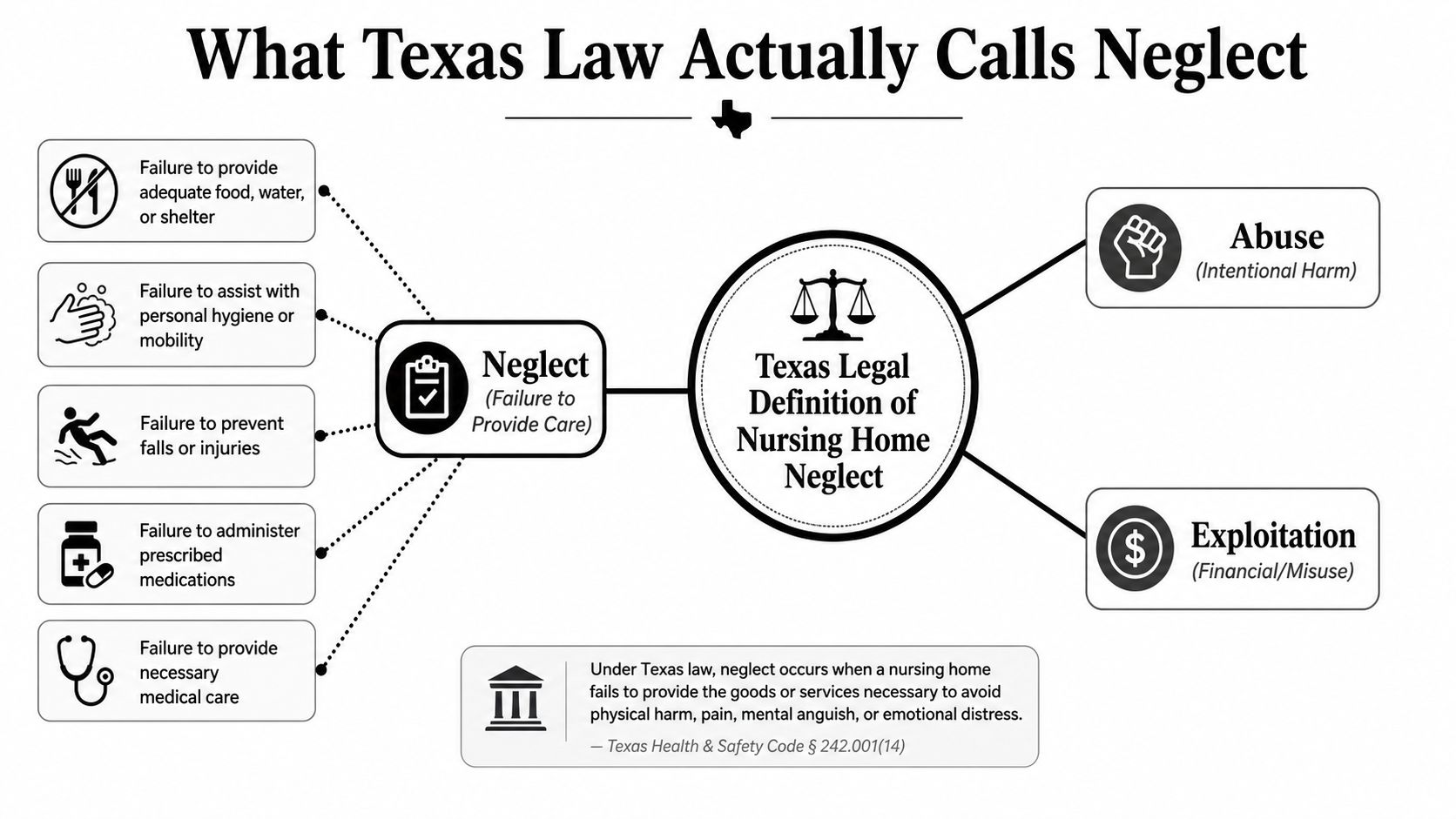
Texas law does not require proof that a nurse or aide intended to hurt your loved one. Families spend too much time chasing that point, and it usually distracts from the central issue. The question is whether the facility failed to provide the care a resident needed to avoid physical or emotional harm or pain, which is how Texas defines neglect.
Common failures that count
Neglect usually shows up through ordinary failures that should never reach a vulnerable resident. Missed medications, ignored call lights, untreated pressure injuries, dehydration, elopement, and a care plan staff never followed all fit the pattern. If a resident needed turning, hygiene help, food, hydration, or monitoring and the facility did not provide it, that is not a harmless mistake.
The legal importance is simple. These failures show the facility did not carry out the care the resident required. Once that happens, the discussion shifts from a bad outcome to a breach of duty, and that is what gives a Texas claim real force.
A few plain-English examples make the point clear:
- Missed medication doses, especially when the chart shows the dose was due and never given.
- Untreated wounds, especially pressure injuries that worsen because no one checks skin or turns the resident.
- Failure to supervise, including preventable falls or wandering.
- Dehydration or poor nutrition, when the resident needed assistance and did not receive it.
- Ignored physician orders, when staff did not follow the care plan at all.
A diagram outlining the legal definition and components of nursing home neglect in the state of Texas helps families see how those failures fit together. The key point is that Texas law looks at the gap between what the resident needed and what the facility did.
If neglect has caused life-altering harm, Catastrophic Injury Claims in Texas becomes relevant because the case is no longer just about poor care. It is about long-term loss, and that changes the value of the claim.
Key Factors in Settlement Value
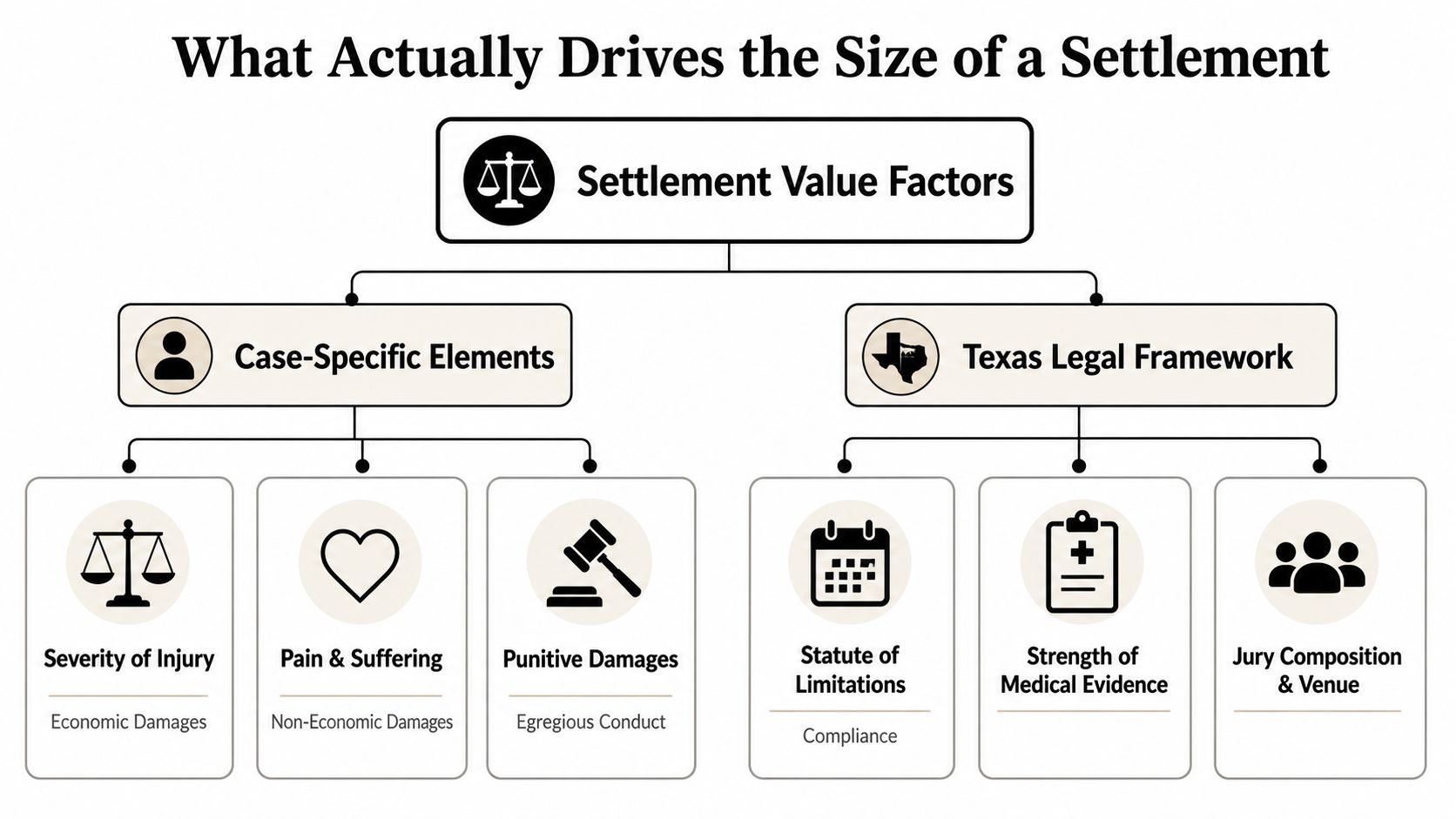
Families ask for a dollar number too early, and I get why. Texas nursing-home-neglect settlements turn on proof, not guesswork. The question is whether you can show a measurable breach of the standard of care and tie it to documented harm. Without that link, the claim has little force. With it, the facility has a problem it cannot explain away.
The evidence stack that moves value
The strongest cases usually have a full paper trail. Medical records show the injury and treatment. Staffing logs show who was on duty and whether the floor was thinly staffed. Incident reports show when the facility knew something went wrong. Care plans show what the resident needed. Photos show the wound, the bruising, the dehydration, the unsafe room. Expert opinions connect the breach to the harm.
That is why one weak chart entry can sink a case, while a complete record set can move the settlement discussion forward. Minor injuries and thin proof usually settle lower. Severe neglect with lasting consequences can support much higher compensation. The negotiation table is about proof, not labels.
Bottom line: The facility's conduct matters once you can show what it did, what it failed to do, and how that failure hurt your loved one.
If you want a useful benchmark for timing, how long you have to file an injury claim in Texas explains why the filing deadline shapes how fast counsel must lock down records and testimony. When families wait, the evidence gets weaker and the settlement value usually follows.
If you are dealing with a death, the first steps matter even more. A helpful companion resource is steps for handling a Texas death notification.
The Two-Year Deadline and Texas Reporting Pathways
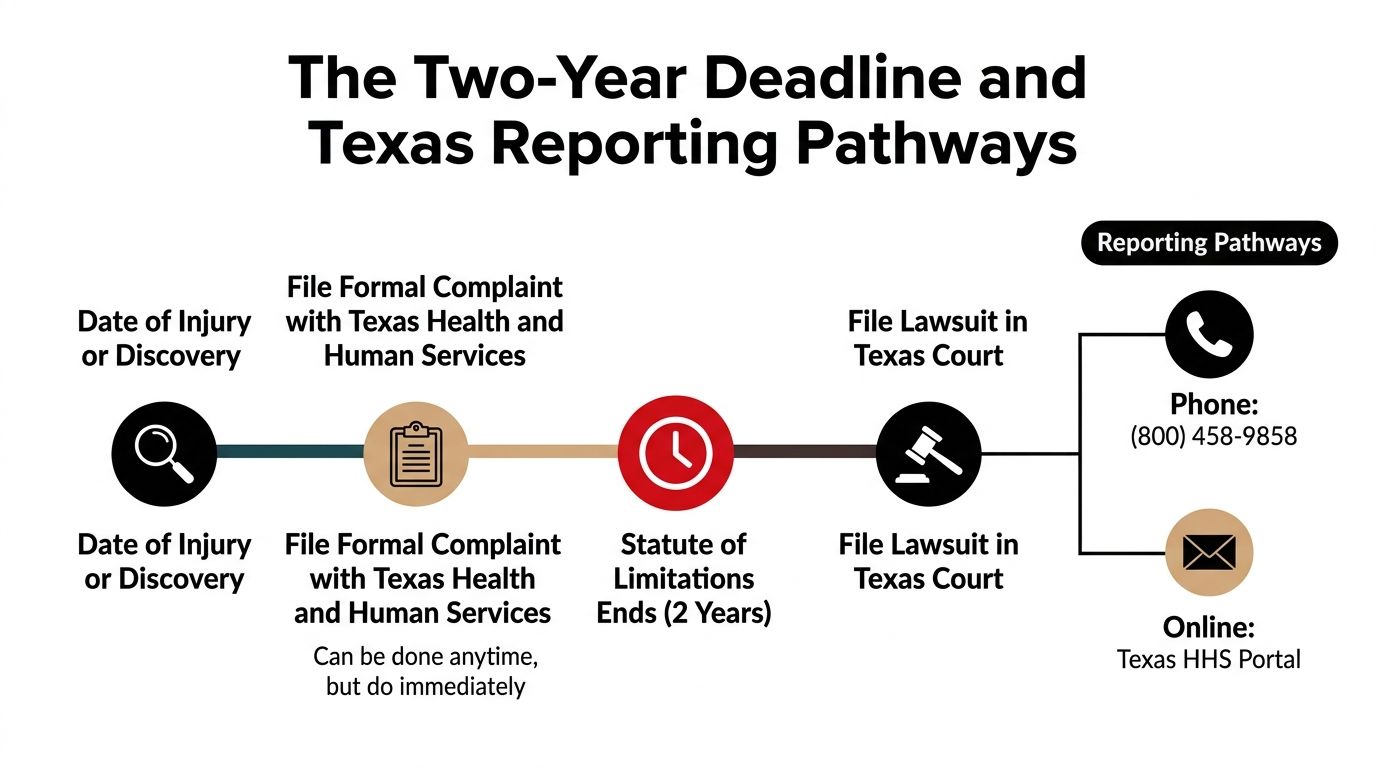
A Texas nursing home neglect claim usually has a 2-year filing period for personal injury and wrongful death claims. The clock can start at the injury, and in some situations it starts when the harm is discovered. Either way, delay hurts the case. Records get pulled, staff forget details, and the facility gets more time to shape its story.
Use the reporting channels as evidence, not paperwork
Texas families can report suspected neglect through Texas HHS's Complaint and Incident Intake, and Medicaid-funded-facility concerns can also be routed to the Medicaid Fraud Control Unit. Those reports create official records that can support a civil claim later. They are not just administrative filings, they become part of the proof your lawyer can use to show the facility had notice and failed to respond.
For a detailed breakdown of the filing period, see our guide on how long you have to file an injury claim in Texas. Families who wait too long usually weaken their own position before the case even starts.
If you're dealing with a death, the first steps are even more urgent. A helpful companion resource is steps for handling a Texas death notification, because families often need a clear sequence when they are hit with sudden news and still have to protect evidence. In a wrongful death case, the early paper trail can affect damages for funeral expenses, loss of companionship, and other recoverable losses.
Practical rule: File the complaint, save the confirmation, and keep every response. Those records can later help prove notice, delay, and failure to act.
Do not wait on the facility's internal review. A nursing-home death or rapid decline deserves outside attention fast. If you are unsure whether the deadline has passed, get legal review immediately. Every week of delay makes the evidence weaker and the settlement value harder to recover.
A Representative Texas Case Example
A Houston-area family noticed a resident developing a severe pressure injury after repeated complaints that the call light was ignored and the care plan wasn't being followed. They didn't wait for the facility to explain itself. They photographed the wound, requested the chart, and pushed for the staffing records before anyone could rewrite the story.
Their lawyer treated the case like a records fight first and a damages fight second. The team pulled medical charts, wound care notes, staff schedules, and the resident's care plan, then brought in a medical expert who could explain how proper repositioning and wound care should have changed the outcome. That kind of review matters because pressure injuries are one of those preventable harms where the paper trail often tells the truth faster than the facility will.
The family also used a resource on never events healthcare best practices to better understand why some outcomes are treated as preventable failures in healthcare settings. That didn't replace the legal work, but it helped the family see why documentation and timing mattered so much.
The case moved because the proof was solid. The demand letter didn't ask the facility to “do the right thing.” It laid out the records, the care gap, the injury progression, and the loss. That is how a claim gets traction. If the family had waited weeks to photograph the wound or let the resident transfer before securing the chart, the defense would have had a much easier job blaming the resident's health instead of the facility's conduct.
This is the part families often miss. A nursing home neglect claim becomes stronger when the facts are preserved early, not when everyone finally agrees something bad happened.
Damages Texas Families Can Recover
A settlement is supposed to make the family whole for the losses the facility caused. In Texas nursing home neglect cases, that usually includes medical expenses, rehabilitation, pain and suffering, emotional trauma, and, in fatal cases, funeral expenses and loss of companionship (Nursing Home Abuse Center). The categories matter because each one needs proof, and each one adds weight to the claim.
Here's the practical breakdown:
| Damage Category | What It Covers | Typical Supporting Evidence |
|---|---|---|
| Medical expenses | Hospital care, wound care, medication changes, rehab, and follow-up treatment | Bills, discharge papers, treatment notes |
| Rehabilitation and facility costs | Therapy, skilled care, and transfer to a safer setting | Facility invoices, placement records, care notes |
| Pain and suffering | Physical pain from injuries and ongoing discomfort | Medical testimony, resident statements, family observations |
| Emotional trauma and loss of dignity | Fear, shame, distress, and loss of independence | Family testimony, counseling records, care records |
| Funeral expenses and wrongful-death losses | Burial costs, loss of companionship, and related family losses | Receipts, estate records, testimony from surviving family |
The defense may try to say the resident was already frail, and sometimes that argument has some force. That's where comparative responsibility becomes an issue in Texas personal injury law. A facility will try to shift blame onto age, illness, or mobility limits, but a strong record limits that tactic because it shows what the staff should have done despite the resident's condition.
If you want a clearer distinction between the kinds of damages at issue, the guide on economic vs non-economic damages helps separate the out-of-pocket losses from the human losses. Both matter. Both belong in the settlement discussion.
What Families Should Do in the First 24 to 48 Hours
Act fast and keep it simple. The first two days are about proof, not arguments.

Your first moves should look like this
- Photograph visible injuries immediately. Take clear pictures of wounds, bruises, swelling, dirty bedding, and unsafe conditions. Those images can anchor the timeline.
- Write down names and shifts. Note who was working, who spoke to you, and what each person said. Staff identity often matters more than families expect.
- Request the care plan and medication logs in writing. Ask for them now, not later. If the records conflict with what you saw, that inconsistency becomes important.
- Save clothing, bedding, and personal items. Don't wash or discard anything tied to the injury. Physical evidence is hard to replace.
- Contact an experienced attorney before signing anything. A lawyer can tell you what to preserve, what to request, and what the facility is trying to lock down.
- Do not sign transfer papers or quick resolution documents without review. Once the facility has the paper trail it wants, your negotiating power can drop fast.
- File a report with Texas HHS. That creates an outside record and can support future fact development.
- Start a written log of every call, visit, and change in condition. The timeline matters.
If you need a lawyer who handles these cases across Texas, the Law Office of Bryan Fagan, PLLC is one option families use for injury and wrongful death matters. The value isn't in the name on the door, it's in whether the lawyer moves quickly to preserve proof before the case gets weaker.
The common mistakes are predictable. Families accept an internal apology, agree to mediation, or let the resident move before records are copied. That usually helps the facility, not you.
Frequently Asked Questions and How We Can Help
A family usually asks one question first, how long will this take. The answer depends on how fast the records come in, how clear the injury is, and whether the facility fights liability. Cases with strong documentation tend to move faster because the proof is already doing part of the work.
They also ask whether they have to pay up front. In a Texas nursing home neglect case, contingency-fee representation is common, and that keeps the family from carrying the legal bill during a crisis. The fee is tied to the result, not to hourly billing that drains resources while the case is still being built.
If your loved one has already passed, you may still have a claim. A wrongful death lawyer Texas families trust will look at whether the death was tied to neglect, what the care records show, and who can bring the claim on behalf of the estate or survivors. Death does not erase the case, it usually makes evidence preservation even more important.
If the facility offers a quick settlement, do not sign it right away. Quick money is usually cheap money when the full record has not been reviewed. Once you release the claim, you may lose the chance to recover for later complications, ongoing care, or the deeper human losses the facility caused.
If your parent lives in another city, that does not stop you from acting. Families in Houston, Dallas–Fort Worth, Austin, San Antonio, and surrounding Texas communities deal with these cases even when the nursing home is far from their own home. The location of your desk does not control your rights, the location of the harm and the records does.
If you need help now, speak with a Texas personal injury lawyer who knows how to build the record, challenge the facility, and move fast on the deadlines. If you need a lawyer who focuses on these cases, our nursing home abuse lawyer in Texas can help. If the case involves a crash, a transfer injury, or a transportation failure on top of neglect, a truck crash lawyer Houston or a Houston car accident attorney from the same firm may also fit the broader injury picture.
A serious injury can change your life in seconds, but you do not have to handle it alone. If you are worried about nursing home neglect, contact the Law Office of Bryan Fagan, PLLC for a free consultation. We can review what happened, explain your options, and help you protect your loved one's rights before evidence disappears. Recovery is possible, and legal help is available.