A serious accident can change your life in seconds—but you don’t have to face it alone. In Texas, the law on lane splitting is straightforward: it’s illegal. This means motorcyclists cannot legally ride between lanes of traffic, whether that traffic is moving slowly or at a complete stop. If you were injured in an accident while splitting lanes, it can complicate your personal injury claim, but it does not automatically mean you lose your right to compensation.
Understanding Your Rights After a Motorcycle Accident in Texas

When you are suddenly facing injuries, mounting medical bills, and calls from insurance adjusters, the first step to protecting your future is understanding your legal rights. Even if you were lane splitting, the other driver might still be primarily at fault for the crash.
Texas personal injury law is built on a principle called comparative responsibility, also known as comparative negligence. This system assigns a percentage of fault to each person involved in an accident. For example, imagine a driver on a Houston freeway suddenly changes lanes without signaling and collides with you. A jury might find that the driver was 80% responsible for causing the crash due to their negligence. However, because you were lane splitting, they might assign 20% of the fault to you.
Under Texas law, you can still recover damages for your injuries as long as you are found to be 50% or less at fault. Your final compensation amount would then be reduced by your percentage of fault. In this example, you could still recover 80% of your total damages.
How Long Do You Have to File a Claim in Texas?
In Texas, the statute of limitations for most personal injury claims is two years from the date of the accident. This deadline is critical. If you miss it, you may lose your right to seek compensation forever. While two years seems like a long time, building a strong case takes time, so it's important to speak with a Texas personal injury lawyer as soon as possible.
How Texas Law Compares to Other States
The legal landscape for motorcyclists varies significantly from one state to another, which often leads to confusion. While a handful of states have legalized some form of lane splitting or filtering, Texas has not. This is a critical distinction because the other driver's insurance company will use the fact that lane splitting is illegal in Texas to try to deny your claim. Their argument will be that since you were breaking the law, you are automatically at fault. This is not true. The key to a successful claim is proving that the other driver's negligence was the primary cause of your injuries.
A quick glance at how Texas motorcycle laws compare to other states highlights these differences:
| State | Legal Status | Key Conditions or Restrictions |
|---|---|---|
| Texas | Illegal | Prohibits riding between lanes of moving or stopped vehicles. |
| California | Legal | Permitted, with safety guidelines from the Highway Patrol. |
| Utah | Legal (Filtering) | Permitted between stopped vehicles on roads with a speed limit of 45 mph or less. |
This table shows that a common practice in other states could complicate your injury claim here in Texas. An experienced Houston car accident attorney understands these nuances and knows how to build a case that focuses on the other driver’s fault.
What Lane Splitting Means and Why It Divides Opinions
To understand how lane splitting can affect your rights after a crash, it's important to know what it is and why it sparks such strong opinions. Lane splitting is when a motorcyclist rides between two lanes of traffic moving in the same direction. This is often confused with lane filtering, which is when a rider moves between stopped cars at an intersection to get to the front. While some states differentiate between the two, Texas law does not—both are illegal.
The Two Sides of the Safety Debate
The controversy around lane splitting comes down to two different views on road safety.
- The Argument for Lane Splitting: Supporters, including many motorcycle safety advocates, argue that it can actually prevent accidents. A motorcyclist in stop-and-go traffic is vulnerable to a rear-end collision from a distracted driver—a common and often deadly type of crash. By moving between cars, a rider becomes more visible and exits this danger zone. It also helps ease traffic congestion.
- The Concerns About Lane Splitting: Many car and truck drivers, however, find the practice dangerous. They are not expecting a vehicle to appear in the space between lanes, which can lead to a sideswipe if a driver changes lanes without seeing the motorcyclist.
Think of it this way: after a Houston freeway crash, an insurance adjuster or jury will hear arguments from both sides. Their personal biases about lane splitting can influence how they assign fault. This is why proving the other driver's negligence is so critical. For victims of a catastrophic injury, demonstrating that a driver’s reckless action—not your maneuver—was the primary cause of the crash is the key to securing fair compensation.
Lane Splitting Laws in Other States
While Texas law is clear, the rules change as soon as you cross state lines. Understanding the national landscape is important because it explains why some drivers may be confused about the rules and why insurance companies might try to use nationwide trends to twist the facts against you in a Texas case.
A handful of states have recognized the potential safety benefits of lane splitting, such as reducing a rider's risk of being rear-ended in heavy traffic, and have passed laws to permit it in some form. However, this movement is far from universal.
States That Have Legalized Lane Splitting or Filtering
As of 2025, only a small number of states have legalized some form of lane filtering or splitting. California was the first, and states like Utah, Montana, and Arizona have followed with more limited lane filtering laws.
For instance, Montana's law allows lane splitting only when a vehicle is stopped or moving at 10 mph or less, and the motorcyclist cannot exceed 20 mph. These specific restrictions are common in states where it is legal. You can learn more about these evolving state motorcycle laws to see just how different the rules are.
Even where legal, common restrictions include:
- Speed Limits: Riders often cannot go more than 10-15 mph faster than surrounding traffic.
- Traffic Conditions: It is typically only allowed when traffic is moving below a certain speed, like 45 mph.
- Roadway Type: Some laws only permit filtering on multi-lane highways.
Why Texas Remains Different
Texas has chosen to maintain its long-standing ban on lane splitting. This means that legal arguments that might succeed in a California court are irrelevant here. If you were injured in a motorcycle accident on a Dallas freeway, only Texas law matters.
This infographic breaks down the core arguments shaping these state laws.
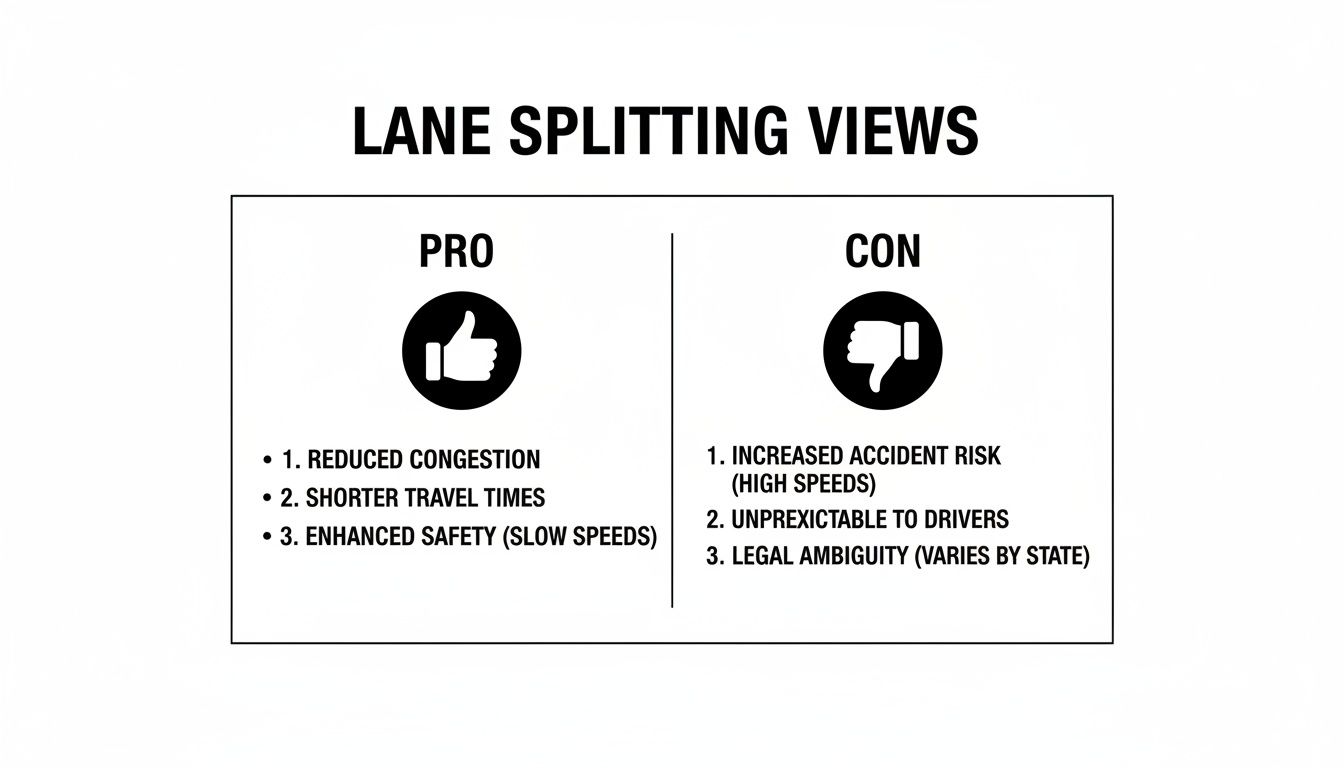
This fundamental conflict—safety versus surprise—is at the heart of the debate. If you were hurt, an insurance adjuster may try to paint you as a reckless rider. A knowledgeable Houston car accident attorney will counter these tactics by focusing on the facts of your case and the clear letter of Texas law.
How Lane Splitting Affects Fault in Texas Accidents
After a serious accident, determining who was at fault can be a major source of stress, especially when the other driver’s insurance company is trying to blame you. For motorcyclists in Texas, the fact that lane splitting is illegal is a significant hurdle.
However, a critical point to remember is that breaking a traffic law does not automatically make you 100% responsible for the crash.
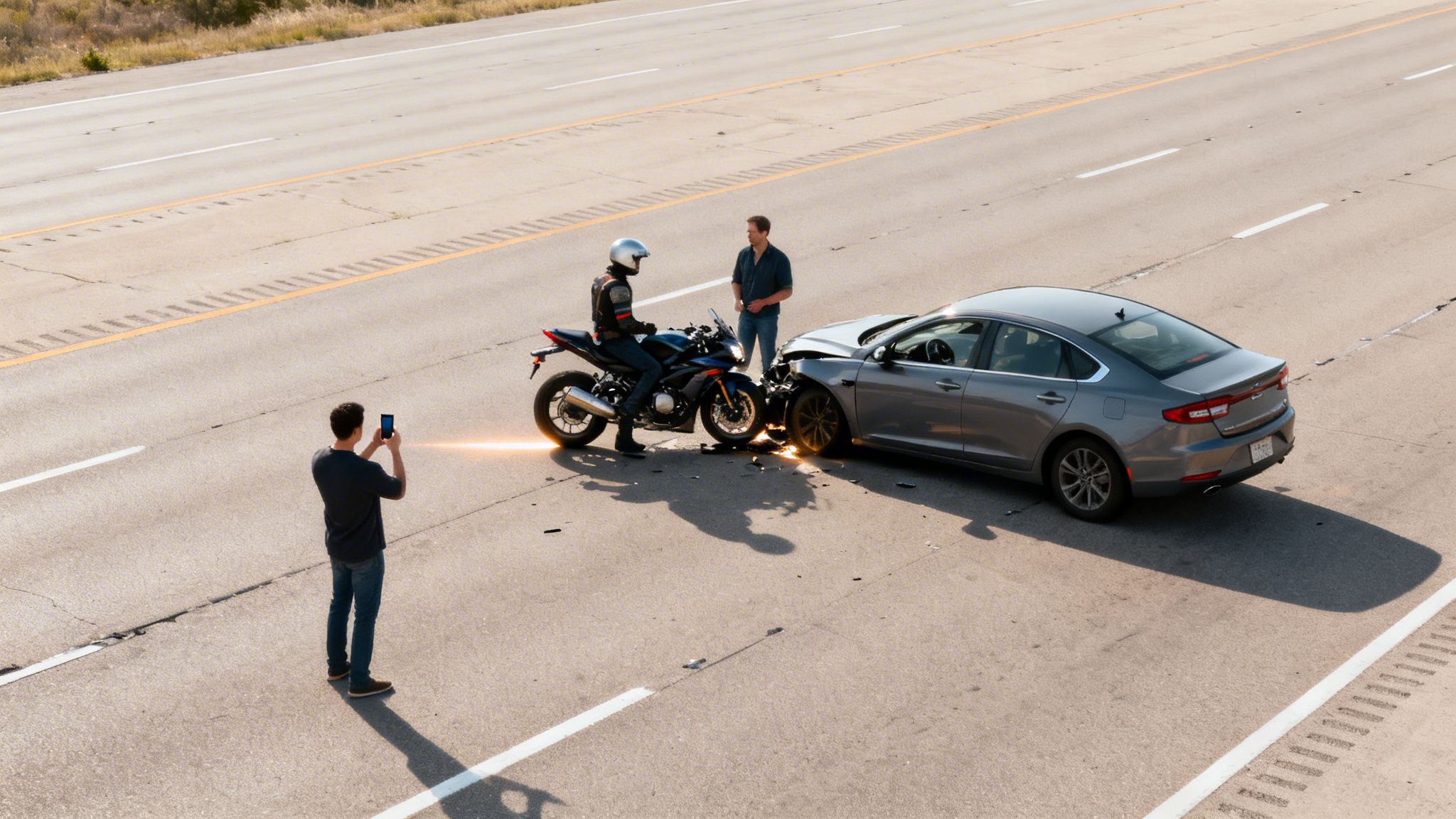
As mentioned, Texas uses a comparative responsibility system. A jury assigns a percentage of blame to everyone involved. As long as your percentage of fault is 50% or less, you can still recover money for your injuries. Your final award will be reduced by your percentage of fault.
A Real-World Example on a Dallas Freeway
Let's make this practical. Imagine you are riding on a congested Dallas freeway where traffic is barely moving. You decide to split lanes to move forward. Suddenly, a car in the next lane swerves into you, changing lanes abruptly without signaling or checking their blind spot. You are thrown from your bike and seriously injured.
In this scenario, the other driver was clearly negligent. They failed to signal and made an unsafe lane change. At the same time, because you were lane splitting, the other driver's insurance company will argue that you were also negligent.
A jury might assign fault like this:
- The driver who cut you off was 70% at fault for their reckless action.
- You, the rider, were 30% at fault for lane splitting, which is illegal in Texas.
Because your share of the blame (30%) is less than the 51% threshold, you can still recover damages. If your total damages—medical bills, lost wages, pain and suffering—were calculated at $100,000, your final award would be reduced by your 30% of fault, meaning you could recover $70,000.
How a Lawyer Protects Your Claim
This is where a skilled Texas personal injury lawyer is essential. An insurance adjuster's job is to shift as much blame as possible onto you to reduce or deny your payout. They will use the fact that you were lane splitting to portray you as a reckless rider who caused your own injuries.
Our job is to dismantle that narrative. We work to prove that the other driver’s negligence—whether it was texting while driving, speeding, or the fail to yield the right of way—was the primary cause of the crash.
We investigate the accident thoroughly, gathering evidence like traffic camera footage and witness statements to build a powerful case. By fighting to minimize your percentage of fault, we work to maximize the compensation you receive for your medical bills, lost income, and the pain you have been forced to endure.
What to Do After a Motorcycle Accident in Texas
In the chaos following a crash, it's hard to think clearly, but the steps you take immediately after can protect your health and your legal rights. You don't have to navigate this alone.

Your first priority is your well-being. Seek medical attention immediately, even if you feel fine. Adrenaline can mask serious injuries, and a medical record created right after the accident is vital evidence for your claim.
Practical Steps for Accident Victims and Families
If you are physically able, here are practical steps to take at the scene:
- Call 911: Always report the crash to the police. An official police report is a crucial record of what happened. Be sure to get the report number from the responding officer.
- Document Everything: Use your phone to take photos and videos of the scene. Capture images of all vehicles, damage, skid marks, traffic signs, and your injuries.
- Gather Witness Information: If anyone saw the accident, get their name and phone number. An independent witness statement can be powerful evidence.
- Preserve Evidence: Do not throw away your damaged helmet, jacket, or other gear. This is tangible proof of the crash's impact. Save any helmet cam or dashcam footage immediately.
How to Handle Insurance Companies
The at-fault driver's insurance company will likely contact you soon after the accident. Be cautious. Adjusters are trained to get you to say things that can weaken your case. The best practical advice is to avoid giving a recorded statement or accepting any early settlement offers before speaking with an experienced lawyer. The first offer is rarely enough to cover the true costs of a serious injury, especially a catastrophic injury requiring long-term care.
A critical part of protecting your rights is documentation. Keep every medical bill, receipt, and record of lost wages. This creates a clear financial picture of how the accident has affected your life. You can learn more in our detailed guide on Texas lane splitting laws.
Remember, you have a right to seek full compensation for your medical treatments, lost income, and pain and suffering. Taking these steps provides the evidence needed to hold the negligent driver accountable.
Why You Need a Texas Motorcycle Accident Lawyer
When you're recovering from a serious motorcycle accident, the last thing you should have to do is battle an insurance company. Their goal is to protect their profits, not you. They will often use an illegal maneuver like lane splitting to try and place all the blame on you.
This is where we step in. Our team launches an independent investigation to uncover the truth. We analyze crash reports, interview witnesses, and consult with experts to build a case that shows what really happened. We are experienced in proving negligence—demonstrating how the other driver failed in their duty to drive safely, how that failure caused your injuries, and the full extent of your damages.
Proving Negligence and Maximizing Your Recovery
For example, we represented a motorcyclist who was seriously injured in a Houston freeway crash. The insurance company claimed our client was weaving through traffic recklessly. Our investigation, however, uncovered traffic camera footage showing the other driver was looking down at their phone just before making an abrupt lane change.
This evidence proved that the driver's distraction was the primary cause of the crash. We were able to secure a settlement that covered all his medical bills, lost wages, and compensation for his pain and suffering. Our firm's experience with complex cases, from devastating truck crashes to those resulting in wrongful death, prepares us to fight for the justice you deserve. Our guide on how to pick a personal injury attorney can help you understand what to look for in legal representation.
You’ve been through enough. Your focus should be on healing, not arguing with insurance adjusters. Let us handle the legal fight so you can concentrate on your recovery.
A free consultation is your first step toward getting answers. We will listen to your story, explain your rights, and outline how we can help. You don’t have to face this alone—we are here to fight for you.
Common Questions About Lane Splitting Accidents
After a crash, it's normal to have many questions. Here are clear answers to some of the most common concerns we hear from injured riders in Texas.
If Lane Splitting Is Illegal, Does That Mean My Case Is a Lost Cause?
Absolutely not. The fact that lane splitting is illegal does not automatically prevent you from recovering compensation. Texas uses a comparative fault system, which means a jury assigns a percentage of blame to each party. As long as you are found 50% or less at fault, you can still recover damages. An experienced lawyer will focus on proving the other driver's negligence—such as texting, speeding, or making an unsafe lane change—was the primary cause of the accident.
How Long Do I Have to File a Motorcycle Accident Claim in Texas?
In Texas, the statute of limitations for filing a personal injury lawsuit is generally two years from the date of the accident. This deadline is strict. If you miss it, you will likely lose your right to seek compensation. It is crucial to act quickly to preserve evidence and protect your legal rights.
Is There a Difference Between Lane Splitting and Lane Filtering in Texas?
Legally, in Texas, there is no difference. State law does not distinguish between riding between moving cars (splitting) and riding between stopped cars (filtering). Both actions are considered illegal and can be used by an insurance company to try and place blame on you.
A serious motorcycle accident can be overwhelming, but you do not have to navigate the legal system alone. At The Law Office of Bryan Fagan, PLLC, our compassionate and experienced personal injury attorneys are dedicated to fighting for injured riders. We work to hold negligent drivers accountable and help you secure the resources you need to heal and rebuild.
Recovery is possible, and legal help is available. Schedule your free, no-obligation consultation today to learn how we can support you.