 Skip to content
A serious accident can change your life in seconds, but you don't have to face it alone. You may be sitting in your car near US-290, Barker-Cypress Road, or Fry Road, trying to decide whether the pain in your neck is serious while the other driver's insurance company is already calling. You may be worried about your children, your job, the repair bill, or a family member who didn't survive.
As a car accident lawyer in Cypress, TX, I know the first advice you receive can shape the entire claim. Texas recorded 3,769 traffic deaths, 244,534 injuries, and 14,396 serious-injury crashes in 2025, according to TxDOT's 2025 Texas Motor Vehicle Traffic Crash Facts report. Those figures aren't just statewide numbers. They represent families who needed prompt medical care, preserved evidence, and a clear plan.
This guide explains what to do at the scene, how Texas assigns fault, how distracted-driving claims are proved, what compensation may be available, which deadlines matter, and what a contingency-fee lawyer can do during the first ninety days. If you're looking for a Texas personal injury lawyer, start with your health, protect the evidence, and avoid giving an insurer information it can use against you.
What a Cypress Crash Really Feels Like in the First Hour
You're turning left near US-290 and Fry Road in the late-afternoon glare. For a moment, the windshield reflects more light than you can process. Then comes the metallic crack of impact, the sudden force against your seat belt, and the sharp smell of airbags, like burnt powder filling the passenger compartment.
Your hands may shake. Your ears may ring. You may look at your child in the back seat before you notice your own shoulder, back, or neck. Adrenaline can make you feel functional even when your body has already suffered an injury.
A Cypress mother in that situation might step out, say she's fine, and decline an ambulance because she needs to get home. Hours later, the stiffness starts. By the next morning, turning her head is difficult. The other driver's insurer may call before she has seen a doctor, asking for a recorded statement and questions about how fast she was driving.
Your first responsibility is not to explain the crash to an adjuster. It's to protect your health and preserve what happened.
Texas recorded a reportable crash every 59 seconds, someone was injured every 2 minutes 9 seconds, and one person was killed every 2 hours 19 minutes in 2025, according to TxDOT. Evidence can disappear while you're waiting for pain to become obvious. A camera may overwrite footage, a vehicle may be repaired, and a witness may forget details.
The pages ahead give you a practical path through the first hour, the evidence problem in distracted-driving cases, Texas's fault rules, recoverable losses, filing deadlines, and the work a lawyer handles after you call. You'll also see how a free consultation works and what to gather before speaking with a firm.
Your First Steps at the Scene to Protect Your Health and Your Case
The first hour has one priority: keep people safe while creating a reliable record. Follow these steps in order as conditions allow.
Move away from traffic. If the vehicles can be moved safely, pull onto the shoulder or another protected area. Turn on hazard lights. Check every occupant for bleeding, confusion, breathing problems, or visible injuries. Don't move someone with a possible spinal injury unless remaining in place creates an immediate danger.
Call 911. Request law-enforcement and medical assistance. In Cypress, the response may involve the Harris County Sheriff's Office or the Texas Department of Public Safety, depending on the roadway and jurisdiction. Ask for the crash report number and note the responding officer's name and badge information.
Photograph before vehicles are moved, if it's safe. Capture vehicle positions, license plates, damage from several angles, skid marks, debris, traffic signals, lane markings, roadway defects, weather conditions, and visible injuries. Don't step into an active lane for a photograph.
Exchange information and identify witnesses. Record each driver's name, phone number, license information, insurance carrier, and policy details. Get witness names and phone numbers. A witness who leaves with only a verbal promise to call may be difficult to locate later.
Stick to facts. Don't apologize, admit fault, or guess about speed, visibility, or what another driver saw. Tell the officer what you remember. Don't argue at the scene.
Get medical care promptly. If emergency personnel recommend transport, follow that advice. Even if symptoms seem minor, arrange a medical evaluation as soon as possible, preferably within 24 hours when practical. Explain every symptom, including soreness, headaches, numbness, dizziness, anxiety, or sleep problems.
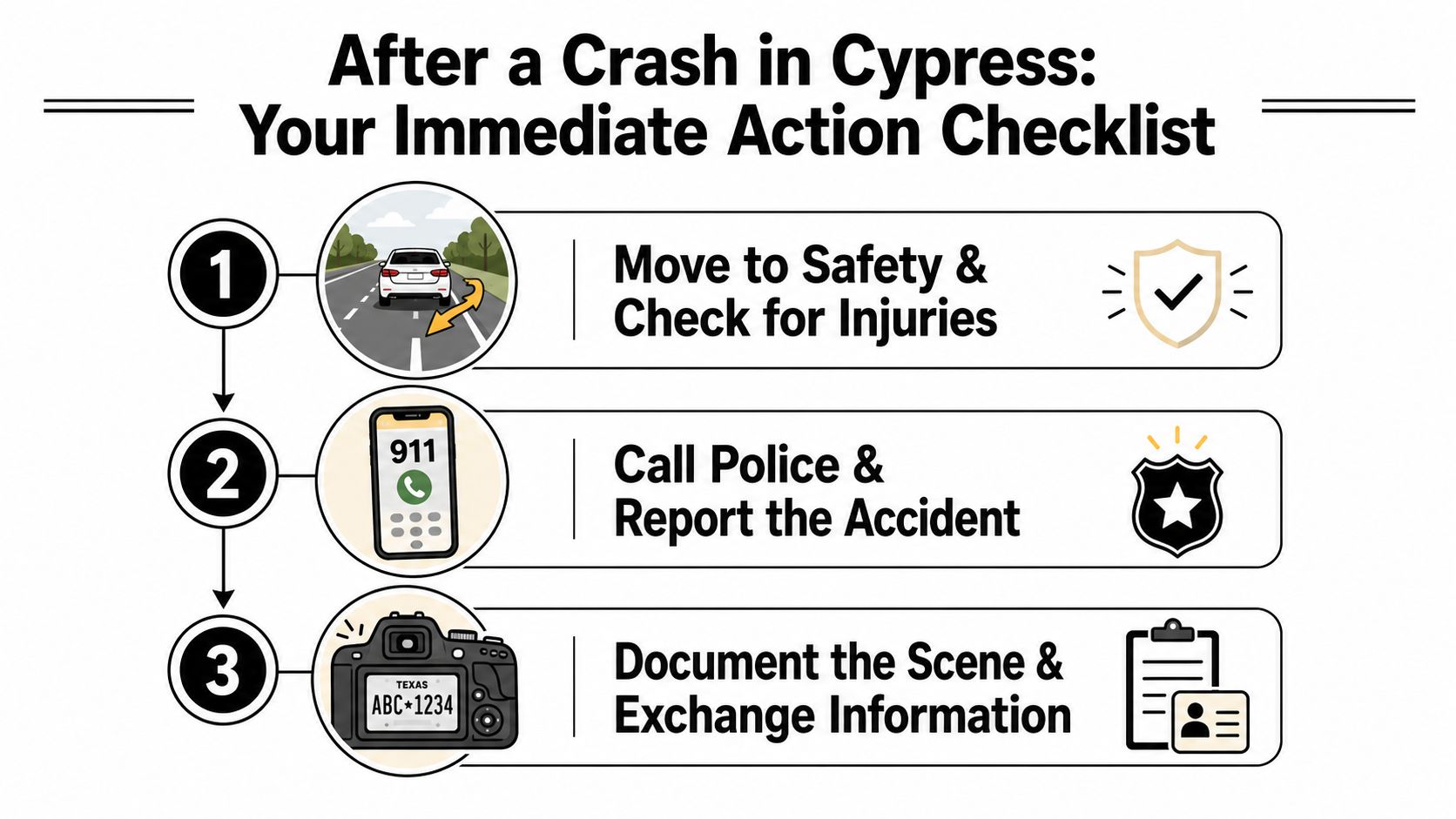
Texas regulators recommend moving to safety when possible, photographing vehicles and insurance information, documenting witnesses and the circumstances, contacting insurers promptly, and keeping a record of communications, as explained by the Texas Department of Insurance's crash-claim guidance. Save receipts for towing, temporary repairs, transportation, medication, and medical visits. The department also advises keeping communication records when dealing with adjusters, a point reinforced in its guidance on what to do after a wreck.
For a more detailed checklist, review this step-by-step guide to what to do after a car accident in Texas. A Car Accident Lawyer in Texas may represent drivers and passengers injured in Texas car accidents.
How Texas Decides Who Pays for a Car Accident
A rear-end crash at a Barker-Cypress Road stoplight can create a clear liability question. The trailing driver looks at a phone, misses stopped traffic, and hits your SUV. Texas generally follows a fault-based system, so the driver whose negligence caused the collision may owe compensation for the resulting losses.
You must connect the other driver's conduct to the crash and your actual damages. That usually means showing the driver owed you reasonable care, failed to use it, caused the collision, and caused an injury or property loss. A police report, witness account, photographs, vehicle data, and proof of phone use can support that chain.
Texas also uses proportionate responsibility. If you are found more than 50% at fault, you generally cannot recover damages. If your assigned share stays below that bar, your recovery is reduced by that percentage, as explained in our guide to comparative negligence in Texas and summarized in Texas comparative-negligence guidance.
Texas Fault and Comparative Responsibility at a Glance
| Factor | Texas Rule | Effect on Cypress Victim |
|---|---|---|
| Negligence | You must connect the other driver's conduct to the crash and your losses. | A collision alone does not establish liability. |
| Shared responsibility | Recovery depends on whether your assigned fault stays below the statutory bar. | The insurer may shift blame to reduce or deny payment. |
| Multiple parties | Fault may be divided among drivers or other responsible parties. | Each assigned percentage affects the amount recovered. |
| Evidence | Reports, witnesses, photographs, video, and vehicle data help establish what happened. | Preserving proof early limits unsupported blame arguments. |
A jury may divide fault among several drivers. Commercial-vehicle cases can require company records, dashcam footage, maintenance files, and electronic driving data, not just an examination of the person behind the wheel. A truck crash lawyer in Houston may need to investigate those additional sources.
Distracted-driving cases turn on proof. Texas reported 93,497 distraction-blamed crashes in 2021, causing 431 deaths and 2,932 serious injuries, according to Texas highway-safety data published by NHTSA. Preserve evidence showing whether the phone was in use, whether the driver had time to react, and whether the distraction caused the impact. Those details can determine whether the insurer treats your claim as a supported case or a disputed story.
Building the Evidence That Wins Cypress Injury Claims
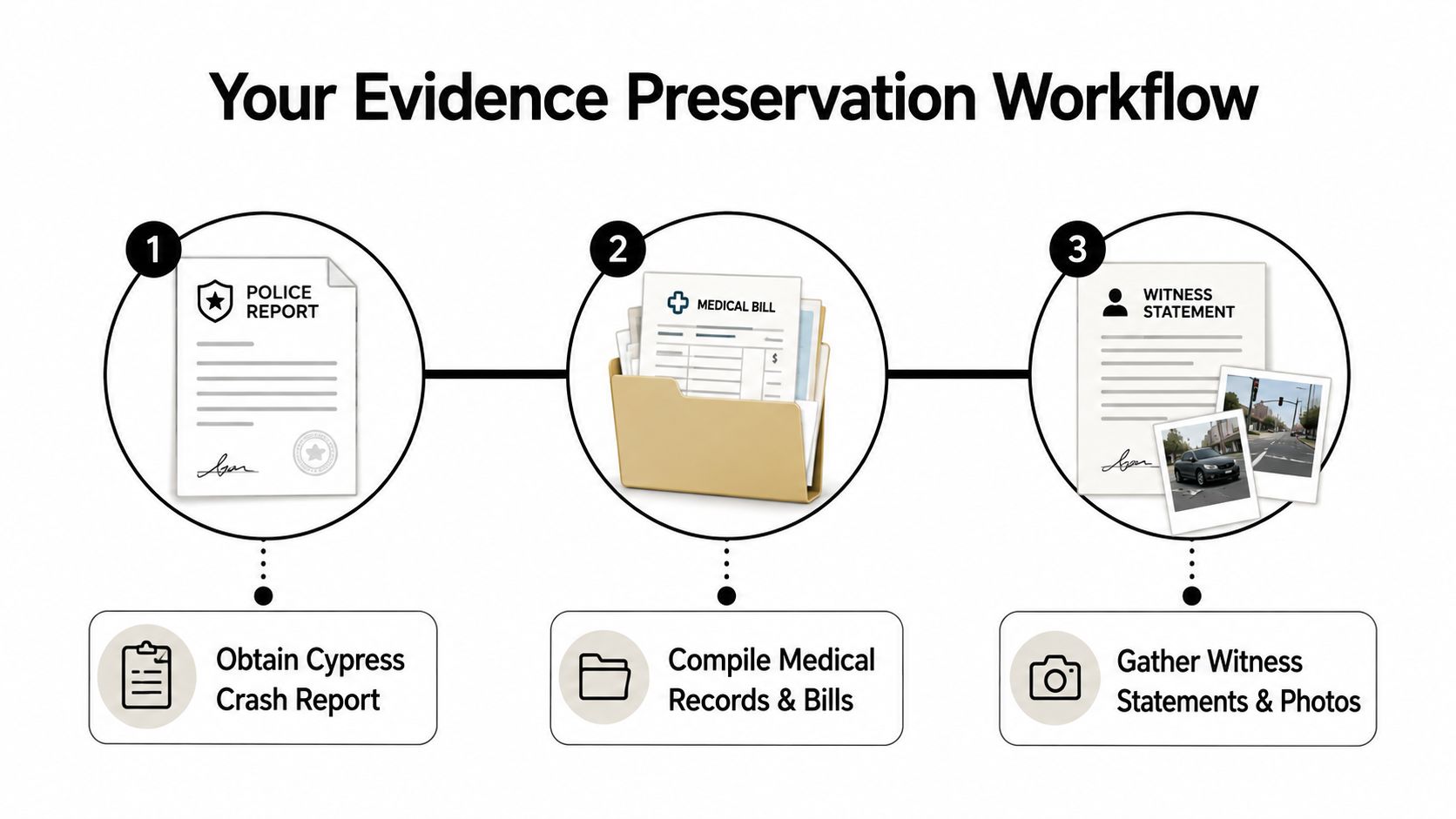
A strong claim grows from a chain of records. Start with the crash report, then preserve scene evidence, obtain medical documentation, identify witnesses, and secure video or digital information before it disappears.
Start with the report and medical record
Request the CR-3 crash report and record the report number, responding officer, and any fault indication. If the crash involved a Cypress-area roadway under another agency's jurisdiction, confirm which agency created the report and how to request it. The report is important, but it isn't the final word on liability.
Seek medical evaluation promptly, even when pain feels manageable. Tell the provider exactly what happened and describe symptoms as they develop. Keep discharge instructions, prescriptions, bills, referrals, work restrictions, and appointment notes. A gap in treatment can give an insurer an argument that the injury wasn't serious or wasn't caused by the crash.
For a broader evidence list, use this Texas injury-claim evidence guide.
Preserve distracted-driving proof
Save dashcam files immediately. Many systems overwrite older footage. Ask witnesses whether they saw the other driver holding a phone, looking down, texting, or failing to react. Photograph nearby businesses and residences that may have exterior cameras, then contact the owners quickly and ask that relevant footage be preserved.
A lawyer may send preservation letters for phone records, vehicle event-data recorder information, 911 audio, surveillance video, and other material. Don't attempt to access another person's phone or accounts yourself. Preserve what you lawfully possess and let counsel seek additional records through proper procedures.
Use this seven-day checklist:
- Day one: Save photographs, videos, dashcam files, texts, and call records.
- Early days: Request the CR-3 report and identify every witness.
- Medical follow-up: Keep a symptom journal and all treatment documents.
- Video search: Identify nearby cameras along the crash route and request preservation.
- Insurance file: Save every letter, email, text, voicemail, and claim number.
- Work losses: Keep wage statements, missed-shift records, and written restrictions.
- Legal review: Contact a lawyer before giving a recorded statement or signing a release.
The same preservation habits can matter in other injury matters, including Slip and Fall / Premises Liability in Texas, where video, maintenance records, and witness accounts may also disappear.
Every Type of Compensation Texas Injury Victims Can Recover
Damages are not limited to the emergency-room bill. They're meant to address the full effect of the crash on your body, finances, work, relationships, and future.
Economic damages may include:
- Medical care: Emergency treatment, hospital care, prescriptions, therapy, surgery, rehabilitation, and necessary future treatment.
- Income loss: Wages missed during recovery and reduced earning capacity when an injury limits future work.
- Property-related expenses: Vehicle repair or replacement, towing, rental transportation, and reasonable temporary-repair costs.
- Out-of-pocket losses: Medication, medical equipment, parking, and mileage connected to treatment.
Non-economic damages address harm that doesn't arrive as an invoice. A jury may consider physical pain, mental anguish, loss of enjoyment of life, scarring, disfigurement, disability, and the effect of the injury on family relationships.
Suppose a Cypress parent suffers a herniated disc and can't perform warehouse work for six months. The claim may include documented treatment, missed pay, transportation expenses, reduced ability to earn, physical pain, sleep disruption, emotional distress, and the effect on ordinary family activities. The value depends on proof, medical opinions, work records, policy limits, fault, and the lasting impact. No honest lawyer can promise a result from a diagnosis alone.
Future damages require careful support. A physician may address continuing therapy or surgery, while vocational and financial evidence may explain reduced earning capacity. A spouse may also have a claim for loss of consortium when legally supported.
Punitive damages are different. Texas law reserves them for especially serious misconduct, such as gross negligence, and certain drunk-driving situations may create additional legal issues. They aren't automatic just because an injury is severe.
Texas Recoverable Damages at a Glance
| Damage Category | What It Covers | Typical Example |
|---|---|---|
| Economic | Financial losses caused by the injury | Medical bills, lost wages, prescriptions |
| Non-economic | Personal effects of the injury | Pain, mental anguish, reduced enjoyment of life |
| Future losses | Continuing needs and diminished ability to work | Ongoing therapy or reduced earning capacity |
| Wrongful death | Losses suffered by eligible surviving family members | Funeral costs and lost financial support |
| Punitive | Exceptional misconduct when legal standards are met | Grossly negligent or qualifying intoxicated conduct |
Evidence determines whether each category is credible. Keep the records, follow medical advice, and remember that any fault assigned to you can reduce the recovery under Texas's proportionate-responsibility rule.
Texas Deadlines You Cannot Afford to Miss
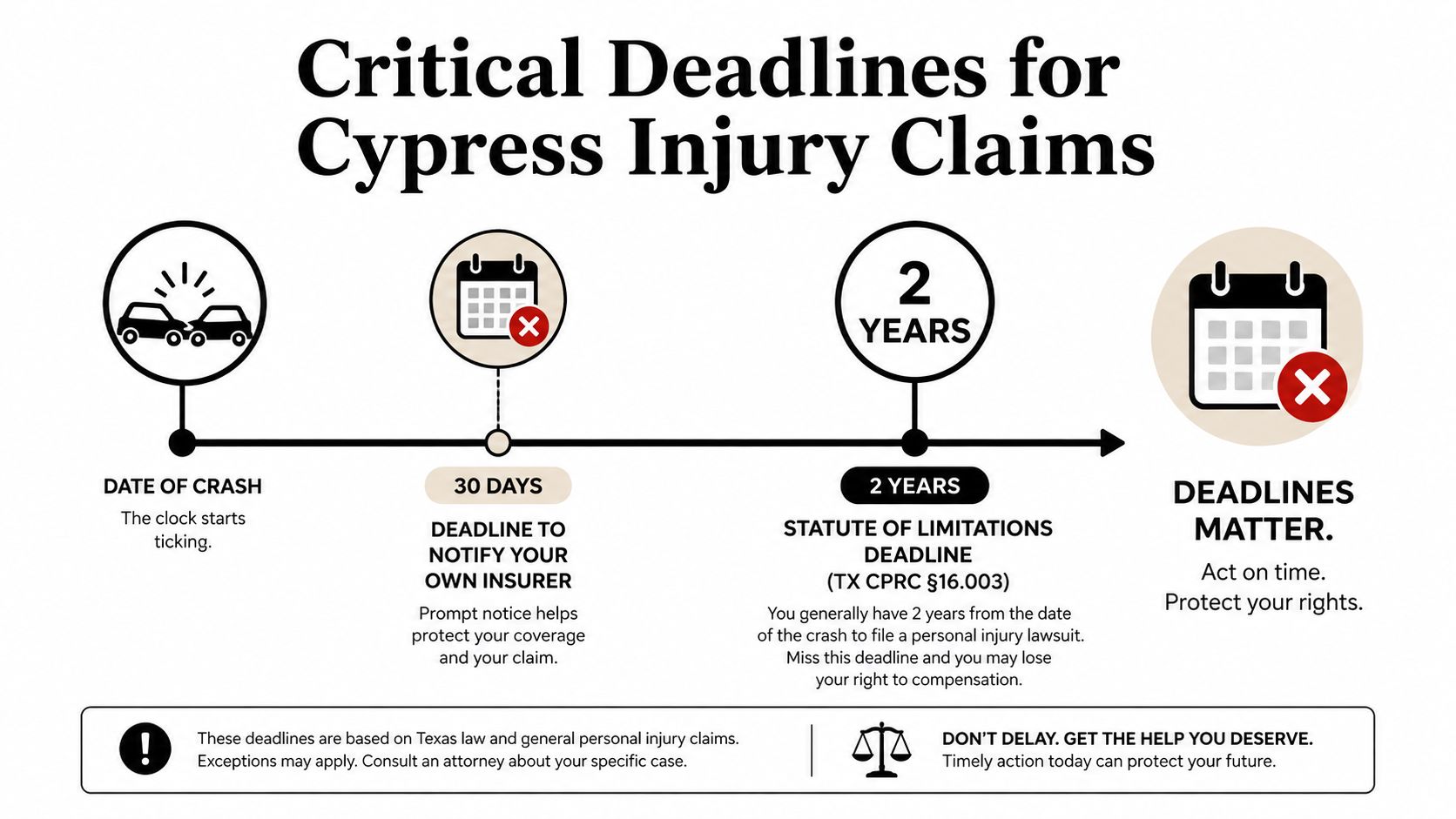
For most Texas personal injury claims, the central deadline is two years from the date of the injury, under Texas Civil Practice and Remedies Code Section 16.003. The same general period commonly applies to wrongful death claims, though the date and legal analysis can differ. Confirm the deadline for your specific claim instead of assuming the ordinary rule applies.
Missing the limitations period can destroy an otherwise valid lawsuit. An insurance claim, ongoing treatment, or settlement conversation doesn't necessarily extend the time to file suit.
Deadlines that require early legal review
Your auto policy may impose a short notice period for uninsured or underinsured motorist claims. Review the policy immediately and notify your carrier as required. Government defendants can involve separate notice rules and shorter timelines, so a crash involving a government vehicle, roadway contractor, sheriff's vehicle, or maintenance truck needs prompt legal attention.
Claims involving minors, governmental entities, death, or coverage disputes can follow different rules. Don't rely on a calendar reminder alone. Have a lawyer identify every applicable deadline and document the notices.
The key deadlines for injury claims provide useful general background, but your facts control. A lawyer can also address what happens if an insurer denies coverage, delays a decision, or offers a release before the medical picture is clear.
A short video can help explain how filing deadlines work, but it can't replace an individualized review.
Write down the crash date, your policy-notice requirement, and any government-notice date. Call a lawyer before an approaching deadline leaves you trying to investigate and file at the same time.
What a Cypress Car Accident Lawyer Actually Does for You
A contingency-fee arrangement lets an injured person hire counsel without paying an hourly bill or retainer at the start. The written agreement should explain the attorney's fee, case expenses, and how reimbursement works if the case resolves. Depending on the agreement, costs such as filing fees, experts, accident reconstruction, and medical records may be advanced and reimbursed from a recovery.
Ask direct questions before signing:
- What is the fee structure? Confirm how the percentage changes, if at all, between settlement and litigation.
- Who advances expenses? Ask how expert fees, records, filing costs, and investigation expenses are handled.
- What happens if there's no recovery? Read the contract carefully and ask what you could owe.
- Who handles communication? Know whether you'll speak with the attorney, a case manager, or another team member.
The first 90 days have a purpose
During the first 30 days, counsel should focus on preserving evidence, identifying all insurance policies, obtaining the crash report, sending claim communications, and organizing medical records. That may include reviewing your own uninsured or underinsured motorist coverage and opening applicable first-party claims.
By 60 days, the attorney should be building a medical chronology, evaluating lost income, locating witnesses, reviewing available video, and deciding how to respond to requests for statements or examinations. In a commercial crash, the investigation may include company records, driver logs, maintenance materials, dispatch communications, and vehicle data.
Around 90 days, the case should have a clearer damage picture and a documented liability theory. Counsel may prepare a demand package, begin negotiations, or recommend filing suit if the insurer won't treat the claim fairly. The timing depends on treatment and evidence, not an artificial promise that every case resolves on the same schedule.

How counsel handles insurer pressure
Adjusters may request a recorded statement, suggest that a quick release is convenient, question treatment, review public social-media posts, or argue that you share blame. Don't let a rushed call define the claim. A Houston car accident attorney can handle communications, challenge unsupported assertions, and make sure the demand reflects the complete injury record.
If a crash involves an 18-wheeler, a commercial vehicle accident lawyer in Texas may need to investigate both the driver and the company. If a loved one died, a wrongful death lawyer in Texas can explain who may bring a claim and which losses may be available. Catastrophic injuries may require life-care, vocational, and medical evidence that a routine property-damage claim doesn't address.
For your consultation, gather the CR-3 report number, insurance declarations page, photographs, medical bills, work-loss records, and witness names. Tell the lawyer about every insurer contact, recorded-statement request, release, and deadline. The Law Office of Bryan Fagan, PLLC offers free consultations and contingency-fee representation for Texas motor-vehicle and serious-injury claims, with meetings available by phone, video, or in person.
You don't need a perfect file before you call. The lawyer can review the facts, check the limitations period, map available coverage, and tell you what should happen next. Urgent matters, including an insurer call, recorded-statement request, or approaching deadline, deserve prompt attention.
The hardest step is usually the first one. It's also the simplest: make the call, explain what happened, and let a qualified lawyer help you protect your options.
If you were injured in Cypress, Law Office of Bryan Fagan, PLLC can review the crash, investigate distracted-driving or fault disputes, and pursue compensation for medical care, lost income, pain, and future needs. Schedule a free consultation with Law Office of Bryan Fagan, PLLC today, with no obligation, and get clear guidance about your next step.


