A serious accident can change your life in seconds, but you don't have to face it alone. If you're sitting at home after a Sugar Land crash, sore, shaken, and trying to figure out whether the insurance company is helping you or setting you up, start with the basics and protect your claim from the first minute.
A car accident lawyer Sugar Land TX claim usually turns on what you do before the paperwork starts. That means the scene, the first medical visit, the crash report, the fault argument, the insurance call, and the deadline on the calendar. Miss one of those pieces, and the value of the case can drop fast.
What to Do Right After a Crash in Sugar Land
If you've just been hit at a place like the US-90A and Industrial intersection, especially with kids in the back seat, your job is simple. Get people safe, get help on the way, and start building a clean record of what happened before anyone starts talking about fault.
The first hour matters
Move out of traffic if you can do it safely. Turn on your hazard lights, check for injuries, and call 911 right away if anyone is hurt or if the other driver won't stop. If you have flares or warning triangles, use them so another driver doesn't turn a bad crash into a second one.
Then gather the other driver's information. The Texas Department of Insurance recommends getting the other driver's name, address, phone number, license plate, insurance company, and policy number, along with witness names and phone numbers, and taking photos of the scene, vehicles, street signs, and damage TDI consumer guidance. That's the practical minimum. If you can record a short voice memo, say the date, time, location, weather, and what lane each vehicle was in.
Practical rule: Don't apologize, don't guess, and don't argue. A polite sentence like “I'm just checking on everyone” is enough.
Sugar Land Police Department handles most crashes inside city limits, while the Fort Bend County Sheriff handles unincorporated areas. Give the responding officer facts, not theories. If you saw the light turn red, say that. If you didn't see the other car until impact, say that too.
What to put on your on-scene checklist
- What to say to the other driver: “Are you hurt?” “Do you have your insurance card?” “Can I get your phone number?”
- What to record by voice memo: The exact intersection, direction of travel, lane position, skid marks, debris, and any witness names.
- What to give the officer: Your driver's license, registration, insurance card, and a calm account of what you directly observed.
Every minute counts because memory fades and physical evidence starts disappearing fast. If you need a plain step-by-step reference later, use this Texas crash checklist once you're out of danger.
The First 72 Hours After Leaving the Scene
The first three days after a wreck are where many valid claims get weakened. Pain often shows up late, and insurance adjusters love gaps in treatment because they can argue your injuries weren't serious.
Get medical care fast and tell the doctor everything
See a doctor within 24 hours if you can, even if the pain seems minor. Adrenaline hides soft-tissue injuries, concussions, and back pain, and an adjuster will later say you were “fine” if you waited too long. If you need trauma care in the Sugar Land and Houston area, use the facility that fits your symptoms and the urgency of your injuries, then describe every symptom, not just the obvious ones.
Keep a copy of your records, imaging orders, discharge papers, and bills. Those documents matter because they connect the crash to the injury, which is exactly what insurers try to break apart. A helpful overview of that connection is in this guide on how medical records affect a Texas injury claim.
Save evidence before it disappears
Dashcam files and nearby video can be overwritten quickly, sometimes in 30 to 72 hours, so save them immediately. Request the crash report from Sugar Land PD or the Texas crash system, track down witnesses while they still remember the details, and start a daily pain and activity journal. If your car hasn't been repaired yet, photograph it again from several angles before the damage changes.
Physical proof goes away fast. Vehicles get fixed, streets get swept, and roadway debris gets removed.
Do the same with your phone. Don't post about the wreck, don't text the at-fault driver, and don't give a recorded statement to any insurance carrier until a lawyer has reviewed the facts. If you're comparing legal help, Car Accident Lawyer in Texas covers drivers and passengers injured in Texas car accidents.
Texas Fault Rules and Filing Deadlines That Affect Your Case
Texas uses an at-fault system. The driver who caused the crash is generally responsible for the damages, and insurers look for any opening to shift blame onto you Texas at-fault system overview.
How comparative fault works
Texas follows modified comparative responsibility. If you are 50 percent or less at fault, you can still recover money, but your recovery drops by your share of fault. If you are 51 percent or more at fault, you recover nothing. See Texas comparative negligence rules for how that bar works in Texas claims Texas comparative negligence guide.
That rule decides a lot of Sugar Land cases. A left-turn driver hit by a speeding through-truck may still share blame if the turn was unsafe. A rear-end collision on Highway 6 may point mostly to the trailing driver, unless there was a sudden unsafe lane change or a chain reaction. Insurers, mediators, and juries sort out those percentages from witness statements, vehicle damage, traffic signals, and the crash report.
Filing deadlines you can't ignore
Most Texas personal injury and wrongful death claims must be filed within two years from the date the claim accrues, usually the crash date Texas statute of limitations summary. If a government entity is involved, shorter notice rules can apply, and those deadlines can come much sooner. Do not assume a claim is safe just because settlement talks are underway.
| Claim Type | Deadline | Governing Law |
|---|---|---|
| Most car injury claims | Two years from the crash date | Texas Civil Practice and Remedies Code § 16.003 |
| Most wrongful death claims | Two years from the date the claim accrues | Texas Civil Practice and Remedies Code § 16.003 |
| Claims involving a government entity | Often a shorter notice period | Texas Tort Claims Act notice rules |
Missing the deadline can bar recovery even when liability is clear. The clock matters from day one, not after the pain gets worse.
Handling Insurance Companies and Calculating Your Damages
The first call from an adjuster usually sounds polite. Don't mistake that for help. Their job is to gather information that helps the carrier limit what it pays, not to value your claim fairly.
What to say, and what to avoid
Give basic facts, then stop. You can confirm the date, location, vehicles involved, and that you're getting medical care. Don't guess about speed, don't estimate fault, and don't agree to a recorded statement without legal review. A written follow-up works better because it creates a clean record of what you said.
Third-party claims go against the at-fault driver's insurer. First-party claims, like PIP or UM/UIM, go through your own coverage. That matters in Texas because the state still has a serious uninsured-driver problem, and the Texas Department of Insurance explains how uninsured and underinsured motorist coverage can protect drivers when the other side can't fully pay TDI uninsured motorist guidance.
If your wreck involved a pedestrian impact, the same insurance problems can show up there too. A separate service page on Pedestrian Accident Claims in Texas addresses pedestrians struck by vehicles in Texas.
Build a real damages worksheet
Use a simple ledger and keep it current. Add each medical bill, follow-up visit, imaging charge, mileage to appointments, missed work time with proof from your employer, and household tasks you had to hire out because you couldn't do them yourself. That record helps prove both economic loss and the human cost of the crash.
Damage categories travel differently in negotiations. Bills are documented line by line, while pain and suffering is proved through medical notes, journals, and your day-to-day limitations.
| Damage Category | What It Covers | Proof Typically Required |
|---|---|---|
| Economic damages | Medical care, lost income, travel costs, out-of-pocket expenses | Bills, wage records, receipts, mileage logs |
| Non-economic damages | Pain, suffering, anxiety, loss of enjoyment, impairment | Medical records, journal entries, testimony |
| Exemplary damages | Punishment in limited cases involving especially bad conduct | Evidence of reckless or wrongful behavior |
A settlement number only has weight if it matches the records behind it. Sloppy files invite low offers.
When and Why You Need a Car Accident Lawyer in Sugar Land TX
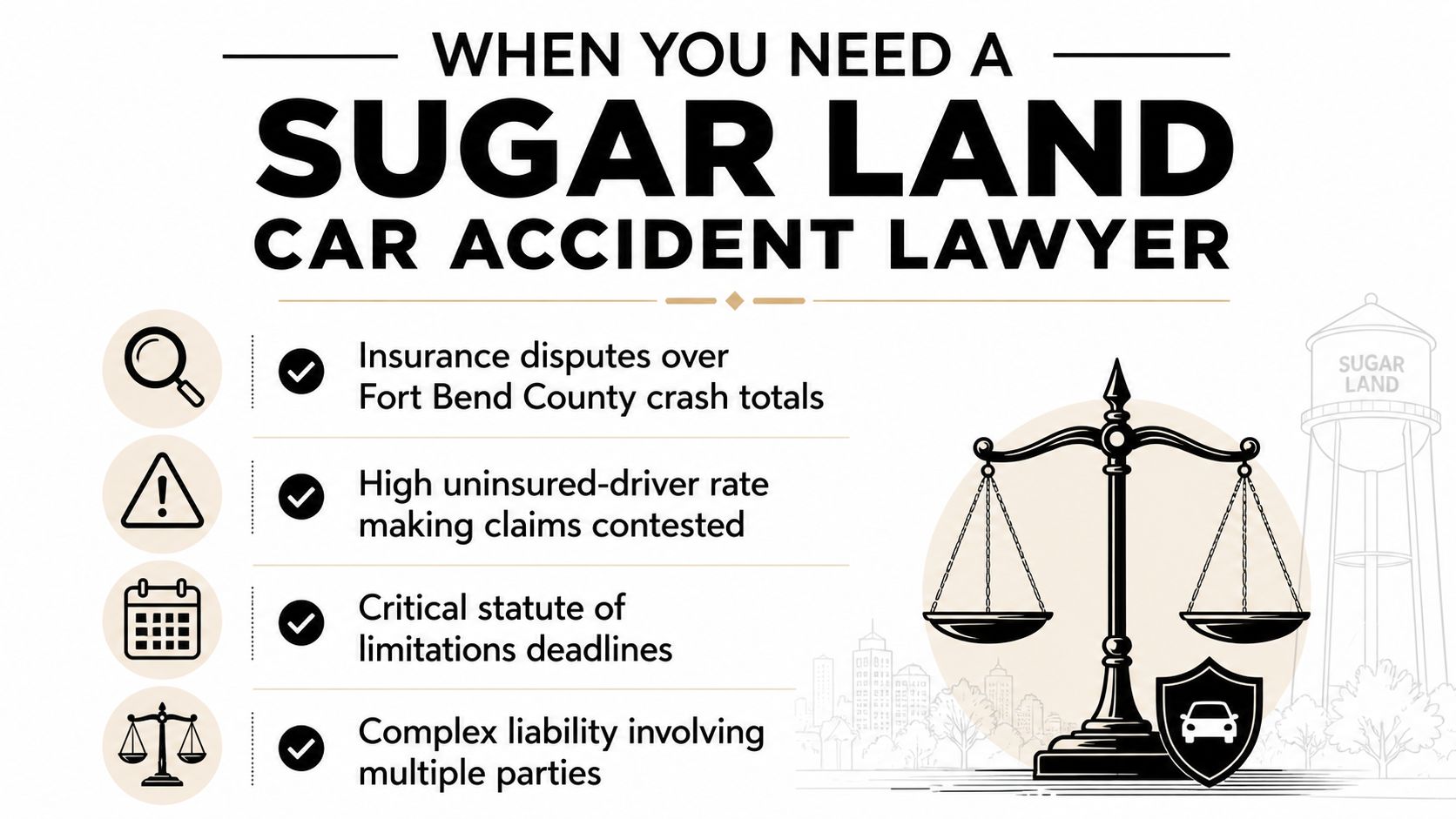
A lot of Sugar Land crashes look simple on paper and then turn into a fight. That happens because fault gets disputed, witnesses disappear, and the insurance company knows many people won't push back hard enough.
Signs the case has outgrown self-representation
If liability is denied, if the offer is too low, if surgery is on the table, if the insurer is pointing to a policy exclusion, or if a commercial vehicle was involved, stop handling it alone. The same warning applies when a fatal crash or catastrophic injury is involved, because those claims can move into wrongful death or severe injury territory fast.
Local crash volume and uninsured-driver issues make this worse. Fort Bend County and the Sugar Land area see enough collisions that coverage disputes aren't rare edge cases, they're a recurring part of the work. A Texas personal injury lawyer with local knowledge can preserve the case before evidence disappears.
What a lawyer should do in the first month
A good Sugar Land car accident lawyer should preserve dashcam footage, send spoliation letters to nearby businesses, identify witnesses, and work with your treating doctors on lien arrangements when needed. In a commercial crash, the lawyer should also look beyond the driver and investigate the employer, the vehicle owner, and any other responsible party.
Here's the point. You don't hire a lawyer just to “have one.” You hire counsel to build pressure, protect evidence, and force the insurer to take the claim seriously.
The Law Office of Bryan Fagan, PLLC handles Texas injury claims on a contingency basis, so the fee structure is tied to recovery rather than hourly billing. Local representation also matters for venue and for understanding how Fort Bend County cases move through the system.
What the Claims and Litigation Process Looks Like
A strong case starts with a demand package, not a lawsuit. It should lay out the medical timeline, list the bills, explain fault, and state the settlement amount requested, with records behind every line item.
From demand to negotiation
Once the demand goes out, the insurer usually answers with questions or a low offer. That exchange may take several rounds, and mediation often comes after both sides have enough information to value the claim. If the carrier still refuses to move, the case gets filed in Fort Bend County.
Filing suit does not mean trial is around the corner. It means the court process has started, and the defense must respond on the record. That shift often changes how an insurer talks.
What litigation involves
Litigation starts with the petition and answer. Then come written discovery, depositions, independent medical examinations, pre-trial motions, mediation, and, if needed, trial. Each step takes time because both sides are building proof, testing credibility, and narrowing the issues a jury will decide.
Settlement is usually faster and less risky. Trial can produce a higher verdict, but it also brings more delay, more expense, and more uncertainty.
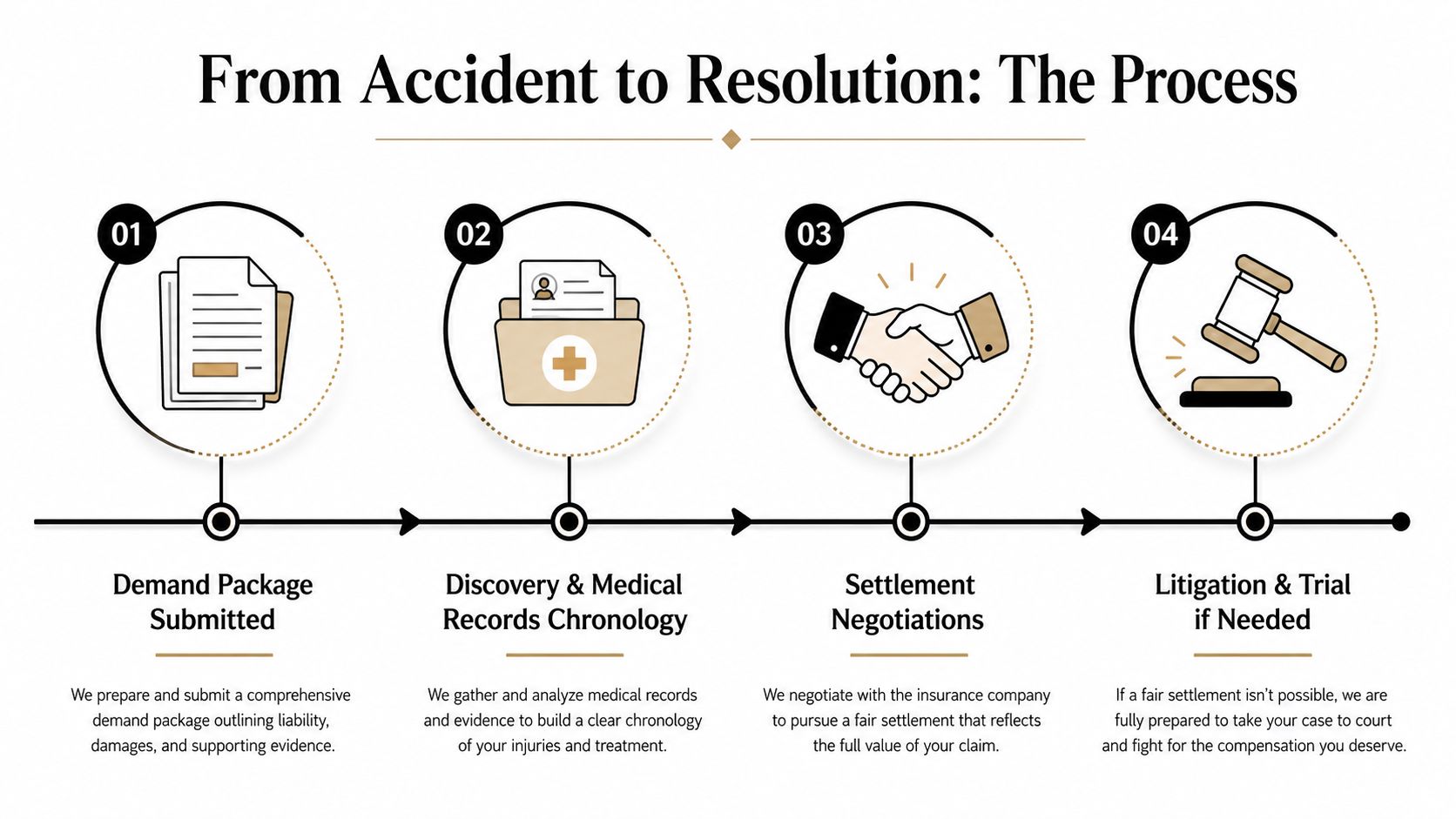
A verdict is never guaranteed. Settlement gives certainty. Trial gives the chance at a better result if the evidence is strong and the defense stays unreasonable. A seasoned Houston car accident attorney knows how to press for the first while preparing for the second.
Practical Tips to Maximize Your Recovery and Next Steps
Your recovery file should be boring and complete. That's what wins trust with adjusters and makes the claim easier to value.
Keep this checklist in front of you
- Attend every medical appointment and follow up on referrals.
- Follow all prescribed restrictions so the records match your actual limitations.
- Save all receipts and mileage logs for every trip tied to treatment.
- Document all communications with insurers, employers, and providers.
- Avoid social media posts about the wreck, your pain, or your activities.
- Never give a recorded statement without counsel reviewing the questions first.
- Track symptoms in a daily journal so the pain doesn't get flattened into a vague complaint later.
A Sugar Land car accident lawyer turns those records into a demand package that tells a clear story, and a clear story usually settles better than a messy file. If the other driver is uninsured, if you were partly at fault, or if there's no police report yet, the claim may still be viable, but the proof has to be handled carefully. For report retrieval, use the Texas crash record system through the state process linked by the Texas Department of Transportation.
If you're dealing with a serious injury, a death in the family, or a fight over uninsured coverage, you should get legal help now. Recovery is possible, and the right attorney can take the pressure off you while you focus on healing.
The Law Office of Bryan Fagan, PLLC helps injured Texans sort out crash claims, insurance disputes, and wrongful death matters with clear guidance and steady communication. If you need a car accident lawyer sugar land tx families can call for a free consultation, visit Law Office of Bryan Fagan, PLLC and get answers before the deadlines and the evidence start working against you.