A serious accident can change your life in seconds—but you don’t have to face it alone. That first phone call from an insurance adjuster is a critical moment in your claim. Your primary goal is simple: stick to the basic, verifiable facts. Nothing more.
Give them your name, contact information, and the date and location of the accident. That's it. Resist the urge to discuss fault, detail your injuries, or offer any opinions. Remember, the adjuster’s job is to find reasons to minimize or deny your claim. In this situation, saying less is always the safest route.
Your First Call with the Insurance Adjuster
A serious crash can turn your world upside down in a heartbeat. The minutes and hours that follow are often a blur of adrenaline, confusion, and shock.
Think about a chaotic multi-car pileup on Houston's I-45 during rush hour. It’s nearly impossible for you to have a crystal-clear memory of every single detail. Insurance adjusters know this. They often call quickly, hoping to get a statement from you while you’re still processing the trauma.
Their questions might sound innocent, but they are carefully crafted to get you to say something that could damage your case later. This is why that first conversation is so important. You are under no obligation to give a detailed narrative or a recorded statement. Your only duty is to report that an accident happened.
Sticking to the Facts
The key is to provide only the essential, undeniable facts. Avoid apologies, speculation, or guesses at all costs. Any statement you make can—and will—be used to argue that your injuries aren't that bad or that you were partly to blame for the crash.
An adjuster’s job is to protect the insurance company's bottom line, not to make sure you get fair compensation. Every question has a purpose, and it's rarely to help your case.
This can be a tough pill to swallow, especially when you're just trying to heal. In Texas, there are around 4,200 annual complaints filed against insurance companies for poor claim handling and lowball offers, putting the state second in the nation for these kinds of issues. Being cautious is your best line of defense. For more guidance on managing this process, these crucial insurance claim tips offer a solid foundation for handling property damage claims, and the principles apply here, too.
This infographic gives a great breakdown of what to say versus what to avoid when that call comes.
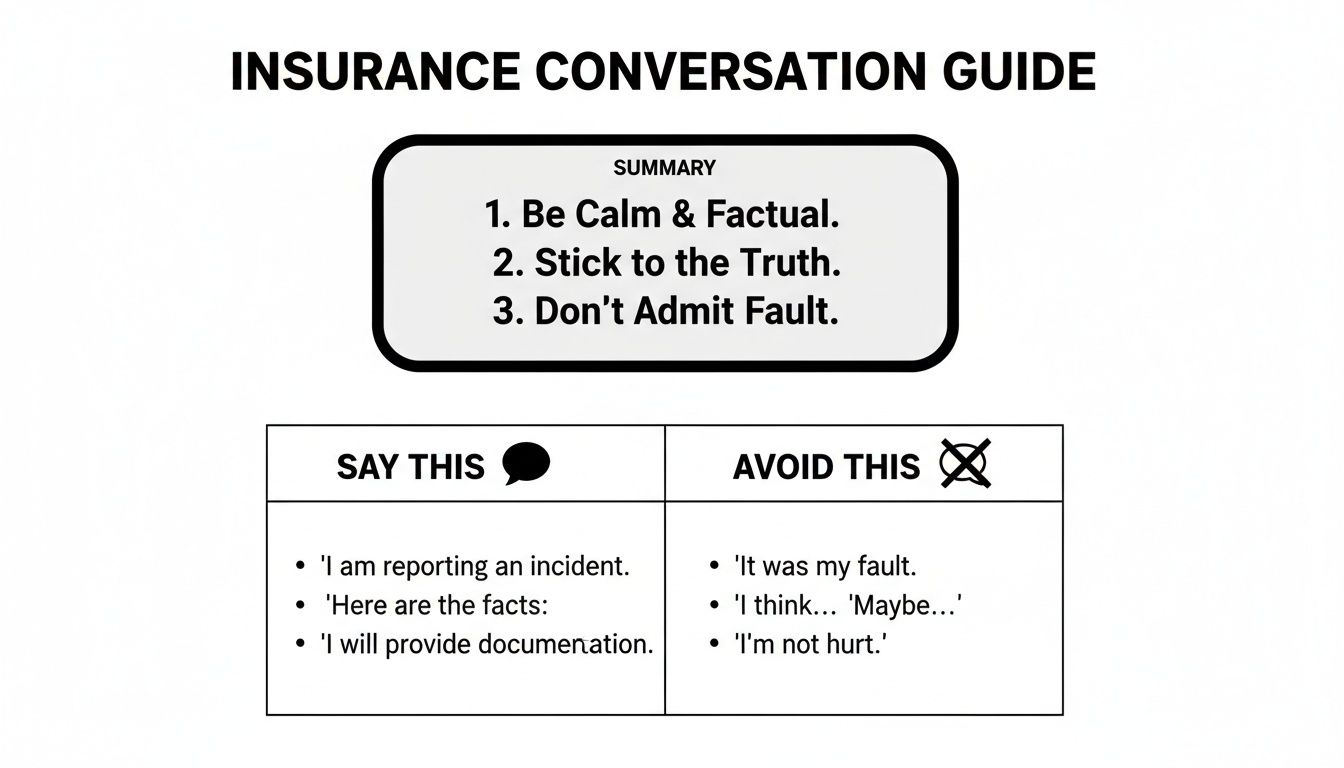
As you can see, sticking to minimal, factual statements protects your rights. Letting your emotions or speculations get the best of you can create major problems down the road.
What to Say vs. What to Avoid with Insurance Adjusters
Navigating this conversation can feel like walking through a minefield. The words you choose matter immensely. Here’s a simple comparison to help you stay on the right track.
| SAY THIS (Safe & Factual) | AVOID THIS (Risky Language) |
|---|---|
| "The accident happened on [Date] at [Location]." | "I think the other driver came out of nowhere." |
| "I am still assessing my injuries and will be seeing a doctor." | "I'm fine," or "I just have a little whiplash." |
| "I can confirm my vehicle is a [Year, Make, Model]." | "My car is totaled; it's a complete wreck." |
| "The police report should have the details you need." | "I'm sorry," or "I should have been more careful." |
| "I'm not prepared to give a recorded statement right now." | "Sure, you can record this call." |
| "Please direct all future questions to my attorney." | "The accident was all their fault." |
Keeping your statements brief and fact-based prevents the adjuster from twisting your words. Let the official reports and, eventually, your attorney, tell the full story.
And don't forget, time is a factor. You have a limited window to act, so be sure to read our guide on how long you have to report an accident to insurance.
Why Recorded Statements Are a Trap
Soon after the crash, you can almost guarantee the other driver’s insurance adjuster will call. They’ll sound friendly, professional, and concerned. Then, they’ll ask for a recorded statement, framing it as just a routine part of the process.
Let us be clear: this is not a formality. It’s a strategic move designed to undermine your claim from the very start.
Imagine you're a truck driver from San Antonio, laid up at home after a bad wreck on I-35. You're on pain medication, maybe a little foggy, and the adjuster calls, pushing you to give a statement "just to get your side of the story." This is a calculated tactic. They are banking on catching you when you're vulnerable and not thinking with 100% clarity.

How Adjusters Use Your Words Against You
Insurance adjusters are skilled negotiators. They are trained to ask leading questions, using very specific wording to get you to downplay your injuries or even accidentally admit to some fault.
A seemingly harmless question like, "So your back is just a little sore?" is a classic example. If you agree, they have you on record. Later, when it turns out you need physical therapy or surgery, they’ll play that recording back to argue your injuries weren't that serious to begin with.
You have the right to protect yourself. In Texas, you are not legally required to provide a recorded statement to the at-fault driver's insurance company.
Their goal is to create a permanent record they can pick apart. They will compare every word you say to the police report, your medical records, and any future testimony, searching for the smallest inconsistency to justify a lowball offer or deny your claim completely.
The Safest Way to Respond
When an adjuster asks for a recorded statement, your response needs to be polite but firm. You don't need to be rude or give a long explanation.
A simple refusal is all it takes:
- "I'm not comfortable providing a recorded statement at this time."
- "I am focusing on my medical treatment right now and can't give a statement."
- "My attorney will be in touch with you to handle all communications."
Saying "no" is one of the most powerful things you can do to protect your case. It stops them from building a case against you with your own words. By declining and directing them to your lawyer, you take back control and put a professional in charge of the conversation, leveling the playing field.
Building a Rock-Solid Evidence File
Knowing what to say to an insurance adjuster is one thing, but your words carry a lot more weight when you can back them up with undeniable proof. The adjuster's job is to poke holes in your story, but a strong evidence file leaves them with very little room to argue. Building this file starts the moment the crash happens.
From here on out, your focus needs to shift from conversation to documentation. Every single piece of evidence you gather helps paint a clear, factual picture of what happened and how it has impacted your life. This is your best defense against the insurance company's favorite tactic: downplaying your injuries or disputing the facts of the accident.
Your Essential Documentation Checklist
Think of this process like building a case, brick by brick. Each item you collect strengthens your foundation and makes it much harder for the insurer to tear down your claim. For example, after a Houston freeway crash, an injured driver's "minor" knee pain later required surgery. Their early medical records and a simple pain journal became the cornerstone of a successful claim because they proved how the injury progressed over time.
Start gathering these crucial items immediately:
- The Official Police Report: As soon as it’s available, get a copy of the official crash report. This document is a powerful, objective account of the incident from a third party.
- Photographs and Videos: Use your phone. Take photos of the accident scene, vehicle damage from every angle, road conditions, traffic signs, and any visible injuries. A quick video can also capture the immediate aftermath.
- Medical Records and Bills: Keep everything related to your medical care. This means ambulance bills, ER records, doctor’s notes, prescription receipts, and physical therapy reports.
- A Personal Pain Journal: This is so important. Each day, take a few minutes to jot down your pain levels, physical limitations, and how your injuries are affecting your daily activities—like struggling to sleep, not being able to work, or missing family events.
Strong documentation transforms your claim from a "he said, she said" situation into a fact-based argument that is extremely difficult for an insurance company to refute.
You’ll also need to document the damage to your vehicle. Part of building your evidence file will involve getting damage assessments and repair estimates, so it’s always a good idea to know how to find a trustworthy mechanic for reliable auto repair.
And remember, preserving this evidence isn't just a good idea—it's a legal responsibility. Deliberately destroying or hiding evidence can have severe consequences for your case. It is vital that you understand the concept of spoliation of evidence and its impact on your claim. By diligently collecting and organizing these documents, you’re giving your attorney the powerful tools needed to fight for the full and fair compensation you rightfully deserve.
Understanding Texas Fault Laws and Insurance Tactics

To protect your rights after a crash, you first have to understand the rules insurance companies play by in Texas. Our state operates under a legal principle called modified comparative negligence, also known as comparative responsibility or the 51% Bar Rule.
This rule is absolutely crucial to your claim. In simple terms, it means you can still get money for your injuries even if you were partially to blame for the accident, but only as long as your share of the fault is 50% or less. If a jury decides you were 51% or more at fault, you get nothing. Zero.
Insurance adjusters are experts at using this rule to their advantage. Their entire goal is to shift as much of the blame as they possibly can onto you, all to reduce—or completely eliminate—what their company has to pay.
How Adjusters Use Fault to Reduce Your Payout
Imagine you were involved in a lane-change accident on a busy Dallas freeway. To you, it’s clear the other driver wasn't paying attention and just swerved right into you. But the insurance adjuster might call and start asking questions designed to trip you up. They might suggest you didn't check your blind spot properly or that you failed to react quickly enough.
Their strategy is to build a case that assigns you a percentage of the fault. If they can successfully argue you were just 25% responsible, they can legally slice your settlement by that exact amount. A $100,000 claim instantly becomes a $75,000 claim. It’s a standard tactic used by every single insurer to protect their profits.
This is precisely why having a skilled Texas personal injury lawyer in your corner is so important. We see these arguments coming from a mile away and know how to build a strong case that proves the other driver’s negligence while minimizing any fault they try to pin on you.
Common Insurance Company Tactics to Watch For
Besides arguing about fault, adjusters have a whole playbook of strategies designed to get you to settle for less than you deserve. Recognizing these tactics is the first step in defending yourself.
- The Quick, Lowball Offer: They might dangle a fast settlement check in front of you just days after the accident. It’s tempting, especially when bills are piling up, but it’s almost always a trap. They want you to take the money before you know the true extent of your injuries and what kind of medical care you'll need down the road.
- Intentional Delays: On the flip side, some adjusters will drag the claims process out for months. They ignore your calls and emails, hoping you’ll get so frustrated and desperate that you'll accept any offer they finally make. It’s a war of attrition they are fully prepared to win.
- Misrepresenting Your Policy: They might tell you that certain medical treatments or other damages aren't covered, even when they are. They are banking on the fact that you haven't read every line of the insurance policy's fine print.
Think about it from the perspective of a hardworking Houston pedestrian who gets hit by a rideshare van. The insurance company calls and denies the claim outright. Unfortunately, this isn't some rare scenario. Across the U.S., denial rates for accident-related claims can easily hit 10-15%. Here in Texas, we see around 4,200 complaints filed each year for lowball offers and processing delays alone—second only to California. You can discover more insights about these insurance denial statistics to see just how widespread this problem is.
An insurance company is a business, and its primary focus is on profits. Leveling the playing field requires having an advocate on your side who understands the law and is prepared to fight for your rights.
Knowing these rules and tactics empowers you. It helps you see clearly that the insurance company is not on your side in this process. Their financial interests are directly opposed to yours.
Knowing When It's Time to Call a Lawyer

A lot of people think they can handle an insurance claim on their own, especially if the accident seems straightforward. But the reality is, the process is almost never as simple as it looks. Remember, insurance companies have entire teams of professionals working around the clock to protect their bottom line. So, how do you know when you’ve hit a wall and need a professional in your corner?
Knowing when to make that call can be the single most important decision you make for your future. You aren't being difficult or looking for a fight by seeking legal advice. You're simply taking a crucial step to protect your rights and your family's financial security. A free consultation can give you a clear path forward with zero cost or obligation.
Clear Signs You Need Legal Help
Some situations are immediate red flags. They're clear signals that the insurance company’s playbook is working against you, and it's time to level the playing field.
You should contact an attorney right away if:
- You suffered serious injuries. If the crash left you with broken bones, required surgery, a traumatic brain injury, or any condition needing long-term care, you absolutely need a lawyer. A Houston car accident attorney can make sure your future medical needs are properly calculated and included in your demand.
- Fault is being disputed. Is the other driver blaming you? Is the insurance company trying to use Texas's 51% comparative responsibility rule to pin some of the blame on you? You need an advocate to fight back against these tactics.
- The insurer is delaying or denying your claim. Unreasonable delays, ignoring your phone calls, or a flat-out denial are classic signs of bad faith. Don't let them wear you down.
- You receive a lowball settlement offer. A quick offer that barely covers your immediate medical bills and lost wages is a major red flag. They're hoping you'll take the easy money and go away.
- The other driver’s insurer contacts you directly. Never, ever speak to them without legal counsel. The only thing you should say is, "Please direct all communication to my attorney."
When the Stakes Are Highest
The need for a lawyer becomes even more critical in cases involving catastrophic injuries or the tragic loss of a loved one.
Imagine a family grieving after a fatal truck crash on a Texas highway. The trucking company's insurance carrier will have lawyers involved from day one, working to minimize their payout. This family needs a wrongful death lawyer in Texas immediately to preserve evidence, investigate the crash, and fight for justice.
In these devastating situations, a family should be focused on healing, not on battling a massive corporation. An experienced truck crash lawyer Houston steps in to handle every single legal detail. We protect the family from aggressive insurance tactics and give them the space to grieve while we fight for the accountability they deserve. Making that call is the first step toward getting the support and justice your family needs.
Common Questions About Texas Accident Claims
After a serious crash, it's completely normal to feel overwhelmed and have a million questions racing through your mind. Knowing your rights and understanding what comes next are the first steps toward taking back control.
We've put together some straightforward answers to the questions we hear most often from accident victims across Texas. Our goal is to give you the clarity you need to make the right decisions for you and your family.
How Long Do You Have to File a Claim in Texas?
In Texas, you generally have two years from the date of the accident to file a personal injury lawsuit. This deadline is known as the statute of limitations.
While two years might sound like a lot of time, it can fly by when you're focused on doctor's appointments and just trying to get back on your feet.
Waiting too long can be a critical mistake. Evidence disappears, witnesses' memories fade, and you could lose your right to seek compensation forever. Contacting a Texas personal injury lawyer soon after the crash is the best way to preserve evidence and make sure all your legal deadlines are met.
Should I Accept the First Settlement Offer?
It is almost always a bad idea to accept the first offer from an insurance company. These initial offers are intentionally low. They are designed to close your case as quickly and cheaply as possible, long before you even know the true extent of your injuries and financial losses.
The adjuster is hoping you'll take the fast cash to cover your immediate bills. But that first offer rarely, if ever, accounts for future medical treatments, ongoing lost wages, or the full impact of your pain and suffering.
Never sign any release or accept a check without first speaking to a Houston car accident attorney. An experienced lawyer can accurately value your claim and fight for the comprehensive compensation you actually deserve.
Your financial recovery is not a sprint; it's a marathon. A quick, low offer now could leave you paying for the consequences of the accident out of your own pocket for years to come.
What if the Other Driver Was Uninsured or Underinsured?
This is a frustratingly common problem on Texas roads. If the at-fault driver has no insurance or not enough to cover all your damages, you may be able to file a claim through your own Uninsured/Underinsured Motorist (UM/UIM) coverage, if you purchased it.
But even when you're dealing with your own insurance company, it can still be a battle. They may try to downplay your injuries or undervalue your claim to protect their bottom line. The reality is that claim denials are frequent.
Imagine a big rig rear-ends your family sedan near Austin, causing serious injuries. U.S. providers routinely deny 5-15% of auto claims, and Texas logs about 4,200 complaints annually for these issues—second only to California. You can discover more about these U.S. healthcare denial rates and statistics to see the full picture.
We strongly recommend having a lawyer represent you to ensure you are treated fairly, even by your own insurer.
A serious accident can change your life in seconds—but you don’t have to face the aftermath alone. The legal system is complex, and insurance companies have powerful resources on their side. At The Law Office of Bryan Fagan, PLLC, we are here to provide the experienced, compassionate, and aggressive representation you need to protect your rights and secure your future.
Recovery is possible, and help is available. We invite you to schedule a free, no-obligation consultation to discuss your case and learn how we can fight for you. Contact us today at https://texaspersonalinjury.net and let our family help yours.