Skip to content
A serious accident can change your life in seconds—but you don’t have to face it alone. You count on your insurance company to be your safety net, but what happens when that safety net breaks? Put simply, a bad faith insurance claim happens when your insurer breaks its promise to treat you fairly and honestly by unreasonably delaying, denying, or underpaying your valid claim.
Your Insurer’s Promise—And When It’s Broken
A serious accident can flip your world upside down in an instant. You’ve paid your insurance premiums faithfully, month after month, year after year, trusting that when you need it most, your provider will be there to protect you. This isn’t just wishful thinking; it’s a legal contract.
So, when the very company that promised to have your back suddenly starts giving you the runaround—delaying your claim, denying it without good reason, or making an insultingly low offer—it feels like a massive betrayal. This isn’t just bad customer service or a simple disagreement. In Texas, it’s known as insurance bad faith, and it’s against the law.
What Is Bad Faith, Really?
At its heart, bad faith is when an insurer puts its own profits ahead of your well-being. They have a legal duty to handle your claim with good faith and fair dealing. When they breach this duty without a reasonable basis for doing so, they are acting in bad faith.
Imagine you get into a major car accident on a busy Houston freeway. You do everything right: you report the crash, get medical care, and file your claim with all the necessary paperwork. But instead of help, you get silence. Your calls aren’t returned, and your adjuster gives you confusing excuses. This isn’t just frustrating; it could be a sign of bad faith.
Under Texas law, your insurance company has an obligation to investigate and pay your claim promptly and fairly. When they fail to do so without a reasonable justification, they can be held accountable for more than just the original claim amount.
This guide will walk you through what bad faith means under Texas law, how to spot the common warning signs, and what you can do to fight back. We know how frustrating this is, and we want to be clear: you have rights. Your recovery—physical, emotional, and financial—is what matters most, and you deserve a fair shot at getting your life back on track.
Understanding Your Right to Fair Treatment from Insurers
When you pay your insurance premiums, you’re doing more than just buying a policy—you’re entering into a contract built on trust. While the pages of your policy detail your coverage, Texas law adds an unspoken, yet powerful, layer to that agreement: the duty of good faith and fair dealing.
This legal duty isn’t just a suggestion; it’s a requirement. It means your insurance company must treat you honestly and fairly when you need them most. Think of it as the insurer’s promise to hold up their end of the bargain when you file a legitimate claim. A bad faith claim arises when they break that promise.
The Foundation of a Bad Faith Claim
It’s important to understand that simply disagreeing with a low settlement offer isn’t automatically bad faith. The bar is higher than that. To successfully bring a bad faith claim against an insurer in Texas, you generally have to prove three things:
- A Valid Claim Exists: First, you have to show that your claim was actually covered under your policy.
- Unreasonable Denial or Delay: The insurer then had to deny, delay, or underpay that valid claim without a reasonable, legitimate reason for doing so.
- The Insurer Knew or Should Have Known: Finally, you must show the company knew—or should have known—that they had no reasonable basis for their actions.
This legal framework is designed to protect you from an insurer who prioritizes its own bottom line over the promises made to you. The flowchart below shows how this breakdown of trust typically unfolds, turning a difficult situation into a legal battle.
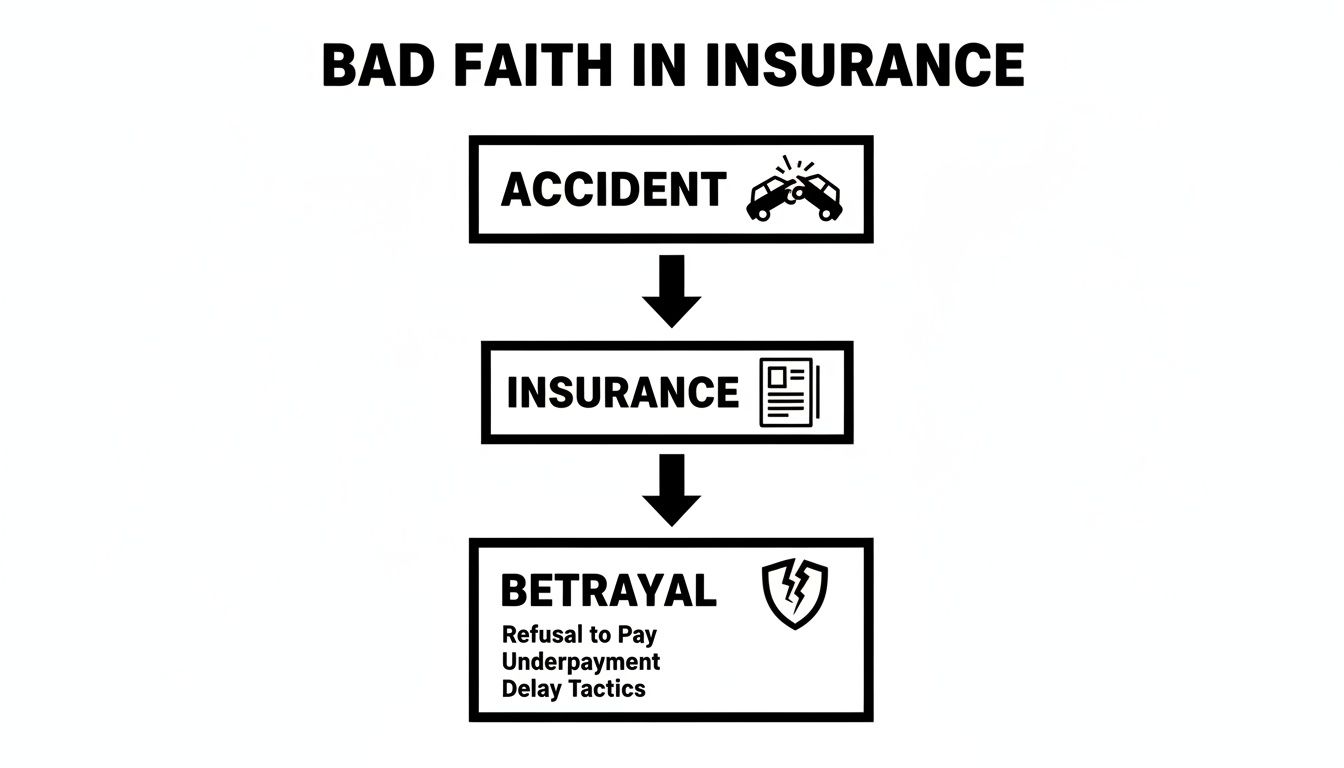
This illustrates the devastating path from a covered accident to an insurer’s breach of trust through unfair delays, denials, or underpayments.
Good Faith vs. Bad Faith Insurance Practices
It can be tough to tell the difference between a tough negotiation and genuine bad faith. This table breaks down what fair, good faith actions look like compared to the unreasonable tactics that might signal a problem.
| Insurer Action | What Good Faith Looks Like | What Bad Faith Looks Like |
|---|---|---|
| Claim Investigation | Conducting a prompt, thorough, and objective investigation to find all the facts. | Delaying the investigation without reason, ignoring evidence that supports your claim, or refusing to investigate at all. |
| Communication | Keeping you informed about the status of your claim and providing clear explanations for decisions. | Ignoring your calls and emails, refusing to provide a reason for a denial, or making misleading statements about your policy. |
| Settlement Offers | Making a fair settlement offer based on the facts and your policy coverage once liability is clear. | Offering an unreasonably low amount (“lowballing”), refusing to negotiate, or delaying payment on an agreed-upon settlement. |
| Policy Interpretation | Interpreting policy language fairly and in line with Texas law. | Twisting the meaning of your policy language to create a reason for denial. |
| Decision Timeline | Affirming or denying your claim within a reasonable amount of time after receiving all necessary information. | Dragging out the claims process for months with endless requests for unnecessary documents or information. |
Spotting these bad faith behaviors is the first step in protecting your rights. If your insurer’s actions fall into the right-hand column, it might be time to seek legal advice from a Texas personal injury lawyer.
Texas Law Is on Your Side
Thankfully, Texas law doesn’t leave policyholders to fight these battles alone. The Texas Insurance Code, specifically Chapter 541, provides strong protections against “Unfair Methods of Competition and Unfair or Deceptive Acts or Practices.”
This powerful statute gives you the right to sue an insurance company for specific bad faith actions, including:
- Misrepresenting what your policy covers to get out of paying a claim.
- Failing to conduct a reasonable investigation before making a decision.
- Refusing to pay a claim without ever investigating it.
- Failing to approve or deny coverage within a reasonable timeframe.
- Not making a good faith effort to reach a prompt, fair, and equitable settlement when their liability is clear.
These aren’t just guidelines; they are enforceable rights. When an insurance company violates them, you can hold them accountable not only for the money you were owed on your original claim but also for the extra harm their bad faith conduct caused. You can learn more about common reasons why insurance companies deny claims to better understand the tactics they use.
Spotting Common Bad Faith Insurance Tactics
When you’re recovering from a serious accident, the last thing you should be doing is fighting with your own insurance company. But the hard truth is that some insurers have a playbook of tactics they use to delay, deny, or underpay your rightful claim—all to protect their bottom line. The first step in protecting yourself is learning to recognize their game.
These strategies aren’t just frustrating; they’re often red flags that your insurer is crossing the line into bad faith. Once you know what to look for, you can stand up for your rights and take the right steps to fight back.

Unreasonable Delays in Processing Your Claim
One of the oldest tricks in the book is simply dragging their feet. A proper investigation takes time, of course, but an unreasonable delay is something else entirely. The insurer is often betting that as your medical bills and financial stress pile up, you’ll get desperate enough to accept any low offer they throw your way.
This can look like:
- Going silent, ignoring your calls and emails for weeks at a time.
- Making you jump through hoops, repeatedly asking for the same documents you’ve already sent them.
- Keeping you in the dark by failing to give you any meaningful updates on your claim.
Imagine you were in a serious truck crash on I-45. You’ve sent in the police report, your medical records, everything they asked for. Yet months later, you’ve heard nothing but vague excuses from the adjuster. That’s not just bad customer service—it could be a deliberate delay tactic that amounts to bad faith.
Lowball Settlement Offers
Another massive red flag is getting a settlement offer that’s so low it’s almost insulting. It doesn’t even begin to cover what you’ve lost. This strategy, known as “lowballing,” is a calculated gamble that you either don’t know what your claim is truly worth or you’re too worn out to fight for what you deserve.
An insurer acting in bad faith might make an offer that covers a fraction of your initial hospital visit but completely ignores:
- The costs of future surgeries, physical therapy, and ongoing care.
- Your full lost income and the impact on your ability to earn a living down the road.
- The immense pain, suffering, and emotional trauma you’ve been forced to endure.
They might dangle a quick check for a few thousand dollars when your actual damages are easily in the six figures. A fair offer is based on the facts and evidence of your losses, not some arbitrary number designed to close your file for cheap.
Under Texas insurance law, once an insurer’s liability is reasonably clear, they have a duty to make a prompt and fair settlement offer. A lowball offer that ignores the clear evidence of your damages is a direct violation of that duty.
Misrepresenting Your Policy or the Law
Insurance policies are notoriously complicated, and some adjusters will use that complexity against you. They might twist the language in your policy, telling you a certain injury or type of damage isn’t covered when it absolutely is.
For example, they could deny a claim for a catastrophic injury by pointing to a policy exclusion that doesn’t really apply to your situation. Or they might misstate Texas law, perhaps trying to convince you that you were more at fault for the accident than you were to reduce their payout. These are deceptive moves designed to make you give up or settle for less. If what the adjuster is telling you just doesn’t sit right, trust your gut.
What to Do When You Suspect Your Insurer Is Acting in Bad Faith
If you’re reading this, chances are you have that sinking feeling in your gut. The insurance company you trusted—and paid—to be there for you is suddenly acting more like an opponent than a partner. It’s a frustrating and powerless position to be in. But you’re not powerless.
What you do next is critical. Taking immediate, deliberate steps can protect your rights and lay the groundwork for a solid case. It shows the insurance company you won’t just be pushed around.
Start a Detailed Communication Log
From this moment forward, document everything. This might be the single most important action you can take. Your memory will fade over time, but a written record is powerful, undeniable evidence.
Grab a notebook or start a new document on your computer. Log every single interaction you have with the insurance company, making sure to include:
- The date and time of the call, email, or letter.
- The name and title of every person you speak with.
- A summary of the conversation—what you asked, what they said, and any promises they made.
- Any reference or claim number they give you.
This log does more than just track conversations; it creates a timeline that can expose patterns of delay, conflicting stories, and other classic bad faith tactics.
Put Everything in Writing
A quick phone call is convenient, but it doesn’t leave a paper trail. To build undeniable proof, you need to shift your communication to writing as much as you can. After every important phone call, send a follow-up email to the adjuster recapping what was discussed.
For your most critical communications, like a formal dispute or a demand for action, use certified mail with a return receipt. It’s a small extra step that gives you legal proof of when the insurance company received your letter, adding a serious layer of accountability.
Never sign a release or accept a “final” payment from an insurer without having an attorney review it first. Signing away your rights prematurely is a mistake you cannot undo. Insurers often use this tactic to close a claim for a fraction of its true value.
Become an Expert on Your Own Policy
Your insurance policy is the contract that binds the company to you. It might be dense and full of legal jargon, but it’s worth your time to read the sections relevant to your claim. If you don’t have a complete copy, request one immediately.
Zero in on understanding these key areas:
- Your coverage limits: What is the absolute maximum the policy will pay?
- Your duties after a loss: What does the policy say you have to do (like provide timely notice or cooperate with their investigation)?
- Exclusions: What does the policy specifically state it will not cover?
Knowing your policy inside and out gives you the power to push back when an adjuster misrepresents your coverage. And if your insurer denies the claim, you have the right to challenge that decision.
Be Aware of Critical Deadlines
It’s crucial to know that in Texas, you’re fighting against more than just the insurance company—you’re also fighting the clock. There are strict deadlines, known as the statute of limitations, for taking legal action.
For a personal injury case, like a car accident, you generally have just two years from the date of the incident to file a lawsuit. A bad faith insurance claim is its own separate legal action and also usually has a two-year deadline. If you miss these dates, you could lose your right to seek justice forever. Some insurers might even drag their feet on your claim, hoping you’ll run out of time.
These steps are a great start to protecting your rights, but you shouldn’t have to carry this burden alone. A Texas personal injury lawyer can take over, making sure every deadline is met and every piece of evidence is locked down.
How a Texas Personal Injury Lawyer Can Help You Fight Back
Trying to take on a massive insurance corporation by yourself is an intimidating, uphill battle. While you’re focused on recovering from serious injuries, their army of adjusters and lawyers has one single goal: protect the company’s profits, not your future. An experienced Texas bad faith insurance attorney completely levels that playing field.
Hiring a lawyer sends a powerful message that you will not be bullied or ignored. It forces the insurer to stop their usual delay tactics and pressure campaigns. Suddenly, they have to start taking your claim seriously. They know they can’t get away with flimsy excuses or lowball offers once a legal expert is watching their every move.

Taking Immediate Control to Protect You
The very first thing we do at The Law Office of Bryan Fagan, PLLC, is take over all communication with the insurance company. From that moment on, the harassing phone calls and confusing demands for paperwork just stop. You can finally breathe and put all your energy into your physical and emotional recovery while we handle the fight.
We don’t just take their word for anything. We immediately launch our own independent investigation into your accident and your claim. Our team will:
- Gather all the evidence, from police reports and witness statements to your complete medical records.
- Consult with accident reconstructionists and medical experts to prove the true, full extent of your injuries and losses.
- Dig into your insurance policy to identify every single piece of coverage you are entitled to under Texas law.
This comprehensive approach allows us to build a rock-solid, evidence-based case that an insurer simply can’t dismiss. We prepare every case as if it’s going to trial, giving us maximum leverage when it’s time to negotiate a settlement.
Fighting for Every Dollar You Deserve
When an insurer acts in bad faith, Texas law allows you to go after much more than just the original benefits they owed you. We fight aggressively to hold them accountable for the full scope of the harm they’ve caused.
A successful bad faith lawsuit can secure compensation for:
- The Full Policy Benefits: The original amount you were rightfully owed under your policy.
- Interest: A penalty of 18% interest on the payment they delayed.
- Emotional Distress: Damages for the anxiety, stress, and mental anguish their actions put you through.
- Attorney’s Fees: Forcing the insurer to pay the cost of hiring a lawyer to fight them.
- Punitive Damages: In cases of truly outrageous misconduct, these damages are meant to punish the insurer and stop them from harming other families in the future.
These additional damages are designed not just to make you whole but to send a clear message: treating policyholders unfairly has severe consequences.
By bringing a bad faith claim, you are not just fighting for yourself. You are holding a powerful corporation accountable and helping to protect other Texas families from suffering the same injustice.
Our Contingency Fee Promise
We firmly believe that everyone deserves a shot at justice, no matter what their financial situation looks like. That’s why we represent all our clients on a contingency fee basis. What does that mean for you? You pay absolutely no upfront costs or out-of-pocket expenses.
You owe us nothing unless we win your case. Our fee is simply a percentage of the compensation we recover for you. This arrangement ensures our goals are perfectly aligned with yours—to secure the maximum possible recovery. This approach removes all the financial risk from your shoulders, allowing you to pursue justice with confidence.
The fight against a bad faith insurance company is not one you should face alone.
You Don’t Have to Face This Fight Alone
Recovering from a serious accident is tough enough. The last thing you need is a battle with an insurance company that refuses to honor its promises. This guide has walked you through what a bad faith insurance claim looks like, how to spot the red flags, and the steps you can take to protect yourself.
But if there’s one thing to take away from all this, it’s that you are not alone in this fight.
You have every right to demand fair treatment and to seek justice when an insurer puts its profits ahead of your well-being. Going up against a massive corporation can feel impossible, but with the right legal team on your side, you can hold them accountable and secure the future you and your family deserve.
Let Us Take the Burden Off Your Shoulders
At the Law Office of Bryan Fagan, PLLC, we’re here to provide the support, guidance, and aggressive representation you need to win. Our team, including dedicated Houston car accident attorneys and wrongful death lawyers, knows the playbook these insurance companies use. More importantly, we know how to counter their tactics effectively under Texas law.
We handle the complex legal battle so you can focus on what truly matters—your recovery and your family.
We invite you to reach out for a free, no-obligation consultation to talk about your case. Let us listen to your story, answer your questions, and explain exactly how we can help you move forward. Your recovery is possible, and powerful legal help is just a phone call away.
Frequently Asked Questions About Texas Bad Faith Insurance Claims
When you’re staring down a difficult insurance company, you’re bound to have questions. Getting clear, straightforward answers is the first step toward understanding your rights and figuring out what to do next.
Here are some of the most common questions we hear from people all across Texas who feel like their insurance company just isn’t playing fair.
What Is the Difference Between Bad Faith and Just Disagreeing on My Claim’s Value?
This is a critical distinction, and it’s one that insurance companies love to blur. Simply disagreeing with your insurer over the value of your claim isn’t automatically bad faith. It’s pretty normal to have different opinions on what a claim for something like a catastrophic injury is truly worth.
But the situation crosses a line and heads into bad faith territory when the insurer’s conduct becomes unreasonable. To have a bad faith claim, you need to show the insurance company denied, delayed, or underpaid your claim without any good reason—and they either knew it or should have known it. A lowball offer pulled out of thin air is a world away from a genuine disagreement based on a fair evaluation of the facts.
How Long Do I Have to File a Bad Faith Lawsuit in Texas?
In Texas, the clock is always ticking. You’re up against a strict deadline called the statute of limitations, and for a bad faith insurance claim, you generally have just two years to file a lawsuit.
It’s incredibly important to know that this two-year deadline is separate from the two-year deadline for your original personal injury claim (like the car accident itself). Insurance adjusters sometimes drag out the claims process, hoping you’ll get confused and miss these crucial deadlines. If you do, you could lose your right to seek justice for good.
Can I Only Sue My Own Insurance Company for Bad Faith?
Most of the time, yes. That special legal duty to act in “good faith and fair dealing” exists between you and your insurance company. We call these first-party claims. For instance, if your own uninsured motorist carrier refuses to pay up after you’re hit by a driver with no insurance, you could have a solid first-party bad faith claim against them.
Claims against the other driver’s insurance company are called “third-party claims.” The bad faith rules are a bit more limited there. However, powerful laws like the Texas Insurance Code can still give you a way to hold the other driver’s insurer accountable for certain dirty tricks and unfair settlement practices.
What Compensation Can I Recover in a Successful Lawsuit?
When you win a bad faith lawsuit, you can seek far more than just the money you were originally owed. Texas law is set up not only to make you whole but also to punish insurance companies for their misconduct.
You may be able to recover:
- The full benefits you should have been paid under your policy in the first place.
- Interest penalties on the delayed payment, which can be as high as 18% per year.
- Compensation for the emotional distress and mental anguish they put you through.
- Your attorney’s fees and the costs of going to court.
- Punitive damages, which are designed to hit the insurer where it hurts—their wallet—to punish them for especially bad behavior and stop them from doing it to anyone else.
At The Law Office of Bryan Fagan, PLLC, we believe you should never have to fight an insurance giant on your own. If you’re being treated unfairly, contact us for a free, no-obligation consultation. It’s time to understand your rights and get the powerful advocacy you deserve. Visit us at https://texaspersonalinjury.net to take the first step.