A serious accident can change your life in seconds — but you don’t have to face it alone. After the shock wears off, you're often left staring at a mountain of medical bills, wondering how you'll make ends meet with lost income, and feeling completely overwhelmed by it all.
This is where a personal injury demand letter becomes one of your most powerful tools. It’s a formal, structured document that lays out the facts of your case, details your injuries and losses, and officially demands a specific settlement from the at-fault party's insurance company.
Your First Move After a Texas Personal Injury

Think of the personal injury demand letter as your opening move—the first step in securing the compensation you rightfully deserve. It immediately sets a professional and serious tone for negotiations. It shows the insurance company you know your rights and are prepared to fight for a fair outcome, all without having to jump straight into a lawsuit.
For instance, after a Houston freeway crash, this letter is how you formally establish the other driver's negligence. You're showing their failure to act with reasonable care is what led directly to your injuries. In Texas, a "fault" state, proving this is the critical first step in holding them financially responsible for the harm they caused.
Why This Letter Is So Important
A well-crafted demand letter accomplishes several key things at once. It organizes all the crucial facts, evidence, and your financial losses into a single, compelling narrative. This forces the insurance adjuster to see your claim not just as a file number, but as the story of a real person whose life has been seriously disrupted.
This initial step is far more common than most people realize. Statistics show that while nearly 400,000 personal injury claims are filed each year, over 99% of these cases settle before ever reaching a trial. A powerful, clear, and persuasive demand letter is your most critical negotiation tool in this process.
It provides a solid foundation for every conversation that follows and can significantly speed up the settlement process. An effective letter can head off the need for a prolonged legal battle by presenting an argument that's simply too strong for an insurer to ignore or counter with a lowball offer.
A strong demand letter does more than just ask for money. It builds a case, demonstrates your preparedness, and pressures the insurance company to negotiate in good faith from the very beginning.
Taking the Right Steps
The goal is to present a logical, evidence-backed argument that leaves no room for doubt about the other party’s liability or the true extent of your damages. This means including everything from the official police report to detailed medical records and proof of your lost wages.
If you were injured as a pedestrian, for example, the details in the letter must clearly and methodically establish how the driver was at fault.
By laying out your case with clarity and confidence, you put the insurance company on notice. You aren't just a victim; you are an informed individual ready to advocate for your recovery. The Law Office of Bryan Fagan, PLLC, is here to ensure your voice is heard and your rights are protected every step of the way.
Building a Compelling Texas Demand Letter

If you want an insurance adjuster to take your claim seriously, your personal injury demand letter needs to be much more than a simple request for money. Think of it as your first chance to lay out the evidence—to build a powerful, logical, and evidence-backed argument for why you are owed a specific settlement amount.
Your goal is to present the case so clearly that there’s no room for doubt. A vague or disorganized letter is just an invitation for the adjuster to send back a lowball offer. On the other hand, a detailed, professional letter puts pressure on them to negotiate fairly right from the start.
Tell the Story of What Happened
Every good demand letter starts with a clear, factual story of the accident. This isn't the time for emotional language. Instead, stick to a step-by-step account of exactly what happened.
Let's say you were in a multi-car pile-up on I-45 in Houston. Your letter should explain where you were, what you were doing right before the crash, and precisely how the other driver’s actions caused the collision. Be sure to reference the police report number and include specific facts, like the other driver getting a ticket for an unsafe lane change.
This section is all about establishing liability. Under Texas law, you have to prove the other party’s negligence—their failure to use reasonable care—was the direct cause of your injuries. By laying out the facts in a methodical way, you start building an undeniable case of fault.
Document Your Injuries and Medical Treatment
Once you've explained how the accident happened, the next step is to detail the consequences. This is where you draw a straight line from the at-fault driver's negligence to the physical harm you’ve suffered.
List every single injury a doctor has diagnosed, from whiplash and a concussion to something more severe like a catastrophic injury. For each one, describe the medical treatment you've received so far.
Create a clear timeline of your care:
- The initial trip to the emergency room.
- Follow-up visits with your primary care doctor.
- Appointments with specialists, such as neurologists or orthopedic surgeons.
- Any physical therapy, chiropractic care, or other rehabilitation.
This detailed medical history proves the severity of your injuries and creates the foundation for the financial damages you'll claim later. It is absolutely critical to wait until you've reached Maximum Medical Improvement (MMI) before sending your letter. MMI is the point when your doctor says you’ve recovered as much as you're going to. Waiting ensures all your medical needs are accounted for.
Itemize Your Economic and Non-Economic Losses
This is the heart of your demand letter. It's where you translate all your financial losses, pain, and suffering into a specific dollar amount. In Texas, you need to break down your damages into two distinct categories.
First, you have Economic Damages, which are your tangible, out-of-pocket costs. This includes things like:
- All medical bills—past, present, and any estimated future costs.
- Lost wages from the time you couldn't work.
- Loss of future earning capacity if your injuries keep you from returning to your old job.
- Property damage, like the cost to repair or replace your car.
Next are the Non-Economic Damages. These are the intangible losses—the human cost of the accident. They are just as real and you deserve to be compensated for them:
- Pain and suffering.
- Emotional distress and mental anguish.
- Loss of enjoyment of life.
- Physical impairment or disfigurement.
A solid demand letter presents all of this information in an organized, easy-to-follow way. Below is a quick checklist of the essential pieces you'll need to pull together.
Essential Elements of Your Demand Letter
| Component | What to Include | Why It Matters |
|---|---|---|
| Factual Narrative | A chronological account of the accident, citing the police report and specific negligent acts. | Establishes liability and shows the other party was clearly at fault. |
| Detailed Injuries | A complete list of all diagnosed injuries, from major to minor. | Connects the accident directly to the physical harm you suffered. |
| Medical Timeline | A log of all doctor visits, treatments, therapies, and medications. | Demonstrates the extent of your medical needs and the seriousness of your condition. |
| Economic Damages | A precise list of all medical bills, lost wages, and other financial costs with documentation. | Provides a clear, mathematical basis for a portion of your settlement demand. |
| Non-Economic Damages | A description of your pain, emotional distress, and how the injuries impacted your daily life. | Justifies compensation for the "human cost" of the accident, which can be significant. |
| Supporting Documents | Copies of police reports, medical records, bills, photos, and letters from employers. | Provides concrete proof for every claim you make, leaving no room for dispute. |
| Specific Demand Amount | A final, total settlement figure that accounts for all damages. | Gives the insurance adjuster a clear starting point for negotiations. |
By including each of these elements, you show the adjuster you've done your homework and are prepared to prove your case.
Your demand must end with a specific, total settlement figure. This number is found by adding up all your documented economic and non-economic damages. Always start with a figure that is higher than the minimum you’d accept to give yourself room to negotiate.
Breaking down these figures is key. For more detail on how to classify these losses, you can read our guide explaining what special damages are. And remember that professional presentation can make a difference; you might even look at some fax cover letter examples for formatting ideas if you're sending your documents that way.
When you structure your letter with this clear framework, you're not just asking for money—you're presenting a logical, persuasive case that an insurance adjuster simply can't ignore.
Calculating the True Value of Your Claim

One of the biggest mistakes you can make after an accident is undervaluing your claim. It’s an easy thing to do when you’re just trying to heal, but it can leave you with a mountain of uncovered costs down the road. A fair settlement demand has to cover a lot more than just the medical bills you have in hand right now.
Figuring out what your personal injury claim is actually worth is a methodical process. You have to account for every single loss you've suffered—and will suffer in the future—because someone else was careless. This is how you make sure your demand letter is taken seriously and leads to a settlement that genuinely helps you get back on your feet.
Economic Damages: The Tangible Costs
The most straightforward part of your calculation involves adding up your economic damages. In Texas, these are sometimes called "special damages," and they represent the tangible, verifiable financial hits you’ve taken. Basically, if you have a receipt, invoice, or pay stub for it, it’s an economic damage.
These costs form the financial bedrock of your demand. It’s absolutely critical to be meticulous here.
Here’s what you need to track:
- Medical Expenses (Past and Future): This is everything related to your care—the ER visit, hospital stay, surgeries, specialist appointments, physical therapy, prescriptions, and even crutches or other medical equipment. If your doctor says you’ll need future treatments, you have to include the estimated costs for that, too.
- Lost Wages and Income: This is the money you couldn't earn because you were out of work. You’ll need a letter from your employer on company letterhead confirming your pay rate and the exact dates you missed.
- Loss of Future Earning Capacity: If your injuries are severe enough to stop you from returning to your old job or working at all, you are entitled to compensation for this lost potential. Calculating this often requires bringing in an expert.
- Property Damage: The cost to repair or replace your vehicle and anything else damaged in the accident is a key economic loss.
- Out-of-Pocket Expenses: Don't forget the little things. Gas money for driving to doctor's appointments, parking fees at the hospital, or paying someone to mow your lawn because you can't. These expenses add up fast.
Non-Economic Damages: The Human Cost
Next, you have to put a number on your non-economic damages, often called "general damages." These losses are intangible, but they are just as real. They represent the human toll of the accident—the physical pain and emotional trauma that don't come with a neat price tag. Because they're subjective, this is often the most heavily debated part of a claim.
Putting a dollar amount on suffering is tough, but it's a vital part of making sure your settlement is fair. In Texas, the law says you are entitled to be compensated for these losses.
Non-economic damages cover things like:
- Pain and Suffering: The physical pain you’ve endured from your injuries.
- Mental Anguish: The emotional fallout, including anxiety, depression, fear, or even PTSD from the accident.
- Physical Impairment: Compensation for losing the use of a part of your body.
- Disfigurement: Scars or other permanent changes to your appearance.
- Loss of Enjoyment of Life: Your inability to do the things you once loved, whether it's a hobby, playing with your kids, or maintaining relationships.
For a deeper dive, you can learn more about the distinction between economic and non-economic damages in Texas.
Using the Multiplier Method to Calculate Pain and Suffering
So how do you assign a value to something so personal? Insurance adjusters and attorneys often use a formula to get a starting point. A common approach is the multiplier method.
Here’s how it works: you first add up all of your economic damages (specifically your medical bills and lost wages). Then, you multiply that total by a number, typically between 1.5 and 5. The multiplier you choose depends on how bad your injuries are, how long your recovery takes, and the long-term impact on your life.
A minor injury with a quick recovery might justify a multiplier of 1.5. But a catastrophic injury that causes a permanent disability could easily warrant a multiplier of 5 or even higher. It gives you a reasonable, defensible starting point for negotiations.
A Real-World Example in Houston
Let's say a client of ours was seriously hurt in a collision with a commercial truck on the 610 Loop. The client, a construction worker, suffered a herniated disc that required surgery and months of grueling physical therapy. A truck crash lawyer Houston would start breaking down the damages like this:
Economic Damages:
- Emergency Room & Hospital Stay: $45,000
- Spinal Surgery: $80,000
- Physical Therapy & Rehabilitation: $15,000
- Lost Wages (6 months): $30,000
- Total Economic Damages: $170,000
Non-Economic Damages: The client went through immense pain, can no longer do heavy lifting, and had to give up his hobbies like fishing and coaching his son's baseball team. Given the surgery and permanent limitations, the attorney applies a multiplier of 4.
- Calculation: $170,000 (Economic) x 4 (Multiplier) = $680,000
Total Initial Demand: Finally, the attorney adds both figures together: $170,000 + $680,000 = $850,000. This becomes the settlement amount requested in the demand letter.
This kind of detailed calculation shows the insurance company that you've done your homework and have a solid basis for your demand. The financial fallout from serious accidents is massive, a trend we're seeing across major cities. In FY 2023, New York City's personal injury claim payouts ballooned to $733.3 million, with vehicle claims hitting record highs—up 158% since 2015. While that's NYC, it reflects trends in big Texas cities, hammering home why it’s so important to calculate all your damages accurately. You can discover more insights about these personal injury claim trends on comptroller.nyc.gov.
Trying to calculate your claim's true value is complex. An experienced Texas personal injury lawyer can make sure no damage gets overlooked. At The Law Office of Bryan Fagan, PLLC, we help you document every single loss so you can demand the full and fair compensation you deserve.
Critical Mistakes That Can Tank Your Injury Claim
Putting together a strong personal injury demand letter is a huge step toward getting the compensation you need. But the path is full of potential traps, and a few common mistakes can seriously sink your claim. You have to remember, insurance adjusters are trained professionals who look for these exact errors to devalue or flat-out deny your case.
Think of this as your guide to avoiding the unforced errors that can put your recovery in jeopardy. Knowing what not to do from the start is just as important as knowing what to do.
Sending Your Demand Letter Too Soon
This is one of the biggest and most costly mistakes you can make. It’s natural to want to get things moving after an accident, but rushing your demand letter can backfire, costing you dearly.
If you send a demand before you’ve reached what doctors call Maximum Medical Improvement (MMI), you're basically guessing what your future medical care will look like. What seems like a minor injury today could develop complications or require long-term treatment you didn't anticipate. Once you sign that settlement agreement, it's final. You can’t go back and ask for more money if your condition gets worse.
Key Takeaway: Never, ever settle your claim until your doctor confirms you've either fully recovered or your condition has stabilized to the point where your future medical needs are clear. This is the only way to ensure every single cost—past, present, and future—is accounted for in your demand.
Admitting Any Degree of Fault
After a wreck, it's just human nature to say things like, “I’m so sorry,” or “I should have seen you coming.” These might feel like harmless, polite things to say in the moment, but an insurance company will twist them into an admission of fault.
This is a huge deal in Texas because of our state's comparative responsibility rule. Under this law, if you are found to be 51% or more at fault for the accident, you get nothing. Zero. Even if you're found just 20% at fault, your final settlement gets slashed by that exact percentage.
Imagine a simple "I'm sorry" at a Dallas accident scene. An adjuster can use that single phrase to argue you share liability, potentially cutting thousands of dollars from your settlement. Stick to the facts. Let the evidence do the talking. Don't hand the insurance company ammunition to use against you.
Using Emotional Language Instead of Hard Facts
The aftermath of an injury is obviously an emotional time. But your demand letter needs to be a professional, fact-based document, not a diary entry. Filling your letter with angry rants or overly dramatic language just makes you seem less credible. It gives the adjuster an easy reason to dismiss your claim as exaggerated.
Your real power is in the evidence. Let the police report, your medical records, and your doctor's official opinions build the case for you.
Instead of writing, “That reckless driver completely ruined my life and caused me unbearable pain,” try a more effective, fact-based approach:
- Fact-Based Statement: “As a direct result of the defendant’s failure to yield, I sustained a C5-C6 disc herniation, which required a cervical fusion surgery on May 15, 2024. My orthopedic surgeon, Dr. Smith, has stated that I will have permanent lifting restrictions of no more than 20 pounds.”
This version is professional, specific, and far more powerful. It forces the adjuster to deal with the provable harm you’ve suffered, not your feelings about it. An experienced Texas personal injury lawyer knows precisely how to frame these facts for maximum impact without hurting your credibility.
Avoiding these common mistakes is absolutely critical to protecting your rights. Every misstep is an open door for the insurance company to pay you less than you deserve. If you've been injured, you don't have to figure this out alone. The Law Office of Bryan Fagan, PLLC, is here to guide you. Schedule a free, no-obligation consultation today to see how we can help you avoid these pitfalls and fight for the full compensation you are owed.
When Your Demand Letter Is Not Enough
Sending your personal injury demand letter is a huge step forward, but it’s rarely the end of the road. More often, it’s just the opening bell for a tough negotiation. Insurance companies are businesses, after all, and they have entire playbooks designed to minimize every single payout they make.
Once your letter is sent, don't be surprised by what comes back. You might be met with complete silence as the insurer hopes you’ll get frustrated and just give up. They might fire back a letter denying all liability. Or, most commonly, they’ll send a lowball settlement offer that doesn’t even begin to cover your medical bills.
The Insurance Company's Playbook
Don't let these initial responses discourage you. These are standard, everyday tactics for insurance adjusters. They're testing you to see how serious you are and whether you have the grit to fight for what you're truly owed. A lowball offer isn't an insult; it's just their opening bid in a negotiation they fully expect to happen.
This is the exact moment when the value of having an experienced Texas personal injury lawyer becomes crystal clear. An attorney has seen these games a thousand times and, more importantly, knows exactly how to shut them down. We can immediately follow up on an ignored letter with legal pressure an insurer simply can’t disregard.
How a Lawyer Escalates the Fight
When an insurance company refuses to negotiate in good faith, your lawyer has several powerful tools to force their hand. An attorney can:
- Counter their arguments: We can take apart their claims of non-liability by presenting the evidence in a way that clearly establishes their client's negligence under Texas law.
- Hire experts: If the accident was complex, like a multi-vehicle pile-up on a Dallas freeway, we can bring in accident reconstruction experts to provide an official report proving exactly who was at fault.
- Apply legal pressure: The single most effective tool in our arsenal is filing a lawsuit. The moment that happens, the insurance company's costs start climbing, and they know you are serious about taking your case all the way to a jury if necessary.
This infographic highlights some of the critical mistakes that can give an insurer all the leverage they need to deny or slash your claim.
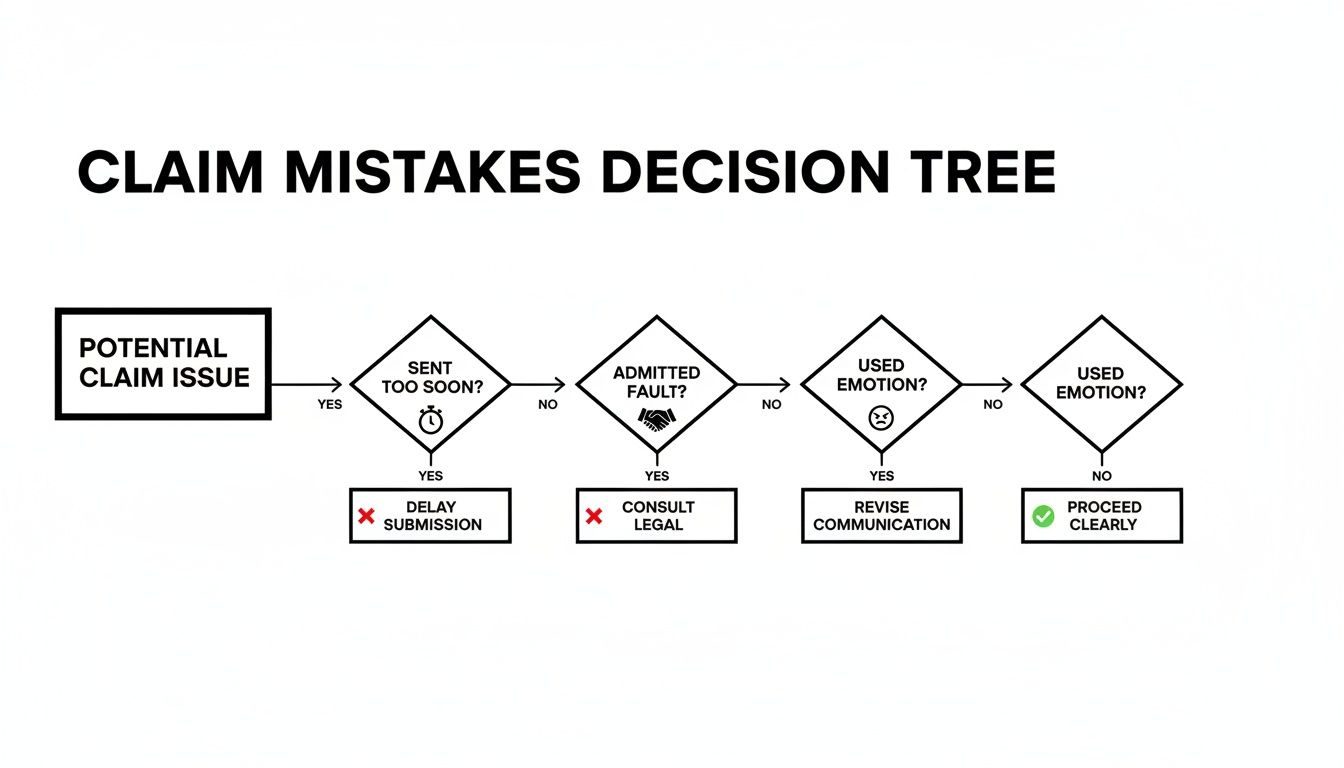
Every one of these missteps—sending a demand too early, accidentally admitting fault, or letting emotion cloud the facts—can be twisted by the insurance company to justify a denial.
The Power of Filing a Lawsuit
Filing a lawsuit doesn't automatically mean you’re headed to a dramatic courtroom trial. In fact, the vast majority of cases still settle after a suit is filed but long before a trial begins.
Filing simply kicks off the legal "discovery" process. This allows your attorney to legally demand information from the other side, including things like internal company documents, a truck driver's logbooks, and sworn testimony from witnesses under oath.
The threat of a trial is often the only thing that makes an insurance company offer a fair settlement. It transforms your demand from a request into a legal necessity they can no longer ignore.
As technology keeps changing, many insurers now use software for automated claims processing. Knowing this helps explain how your claim might be initially evaluated by a machine and why having a human legal expert is so vital to getting a fair result.
Remember, Texas has a strict two-year statute of limitations for personal injury claims. You must file a lawsuit within two years of the date of the accident, or you lose your right to recover a single penny. That deadline makes it critical to act fast when an insurer is dragging its feet.
If your demand letter was ignored or you received an insulting offer, it’s not over. It’s a signal that it's time to bring in professional help. The Law Office of Bryan Fagan, PLLC, is ready to step in and fight for you. Contact us for a free consultation, and let us show you how we can turn their "no" into the justice you deserve.
Common Questions About Personal Injury Demand Letters
It’s completely normal to have questions swirling around after learning about the demand letter process. The legal world can feel like a maze, but getting clear answers is how you start to take back control. Let's tackle some of the most common questions we hear from clients just like you.
How Long Do I Have to Send a Demand Letter in Texas?
In Texas, the official deadline, or statute of limitations, for most personal injury cases is two years from the day of the accident. This is the hard cutoff for filing a lawsuit, but the timing for your demand letter is more about strategy than a strict deadline.
You should only send your demand letter after you've reached what's known as Maximum Medical Improvement (MMI). This is the point your doctor says you’ve recovered as much as you ever will. If you send it too early, you won’t know the final cost of your medical care, and you could end up settling for far less than you deserve. A Texas personal injury lawyer can help you pinpoint the perfect time to send the letter to protect your rights and give you the most leverage.
Can I Write a Personal Injury Demand Letter Myself?
Legally, yes, you can. If your accident was minor with very clear fault and minimal injuries, writing it yourself might be an option. But for anything more serious—think commercial truck accidents, catastrophic injuries, or even a wrongful death claim—it’s a move I’d strongly advise against.
Insurance adjusters are trained negotiators who deal with claims day in and day out. A demand letter from an established law firm tells them you’re serious and you know the game. It often results in a much better initial offer right out of the gate. An attorney knows how to frame the legal arguments to maximize your claim's value—a skill that can make a huge difference in your final settlement.
What Happens If the Insurance Company Ignores My Demand Letter?
Unfortunately, this happens. Getting the silent treatment is a classic insurance company tactic, especially when they're dealing with someone without a lawyer. Their goal is to frustrate you into either giving up or accepting a lowball offer they throw out later.
If your demand letter is met with silence, take it as a flashing neon sign that you need legal help. An attorney from a firm like The Law Office of Bryan Fagan, PLLC, can follow up and apply pressure. More importantly, we can file a lawsuit. That legal step is often the only thing that gets an insurer to stop playing games and start negotiating in good faith. A lawyer makes you impossible to ignore.
Should I Demand a Specific Settlement Amount?
Yes, absolutely. The whole point of the demand letter is to lay out your case and ask for a specific, well-supported amount of money to close your claim. This number isn't just a guess; it's the total of your documented economic damages (like medical bills and lost income) plus your calculated non-economic damages (for things like pain and suffering).
Think of this number as your opening bid. You should always demand an amount that’s higher than the bare minimum you’d be willing to accept. This gives you room to negotiate, because you can bet the insurance company will come back with a lower counteroffer. A skilled Houston car accident attorney can help you calculate a demand that is both fair and strategically positioned for a successful negotiation.
A serious injury can make you feel like you've lost all control, but recovery is possible, and legal help is available. Understanding your rights is the first step, and taking action is the next. If you're overwhelmed by the aftermath of an accident and have questions about your personal injury claim, you don’t have to figure it all out on your own.
The team at The Law Office of Bryan Fagan, PLLC is here to give you the clarity and support you need. We invite you to schedule a free, no-obligation consultation to talk about your case. Let us help you navigate the path forward and get the justice you deserve. Visit us at https://texaspersonalinjury.net to get started.