A serious accident can change your life in seconds — but you don’t have to face it alone. When another driver hits you and you discover they don't have insurance, the stress and uncertainty can feel overwhelming. The first place you'll likely turn for help is your own policy. Specifically, you'll look to your Uninsured/Underinsured Motorist (UM/UIM) coverage. This is a part of your auto insurance designed to step in and cover your medical bills, lost wages, and vehicle damage when the person who caused the crash can't.
The Uninsured Driver Problem in Texas
A serious car crash can flip your world upside down, leaving you with injuries, a wrecked car, and a mountain of stress. Finding out the other driver doesn't have insurance just adds insult to injury. If this has happened to you, it’s important to know you're not alone, and you have options.
Picture this: you’re heading home on a busy Houston freeway like I-45, and out of nowhere, another car swerves into your lane, causing a violent crash. In the chaotic aftermath, you learn the other driver let their insurance policy lapse. This isn't a rare scenario; it's a grim reality on Texas roads. Too many drivers break the law, leaving responsible people like you holding the bag for their negligence.
Why So Many Texas Drivers Are Uninsured
The truth is, millions of drivers are on the road without the legally required insurance. A recent study from the Insurance Research Council found that in 2023, a shocking 15.4% of all drivers in the U.S. were uninsured. That’s more than one in every seven drivers on the road.
With over 30 million uninsured motorists nationwide, every trip you take is a gamble. Rising insurance premiums and economic struggles are often to blame, but whatever the reason, the outcome is the same: innocent victims are stuck with devastating physical and financial burdens.
After a wreck, you could be facing:
- Sky-high medical bills from the ER, surgeries, and physical therapy.
- Lost income because your injuries keep you from working.
- Hefty car repair costs that you can't possibly pay out-of-pocket.
- The physical pain and emotional trauma that come with the accident and your recovery.
A serious accident is more than a legal issue—it’s a life issue. The stress of trying to heal while worrying about how to pay your bills can be overwhelming. But there is help available, and you don’t have to carry this burden by yourself.
Fortunately, Texas law provides a safety net for responsible drivers. As a Houston car accident attorney, The Law Office of Bryan Fagan, PLLC can tell you that the single most important tool in these situations is your own insurance policy—specifically, your Uninsured/Underinsured Motorist (UM/UIM) coverage. Our firm can help you make sense of your policy and fight for the compensation you rightfully deserve.
Your Action Plan at the Accident Scene
The moments after a car crash are a blur of twisted metal and raw adrenaline. It’s completely normal to feel disoriented and anxious, wondering what you’re supposed to do next. But the steps you take right there at the scene are absolutely critical, especially when the other driver admits they don’t have insurance.
Having a clear plan helps you protect your health, your rights, and your ability to get fairly compensated later. Your first priority, always, is safety. If you can, move your vehicle out of traffic. Check on yourself and anyone else in your car, but don't try to move someone who seems seriously hurt.
Immediately Call 911
This is non-negotiable. No matter how minor the accident seems or what the other driver says, always call 911. This gets police and paramedics heading your way.
That official police report is one of the most powerful pieces of evidence you can have. The officer will document everything: where the cars ended up, what you and the other driver said, witness statements, and their initial take on who was at fault. Crucially, they will confirm that the other driver is uninsured. This creates an official, unbiased record that your insurance company and a Texas personal injury lawyer will lean on heavily. Never agree to handle things "off the record." That almost always benefits the person who caused the crash, not you.
This simple chart breaks down the essential first moves after a crash.
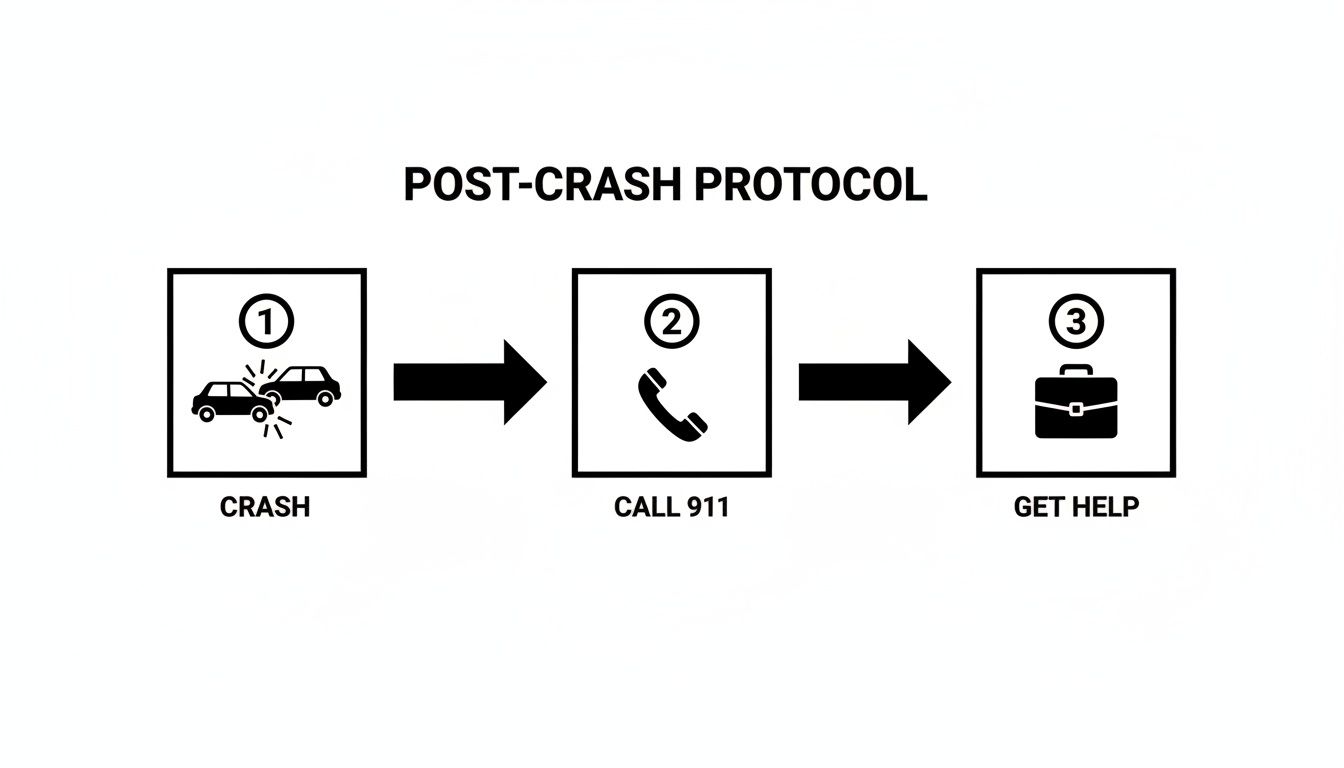
As you can see, the protocol is straightforward. After the impact, you call for help. Then, you get the medical and legal support you need to start putting the pieces back together.
Document Everything at the Scene
While you wait for the police, use your smartphone to create a detailed visual story of exactly what happened.
Start taking pictures and videos of everything you can think of:
- Both vehicles: Get shots from every angle, making sure to capture all the damage.
- The bigger picture: Snap photos of skid marks, traffic signs, debris on the road, and the general weather conditions.
- Your injuries: Even if it’s just a scrape or a bruise, document it.
- The other driver's license plate and the VIN (vehicle identification number) on their dashboard or door jamb.
You'll also want to exchange information with the other driver and talk to anyone who saw what happened. Politely but firmly get their full name, phone number, and address.
Stay calm and stick to the facts. Don't get into a debate about who's to blame. Even a simple "I'm sorry" can be twisted and used against you by an insurance adjuster down the road.
Finally, don't brush off your injuries. Adrenaline can mask pain, and what feels like minor soreness right now could be a serious problem tomorrow. Let the paramedics check you out, and make it a priority to see a doctor for a full evaluation as soon as possible. Following these steps builds the solid foundation you need for a strong claim, whether you were in a car or were hit by a car as a pedestrian.
How Uninsured Motorist (UM) Coverage Protects You
Getting hit by a driver without insurance can feel like hitting a brick wall. This is exactly why Texas law includes a powerful safety net for responsible drivers: Uninsured/Underinsured Motorist (UM/UIM) coverage.
Think of it as your own personal shield. It's insurance you buy for yourself to step in when the at-fault driver can’t pay for the damage they caused. In Texas, insurance companies are required to offer you this coverage. Unless you specifically signed a form to reject it, you likely have it—and it's one of the most critical protections you can have.
What Does UM/UIM Insurance Cover?
Your UM/UIM policy essentially takes the place of the insurance the other driver should have had. It’s designed to make you whole again, covering the same kinds of damages their liability policy would have paid for. This means you won't be stuck with a mountain of debt from a crash that wasn't your fault.
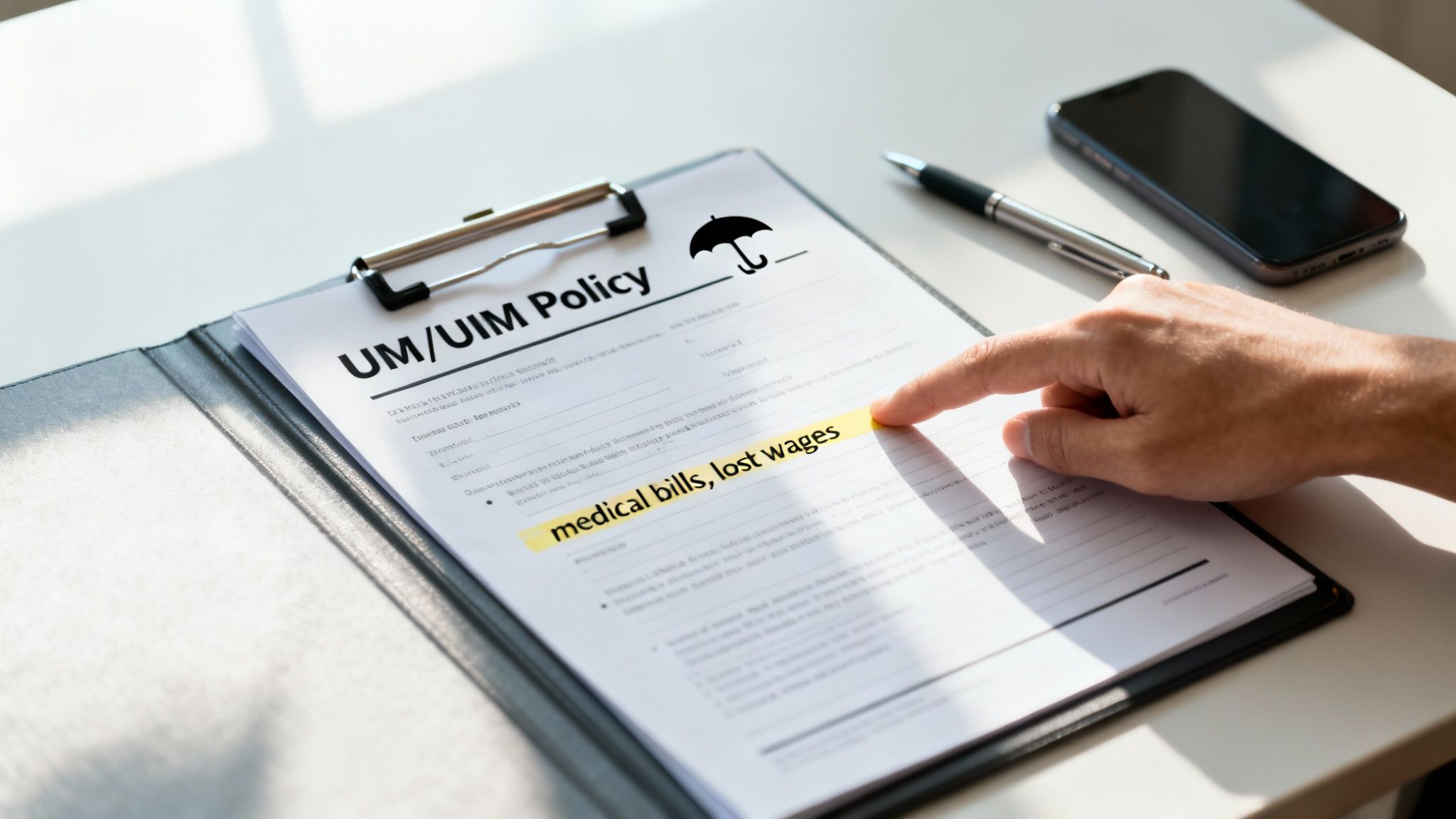
Generally, your UM/UIM coverage can help pay for a wide range of losses, including:
- Medical Bills: This covers everything from the ambulance ride and ER visit to ongoing physical therapy, surgeries, and any future medical care you might need.
- Lost Wages: If your injuries keep you out of work, this coverage helps replace that lost income while you focus on getting better.
- Pain and Suffering: This is compensation for the physical pain, emotional distress, and disruption the accident has caused in your life.
- Property Damage: Depending on your specific policy, UM coverage can also pay to get your vehicle repaired or replaced.
This coverage is incredibly versatile. It’s not just for accidents with uninsured drivers; it also applies to hit-and-run crashes where the at-fault driver is never found.
How to File a UM/UIM Claim
You might think filing a claim with your own insurance company would be simple, but it’s rarely that easy. Once you file a UM claim, your insurance company’s role changes. They step into the shoes of the at-fault driver, and their goal becomes minimizing their payout. Their interests are no longer aligned with yours.
The process usually looks like this:
- Report the Accident: Notify your insurer immediately after the crash and let them know the other driver was uninsured.
- Gather Your Documents: You'll need to provide the police report, photos from the scene, your medical bills, and proof of any income you've lost.
- Cooperate with Their Investigation: The adjuster will investigate the crash to confirm the other driver was at fault and truly is uninsured.
- Negotiate a Settlement: Once your damages are all tallied up, your attorney will negotiate with the insurance company to secure a fair settlement.
Real-world example: After a Houston freeway crash, our client was left with a serious back injury requiring surgery, and her medical bills quickly shot past $80,000. The at-fault driver was uninsured. We filed a claim under her Uninsured Motorist policy. Her insurance company’s first offer? A measly $25,000. We fought back, proved the full extent of her current and future medical needs, and secured a settlement that covered everything.
It's a tough pill to swallow, but your own insurer might try to deny your claim or offer you a lowball settlement. A Texas personal injury lawyer can take over all communications with the adjuster, build a solid case for you, and fight to get you the full amount you're owed under your policy. You can learn more by checking out our guide on uninsured motorist coverage in Texas. After all, you paid for this coverage—you have every right to use it when you need it most.
Should You Sue the At-Fault Driver?
After you’ve dealt with the insurance side of things, it’s natural to want the person who hurt you to be held responsible for their actions. In Texas, you have the right to file a personal injury lawsuit against an uninsured driver. But before you go down that road, it's critical to understand the real-world challenges involved.
Winning a lawsuit and actually getting paid are two entirely different things. The hard truth is that many drivers who don’t carry insurance simply don't have the money to pay a court-ordered judgment.
The Problem of the "Judgment Proof" Driver
"Judgment proof" is a term for someone who doesn't have the assets or income to satisfy a judgment. Let's say you go to court and win a $100,000 award for your medical bills, lost wages, and suffering. That’s a victory on paper, but it’s a hollow one if the driver at fault has nothing to give you.
A court judgment is just a piece of paper—it’s not a check. If the person you sue has no money, that piece of paper might be all you ever get.
This is why a smart Texas personal injury lawyer will always investigate the other driver's financial situation before recommending a lawsuit. We need to find out if there's any realistic path to getting you compensated.
We'll dig into questions like:
- Do they own any property? A house, land, or other real estate could potentially be used to satisfy a judgment.
- Do they have a steady job? If there's a reliable income stream, we might be able to garnish their wages, though Texas law has strict limits on this.
- Do they have any other valuable assets? This could be anything from bank accounts and investments to expensive personal property.
If our investigation shows the driver is truly judgment proof, filing a lawsuit could end up costing you more in time, stress, and legal fees than you could ever hope to get back. Our job is to give you a clear, honest assessment of your options and steer you toward a path that offers a real chance of financial recovery.
Filing a Lawsuit and Proving Your Case
If we find that the driver does have assets worth pursuing, then filing a personal injury lawsuit is the next logical step. This is where we formally make the case that the other driver’s negligence was the direct cause of your injuries and all the losses that followed.
To win in court, we have to prove four elements of negligence under Texas law:
- Duty: The other driver had a legal obligation to drive safely.
- Breach: They failed in that duty (e.g., they ran a red light, were texting, or were speeding).
- Causation: Their failure to drive safely is what directly caused the crash and your injuries.
- Damages: As a result, you suffered real losses—medical bills, lost income, and pain and suffering.
Imagine you were hit on Loop 1604 in San Antonio by an uninsured driver who blew through a stop sign. We would use the police report, eyewitness accounts, and traffic camera footage to prove they breached their duty. Then, we’d use your medical records and pay stubs to paint a clear picture of the damages you’ve suffered. This process allows us to build a powerful, evidence-based case to hold the driver accountable.
Understanding Key Texas Accident Laws
To navigate an insurance claim after getting hit by an uninsured driver, you need to understand the basic rules of the road in Texas. These laws are the foundation of any personal injury case, determining who is responsible for your damages. Knowing how this works empowers you and shows the value an experienced Houston car accident attorney brings to the table.
At its core, Texas is an at-fault state. This means whoever caused the crash is responsible for the damage that follows. If someone runs a red light and T-bones you, their negligence makes them legally liable for your medical bills, lost wages, and other losses. Of course, insurance companies often try to shift blame, which brings us to the next critical rule.
How Long Do You Have to File a Claim in Texas?
Beyond the rules of fault, there is one deadline you absolutely cannot miss: the statute of limitations. This is a strict, state-mandated time limit for filing a personal injury lawsuit.
In Texas, you generally have two years from the date of the accident to file your lawsuit.
If you miss this two-year window, the court will almost certainly throw out your case, and you will lose your right to seek compensation forever. Two years might seem like a long time, but building a solid case takes time. This unforgiving deadline is exactly why you should contact a lawyer as soon as you can after any kind of accident, whether it's a car wreck, a catastrophic injury, or a wrongful death claim.
How Shared Fault Can Affect Your Claim
Texas uses a rule called modified comparative responsibility, often called the 51% Bar Rule. This law applies when more than one person might be partly at fault for an accident. A percentage of fault is assigned to each driver involved.
Here’s how it works:
- You can recover money for your damages as long as you are found to be 50% or less at fault for the wreck.
- Your final compensation is reduced by your percentage of fault. For example, if you’re awarded $100,000 but a jury decides you were 10% to blame, your payout drops to $90,000.
- If you are found to be 51% or more at fault, you get nothing.
Real-world example: Imagine you get hit by an uninsured driver at a Houston intersection. You had a green light, but their insurance company finds evidence you were going a few miles over the speed limit. A jury might find the other driver 90% at fault for running the light but assign you 10% of the blame for speeding. Under the 51% rule, you could still recover 90% of your damages.
Because this rule can drastically reduce—or eliminate—your financial recovery, it’s vital to have a skilled Texas personal injury lawyer fighting back against any unfair blame the other side tries to pin on you.
How a Texas Personal Injury Lawyer Can Help
Trying to navigate the aftermath of a crash with an uninsured driver can feel like you're lost in a maze. It's frustrating and overwhelming, but you don't have to face it alone. Bringing an experienced Texas personal injury lawyer onto your team is the single most powerful step you can take to protect your rights and your financial future.
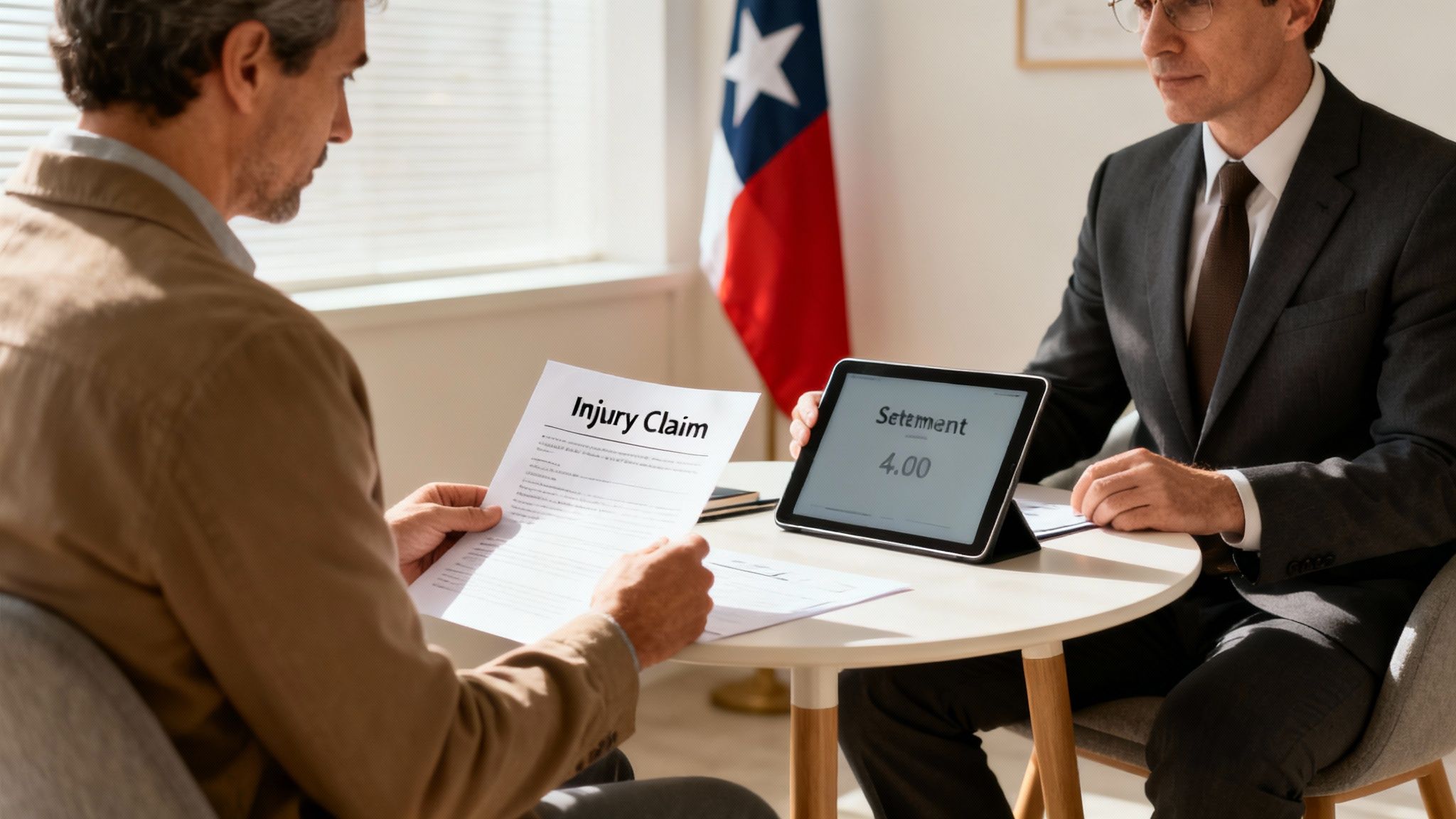
At The Law Office of Bryan Fagan, PLLC, our job is to immediately take that weight off your shoulders. We become your dedicated advocates, handling every detail so you can focus on what really matters: healing.
Taking Control of Your Claim
From the moment you hire us, we get to work building the strongest possible case for you.
This includes:
- Conducting a Thorough Investigation: We dig deeper than the police report. We’ll gather witness statements, find traffic camera footage, and sometimes bring in accident reconstruction experts to prove exactly how the uninsured driver caused your injuries.
- Handling All Insurance Communications: We take over all communication with your insurance company for your UM claim, stopping them from using their usual tactics to devalue or deny your case.
- Protecting You From Lowball Offers: Insurance companies are businesses, and their number one goal is protecting profits. Their first settlement offer is almost always a fraction of what you truly deserve. We know their playbook and fight back against any attempt to minimize your claim.
Calculating the True Value of Your Damages
One of the most critical roles we play is calculating the full and fair value of your losses. This isn't just about today's medical bills; it's about securing your financial stability for years to come.
We meticulously document and demand compensation for everything you’ve lost:
- Current and future medical expenses
- Lost wages and your diminished ability to earn in the future
- Physical pain and emotional suffering
- Rehabilitation and any long-term care needs
For example, after a serious truck crash lawyer Houston victims often face multiple surgeries and years of physical therapy. We work with medical and financial experts to project those future costs, making sure your settlement is enough to cover a lifetime of necessary care. Getting this right is everything, and a knowledgeable guide on how to pick a personal injury attorney can help you find the right firm for your specific situation.
At The Law Office of Bryan Fagan, PLLC, we work on a contingency-fee basis. This means you pay absolutely no upfront costs or attorney’s fees unless we win your case. This removes any financial barrier to getting the powerful legal representation you need.
A severe accident caused by an uninsured driver can leave you feeling powerless, but you have more control than you might think. With the right legal team in your corner, you can get the resources you need to rebuild your life. Recovery is possible, and we're here to help you get there.
Frequently Asked Questions About Uninsured Accidents
The aftermath of a car wreck is always chaotic, but when the other driver is uninsured, it can leave you with many questions. Below are clear answers to the questions we hear most often from people in this frustrating situation.
What If the Driver Gave Me Fake Insurance Information?
It happens more often than you would think. An at-fault driver panics and gives you a fake insurance card or an old, expired policy number to avoid responsibility. If you find out the information they gave you is bogus, you should immediately treat the situation as if they were uninsured from the start.
Your first move should be to use your own Uninsured/Underinsured Motorist (UM/UIM) coverage. It’s critical that you report the fake information to the police so they can update the crash report. You also need to let your own insurance company know what’s going on right away. A good Texas personal injury lawyer can investigate the driver’s actual insurance status while helping you navigate the claim with your own provider.
My Insurance Company Is Making My UM Claim Difficult. What Should I Do?
This is where things can get frustrating. You've paid your premiums faithfully, expecting your insurance company to have your back. But when you file a UM claim, their goal is often to protect their bottom line, which puts them at odds with you. Suddenly, the company you pay to protect you starts acting like an opponent.
If they’re dragging their feet, giving you the runaround, making a low settlement offer, or denying your claim, call a car accident attorney immediately. Your lawyer becomes your champion, dealing with the adjuster and fighting for what you’re owed. We know their tactics, and if they refuse to be fair, we are prepared to take them to court to get you the full compensation your policy promises.
What Are My Options if I Do Not Have UM Coverage?
If you waived UM/UIM coverage, your path to getting compensation gets more difficult, but you’re not out of options. The most direct route is filing a personal injury lawsuit directly against the driver who hit you.
The big hurdle, however, is collecting any money you win. A driver who can't afford insurance often doesn't have the assets to pay a judgment. An experienced attorney can run an asset check to see if they own property or have other resources. We will also investigate your case to see if anyone else—like an employer or another third party—could share some of the blame for the wreck.
To get a better handle on the medical side of things after a crash, you can also check out these frequently asked questions about auto accident care.
A serious wreck can turn your world upside down, but you don’t have to pick up the pieces by yourself. The legal team at the Law Office of Bryan Fagan, PLLC is here to make sure you understand your rights and to fight for the recovery you deserve. Reach out today for a free, no-obligation consultation to go over your case. Let us handle the legal fight so you can focus on what really matters—getting better. Recovery is possible, and legal help is available.