A serious accident can change your life in a heartbeat, but you don’t have to face the financial storm alone. When you've been injured because of someone else's negligence in Texas, the law provides a way to recover your specific, calculable financial losses. These are called special damages.
Think of them as the itemized bill for your accident—every single dollar you've had to spend or have lost out on, all backed up by receipts, invoices, and pay stubs. Understanding what you can claim is the first step toward getting the fair compensation you need to rebuild your life.
Understanding Your Financial Losses After an Accident
When you're hurt in a crash, the physical pain is just the beginning. A tidal wave of unexpected bills can quickly become overwhelming, piling on immense stress when all you should be focused on is getting better. Special damages, also known as economic damages, are designed to make you financially whole again by reimbursing you for these exact, measurable costs.
This is what separates them from general damages, which are meant to compensate for non-financial harms like pain and suffering. Special damages are tangible. They represent the straightforward, out-of-pocket costs you can literally add up with a calculator.
The Real-World Cost of an Accident
Picture this: you're in a collision on a busy Houston freeway. The immediate aftermath isn't just about a crumpled car; it's a cascade of expenses that starts adding up faster than you can imagine.
- Immediate Medical Care: The ambulance ride alone can be costly, not to mention the emergency room visit and all the initial X-rays and tests. These bills can run into thousands of dollars before you're even discharged.
- Ongoing Treatment: Your recovery might require follow-up visits with specialists, weeks or months of physical therapy, prescription medications, and maybe even medical equipment for your home.
- Lost Income: If your injuries keep you from working, your regular paychecks stop coming in. This adds a huge layer of financial strain right when you can least afford it.
- Property Damage: The cost to get your car fixed—or worse, replaced—is another significant and immediate financial blow.
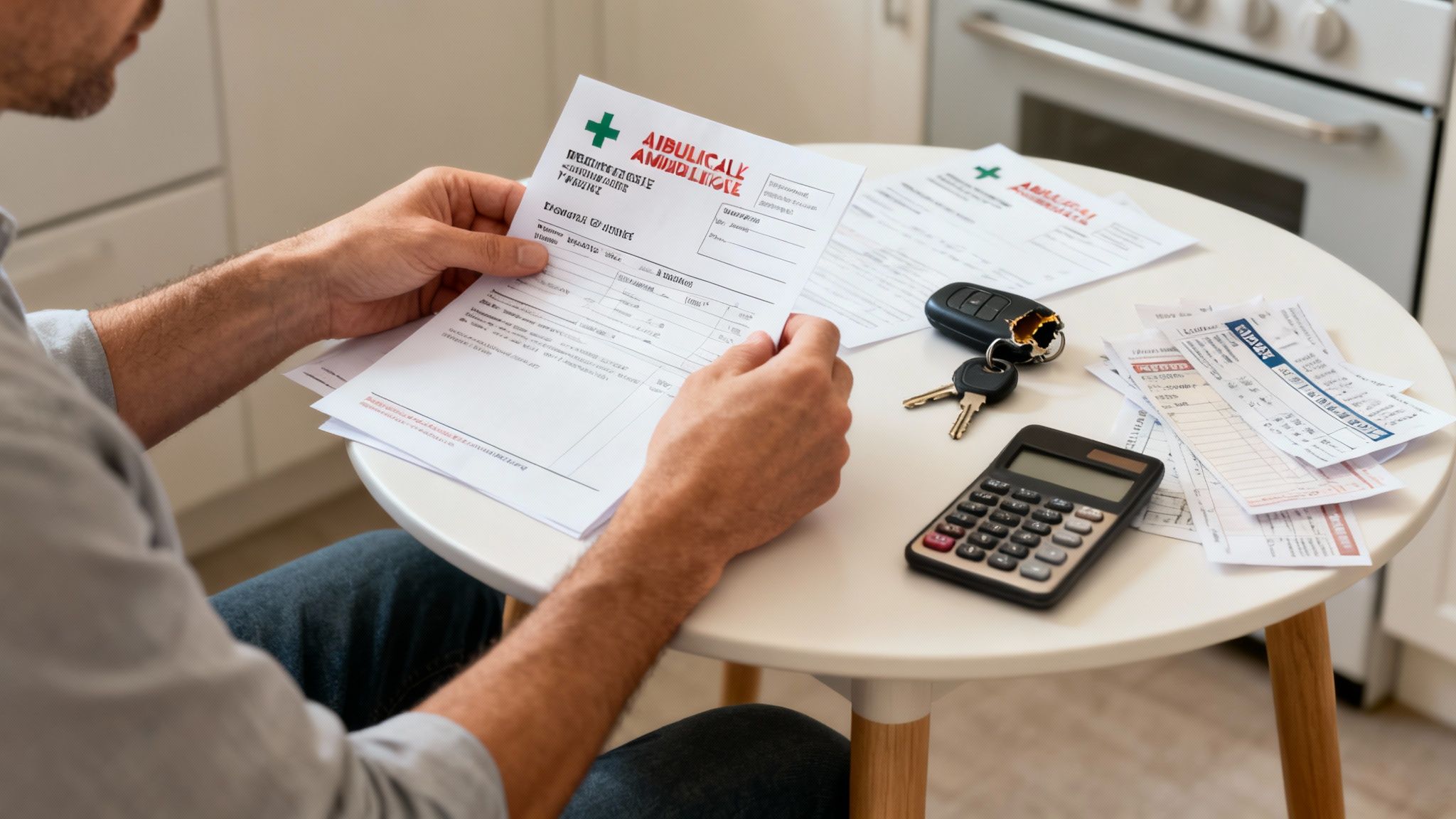
Let's say a motorcycle rider gets hit. They might face $25,000 in medical bills for surgery, lose $15,000 in wages while they recover, and need $8,000 to replace their bike. That’s a quick $48,000 in special damages—all concrete losses backed by solid proof. Nationally, the average for auto accident claims often falls somewhere between $20,000 and $50,000, which just goes to show how substantial these costs can become.
This is why it is absolutely critical to keep meticulous records of every single expense related to your accident. These documents are the bedrock of your personal injury claim and the hard evidence you'll need to demand fair compensation. If you're wondering how your own health insurance plays into this, you can learn more from our guide on whether health insurance covers auto accidents.
The Most Common Types of Special Damages You Can Claim
When you're trying to piece your life back together after an accident, knowing exactly what you can claim is a powerful first step. Special damages are all about covering the tangible, out-of-pocket costs you’re facing—and they go way beyond just the obvious hospital bills.
Let's break down the most common categories so you can start to identify every single financial loss that’s been tied to your injuries.
Past and Future Medical Care
This is often the biggest piece of the puzzle in a special damages claim. It’s not just about the major surgeries; it includes every single medical expense you've already paid for and will have to pay for because of the accident. Every single cost counts.
Common medical expenses include:
- Emergency Services: Think about the ambulance that took you from the scene and every cost that came with that emergency room visit.
- Hospital Stays and Surgery: This covers the bills for any operations, overnight stays, and all the in-hospital care you received.
- Ongoing Treatment: We’re talking about follow-up appointments with specialists, physical or occupational therapy, and even chiropractic care.
- Medications and Equipment: This includes the cost of prescriptions, pain management, and any necessary medical devices like crutches or a wheelchair.
Imagine you were hurt in a serious truck crash on I-45 in Houston. Your special damages would obviously include the initial surgery to fix a broken bone. But they would also cover the months of physical therapy needed to get your mobility back and the cost of every prescription you had to fill along the way.
Tracking even the small expenses is absolutely crucial. Keep a simple log of your mileage driving to and from doctor’s appointments, trips to the pharmacy, and therapy sessions. These out-of-pocket costs are a legitimate part of your special damages, and they can add up to a significant amount over time.
Lost Income and Earning Capacity
When an injury keeps you from working, the financial strain hits fast and is incredibly stressful. Special damages are designed to cover this exact loss, making sure you don't fall behind on your bills while you’re focused on getting better.
There are two key parts to this category:
- Lost Wages: This is the income you have already lost. We calculate this based on the paychecks you missed, including any overtime or bonuses you would have earned if you hadn't been injured.
- Loss of Earning Capacity: This is all about the financial harm you'll face in the future. If your injuries are catastrophic and stop you from returning to your old job—or from working at all—you can claim damages for the income you will lose over your lifetime. This is a much more complex calculation that often requires an expert analysis to get right.
Property Damage and Other Expenses
The damage from an accident almost always extends beyond your physical injuries. Any personal property that was damaged in the incident is also a key part of your special damages claim.
This most commonly includes:
- Vehicle Repair or Replacement: The cost to fix your car, truck, or motorcycle. If your vehicle is a total loss, this would be its fair market value right before the crash.
- Other Personal Property: You can also get compensation for any other items that were damaged, like a laptop, cell phone, or even your eyeglasses.
In wrongful death cases, these financial losses take on an even greater weight. A dedicated Texas wrongful death lawyer can help a grieving family claim special damages, which often include the deceased's final medical bills, which can easily range from $50,000 to $200,000 for ICU care, plus their lost future earnings. For one Dallas family we represented after a tragic drunk driving fatality, we successfully claimed $450,000 in special damages, which we proved using their loved one's salary history and medical records.
Research actually shows that across the U.S., special damages account for about 50% of personal injury awards, with lost wages making up a huge portion of that. You can find more details about how these damages are valued in our article explaining the difference between economic and non-economic damages.
How to Prove and Calculate Your Special Damages
To get the full compensation you deserve, your claim needs more than just a list of financial losses—it needs solid proof. Think of it like building a case. Every receipt, bill, and pay stub is a crucial piece of evidence that helps tell the story of how the accident has impacted you financially.
This process involves meticulously gathering documents for every expense and lost dollar. For an insurance company or a jury to take your claim seriously, each special damage must be backed by clear, undeniable proof. We know this sounds like a lot to handle, especially while you're recovering, which is why a dedicated Texas personal injury lawyer will manage this entire process for you.
This infographic breaks down the core categories of special damages you'll need to document.
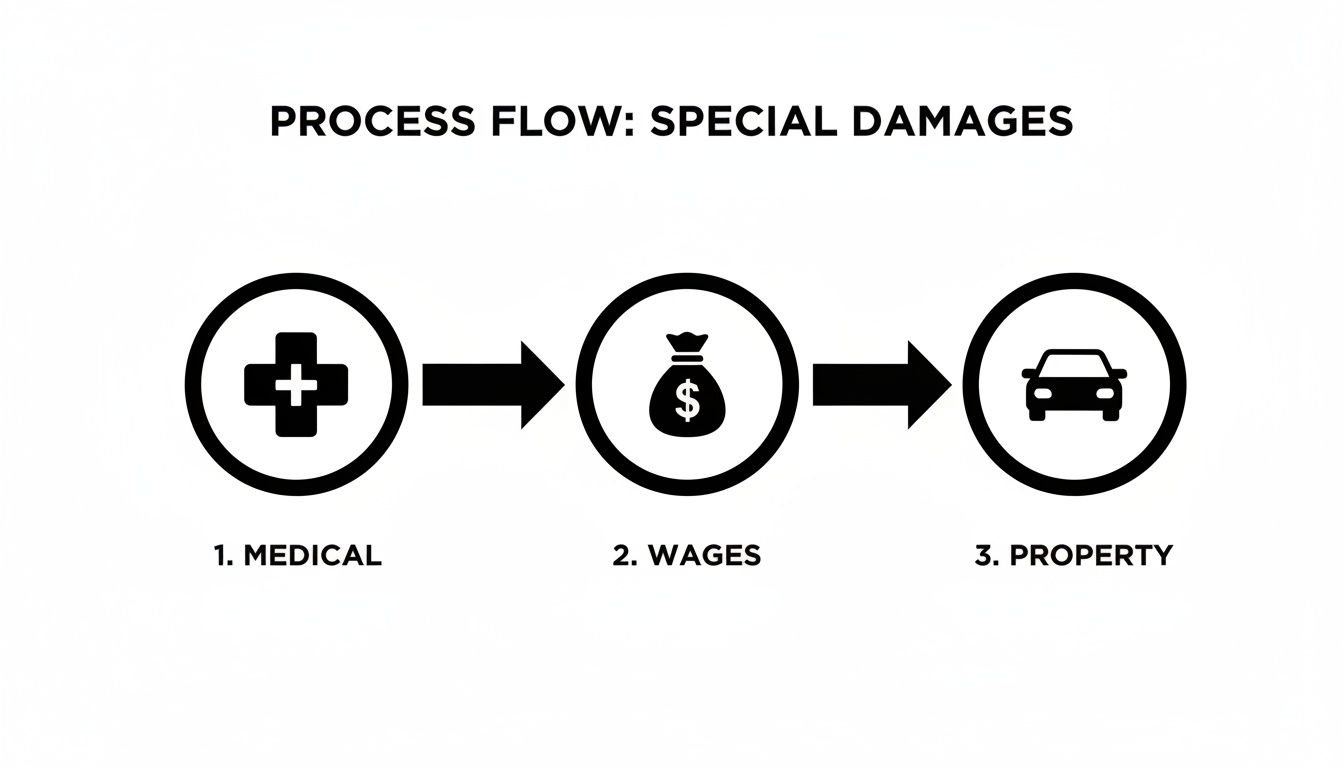
As the visual shows, your claim is built on three pillars of evidence: medical expenses, lost wages, and property damage. Each one requires its own specific documentation to stand up to scrutiny.
The Power of Detailed Documentation
The strength of your entire claim rests on the quality of your records. Vague estimates and guesswork simply won't cut it. You need to create a paper trail that leaves absolutely no room for doubt.
Here’s the essential documentation you’ll need to start gathering:
- Medical Bills: Keep every single invoice from the hospital, ambulance, doctors, physical therapists, and pharmacies.
- Pay Stubs and Wage Verification: Collect your most recent pay stubs and ask your employer for a letter that confirms your rate of pay and the exact hours you missed.
- Repair Estimates: Get multiple written estimates for your vehicle repairs or a statement from the insurance company declaring it a total loss.
Detailed records are your most powerful tool. Well-documented special damages can significantly increase settlement offers—sometimes by as much as three times. Organizing bills chronologically and including expert projections for future care creates an undeniable case for the full value of your losses.
Calculating Future Losses
What about the costs that haven't even happened yet? This is a critical question. If your injuries require long-term care or prevent you from returning to your old job, we have to calculate those future losses. This is where an experienced Houston car accident attorney brings in the experts.
Economists and vocational specialists will analyze your medical prognosis, work history, and earning potential to project the financial impact over your lifetime. They create detailed reports that assign a specific dollar value to future medical treatments and diminished earning capacity, making sure these long-term costs are included in your settlement demand.
Failing to account for these future needs is a massive risk that could leave you with huge bills years down the road. The value of this approach is well-documented; for example, one San Antonio cyclist's claim for $65,000 in special damages was fully recovered because it included $40,000 for hospital care and $10,000 in lost wages, all proven with documentation. You can learn more about how experts value these claims from external resources.
Modern tools can help make this easier. For example, using a Receipt OCR API for automated expense reports can help simplify organizing the financial documents needed to prove your claim.
How Texas Laws Impact Your Special Damages Claim
Getting a fair outcome in a personal injury claim isn’t just about proving your injuries; it’s about navigating the specific Texas laws that control your financial recovery. These rules can either safeguard your right to get paid or, if you’re not careful, shut the door on your claim completely.
Two of the biggest hurdles you need to be aware of are Texas's rule on shared fault and the non-negotiable deadline for filing a lawsuit. Insurance companies know these laws inside and out, and they won't hesitate to use them to reduce your payout or deny your claim altogether. This is why having a skilled Texas personal injury lawyer isn't just an advantage—it's your shield.
Understanding Modified Comparative Fault
Here in Texas, we operate under a rule called modified comparative fault, sometimes known as the 51% Bar Rule. It’s the law that decides what happens when more than one person is to blame for an accident.
Here’s the breakdown of what that means for your case:
- You can still collect damages even if you were partially at fault for what happened.
- Your final compensation award will be reduced by whatever percentage of fault is assigned to you.
- But here's the critical part: if a jury finds you 51% or more responsible, you are legally barred from recovering a single penny.
Let’s put it into perspective. Say you’re in a wreck and you have $100,000 in special damages. If the other driver is found 80% at fault and you’re found 20% at fault, your recovery gets reduced by 20%, leaving you with $80,000. But if the insurance adjuster successfully argues that you were 51% to blame, your award drops to zero. Nothing.
An experienced Houston truck crash lawyer is your best defense against these blame-shifting tactics. We know how to anticipate these arguments and build a rock-solid case that proves the other party’s negligence, protecting your right to full and fair compensation.
How Long Do You Have to File a Claim in Texas?
From the moment an accident occurs, a legal clock starts ticking. For most personal injury claims in Texas, the statute of limitations is just two years from the date you were injured.
This isn’t a suggestion; it's a hard deadline. If you fail to file a lawsuit within that two-year window, you lose your right to seek compensation forever, no matter how strong or obvious your case is.
Moving quickly is absolutely vital. Not only does it ensure you meet this strict legal deadline, but it also gives your attorney the best chance to preserve crucial evidence—like witness statements, security footage, and vehicle data—before it gets lost or destroyed.
If you’ve been hurt, don’t wait until it’s too late. The Law Office of Bryan Fagan, PLLC is here to help you understand your rights and take immediate action. Schedule a free, no-obligation consultation today to make sure your claim is protected.
Practical Steps to Protect Your Claim After an Accident

In the chaos right after a car wreck, the things you do—and don't do—matter immensely. Your actions can either build a strong foundation for recovering what you’ve lost or, unfortunately, weaken your case from the start.
This isn’t about legal strategy; it’s about practical, common-sense steps you can take to protect yourself. Think of it as a straightforward guide to get you through those first tough hours and days, all while making sure the evidence needed to prove your damages is preserved.
Your Immediate Accident Checklist
First things first: your health is the absolute priority. After any accident, get to a safe spot and call 911. Once that's done, here’s what you can do to safeguard your rights.
-
Seek Immediate Medical Care: Even if you think you’re okay, go to an ER or urgent care. The adrenaline pumping through your body can easily hide serious injuries, and getting checked out creates a crucial medical record that connects your injuries directly to the crash.
-
Report the Accident Officially: Always get a police report. This document is a cornerstone of your claim, locking in the official time, location, and basic facts of what happened.
-
Document Everything at the Scene: If you’re able, your smartphone is your best friend. Take photos and videos of everything—the damage to all vehicles from different angles, skid marks on the road, the weather conditions, and any visible injuries you have.
-
Gather Witness Information: Did anyone see what happened? Get their name and phone number. An independent witness who can back up your side of the story is incredibly powerful, especially when the other driver starts changing their story.
A huge mistake people make is trying to be "nice" by downplaying their injuries or even apologizing at the scene. Stick to the facts. When you talk to the other driver or the police, simple statements like, "I need to get medical attention," are all you need to say.
How to Handle Insurance Companies and Track Your Recovery
It won’t take long for the other driver's insurance adjuster to call. Be prepared. Their job is to pay out as little as possible—they are not on your side.
Keep these points in mind:
- Do Not Give a Recorded Statement: You have no legal obligation to give a recorded statement to the other party's insurance company. You can politely decline and tell them your attorney will be in touch.
- Do Not Sign Anything: Never sign medical authorizations or quick settlement offers without a lawyer looking at them first. You could be signing away your right to the compensation you truly need.
- Start a Recovery Journal: Grab a simple notebook and start jotting things down. Track your doctor's appointments, what you spend on prescriptions, the days you miss from work, and how you're feeling each day. This journal becomes powerful evidence for both your special and general damages.
A wrongful death lawyer in Texas can step in and take over all communication with the insurance companies. This lets your family focus on grieving and healing without the constant stress of dealing with adjusters. We handle them so you can focus on what matters most.
The road ahead might feel overwhelming, but you don't have to walk it alone. By taking these practical steps, you are putting yourself in the strongest position to recover.
How a Lawyer Can Maximize Your Special Damages Recovery
Trying to piece your life back together after a serious accident is overwhelming enough without having to fight an insurance company for fair compensation. That’s where we come in. Bringing an experienced Texas personal injury lawyer into the picture is the single most important move you can make to protect your financial future and maximize your recovery.
Our job is to lift that entire burden from your shoulders so you can pour all your energy into healing.
From the moment you hire us, we get to work, launching a full-scale investigation into the accident. We handle every last detail—pulling police reports, tracking down witnesses, and meticulously gathering every single medical bill, pay stub, and out-of-pocket receipt. We leave no stone unturned.
Building Your Strongest Case for Compensation
Calculating the true value of your claim is a lot more complex than just adding up the receipts you have today. A huge part of our role—and where many people accidentally leave a fortune on the table—is accurately projecting what you’ll need for the future.
Our process is built to secure every dollar you deserve:
- Calling in the Experts: We don’t guess about your future needs. We bring in medical professionals to map out your long-term treatment costs, economists to calculate your total lost earning potential, and vocational specialists to determine the financial impact if you can't return to your old job.
- Negotiating from a Position of Strength: We assemble a powerful demand package that outlines and proves every single special damage you’ve suffered. Armed with this evidence, we negotiate aggressively with the insurance company on your behalf. You can get a deeper look at this critical step in our article on how to write a personal injury demand letter.
- Preparing for a Fight: If the insurance adjuster refuses to make a fair offer that covers all your losses, we don't back down. Our trial-tested attorneys are always ready to take your case to court and fight for you in front of a judge and jury. To ensure every detail is perfectly documented for trial, law firms often use professional legal transcription services to create precise records of all proceedings.
We handle all personal injury cases on a contingency-fee basis. This means you pay absolutely no legal fees unless we win your case. There’s zero financial risk, giving you access to top-tier legal help right when you need it most.
When you trust the Law Office of Bryan Fagan, PLLC with your claim, you get a dedicated team that is committed to fighting for your right to full compensation. Your recovery is our one and only priority.
Common Questions We Hear About Special Damages
When you're dealing with the aftermath of an accident, you've got enough on your mind. Here are some straightforward answers to the questions we hear most often from our clients about special damages in Texas.
Can I Still Get Special Damages if I Was Partially at Fault for the Accident?
Yes, you absolutely can. Texas operates under a legal principle called "modified comparative fault." All that means is you can still recover money for your damages as long as a court doesn't find you 51% or more responsible for what happened.
There's a catch, though. Your final compensation will be reduced by whatever percentage of fault is assigned to you. For instance, if you have $100,000 in documented special damages but are found to be 20% at fault, your award gets knocked down to $80,000. This is exactly why having a sharp attorney is so important—we fight back against the insurance company's attempts to shift unfair blame onto you.
What if I Don't Have Receipts for All of My Expenses?
Don't panic if you can't find every single receipt. While original receipts are always the gold standard, a good legal team knows how to reconstruct those costs and prove your losses using other documents.
We can often use bank or credit card statements, pharmacy records, and even mileage logs from your trips to the doctor to build a clear picture of your out-of-pocket expenses. The key is to start tracking everything you can right after the accident. A dedicated lawyer can help you find and prove every single cost you might have otherwise missed.
How Are Future Lost Wages Calculated if I Can’t Go Back to My Old Job?
Figuring out future losses—what lawyers call "loss of earning capacity"—is one of the most complex parts of a serious injury claim. It’s not just guesswork; it requires a deep, expert-driven analysis.
We bring in vocational and economic experts who take a hard look at your age, your education, your entire work history, and how your injuries will realistically limit you for the rest of your life. They project what you would have earned over your career and compare it to what you can earn now. That difference becomes the foundation of your claim, making sure you're compensated for the full lifetime financial fallout from the injury.
A serious injury throws your life into chaos. The last thing you need is the added stress of worrying about how to pay the bills while you're trying to heal. The experienced Texas personal injury lawyers at The Law Office of Bryan Fagan, PLLC are here to take that weight off your shoulders. We will manage every single detail of your claim, fight for every dollar you deserve, and make sure your rights are protected from start to finish.
Recovery is possible, and legal help is available. Contact us today for a free, no-obligation consultation to talk about your case and find out how we can help you start moving forward. Schedule your free consultation online or give us a call right now.