Skip to content
A serious accident can change your life in seconds — but you don’t have to face it alone. Winning your personal injury claim is a huge victory, but it doesn't automatically close the books on your medical expenses. You can and should negotiate your medical bills after a settlement. This is a separate, crucial step—one where you can often secure major reductions and keep more of the recovery money you fought so hard for.
Your Settlement Is Won—What About The Medical Bills?

Securing a settlement after a life-altering event like a Houston freeway crash or a tragic wrongful death brings an incredible sense of relief. It’s a major step forward on your road to recovery. But as you start to breathe again, you might find yourself staring at a mountain of medical bills, wondering what comes next.
Many people in Texas believe settlement funds are just handed over to hospitals and clinics, but it's more complicated than that. This guide is here to walk you through it. Dealing with these bills is a normal, and entirely manageable, part of the post-settlement journey. You have more power than you realize, and negotiation is the key to protecting your financial future.
The Last Step to Protecting Your Recovery
After your case settles, it's vital to understand what you're up against, including the potential for lawsuits over medical debt if those bills are ignored. We share this not to cause alarm, but to empower you with the facts. Taking control of these final financial details is how you truly safeguard the compensation meant to secure your future.
The goal here is simple: make sure you keep as much of your settlement as possible. That money is for your pain and suffering, your lost wages, and your future stability—not just to pay off the initial sticker price from medical providers.
Here's the good news: hospitals, doctors, and insurance companies are often willing to come to the table. They know that a guaranteed, prompt payment from your settlement is far better than chasing you through a long and uncertain collections process.
For you, this creates a real opportunity to slash the total amount you owe and maximize what you actually take home. Even the way you decide to receive your funds can play a role; you can learn more about your options by exploring the differences between a structured settlement vs lump sum. By approaching this last stage with a clear strategy, you can turn a moment of anxiety into an act of financial empowerment.
Who Has A Claim To Your Settlement Funds?
Before you can think about negotiating medical bills after a settlement, you have to get a handle on who's lining up for a piece of the pie and why. This isn't just about paying off the bills you've gotten in the mail. In Texas personal injury law, certain groups have legally recognized claims that give them the right to be paid directly from your settlement money.
Think of it this way: your settlement is the finish line, but there are a few officials waiting there who get to take their cut first. The two most common and powerful claimants are medical providers with liens and insurance companies with subrogation rights.
Understanding Hospital Liens in Texas
A hospital lien is a powerful legal tool hospitals use to make sure they get paid for emergency services they provided to an accident victim. Under Texas law, if you're treated at a hospital within 72 hours of an accident caused by someone else's negligence, that hospital can file a lien against your personal injury claim.
This isn't just another bill. It’s a formal, legally binding claim attached directly to your settlement funds. The hospital is essentially putting everyone on notice—including the at-fault driver's insurance company—that it must be paid before you see a dime of your net recovery.
For instance, after a Houston freeway crash, the hospital that performed your emergency surgery will almost certainly file a lien. It’s their way of guaranteeing they get paid from whatever settlement you eventually receive.
Key Takeaway: A hospital lien isn't a suggestion. It's a legally enforceable debt against your settlement that must be satisfied. Trying to ignore it can lead to serious legal trouble.
Demystifying Subrogation Claims
The second major player you'll encounter is subrogation. You'll hear this term a lot, and it's a straightforward concept: if an insurance company pays for your medical treatment, it has the right to get that money back from the person who caused your injuries (the at-fault party).
So, who can make a subrogation claim?
- Your Health Insurance Provider: If you used your Blue Cross Blue Shield, Aetna, or another private health plan to cover doctor visits and physical therapy, that insurer has a right to be reimbursed from your settlement.
- Government Programs: Federal programs like Medicare and Texas Medicaid have incredibly strong, legally mandated rights to repayment. They're often said to have a "super lien" because their right to recovery is so powerful and must be handled with extreme care.
- ERISA Plans: Many health plans sponsored by employers are governed by a federal law known as ERISA, which also grants them very strong subrogation rights.
Let's say you were hurt in a catastrophic injury from a multi-car pileup. Your health insurance paid $50,000 for your hospital stay and follow-up care. The moment you settle your case, your insurer will step forward with its subrogation right to be repaid that $50,000.
It's these claims, along with hospital liens, that explain why the gross settlement amount is always different from what you actually take home. Figuring out how settlement funds are handled is a critical part of the process. If you want a deeper look, you can explore whether funds from a personal injury award are considered community property in Texas.
Before you can move forward, you must identify every single lien and subrogation claim. You can't negotiate effectively if you don't know exactly who's at the table and the legal power behind their claim.
Key Players With A Claim On Your Settlement
After a settlement, several entities will likely come forward to claim a portion of the funds as reimbursement for costs they covered. Here’s a quick breakdown of who they are and the legal basis for their claims in Texas.
| Claimant Type | What They Want | Legal Basis in Texas |
|---|---|---|
| Hospitals | Repayment for emergency services provided within 72 hours of the accident. | Texas Property Code Chapter 55 gives hospitals the right to file a statutory lien. |
| Private Health Insurers | Reimbursement for medical bills they paid on your behalf (e.g., Blue Cross, Aetna). | The insurance policy itself contains a subrogation clause, creating a contractual right. |
| ERISA Plans | Repayment for health benefits paid by an employer-sponsored plan. | The Employee Retirement Income Security Act (ERISA), a federal law, often preempts state law and provides strong reimbursement rights. |
| Medicare | Repayment for any conditional payments made for your accident-related medical care. | The Medicare Secondary Payer Act gives them a federal "super lien" with a powerful right to recovery. |
| Medicaid | Reimbursement for medical expenses paid by the state program. | Both federal and state law mandate repayment from third-party liability settlements. |
| Workers' Compensation | Repayment for medical and indemnity benefits if the injury happened on the job. | Texas Labor Code gives the carrier a statutory right of subrogation. |
Knowing who has a seat at the negotiating table is the essential first step in protecting your settlement and ensuring you resolve all outstanding financial obligations.
How to Prepare For a Successful Negotiation
Winning a negotiation starts long before you ever pick up the phone. You have to think of it like you're building a case—not against an adversary, but for a fair outcome. Your success hinges on being organized, thorough, and having every fact at your fingertips. Information is your most powerful tool, and this is how you gather it.
Your first step is to collect every single piece of paper related to your medical care. This means grabbing summary bills, any collection notices you’ve received, and, most importantly, the Explanation of Benefits (EOB) from your insurance company for every single service. The EOBs are gold because they show what was billed, what your insurer actually paid, and what they believe your remaining responsibility is.
Why You Must Demand Itemized Bills
Once you have the EOBs, your next move is critical: contact every single medical provider and request a fully itemized statement. From the emergency room to the physical therapist, you need a detailed breakdown. A summary bill just gives you a total; an itemized bill lists every charge, line by line.
This step is completely non-negotiable. Medical billing is a notoriously complex world, and errors are shockingly common, especially after a traumatic injury that involves a dozen different departments and specialists. An itemized bill is your magnifying glass to spot those mistakes.
Think about it. After a San Antonio motorcycle accident, your recovery is often a blur. An itemized bill might reveal you were charged for a medication you're allergic to, billed twice for the same MRI, or even charged for a higher level of emergency care than you actually received. Without that detailed breakdown, you’d be flying blind.
The visual below gives you a clear picture of how your settlement funds flow to address these claims from hospitals and insurance companies.
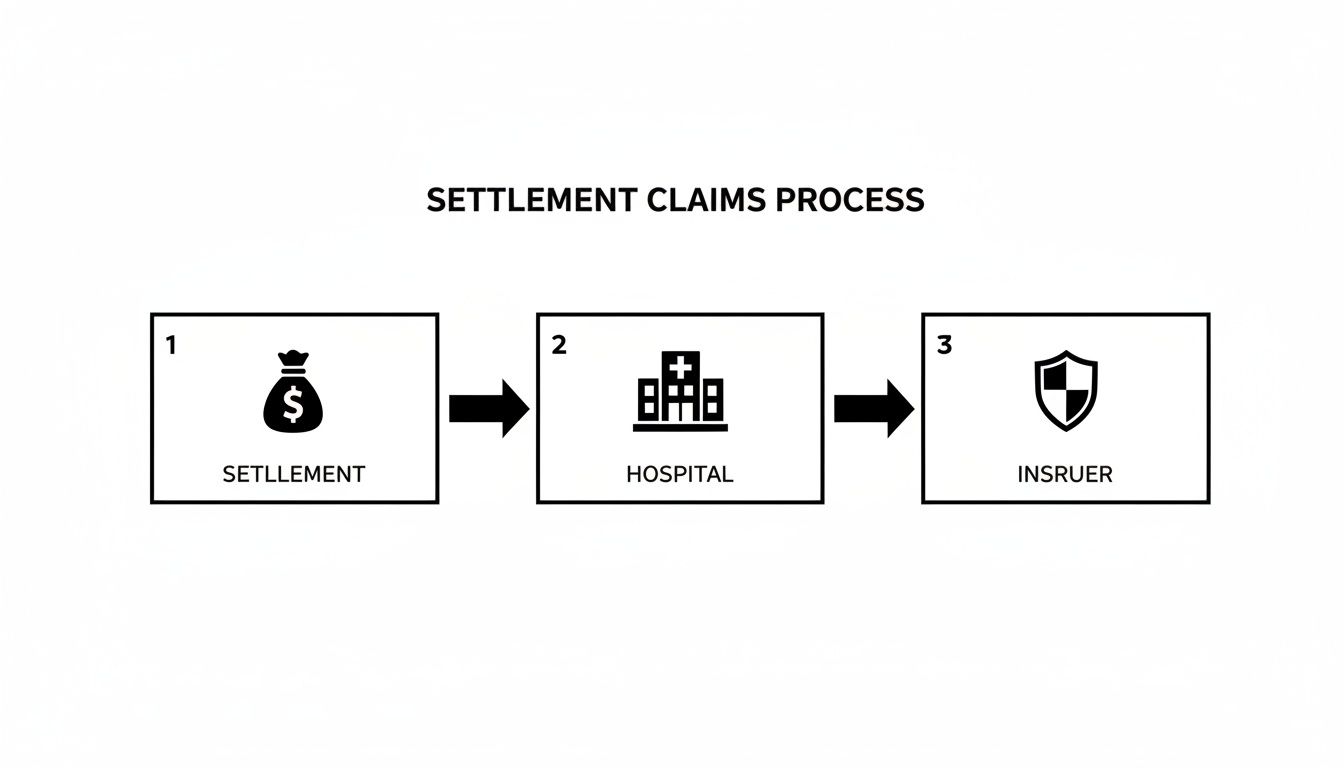
This process really drives home why having accurate, verified bills is so essential before a single dollar from your settlement is paid out.
Organizing Your Documentation For a Stronger Position
Once the itemized bills start rolling in, it's time to get organized. You don't need a fancy system. A simple spreadsheet or even a dedicated folder for each provider will do the trick. Your goal is to track:
- Provider Name: The hospital, clinic, or doctor's office.
- Total Amount Billed: The full, original "sticker price" for their services.
- Insurance Payments: What your health insurer has already paid toward the bill.
- Your Remaining Balance: The amount they claim you still owe.
- Notes: A section to jot down any potential errors, duplicate charges, or questions you have about a specific line item.
This organized approach does more than just keep you sane; it transforms you from a passive victim of the billing system into an informed advocate for your own financial recovery. When you finally make that call, you'll have a complete and accurate picture of your medical debt, armed with the specific details needed for a successful negotiation.
You are not just a patient anymore; you are now the manager of this financial process. Having your documents in perfect order gives you the confidence and credibility to challenge inaccuracies and propose fair reductions.
Many people feel intimidated by the idea of negotiating, but you're not alone in this, and it works. A LendingTree survey found that 60% of Americans with medical debt try to negotiate, and an incredible 90% of them achieve at least some success. That shows that speaking up makes a difference. You can find more details in their full report on medical debt negotiations.
With your documents organized and your facts straight, you are no longer just reacting to demands for payment. You are proactively setting the stage for a conversation where you have control, clarity, and the power to protect the settlement you rightfully won.
Proven Strategies For Hospital Bill Negotiations

Once you’ve got that organized file of itemized bills, you’re in the strongest possible position to start negotiating. This is where you can get proactive, work to slash what you owe, and keep more of your hard-won settlement money where it belongs—with you.
The key is to approach the conversation with a polite, firm, and business-like attitude. Remember, the person in the hospital’s billing department is just doing their job. Treating them with respect can go a long way, but you also have to be a fierce advocate for your own financial future. The goal is to find a fair middle ground that clears the debt and lets you finally move on.
Opening The Conversation
When you make that first call, be direct about your purpose. You aren't disputing that you received care; you're calling to discuss the bill and find a solution now that your personal injury case has settled.
Here are a few proven ways to frame the conversation:
- Offer a Prompt, Lump-Sum Payment: Hospitals are businesses, and they value guaranteed money over the possibility of getting nothing. You can say, "My personal injury case has settled, and I can resolve this bill. I'm prepared to offer a prompt, one-time payment of [start with a lower percentage, like 40-50%] to settle this account in full today." This immediately shows you're serious and gives them an easy out.
- Highlight the "Billed" vs. "Accepted" Rate: This is a big one. Point out the massive difference between the hospital's inflated "chargemaster" rate (the sticker price) and the much lower rates they happily accept from insurance companies for the exact same services. You could say, "I've reviewed the itemized bill and see the charges are much higher than what insurance plans typically pay. I'm hoping to pay a more reasonable amount, closer to the accepted insurance rate."
- Explain the Realities of Your Settlement: Be honest about your situation. Remind them that your settlement isn't a lottery win—it has to cover everything. An effective approach is, "After my attorney’s fees and case costs, the amount left from my settlement is limited. This money also has to cover my lost wages and future medical needs. I need your help finding a fair reduction so I can meet all my obligations."
This approach completely reframes the dynamic. You’re not just a name on an invoice; you're a person trying to put their life back together after a traumatic event with finite resources.
A Real-World Example From a DFW Rideshare Accident
Consider a client who was seriously injured in a rideshare accident right here in the Dallas-Fort Worth area. He needed emergency surgery and a long hospital stay, which left him with a hospital lien for over $100,000. Once we secured a settlement, the hospital naturally expected to be paid in full.
We didn't just roll over. Our legal team put together a detailed argument for the hospital. We explained that our client had significant legal costs and that the settlement was also meant to compensate him for months of lost income and his ongoing pain and suffering.
We successfully argued that accepting an immediate, guaranteed payment of $60,000 was a much better and more certain outcome for the hospital than trying to fight for the full amount. The hospital agreed. This one negotiation saved our client $40,000 that he could then use for his family and his recovery.
This is a powerful, real-world example of how negotiating medical bills after a settlement can make a life-changing difference.
The Power of Persistence
Don't get discouraged if your first offer gets shot down. Negotiation is almost always a back-and-forth process. If the billing representative tells you no, politely ask to speak with a supervisor or manager—someone with more authority to approve a reduction.
You’re not alone in this, and it really works. Studies have shown that patients who take the time to negotiate their medical bills are often successful. In one survey, patients who challenged out-of-network bills managed to reduce their costs a remarkable 56% of the time. While only 19% of people in that survey even tried to negotiate, those who did saw an incredible 63% success rate when dealing directly with providers. You can see the details of these patient negotiation outcomes for yourself to understand just how effective this can be.
And a final, critical point: always follow up a verbal agreement in writing. Send an email or a letter that summarizes the agreed-upon reduction and payment amount. Do not send a dime until you have a signed letter from the provider confirming that your payment will satisfy the debt in full. This written agreement is your legal shield against any future collection attempts. It's the final step to putting the bill behind you for good.
How To Approach Insurance And Government Liens
When you're trying to reduce medical bills after a settlement, dealing with a hospital is one thing. Facing a massive insurance company or a government agency is a completely different challenge.
These organizations aren't like your local clinic. They have entire departments dedicated to recovering money and operate under complex federal and state laws that give them a tremendous amount of power.
This is where you'll run into powerful subrogation claims from health insurers, ERISA plans, Medicare, and Medicaid. Their one and only goal is to get reimbursed for the medical costs they covered for you. While their right to get paid back is strong, it isn't absolute. You still have room to negotiate, but the key is understanding the unique rules for each type of claim and coming at them with a smart, informed strategy.
Tackling Medicare’s Powerful “Super Lien”
If Medicare paid for any of your accident-related medical care, you have to handle their claim with extreme care. Federal law gives Medicare what’s known as a “super lien,” an automatic and powerful right to be repaid directly from your settlement proceeds.
Trying to ignore a Medicare lien can backfire spectacularly, even leading to the federal government suing you directly. You can't just hope they won't notice; they have a sophisticated system for tracking personal injury cases involving their beneficiaries.
The process typically involves:
- Reporting the case: You or your attorney must notify Medicare about your personal injury claim.
- Requesting a conditional payment summary: This document lists all the payments Medicare believes are related to your accident.
- Disputing unrelated charges: You have the right to comb through this list and challenge any treatments that weren't for your accident injuries.
- Negotiating the final amount: After you settle, Medicare issues a final demand letter. This is the point where an attorney can step in to negotiate reductions.
One of the most effective arguments is that Medicare should share in the cost of getting the settlement in the first place. This is where an experienced Texas personal injury lawyer becomes invaluable.
The Challenge of ERISA Health Plans
A lot of people get health insurance through work, and these employer-sponsored plans often fall under a federal law called the Employee Retirement Income Security Act (ERISA). ERISA plans have incredibly strong reimbursement rights—sometimes even stronger than standard health insurers.
It's the language buried in the plan documents that gives them so much power. Many ERISA plans state they must be paid back in full, no matter what your attorney's fees are or whether your settlement was enough to fully compensate you for all your damages. It can feel deeply unfair, but it's the law.
Despite their powerful legal standing, ERISA liens aren't always set in stone. An attorney can pore over the specific plan language to find any weaknesses or limitations in their claim. We can often still negotiate a reduction by showing them the practical realities of the settlement and the huge costs involved in winning it.
Using The Common Fund Doctrine In Texas
One of the most powerful tools in your attorney's arsenal for negotiating with insurers and government payers is the common fund doctrine. This legal principle is based on a simple idea of fairness: since your lawyer did all the work to create the "common fund" (your settlement), the company seeking reimbursement from it should have to pay its fair share of the attorney’s fees and costs.
Let's say your health insurer has a $30,000 subrogation claim on your settlement. If your attorney's contingency fee is one-third, we would argue that the insurer must reduce their lien by one-third ($10,000) to chip in for the legal work that made their recovery possible.
This argument is a cornerstone of successfully negotiating these liens down, making sure you keep more of the money that was meant for your recovery. It’s a complex legal argument that a skilled truck crash lawyer Houston knows how to make effectively. As you prepare to handle these claims, it can also help to have a broader perspective by understanding dental insurance and government assistance programs like Medicaid and CHIP.
You Don't Have To Handle This Alone
Getting through an accident is a journey, and negotiating your medical bills is often the final—and most critical—step. While the strategies we've gone over can definitely put you in a stronger position, the whole process can be overwhelming. You should be focused on healing, not haggling with insurance companies.
This is where having an experienced Texas personal injury lawyer in your corner really makes a difference. You should never feel like you have to carry this burden by yourself. At The Law Office of Bryan Fagan, PLLC, these post-settlement negotiations are a core part of our commitment to you. We fight to win your case, and then we fight to protect what you’ve won.
Your Advocate From Start To Finish
Your recovery is what truly matters. We're here to shoulder the legal and financial burdens so you can concentrate on putting your life back together.
Our team has spent years going head-to-head with hospital billing departments, insurance adjusters, and government agencies all across Texas. We know their tactics, we anticipate their arguments, and we know how to counter them effectively to make sure the maximum amount of money stays in your pocket.
Your personal injury settlement is meant to secure your future, not just pay off past debts. Our job is to defend that principle at every stage, even after the case is officially "settled."
Because we work on a contingency basis, our success is tied directly to yours. You won't pay us a dime unless we secure a recovery for you. You can learn more about how contingency fee lawyers near you operate, which allows you to get powerful representation without any upfront costs.
We invite you to schedule a free, no-pressure consultation to talk about your case. Let us show you how we can help.
Got Questions About Negotiating Medical Bills? We've Got Answers.
When you're nearing the end of a personal injury case, the questions about medical bills and liens can start piling up. It's completely normal. Below, we've tackled some of the most common concerns we hear from our clients right here in Texas.
Can I Start Negotiating Medical Bills Before My Settlement Is Final?
Technically, yes, you can open a dialogue with providers anytime. However, your strongest leverage comes after your settlement is finalized.
Think about it from their perspective: once the settlement funds are secured, they know a payment is guaranteed. They're far more motivated to strike a deal and close the books. Trying to negotiate too early often falls flat because the final settlement amount is the biggest card your attorney has to play. A Houston car accident attorney can give you the best advice on timing based on where you are in the process.
What If a Hospital Flat-Out Refuses to Negotiate My Bill?
First off, don't panic if a provider digs in their heels. It happens. The initial step is to get their refusal in writing. This creates a paper trail. From there, you can comb through the itemized bill one last time for errors or see if the hospital has a patient advocate who might be able to help.
But honestly, this is the exact moment when having an experienced lawyer in your corner becomes critical. We can apply legal pressure and leverage our firm’s history of negotiating with these specific Texas providers to get them back to the table. We often secure reductions they simply wouldn't offer to an individual.
Will My Credit Score Tank While I'm Waiting for My Settlement?
It’s a valid concern. If your unpaid medical bills get sent to a collections agency while your case is still moving forward, it could hurt your credit score.
This is where proactive communication is key. You need to inform your providers that you have a pending personal injury claim and that the bills will be paid from the settlement proceeds. A formal letter from your attorney—often called a "letter of protection"—is usually enough to prevent your accounts from ever being sent to collections.
How Much of a Reduction Can I Realistically Expect to Get?
There’s no magic number here; it truly depends on the unique facts of your case. The final reduction hinges on several factors:
- The type of debt: A hospital lien is a different beast than an insurance subrogation claim.
- The total amount of your medical bills: Larger balances sometimes offer more room for negotiation.
- The strength of your overall negotiating position: This includes the settlement amount, comparative responsibility arguments, and more.
That said, reductions can range anywhere from 10% to over 50%. A seasoned Texas personal injury lawyer can look at the specific liens and claims in your case and give you a realistic target based on years of successful negotiations for other clients.
Your recovery is about more than just a settlement check—it's about making sure that money is protected for your future. At The Law Office of Bryan Fagan, PLLC, we handle these tough, complex negotiations so you can focus on what really matters: getting better.
If you have questions about your case, contact us for a free, no-obligation consultation today. We want to reassure you that recovery is possible and that legal help is available. Let us help you protect your settlement.