A serious accident can change your life in seconds—but you don’t have to face it alone. One moment, you’re driving down a Texas highway. The next, your world is shattered by the sound of screeching tires and crushing metal. A serious accident leaves you in shock, dealing with pain and a flood of uncertainty. This is about far more than just a damaged car—it's about your health, your family, and what comes next.
The Law Office of Bryan Fagan, PLLC is here to provide clear answers and compassionate guidance. We understand what you are going through, and we are here to help you navigate the path to recovery.
Your Life Changed Instantly. What Happens Next?

The moments after a crash are chaotic and overwhelming. You are trying to make sense of what just happened while likely dealing with injuries and fear. We have helped countless Texans in your situation, and we want you to know that recovery is possible. This guide is your first step toward getting back on your feet.
We’re going to walk you through the Texas motor vehicle accident claims process, step by step. Our goal is to cut through the legal jargon and give you clear, practical knowledge to protect your rights and secure the stability you need to heal. You have legal options, and we'll show you how they work.
Taking Your First Steps Toward Recovery
The road to recovery begins the moment the accident is over. Your immediate health needs are the top priority. For instance, even seemingly minor issues like neck pain can be addressed with things like effective neck pain relief stretches, but getting a professional medical evaluation is non-negotiable.
Seeking prompt medical attention is crucial for two reasons: it starts your physical healing and creates an official record of your injuries. This record is vital for any future claim. Don't make the mistake of thinking you're fine. Serious injuries like internal bleeding or whiplash can take hours or even days to show symptoms.
A serious accident isn't just a legal problem; it's a life problem. Protecting your right to compensation is about ensuring you have the resources to rebuild and heal—physically, emotionally, and financially.
What You Must Do Immediately After a Crash
The actions you take right at the scene can dramatically affect the outcome of your claim. While no two crashes are identical, a few key steps will always protect you and your legal rights. For a more detailed breakdown, check out our comprehensive guide on what to do after a car accident.
In the meantime, these practical steps are essential:
- Call 911: Always report the accident and request medical help if anyone is hurt. A police report is one of the most critical pieces of evidence you can have.
- Document Everything: Use your phone. Take photos and videos of the vehicle damage, the surrounding scene, traffic signs, and any visible injuries. Get names and phone numbers from any witnesses.
- Do Not Admit Fault: When talking to the other driver, passengers, or even the police, stick to the objective facts. Never say "I'm sorry" or anything that could be interpreted as accepting blame. This is critical for protecting your rights.
Understanding Your Rights Under Texas Injury Law
After a traumatic car wreck, the last thing you want to do is try to make sense of dense legal jargon. You just need straight answers. Texas law provides a clear path for accident victims to seek justice and financial recovery, and understanding the basics is the first step toward getting your life back on track.
The entire Texas personal injury system is built on one core idea: negligence.
Simply put, negligence happens when someone fails to act with reasonable care, and that failure causes you harm. Every person who gets behind the wheel in Texas has a duty of care to drive safely and avoid putting others in danger.
When a driver breaks that duty—maybe by texting, speeding, or running a red light—they have acted negligently. If that careless act causes a crash that leaves you injured, they are legally responsible for the damage they’ve caused.
How Long Do You Have to File a Claim in Texas?
You must know about the statute of limitations. This is a non-negotiable legal deadline for filing a lawsuit. If you miss this deadline, you lose your right to seek compensation forever, no matter how strong your case is.
For most personal injury cases in Texas, including all motor vehicle accident claims, the deadline is firm.
- Two-Year Deadline: You have exactly two years from the date of the accident to file a lawsuit against the person or party who caused your injuries.
Two years might sound like a long time, but it can fly by. Evidence gets lost, witnesses move away or forget key details, and insurance companies are notorious for using delay tactics to run out the clock. This is why it’s so important to talk with an experienced Texas personal injury lawyer right away.
Acting quickly gives your legal team the time needed to preserve critical evidence, track down and interview witnesses while the crash is still fresh in their minds, and start building a powerful case for you. Waiting too long can seriously harm, or even destroy, your claim. For families pursuing a wrongful death claim, this two-year window is just as critical for seeking justice. Whether your case involves a standard car accident or a complex truck crash, the statute of limitations is an unforgiving deadline you can't afford to ignore.
What If I Was Partially At Fault? Comparative Responsibility in Texas
Many accident victims worry that if they were even a little bit at fault, they lose their right to file a claim. Fortunately, that’s not how Texas law works. Our state uses a “modified comparative fault” rule, also known as proportionate responsibility or the 51% Bar Rule.
The 51% Bar Rule: In Texas, you can recover damages from an accident as long as you are found to be 50% or less responsible for causing it. Your final compensation is simply reduced by whatever percentage of fault is assigned to you.
For example, imagine you were in a crash on a busy Houston freeway. The other driver was weaving through traffic and speeding, but you might have changed lanes without a perfect signal. A jury could decide the other driver was 90% at fault and you were 10% at fault. If your total damages were $100,000, you could still recover $90,000.
However, if that same jury decided you were 51% or more at fault, you would be barred from recovering anything at all. This is why it's vital to have an experienced Houston car accident attorney evaluate your case.
Calculating The Full Cost Of A Serious Accident
Never mistake an insurance adjuster’s first offer for a fair one. It's almost always a lowball number, a business tactic meant to close your case as quickly and cheaply as possible. We know that a true recovery depends on accounting for every single loss—not just the bills sitting on your kitchen table.
To understand what you’re rightfully owed, we have to look at the full picture. The law breaks down the compensation, or "damages," you can recover into two main groups: economic and non-economic damages.
The first group is for your Economic Damages. Think of these as the clear, measurable financial hits you’ve taken because of the crash. They’re the costs you can track with receipts, pay stubs, and invoices.
Just as important are the Non-Economic Damages. These are the intangible, human costs of an accident. They don’t have a price tag, but their impact on your life is very real and deserves significant compensation.
Economic Damages: The Financial Toll of the Crash
Economic damages cover every out-of-pocket expense and financial setback you’ve faced since the accident. This isn’t just about the ambulance ride or the ER visit; it’s about every single cost that follows.
When we calculate these damages, we look at all potential medical needs, including treatment for the various conditions they treat that can develop after a serious injury. A complete calculation has to include:
- Past and Future Medical Bills: This covers everything from the initial hospital stay, surgeries, and physical therapy to prescriptions, crutches, and even modifications needed for your home.
- Lost Wages: If you couldn't work while you were recovering, you are owed that lost income.
- Diminished Earning Capacity: This is one of the most critical and easily overlooked damages. If your injuries stop you from returning to your old job or limit your future earning potential, you deserve to be compensated for that lost future.
Think about a construction worker from Dallas who suffers a severe back injury in a wreck caused by a negligent truck driver. He can no longer handle the physical demands of his job. He deserves compensation not just for the wages he's already lost, but for the lifetime of earnings he will miss out on because of his permanent injury.
Before we move on, let's look at the main types of compensation you can pursue in a Texas accident claim. This table breaks down the key categories of damages.
Types of Compensation in a Texas Accident Claim
| Damage Category | What It Covers | Example |
|---|---|---|
| Medical Expenses | All past, present, and future costs for medical care related to the accident. | Hospital stays, surgeries, physical therapy, prescription medication, and assistive devices. |
| Lost Wages | Income lost due to time off work for recovery. | Paychecks missed while unable to work after the accident. |
| Loss of Earning Capacity | Reduction in your ability to earn income in the future due to permanent injuries. | A surgeon who can no longer perform surgery due to a hand injury. |
| Pain and Suffering | The physical pain and mental discomfort experienced from your injuries. | Chronic pain, discomfort, and the experience of undergoing painful medical treatments. |
| Mental Anguish | The emotional and psychological trauma resulting from the accident. | Anxiety, depression, PTSD, fear, and sleep disturbances. |
| Physical Impairment | Loss of use of a body part or permanent physical limitations. | Inability to walk without a cane, lift objects, or participate in physical activities. |
| Disfigurement | Permanent scarring or physical alterations from the injuries. | Noticeable scars on the face, arms, or legs. |
This table provides a snapshot, but a thorough claim investigates the unique details of your situation to ensure nothing is overlooked.
Non-Economic Damages: The Human Impact
While economic damages add up your financial losses, non-economic damages are there to compensate you for the devastating personal toll the accident took on your life. These losses are deeply personal, and they are a non-negotiable part of any fair settlement in motor vehicle accident claims.
Insurance adjusters love to downplay or ignore these damages because they're harder to put a number on. An experienced Texas personal injury lawyer knows exactly how to build a case that shows the true extent of your suffering and makes sure it's valued properly.
These damages are every bit as real and compensable as your medical bills. They include:
- Pain and Suffering: This accounts for the physical pain you've had to endure and will continue to live with. Learn more about how Texas law values pain and suffering in our detailed guide.
- Mental and Emotional Anguish: This covers the psychological fallout—anxiety, depression, fear, and PTSD—that so often follows a traumatic event.
- Loss of Enjoyment of Life: If your injuries keep you from your hobbies, family activities, or anything you once loved, you deserve to be compensated for that loss.
- Physical Impairment and Disfigurement: This addresses permanent limitations, scarring, or other physical changes the accident left you with.
Even as the value of injury claims rises, insurance companies are digging in their heels and fighting harder than ever to avoid paying what's fair. Bodily injury claims have seen average payouts jump to $29.1K per person—a 36% increase since late 2020. Yet, insurers often work overtime to minimize your payment.
This growing resistance from insurers is exactly why having a strong advocate on your side has never been more important.
A Step By Step Guide To The Claim Process
After a serious crash, the road ahead can feel like a confusing mess of paperwork, phone calls, and legal deadlines. You’re not just recovering from your injuries—you’re suddenly thrown into a complex legal process.
But you don’t have to navigate it alone. Understanding how a motor vehicle accident claim works gives you a clear roadmap, empowering you to take back control and focus on what truly matters: getting better.
Let's walk through the process together, from the chaotic moments after the crash to a final resolution.
The First 48 Hours Are Critical
What you do in the first two days after a wreck can make or break your claim. Your top priority, always, is your health and safety.
Call 911 and Get Medical Help: Always get police and paramedics on the scene. A police report is an essential piece of evidence, and seeing a doctor right away creates a clear medical record linking your injuries to the accident. Even if you think you’re fine, adrenaline can mask serious injuries that show up later.
Gather Evidence at the Scene: If you’re physically able, use your phone to take pictures and videos of everything. Snap photos of the vehicle damage, skid marks, traffic signs, road conditions, and any visible injuries. Make sure to get the names and phone numbers of anyone who saw what happened.
Report the Crash, But Don’t Give a Statement: You have to let your own insurance company know you were in an accident. But when you talk to any insurance adjuster—especially the one from the other driver's company—stick to the basic facts. Do not agree to a recorded statement or admit any fault before you’ve spoken to an attorney.
These initial steps help build the foundation for recovering the costs that pile up after a crash.
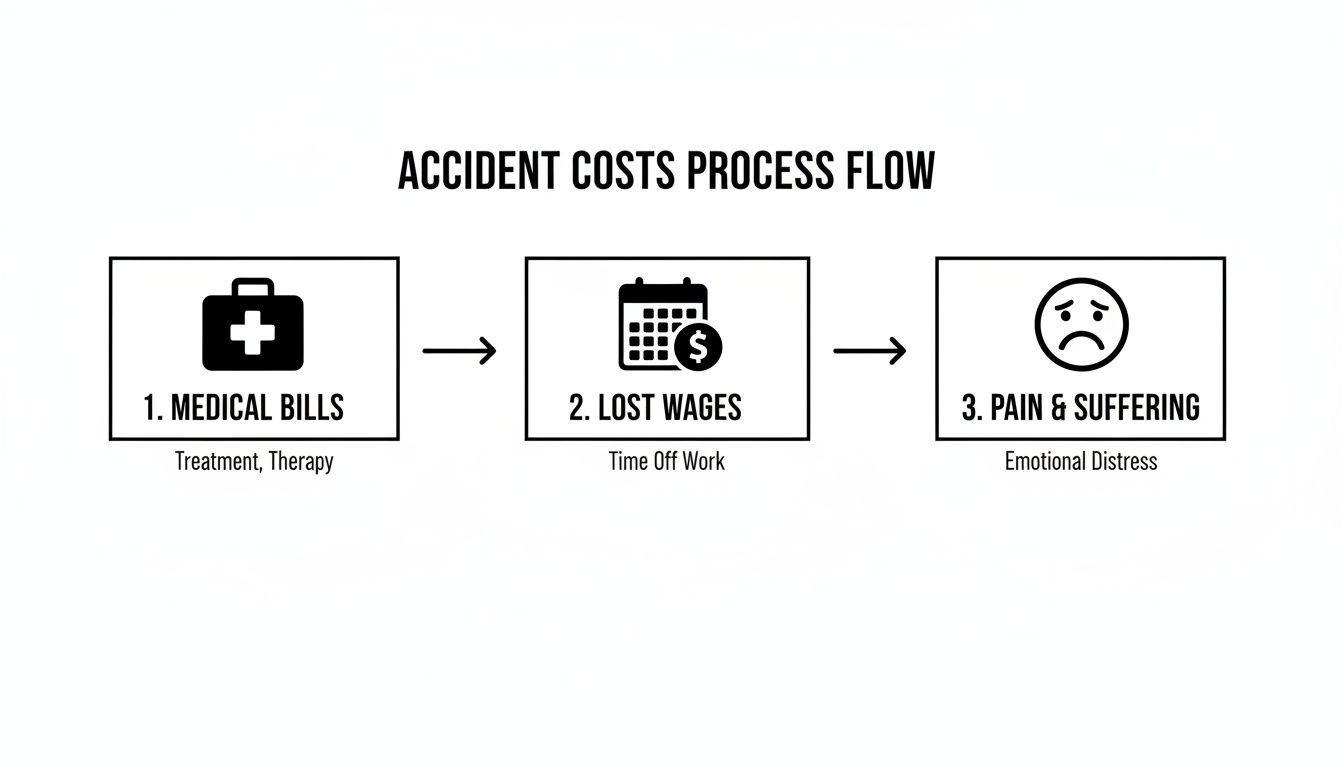
As you can see, a successful claim doesn't just cover the bills you can hold in your hand. It also accounts for the very real, but less tangible, impact on your life.
The Investigation Phase
Once you have a law firm on your side, that burden is no longer yours to carry. We immediately launch our own deep-dive investigation into the accident, going far beyond the initial police report.
Our investigation typically involves:
- Securing the Official Police Report: We get our hands on the official report and scrutinize it for witness statements, the officer’s initial findings, and other key details. You can also learn more about how to read a police accident report to understand what it contains.
- Interviewing Witnesses: We track down and speak with everyone who saw the crash to get their unbiased story of what happened before memories fade.
- Gathering Hard Evidence: This is where we hunt for surveillance footage from nearby businesses, red-light camera videos, and even "black box" data from the vehicles themselves.
- Hiring Experts: In more complicated cases, like those involving a commercial truck or a disputed-fault scenario, we bring in accident reconstruction specialists to prove exactly how the crash unfolded and who was responsible.
Our Promise: You focus on healing. We'll handle every single phone call, every form, and every conversation with the insurance companies. You will never have to face them alone.
Negotiation vs. Filing a Lawsuit
Once we’ve built a powerful case backed by solid evidence, we draft and send a formal demand letter to the at-fault driver’s insurance company. This letter lays out why their client is liable and details the full extent of your damages—both economic and non-economic.
This is where the real fight often begins. The insurance adjuster will come back with a response, usually a lowball offer, and we will negotiate aggressively to secure a fair settlement that covers everything you’ve lost. The vast majority of motor vehicle accident claims are settled at this stage without ever stepping foot in a courtroom.
But if the insurance company digs in its heels and refuses to be reasonable, we don't back down. We file a lawsuit. While our goal is always an efficient resolution for you, we prepare every case from day one as if it’s going to trial. That level of preparation shows the insurance company we mean business and puts you in the strongest possible position to get the full compensation you deserve.
Navigating Complex Motor Vehicle Accident Cases
A car crash is already overwhelming, but some situations are far more complicated than a typical fender-bender. When an accident involves catastrophic injuries, an uninsured driver, or the unimaginable loss of a loved one, the legal path forward can feel impossible to navigate alone.
These are the cases that demand deep legal experience and a compassionate hand. Understanding your rights in these difficult scenarios is the first step toward securing the justice and financial stability your family needs to heal.
What Happens When The At-Fault Driver Has No Insurance
It’s a nightmare scenario. You’re hurt in a crash, and you discover the driver who hit you either has no insurance or not nearly enough to cover your mounting medical bills. This is precisely why Uninsured/Underinsured Motorist (UM/UIM) coverage exists on your own policy—it’s your safety net.
When you file a UM/UIM claim, you’re turning to your own insurance company for help. It feels strange, but this is exactly what you pay for. The problem is, your insurer often stops acting like your protector and starts acting like an opponent. They may try to deny, delay, or undervalue your claim, just like the other driver’s insurance would.
An experienced Texas personal injury lawyer steps in to handle this fight for you by:
- Proving the other driver was at fault and didn't have enough insurance.
- Documenting the full scope of your damages, including what you'll need for future medical care.
- Negotiating aggressively with your own insurance company to make them honor their policy and pay you what you are rightfully owed.
Pursuing Justice Through A Wrongful Death Claim
Losing a family member in a preventable accident is a pain that words can never truly capture. While no amount of money can bring them back, a wrongful death claim offers a legal path for families to hold the negligent party accountable and find financial stability after a tragedy.
In Texas, a wrongful death claim can be filed by the surviving spouse, children, or parents of the deceased. It allows you to seek compensation for both the financial and emotional voids left behind.
These claims are designed to cover devastating losses, including:
- Lost future income the person would have provided for the family.
- The loss of companionship, love, guidance, and emotional support.
- Mental and emotional anguish the surviving family members have suffered.
- Funeral and burial costs.
A compassionate wrongful death lawyer Texas can carry the legal burden with sensitivity, giving your family space to grieve while we pursue justice on your behalf.
Catastrophic Injury Cases Requiring Lifelong Care
Some crashes leave victims with injuries so severe that their lives are changed forever. Catastrophic injuries—like traumatic brain injuries (TBI), spinal cord damage causing paralysis, severe burns, or amputations—require a completely different legal strategy.
These cases aren't just about paying for past medical bills. They are about securing a financial future that accounts for a lifetime of necessary care. For instance, after a devastating wreck with a commercial truck, a truck crash lawyer Houston must carefully calculate every single future cost, which can include:
- Years of physical and occupational therapy.
- 24/7 in-home nursing or attendant care.
- Multiple future surgeries and medical procedures.
- Modifications to a home or vehicle to accommodate a disability.
- Advanced medical equipment and assistive devices.
While national data shows some encouraging safety trends, like a recent drop in the fatality rate per 100 million miles driven, the reality on Texas roads remains harsh. As you can explore in more detail from recent NHTSA findings, devastating crashes still happen every single day. For those left with catastrophic injuries, the fight for fair compensation isn't just a legal battle—it's a fight for their future quality of life.
Why An Experienced Injury Lawyer Is Essential

A serious accident can change your life in seconds—but you don’t have to face the aftermath alone. Going up against a massive insurance corporation is an unfair fight. Their primary goal is to protect their profits by minimizing their payout, not to secure your future well-being. This is where an experienced Texas personal injury lawyer becomes your most crucial ally.
You need an advocate who can level the playing field. When you partner with us, you get a dedicated team that is committed to fighting for your best interests.
We Even The Odds And Fight For You
An attorney’s role goes far beyond just filing paperwork. We become your shield and your strategist, handling every legal detail so you can focus on your health and your family. Having an experienced lawyer in your corner is absolutely essential for your motor vehicle accident claim.
Here’s how we make a real difference:
- Accurately Calculating Your Claim's Full Value: We look beyond the immediate bills to account for future medical care, lost earning capacity, and the very real human cost of pain and suffering.
- Gathering Evidence the Insurer Ignores: We conduct an independent investigation to uncover all facts supporting your claim, from securing surveillance footage to consulting with accident reconstruction experts.
- Handling All Negotiations: We manage every communication with the insurance company. You won’t have to deal with adjusters trying to get you to accept a lowball offer or twist your words in a recorded statement.
- Navigating Complex Deadlines and Procedures: We ensure every deadline, like the statute of limitations, is met and every legal procedure is followed correctly.
Crucially, our firm works on a contingency-fee basis. This means you pay absolutely no attorney fees unless we successfully recover compensation for you. You get expert legal representation without any upfront financial risk.
You are not just another case number to us. You are a member of our community who has been hurt, and you deserve justice. Recovery is possible, and having the right legal partner makes all the difference in your journey.
If you’re ready to discuss your case and understand your options, our team is here to listen. We invite you to contact The Law Office of Bryan Fagan, PLLC for a free, no-obligation consultation. Let us help you take the first step toward getting your life back.
Frequently Asked Questions About Accident Claims
After a serious Texas accident, your mind is probably racing with urgent questions. We've compiled some of the most common concerns we hear from injured people and their families to give you some clarity. The answers below can help you understand your rights and what to expect when filing motor vehicle accident claims.
How Much Does It Cost To Hire A Personal Injury Lawyer?
Hiring our firm costs you nothing upfront. We handle cases on a contingency fee basis, which is a straightforward arrangement: we only get paid if we win your case.
Our fee is a percentage of the compensation we recover for you. If we don’t secure a settlement or verdict in your favor, you owe us absolutely nothing for our work. This approach allows everyone to access experienced legal help without financial risk.
Should I Talk To The Other Driver’s Insurance Company?
No. You should avoid giving a recorded statement to the at-fault driver's insurance adjuster at all costs. These adjusters are trained professionals, and their job is to protect their company's profits by minimizing or denying your claim.
They know exactly what to ask to make you say something that can be used against you later. The best thing you can do is let your attorney handle all communications. This protects your rights and stops them from twisting your words.
Key Takeaway: Never agree to a recorded statement without talking to your lawyer first. Simply tell the adjuster your attorney will be in touch and hang up the phone.
What If The Accident Was Partially My Fault?
Even if you believe you share some of the blame, you can still recover damages in Texas. Our state follows a rule called "proportionate responsibility," sometimes known as the 51% bar.
This means you can file a claim and receive compensation as long as you are not found to be 51% or more at fault for the wreck. Your final award will be reduced by your percentage of fault. For instance, if you were found 10% responsible for the crash, your total recovery would be reduced by that 10%.
How Long Will My Motor Vehicle Accident Claim Take?
There’s no single answer to this question, as every case is different. A straightforward claim with clear fault and minor injuries might wrap up in a few months. On the other hand, a complex case involving severe injuries, a dispute over who was at fault, or an uncooperative insurance company can take a year or more, especially if a lawsuit becomes necessary.
Our top priority is securing the best possible outcome for you, not the fastest one. We will never let an insurance company pressure us into taking a lowball offer just to close your file. Your full and fair recovery is the only thing that matters.
A serious accident is overwhelming, but you don’t have to face this journey alone. The dedicated team at The Law Office of Bryan Fagan, PLLC is here to fight for the justice you deserve. We invite you to schedule a free, no-obligation consultation to discuss your case by visiting us at https://texaspersonalinjury.net or calling us today. Your recovery is possible, and we are here to help.