A serious accident can change your life in seconds — but you don’t have to face it alone. A car wreck is over in an instant, but the consequences can last a lifetime. That initial shock and jolt are just the start. What often follows is a creeping neck pain, stiffness, and headaches that signal a whiplash injury—a serious medical problem, not just a minor ache you can ignore. If another driver’s negligence left you with whiplash in Texas, you have the right to demand compensation.
The Hidden Dangers of Whiplash After a Texas Car Crash
You're stopped in heavy traffic on I-45 in Houston when, out of nowhere, another car slams into your rear bumper. The impact is jarring, but at first, you feel more shaken up than truly hurt. It’s only in the hours or even days that follow that a dull ache in your neck starts to burn, growing into a sharp, persistent pain. This is the classic, delayed onset of whiplash.
Whiplash is a significant soft tissue injury caused by your head whipping violently back and forth during a collision. It’s insidious because, unlike a broken bone, it doesn't show up on a standard X-ray. Insurance companies love this fact and often try to downplay the severity of whiplash claims. But the pain, limitation, and long-term consequences are very real.
Recognizing Delayed Whiplash Symptoms
It's critical to understand that whiplash symptoms rarely show up right away. The adrenaline pumping through your body after a crash is a powerful painkiller. You need to be vigilant and watch for these common signs in the days and weeks that follow:
- Nagging neck pain and stiffness
- Headaches that seem to start at the base of your skull and radiate upward
- Dizziness or a feeling of being unsteady on your feet
- Pain that spreads into your shoulders, upper back, or arms
- Numbness or a "pins and needles" feeling in your arms and hands
- Unexplained fatigue, brain fog, or blurred vision
If you've been in a wreck, you're not alone in dealing with this. Statistics show that about 3 million Americans suffer whiplash injuries every year, and a shocking number of them are left with chronic pain and disability. The financial burden is staggering, costing the U.S. billions annually in medical care alone.
Why Immediate Medical Care Is Crucial
Getting a medical evaluation right away is the single most important thing you can do after a collision. Even if you feel okay, a doctor can spot underlying damage before it gets worse.
This isn't just about your health; it's about protecting your claim. A prompt medical visit creates a direct, undeniable link between the accident and your injuries. Without it, you’re handing the insurance adjuster an easy excuse to argue your injuries aren't related to the crash at all, potentially torpedoing your right to fair compensation.
Even if your symptoms seem mild at first, seeking proper care is vital for preventing long-term problems. You can learn more about specialized treatments like chiropractic care after a car accident for whiplash or explore our guide on motor vehicle accident injuries treatment to understand all your options.
Documenting Your Injury to Build a Powerful Claim
A whiplash claim is only as strong as the evidence you have to back it up. The moments, days, and weeks right after a crash are absolutely critical. What you do—and just as importantly, what you don't do—can make or break your ability to get the compensation you deserve. Think of this as your game plan for protecting your rights from the very beginning.
The path to getting justice starts the second you feel that jolt. It’s a clear chain of events that insurers and juries need to understand.
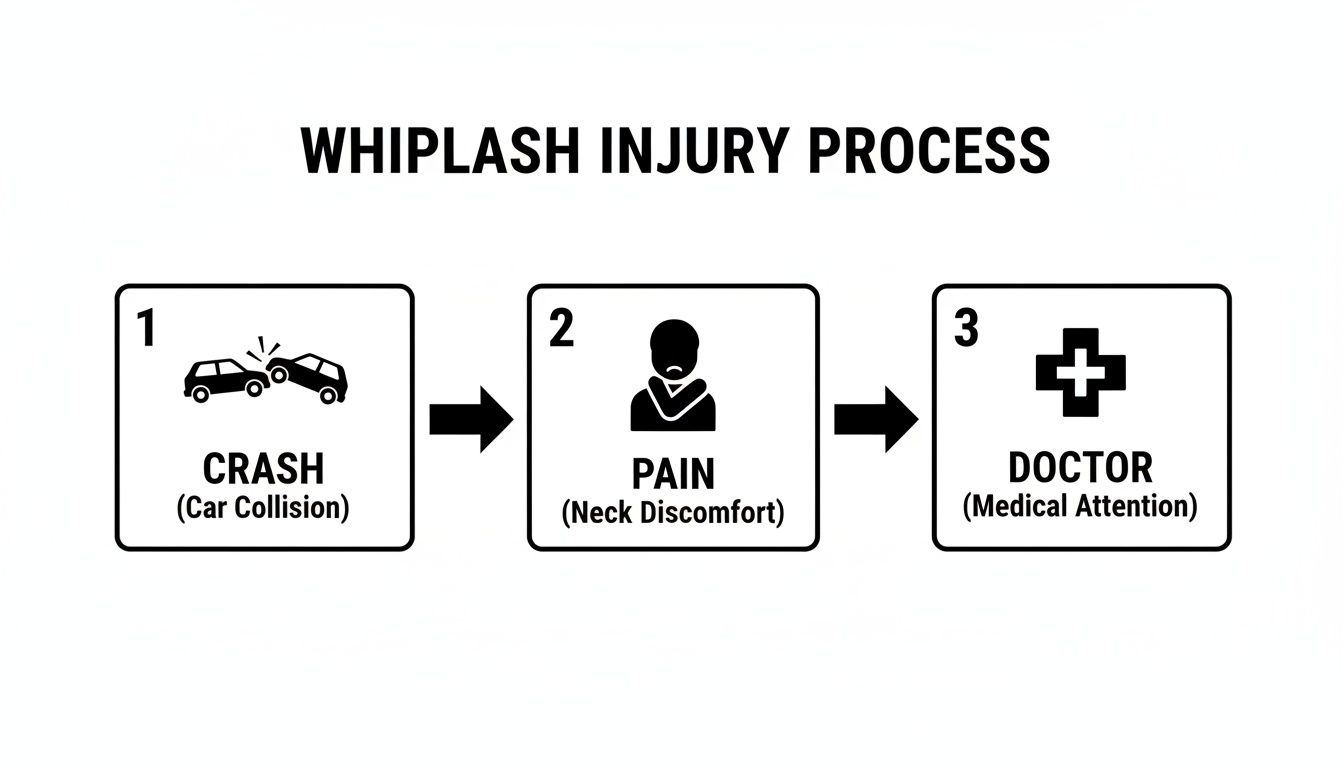
As you can see, the collision leads to the injury, which demands professional medical care. Your job is to document every single step of this journey to create a clear, undeniable timeline.
Your First Moves at the Scene
If you’re physically able to, start gathering evidence right there at the accident scene. Your smartphone is your best friend in this situation. Take photos and videos of everything: where the cars ended up, the damage to all vehicles involved (yours and theirs), skid marks on the pavement, and any traffic signs or signals nearby.
Next, you need to exchange information. Get the other driver's name, contact details, and insurance information. It’s also incredibly important to talk to anyone who saw what happened. The story from a neutral witness can be extremely powerful. Make sure to get their name and phone number so your lawyer can follow up with them later.
Finally, always call the police to file an official report. In Texas, that police report creates an official record of the crash. It often includes the officer’s initial thoughts on who was at fault, making it a cornerstone of your personal injury claim.
The Power of a Pain and Symptom Journal
Here’s something many people overlook: whiplash symptoms often sneak up on you, getting worse in the days following the accident. That’s why a detailed journal is an invaluable piece of evidence. Start it on day one. Every single day, jot down how you’re feeling.
A daily journal turns your personal experience of pain into tangible evidence. It creates a detailed, day-by-day record of how this injury is impacting your life, which makes it much harder for an insurance adjuster to minimize what you're going through.
Be sure to track these details:
- Pain Levels: On a simple scale of 1 to 10, how bad is your neck, shoulder, or head pain?
- Symptoms: Write down everything. Are you feeling stiff? Dizzy? Numb? Fatigued or having trouble concentrating?
- Daily Limitations: How is the injury getting in the way of your life? Document your struggles with work, chores, driving, or even simple things like playing with your kids.
- Medical Visits: Keep a log of every appointment with doctors, chiropractors, physical therapists, and any other specialists.
This journal will paint a vivid picture of your recovery journey and the true, human cost of your injury. It's essential for calculating non-economic damages like pain and suffering.
Understanding Key Texas Legal Rules
As you get started, there are two legal concepts in Texas you absolutely need to know. The first is negligence. To win your case, you have to prove the other driver was negligent—that they failed to drive with reasonable care, which caused the crash and your injuries. For example, after a Houston freeway crash, evidence like the police report, your photos, and witness statements are what you'll use to prove it.
The second concept is the statute of limitations. In Texas, you generally have just two years from the date of the accident to file a personal injury lawsuit. That might sound like a long time, but it flies by when you're focused on healing. If you miss this deadline, your right to seek compensation is almost certainly gone forever. That’s why moving quickly isn't just a good idea; it's a requirement.
It's also crucial to preserve all evidence during this period. Intentionally destroying or "losing" evidence can wreck your case. You can learn more about this responsibility in our detailed guide on what is spoliation of evidence.
Calculating the True Value of Your Whiplash Claim
Knowing what your whiplash claim is actually worth is one of the most powerful positions you can be in. Insurance adjusters are trained negotiators, and their first move is often a lowball offer. They're hoping you'll take a quick, easy payout before you realize the true cost of your injury. To counter this, you need a clear picture of how compensation is calculated in Texas.
Your claim isn't just one random number. It’s a combination of every single way the accident has impacted your life, and in Texas, these impacts are sorted into two main buckets: economic damages and non-economic damages.

Economic Damages: The Tangible Costs
Let’s start with the easy part. Economic damages are all the straightforward, calculable losses you’ve racked up because of the wreck. If you have a receipt, bill, or pay stub for it, it probably falls into this category. Think of these as the direct, out-of-pocket expenses.
Your economic damages will almost always include:
- All Medical Bills: This isn't just the ER visit. It's the ambulance ride, follow-ups with specialists, chiropractic care, physical therapy, prescription drugs, MRIs, and even things like a neck brace. Every cent counts.
- Lost Wages and Income: If your whiplash kept you out of work—whether for a few days or a few months—you deserve to be paid for that lost income.
- Loss of Future Earning Capacity: Sometimes, a whiplash injury is severe enough to permanently impact your ability to do your job or earn what you did before. If that's the case, you can claim compensation for that long-term financial hit.
- Future Medical Expenses: Recovery isn't always quick. Your compensation should cover the cost of future physical therapy, pain management, or even potential surgeries that your doctors believe you’ll need down the road.
When you're trying to figure out the value of your claim, it’s crucial to understand your recovery timeline. Knowing how long whiplash takes to heal gives you a realistic idea of what to expect for both current and future medical costs and lost work.
Non-Economic Damages: The Human Cost
This is where things get more personal. Non-economic damages are harder to put a price tag on, but they are just as real and just as important. This is compensation for how the injury has personally affected your quality of life. Your pain and symptom journal is your most powerful tool here.
Insurance companies love to dismiss these damages as subjective or "made up," but Texas law is clear: you have a right to be compensated for the physical pain and emotional turmoil an injury causes. Our job is to make them listen.
These damages cover the profound, personal toll of the injury:
- Pain and Suffering: This is for the actual physical pain, discomfort, and general misery you've dealt with since the accident and may continue to face.
- Mental Anguish: A car wreck is traumatic. This covers the anxiety, depression, fear of driving, or sleepless nights that often follow.
- Loss of Enjoyment of Life: Were you an avid golfer? Did you love gardening or picking up your grandkids? If chronic neck pain now prevents you from doing the things you love, you deserve to be compensated for that loss.
- Physical Impairment: This addresses lasting physical limitations, like a permanently reduced range of motion in your neck or chronic headaches.
To help you see how this all comes together, we've broken down the different types of compensation you can pursue.
Understanding Your Potential Compensation for Whiplash
| Type of Damage | What It Covers | Real-World Examples |
|---|---|---|
| Economic | All direct financial losses with a paper trail. | Ambulance ride, ER visit, chiropractic adjustments, prescription medication costs, lost paychecks from missed work, future physical therapy sessions. |
| Non-Economic | The intangible, human cost of the injury. | Chronic neck pain, anxiety when driving, inability to play with your children, persistent headaches, depression, loss of hobbies. |
Each category is a critical piece of the puzzle. Adding them together gives us a true picture of what you’ve lost.
The final value of your claim will be a combination of all these economic and non-economic damages, tailored to the specific facts of your accident. A skilled Houston car accident attorney knows how to build a powerful case for both, making sure that no part of your story is ignored.
Dealing With Insurance Companies and Proving Your Case
Soon after a crash, you can expect a call from the other driver's insurance adjuster. It’s absolutely critical to remember one thing: this person is not your friend. Their entire job is to protect their company’s bottom line, which means paying you as little as possible—or better yet, nothing at all.
They're often masters of a friendly, concerned tone, hoping to catch you off guard. This isn’t genuine sympathy; it’s a calculated strategy to make you feel comfortable enough to say something that could torpedo your own claim.
Common Insurance Adjuster Tactics
Insurance adjusters follow a well-worn playbook designed to minimize payouts. One of their go-to moves is asking for a recorded statement right away. You are not legally required to give them one, and you should always politely decline. They are trained to ask tricky, leading questions that can twist your words, making it seem like you're admitting fault or that your injuries aren't a big deal.
A simple, polite response like "I'm doing okay" can be twisted and used against you as "proof" that you weren't seriously hurt.
Watch out for the quick settlement offer, too. The adjuster might call just days after the accident with what sounds like a tempting offer for a few thousand dollars. When medical bills are already starting to show up, it can be hard to say no, but this is almost always a trap. A whiplash injury can take days or even weeks to fully reveal itself. If you accept that early offer, you forfeit your right to seek any more compensation, even if your condition gets much worse.
Building an Undeniable Case for Compensation
The best way to counter these tactics is to build a case so strong it simply can't be ignored. At The Law Office of Bryan Fagan, PLLC, we are meticulous. We leave no stone unturned in our mission to prove both the other driver's negligence and the true extent of your injuries.
We rely on hard evidence to establish fault, including powerful tools like:
- Accident Reconstruction Reports: We bring in experts who can analyze crash scene data, vehicle damage, and physics to create a scientific model of what happened, proving the other driver was to blame.
- Witness Testimony: Finding and interviewing neutral, third-party witnesses can provide accounts of the accident that powerfully support your side of the story.
- Police Reports and Citations: The official police report is often the first and most vital piece of evidence pointing to the at-fault driver.
Proving your whiplash injury is just as crucial. We collaborate with your doctors and other medical experts to build a clear, compelling medical narrative. This often means gathering detailed medical records, imaging results like MRIs, and sometimes even securing testimony from medical professionals. They can explain to an insurance company—or a jury—exactly how the collision caused your specific neck injury.
The insurance industry is always looking for ways to devalue and deny claims for injuries like whiplash. A powerful, evidence-backed case presented by an experienced attorney is the only way to level the playing field and compel them to offer a fair settlement.
This isn't just a local issue; it's a global trend for insurers to clamp down on these claims. For example, major legal reforms in England and Wales after 2021 specifically targeting whiplash slashed road traffic injury claims by 50%. This shows a worldwide push to minimize these payouts, making it more important than ever for Texas victims to have a strong advocate. For a deeper dive into these international trends, you can discover more insights about whiplash claim reforms on connectedworld.clydeco.com.
Trying to manage these conversations and gather this level of evidence is an overwhelming burden when you're also trying to recover from an injury. For some practical tips on handling those initial calls, check out our guide on how to deal with insurance adjusters. A skilled Texas personal injury lawyer takes this entire weight off your shoulders. We handle every communication and all the evidence gathering so you can focus on the one thing that truly matters: getting better.
Why a Texas Personal Injury Lawyer Is Your Best Ally
After a crash, your top priority should be your health. Period. But it doesn't take long for the other realities to sink in—the medical bills piling up, the lost wages from missed work, and the endless calls from insurance adjusters. Trying to juggle a legal claim while you're recovering from a painful injury like whiplash is more than most people can handle. This is where having a dedicated advocate on your side changes everything.
Hiring an experienced Texas personal injury lawyer isn’t just about getting legal advice. It’s a strategic move to level the playing field. It's about handing the fight over to a professional so you can finally focus on what matters most: healing.

We Handle the Insurance Companies for You
From the moment you partner with The Law Office of Bryan Fagan, PLLC, you can stop talking to insurance adjusters. We take over all communications, immediately shielding you from their high-pressure tactics. This puts a stop to the requests for a recorded statement or attempts to push you into accepting a premature, lowball offer.
Our team knows exactly how to build and present your case to insurers. We gather all your medical records, proof of lost income, and the documentation of your pain and suffering, then package it into a compelling demand that shows the true, full value of your claim.
A Thorough Investigation and Accurate Valuation
We don't just take the police report at face value. Our process starts with a deep dive into the facts of your accident. We leave no stone unturned. This might involve:
- Revisiting the crash scene to uncover evidence that was missed.
- Tracking down and interviewing witnesses who saw what really happened.
- Bringing in accident reconstruction experts to scientifically prove the other driver was at fault.
At the same time, we get to work calculating the real value of your claim for compensation for whiplash injuries. We add up every single medical bill and lost paycheck, but we don't stop there. We consult with your doctors to project the costs of any future care you might need and build a powerful argument for non-economic damages to make sure your pain and suffering are fully accounted for.
Hiring our firm sends a clear message to the insurance company: you will not be intimidated, and your claim will be taken seriously. We are prepared to fight for every dollar you are owed, whether at the negotiating table or in a courtroom.
Aggressive Negotiation and Trial Readiness
Armed with a strong, evidence-backed case, we enter negotiations from a position of power. Our primary goal is always to secure a fair and just settlement for you without the added stress and time of a trial. But some insurance companies simply refuse to be reasonable.
If they won't make an offer that covers what you deserve, our experienced trial attorneys are always prepared to take your case to court. We are not afraid to stand up to massive insurance corporations in front of a Texas jury.
Our commitment is backed by our contingency-fee promise: you pay absolutely no attorney’s fees unless we win your case. There is zero financial risk to you. Hiring a skilled Houston car accident attorney or a dedicated truck crash lawyer Houston isn't a cost—it's an investment in your recovery, and we make sure it's one you can afford. Our experience also extends to catastrophic injury cases and providing compassionate counsel for families seeking a wrongful death lawyer Texas.
How Long Do You Have to File a Claim in Texas?
When you're trying to heal, the last thing you want is more uncertainty. A serious crash can turn your life upside down in a heartbeat, but you don’t have to navigate the legal aftermath by yourself. We’ve found that getting clear, direct answers is one of the best ways to reduce stress and feel confident in the decisions you make for your future.
Here are some of the most common and urgent questions we hear from people across Texas who are dealing with a whiplash injury claim.
What if the Insurance Company Says My Whiplash Isn't a "Serious" Injury?
This is one of the oldest tricks in the insurance adjuster's playbook, and frankly, it's one of the most frustrating. They'll often try to downplay your injury by calling it a "soft tissue" issue that doesn't show up on a standard X-ray, implying it can't possibly be severe. This argument is medically false and legally weak, but they use it to intimidate victims into accepting a lowball settlement.
We fight back by building a medical story they can't ignore. Your consistent medical records are the foundation—doctor's notes, physical therapy progress reports, and results from more advanced imaging like an MRI are all critical. Together, these documents create a detailed, undeniable timeline of your pain and recovery. If needed, we bring in medical experts who can testify and clearly connect the collision to the severity of your injury and its long-term impact. We don't let insurers dismiss your pain; we force them to confront the evidence.
How Long Do I Have to File a Whiplash Lawsuit in Texas?
In Texas, the official deadline for filing a lawsuit is set by a law called the statute of limitations. For most personal injury cases, including whiplash from a car wreck, you have two years from the date of the accident to file your lawsuit.
Two years might sound like a long time, but it flies by when you're juggling doctor's appointments, therapy sessions, and just trying to get your life back on track. Building a powerful case takes time—we need to gather all the evidence, consult with experts, and go back and forth with the insurance company. If you miss that two-year cutoff, the court will almost certainly throw out your case, and you lose your right to seek compensation for whiplash injuries forever. This is exactly why it’s so important to talk to a lawyer well before the deadline gets close.
Can I Still Get Compensation if I Was Partially at Fault?
Yes, in many cases, you absolutely can. Texas follows a legal principle known as modified comparative fault, or what's sometimes called proportionate responsibility. What this rule means is that you can still recover damages from the other driver as long as you are not found to be 51% or more at fault for the crash.
Your final compensation award is simply reduced by whatever percentage of fault is assigned to you.
Here’s a real-world example: Let's say a jury decides your total damages from the accident are $50,000. But they also determine you were 10% at fault—maybe you were going slightly over the speed limit. Under Texas law, your $50,000 award would be reduced by your 10% of fault ($5,000), meaning you would receive $45,000.
Insurance companies will do everything in their power to shift as much blame onto you as possible to shrink their payout. Having an experienced Houston car accident attorney is crucial for fighting back against these unfair accusations and making sure fault is assessed correctly.
What if My Whiplash Symptoms Didn't Show Up for a Few Days?
This happens all the time, and it’s completely normal from a medical standpoint. During a traumatic event like a car crash, your body is flooded with adrenaline. This is a powerful, natural painkiller that can easily mask the signs of an injury for hours or even days. It's often only after the shock wears off that the inflammation and muscle damage from the whiplash start causing noticeable pain and stiffness.
Insurance adjusters love to pounce on this delay. They might try to argue that since you didn't complain of pain at the scene, your injury must have come from somewhere else. It’s a bogus argument designed to deny your claim. The key to defeating it is to get a medical evaluation the moment you start feeling symptoms, no matter how minor they seem. A doctor can officially document the delayed onset of your pain and link it directly to the collision, giving you the critical medical evidence needed to protect your right to compensation.
A car accident can leave you with physical pain, emotional trauma, and a mountain of questions. But you do not have to find the answers on your own. At The Law Office of Bryan Fagan, PLLC, we want you to know that recovery is possible, and legal help is available. Our team is here to provide the guidance and aggressive advocacy you need to secure the compensation you deserve. We handle the legal fight so you can focus on healing.
If you or a loved one has suffered a whiplash injury in Texas, we invite you to contact us for a free, no-obligation consultation to discuss your rights and options. Let us help you take the first step toward recovery and justice. Schedule your free case review by visiting us at https://texaspersonalinjury.net.