A serious accident can change your life in seconds—but you don’t have to face it alone. If you're dealing with neck pain and stiffness after a crash, you might have whiplash. Under Texas law, when another driver's negligence causes this kind of injury, you have the right to seek financial compensation for your medical bills, lost income, and the pain you've been forced to endure. An experienced Texas personal injury lawyer can help you understand your rights and fight for the recovery you deserve.
What Your Whiplash Compensation Can Include
After a collision, the physical pain is only one part of the story. You're suddenly juggling medical appointments that disrupt your life, bills are piling up, and the stress can feel completely overwhelming. The legal term for the financial recovery you can pursue is "damages." In Texas, this compensation is meant to cover the full impact of the injury on your life.
Your right to compensation often starts with understanding the source of your injuries, especially common issues like car accident-related pain, which is a frequent cause of whiplash.

H3: Understanding The Types Of Damages
Compensation for a whiplash injury isn't just a single lump sum; it's a combination of all the different losses you've suffered. These damages are generally broken down into two main categories.
Think of it like this: there are the bills you can hold in your hand, and then there are the invisible costs that have turned your world upside down.
Types of Damages in a Whiplash Claim
This table breaks down the different categories of compensation you can claim in a Texas whiplash injury case, helping you understand the full scope of your potential recovery.
| Type of Damage | What It Covers | Example |
|---|---|---|
| Economic Damages | These are the tangible, verifiable financial losses you can prove with receipts, bills, and pay stubs. | Emergency room visits, physical therapy sessions, prescription medications, and wages you lost because you couldn't work. |
| Non-Economic Damages | These damages compensate you for the non-financial impact of the injury on your life. | Your physical pain, emotional distress, mental anguish, and the loss of enjoyment in activities you once loved. |
While economic damages are straightforward, non-economic damages are just as real. They represent the human cost of the injury. You can learn more by reading our detailed breakdown of economic vs. non-economic damages.
A common misconception is that a minor fender-bender can't cause a serious injury. But the truth is, the force of even a low-speed impact is often enough to cause significant strain to the delicate muscles and ligaments in your neck.
It's a fact that crashes at speeds below 12 miles per hour can result in serious, lasting injuries. Research has shown time and again that there's often no correlation between how bad the car looks and how badly the person inside is hurt.
Each year, approximately 3 million Americans sustain whiplash injuries, and a shocking number of them are left dealing with chronic pain.
An experienced Texas personal injury lawyer knows how to identify and calculate every potential damage, making sure nothing gets overlooked. We fight to make sure your compensation reflects not just your current bills but also the future challenges you may face on your road to recovery.
What a Typical Whiplash Settlement Looks Like in Texas
It’s one of the first questions on your mind: "How much is my whiplash claim actually worth?" The honest answer is there’s no magic number. Every single case is different, and the value of your settlement hinges entirely on the specific details of the accident and your injuries.
A minor strain that heals in a few weeks is going to be valued very differently than a severe injury causing chronic pain and limitations. The whole point of compensation is to make you "whole" again in the eyes of the law by covering all the ways this injury has disrupted your life. That’s why two people in the exact same type of crash can walk away with vastly different settlements.

Key Factors That Determine Your Settlement Value
Think of your claim's value as being built from several critical blocks. The final settlement amount—whether offered by an insurance company or awarded by a jury—is directly influenced by how well you can demonstrate the full extent of each of these factors.
- Severity of Your Injuries: This is the biggest piece of the puzzle. A minor strain that needs a few doctor visits will have a lower value. But if you're dealing with torn ligaments, nerve damage, or chronic pain that requires long-term physical therapy, the value of your claim goes up significantly.
- Total Medical Expenses: This isn't just the ER bill. It’s every single cost tied to your recovery: the ambulance ride, chiropractic care, physical therapy sessions, prescription medications, and even any future treatments your doctor says you’ll need.
- Lost Wages and Earning Capacity: If your injury kept you out of work, you have a right to claim those lost paychecks. But it goes deeper. If the whiplash leaves you with a long-term or permanent issue that affects your ability to do your job and earn a living down the road, that loss of future earning capacity becomes a major part of your compensation.
- Pain and Suffering: This is what’s known as "non-economic" damage. It’s compensation for the physical pain, emotional distress, and overall loss of quality of life you've had to endure. A permanent injury that stops you from playing with your kids or enjoying your hobbies will justify much higher damages here.
For example, after a Houston freeway crash, a construction worker who gets whiplash can no longer perform his physically demanding job. His claim will be worth far more than an office worker who recovers completely after a few weeks of PT. The impact on his life and livelihood is just that much greater.
Understanding Average Settlement Ranges
While every case is unique, looking at national data can give you a general ballpark. Across the U.S., the average settlement for a whiplash injury typically falls between $12,000 and $30,000 for cases that don't involve permanent impairments.
However, plenty of whiplash claims settle for far more, with documented cases going well past $100,000 when the injuries are severe or lead to long-lasting problems. You can learn more about the factors behind these whiplash compensation payouts to see what drives these values.
The most important thing to remember is this: your settlement should reflect your unique losses. An experienced Texas personal injury lawyer’s job is to make sure your story is told and that every single loss—big and small—is accounted for.
Insurance companies love to downplay whiplash, often dismissing it as "just a soft tissue injury." We know better. We've seen firsthand how these injuries can have a profound and lasting impact on a person's daily life. A Houston car accident attorney from The Law Office of Bryan Fagan, PLLC, will fight to make sure the full extent of your suffering is recognized and fairly compensated. We know how to build a case that proves the true value of your claim.
How Texas Law Shapes Your Whiplash Claim
Getting the compensation you deserve isn't just about proving you were hurt. It's about following the rules—and in this case, the rulebook is Texas state law. These aren't just suggestions; they're strict requirements that can make or break your case. If you don't follow them, you could lose your right to recover a single penny.
This is where having a seasoned Texas personal injury lawyer in your corner becomes a game-changer. We don't just know these laws; we work with them every day to protect our clients and build the strongest claims possible. Let us handle the legal headaches so you can focus on what's most important: getting better.
How Long Do You Have to File a Claim in Texas? The Two-Year Clock
In Texas, the clock starts ticking the moment your accident happens. You have a strict deadline, known as the statute of limitations, to file a personal injury lawsuit. For nearly all whiplash claims, that deadline is two years from the date of the crash.
This isn't a soft deadline. It's a hard stop. If you try to file a lawsuit even one day after that two-year window closes, the court will almost certainly throw out your case. You'll be permanently barred from seeking any money for your injuries, no matter how strong your claim was.
Think of the statute of limitations as a non-negotiable countdown. Even if you're deep in negotiations with an insurance company, that clock is still ticking in the background.
Insurance adjusters know this rule inside and out. Some will even intentionally drag out the negotiation process, hoping you'll get distracted and miss the filing deadline. Once that happens, they have no legal reason to pay you. That's why it is absolutely critical to call a lawyer right after an accident.
What Happens If I'm Partially at Fault? Texas's Comparative Responsibility Rule
What if the other driver tries to pin some of the blame on you? It’s a common tactic. Texas handles this with a law called proportionate responsibility, which you might also hear called comparative negligence.
This rule says you can still get compensation even if you were partly to blame for the accident, but there's a huge catch.
Here’s how it plays out in the real world:
- You can collect damages if you are 50% or less at fault. Your final award will simply be reduced by whatever percentage of fault is assigned to you. For example, if you're awarded $100,000 but found to be 20% at fault, your award is cut by $20,000, leaving you with $80,000.
- You get nothing if you are 51% or more at fault. This is the critical cutoff. If a jury decides you were more than half responsible for the wreck, Texas law bars you from recovering any money at all.
Let's say you were hit on a Dallas highway by a driver who ran a red light. The insurance company finds out you were going a few miles over the speed limit and tries to argue you're 30% responsible just to slash their payout. A skilled Houston car accident attorney knows how to fight back against these accusations, using evidence to minimize your percentage of fault and protect your right to full compensation.
You Don't Have to Figure This Out Alone
These laws are confusing, and the stakes are high. One small misstep or missed deadline can cost you everything. You don't have to navigate this complicated system by yourself. The attorneys at The Law Office of Bryan Fagan, PLLC are here to be your guide and your advocate.
We make sure every deadline is hit, every piece of evidence is locked down, and every lowball argument from the insurance company is challenged. Our entire job is to take the legal burden off your shoulders so you can pour all your energy into healing. We're committed to protecting your rights, every single step of the way.
Building a Strong Whiplash Claim with the Right Evidence
Winning a whiplash claim comes down to one thing: solid evidence. Insurance companies are not on your side; their adjusters are trained to find any excuse to pay you as little as possible or deny your claim altogether. You have to tell the story of your accident, your injuries, and how your life has been turned upside down. Strong evidence makes that story undeniable.
Without clear proof, it’s just your word against theirs. This practical advice will walk you through gathering the essential proof you need to build a powerful case and fight for the full compensation for whiplash you deserve.
The Cornerstones of Your Claim
Some pieces of evidence are non-negotiable in any Texas car wreck case. They lay the groundwork by establishing the basic facts of what happened, who was involved, and what injuries you suffered.
- The Official Police Report: This is usually the first thing an adjuster asks for. It contains the responding officer’s notes on how the crash happened, who was involved, and whether any tickets were issued.
- Photos and Videos from the Scene: If you’re able, start taking pictures right away. Snap photos of the vehicle damage, skid marks, traffic lights, and any visible injuries. Visual proof is incredibly hard to argue with.
- Witness Information: Grab the names and phone numbers of anyone who saw what happened. An independent account from a neutral third party can be a game-changer, backing up your version of the story.
Nailing down these details immediately creates a factual foundation for your claim, giving the insurance company less room to argue.
Why Medical Records Are Your Most Powerful Tool
When it comes to proving a whiplash injury, nothing is more important than your medical records. Insurance adjusters are naturally skeptical and often try to downplay whiplash as a minor complaint. Consistent and detailed medical documentation is your best weapon against that tactic.
What to do after an accident? You absolutely must see a doctor right away, even if you think you’re okay. Whiplash symptoms can take days to fully surface, and any delay in treatment gives the insurance company an opening to claim your injuries aren’t from the crash.
Think of your medical file as the official story of your injury and recovery. Every doctor's visit, physical therapy session, and prescription creates a timeline that proves how severe your pain is and why your treatment is necessary.
Be sure to document every single treatment you receive, including specialized options like MLS laser therapy for neck pain management. These records are what connect your financial losses—your medical bills—directly to the other driver’s negligence.
Documenting the Human Cost of Whiplash
Police reports and medical bills prove the black-and-white facts of your case, but they don't tell the whole story. To get compensated for pain and suffering, you have to show how this injury has personally wrecked your daily life.
This is why keeping a personal injury journal is so critical. Every day, just take a few minutes to jot down:
- Your pain levels and what your symptoms feel like.
- Activities you couldn’t do or struggled to complete.
- How the injury affected your sleep or your mood.
- Any family events or social plans you had to miss.
A journal turns an abstract term like "pain and suffering" into concrete, real-world examples of your struggle. It provides a personal narrative that makes your formal evidence that much more powerful. For more complex crashes, your lawyer might also bring in experts to explain the physics of the collision. You can learn more about how an accident reconstruction expert witness can strengthen a claim.
Navigating the Whiplash Claim Process Step by Step
Understanding the path your whiplash claim will take can make the entire experience feel much less intimidating. When you know what to expect at each stage, you can feel more in control during a time filled with uncertainty. The process usually flows from an initial insurance claim to negotiations and, only if absolutely necessary, to a lawsuit.
A personal injury claim is a methodical process, not a sudden event. It kicks off the moment you notify the at-fault driver's insurance company and wraps up when you receive a fair settlement or a court verdict. Having a skilled advocate from The Law Office of Bryan Fagan, PLLC guiding you can make all the difference.
The Initial Insurance Claim and the Adjuster
Your first move is to report the accident to the at-fault driver's insurance company. This opens a claim, and they will assign a claims adjuster to your case. It is absolutely crucial to remember the adjuster's role.
An insurance adjuster works for the insurance company, not for you. Their primary job is to protect their employer's bottom line by resolving your claim for the lowest amount possible.
They will probably sound friendly and helpful, but they are trained to hunt for any information that could weaken your claim. Be careful what you say, never admit any fault, and avoid giving a recorded statement until you've spoken with an experienced Houston car accident attorney.
This infographic shows the fundamental pieces of evidence you need to start building a strong claim.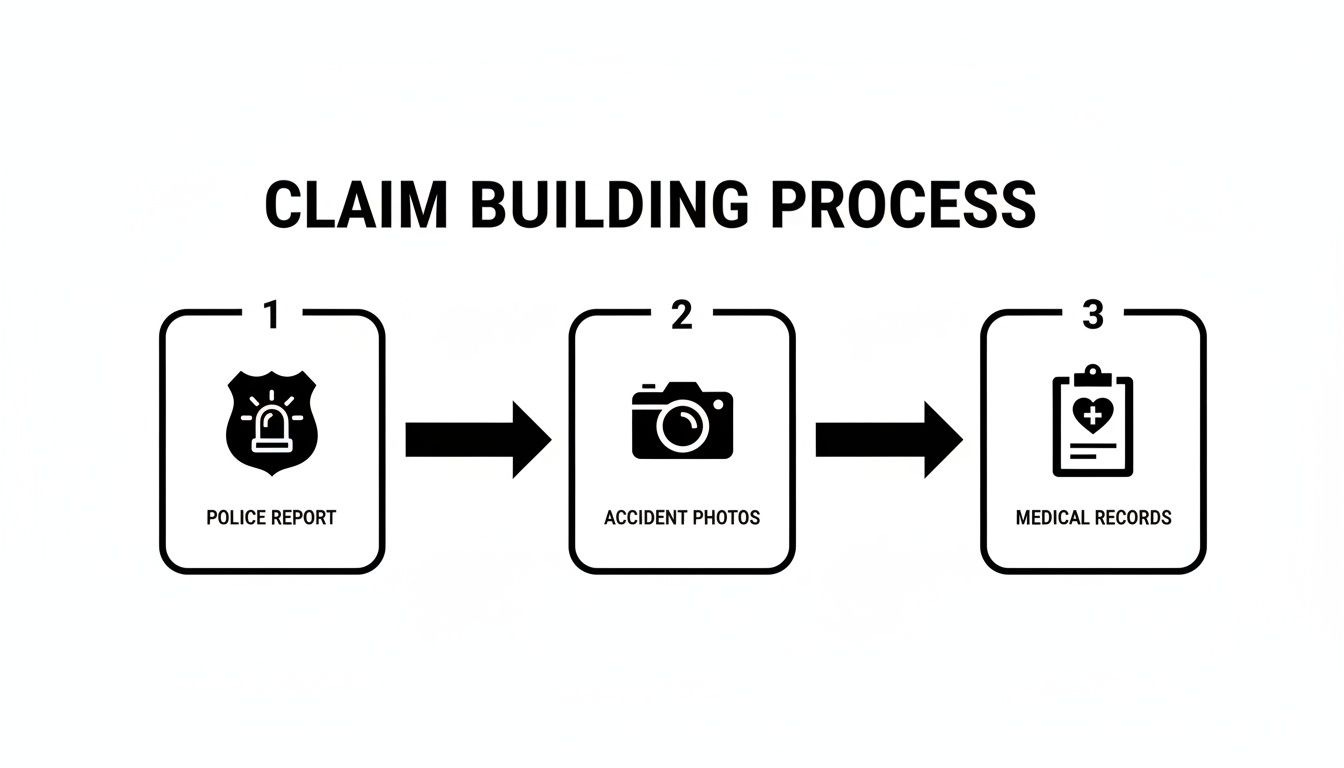
These three elements—the official police report, visual proof from the scene, and your medical documentation—form the undeniable bedrock of your case.
The Negotiation Phase
Once your medical treatment is finished or you’ve reached what’s known as maximum medical improvement, your attorney will get to work. They’ll gather all your medical bills, treatment records, and proof of lost wages. From there, they will calculate the full value of your claim, including pain and suffering, and send a formal demand letter to the insurance company.
This letter officially kicks off the negotiation process. The adjuster will almost always fire back with a low initial offer. This is a standard tactic; they’re testing the waters to see if you’re desperate enough to accept a fraction of what your claim is really worth.
An experienced lawyer knows how to shut down these lowball offers with compelling evidence and powerful legal arguments. We highlight the severity of your injuries, the true extent of your financial losses, and the profound impact this accident has had on your life. For instance, if you were hurt in a serious wreck involving a commercial vehicle, a skilled truck crash lawyer Houston understands the specific federal regulations and complex insurance policies at play, which adds another layer of expertise to the negotiations. We also handle cases involving catastrophic injury and wrongful death, bringing a depth of experience to every claim.
When a Lawsuit Becomes Necessary
The vast majority of personal injury claims are settled out of court. But if the insurance company digs in its heels, refuses to negotiate in good faith, or won't offer a fair settlement, filing a lawsuit is the necessary next step to protect your rights.
Filing a lawsuit doesn't mean your case is automatically heading for a dramatic trial. It simply moves the fight into the formal legal system and gives your attorney some powerful tools to continue fighting for you.
This stage involves processes like:
- Discovery: This is where both sides formally exchange information. It includes sharing documents, witness lists, and answers to written questions. We also take depositions, which are sworn testimonies given out of court.
- Mediation: In many cases, the court will order the parties to attend mediation. This is a structured negotiation session where a neutral third-party mediator works to help both sides find a middle ground and reach a settlement.
Our attorneys at The Law Office of Bryan Fagan, PLLC are seasoned negotiators and aggressive litigators. While we always aim to secure a fair settlement as efficiently as possible, we are always prepared to take your case to trial if that’s what it takes to get the justice and compensation you deserve. You should never feel pressured to accept less than you are owed, and we are here to make sure you don't have to.
Why a Texas Whiplash Injury Lawyer Makes a Difference
After an accident, you’re dealing with pain, medical bills, and a mountain of stress. The last thing you need is to go toe-to-toe with a massive insurance corporation. This is where an experienced Texas personal injury lawyer becomes your most crucial advocate, leveling the playing field and fighting for your right to fair compensation.
Let's be clear: insurance companies are businesses, and their goal is to protect their profits, not your well-being. Their adjusters are skilled negotiators trained to minimize payouts. They might try to downplay your injuries, question your medical treatments, or find creative ways to shift the blame onto you. Trying to handle this alone while you’re focused on healing is an uphill battle you shouldn’t have to fight.

How an Attorney Strengthens Your Claim
When you partner with The Law Office of Bryan Fagan, PLLC, you get a dedicated team that manages every single detail of your case so you can focus on what truly matters—getting better. We lift that burden right off your shoulders by handling all the complex and time-consuming work.
Here’s what we do for you:
- Handle All Communications: We take over every call and email with the insurance companies. You won’t have to worry about an adjuster twisting your words or pressuring you into a quick, lowball settlement.
- Conduct a Thorough Investigation: We immediately get to work gathering critical evidence. From the official police report and witness statements to traffic camera footage, we make sure no stone is left unturned.
- Calculate Your Full Damages: We meticulously document every loss you've suffered. This isn't just about your current medical bills; it includes future therapy, lost earning potential, and the true cost of your pain and suffering.
- Negotiate Aggressively: Armed with solid evidence and a deep understanding of Texas law, we negotiate from a position of strength to demand the maximum compensation for whiplash you are owed.
An attorney knows exactly how to counter the tactics insurance companies use to undervalue claims. We anticipate their arguments, challenge their offers, and make sure your story is heard and respected.
No Upfront Costs and No Financial Risk
We firmly believe that everyone deserves access to justice, regardless of their financial situation. That’s why we handle whiplash injury cases on a contingency-fee basis.
What does this mean for you? You pay absolutely no attorney’s fees unless we win your case and recover money for you.
There are no hidden costs or out-of-pocket expenses. Our fee is simply a percentage of the settlement or verdict we secure on your behalf. If we don’t win, you owe us nothing. It’s that simple. You can learn more about how a contingency fee agreement works and see how it provides a completely risk-free path to getting the expert legal help you need.
A serious accident can change your life in an instant—but you don’t have to face the aftermath alone. The Law Office of Bryan Fagan, PLLC is here to offer the support, experience, and determined advocacy needed to help you move forward. Recovery is possible, and legal help is available.
Schedule a free, no-obligation consultation with our team today to discuss your case and learn how we can fight for you.
Your Top Questions About Texas Whiplash Claims, Answered
When you're dealing with the aftermath of a car wreck, questions are bound to pop up. Here are some clear, straightforward answers to the most common concerns we hear from our clients dealing with whiplash injuries across Texas.
How Long Do I Have to File a Whiplash Claim in Texas?
In Texas, the clock starts ticking the moment the accident happens. You generally have two years from that date to file a personal injury lawsuit.
This deadline is called the statute of limitations, and it's incredibly strict. If you miss that two-year window, the courthouse doors will almost certainly slam shut on your right to seek compensation, no matter how solid your case is. This is why it's so important to talk to an attorney as soon as possible to protect your rights.
What if I Was Partially at Fault for the Wreck?
This is a common worry, but it doesn't automatically kill your claim. Texas uses a rule called "proportionate responsibility."
Basically, you can still recover money for your injuries as long as a court decides you were 50% or less at fault for the collision. Your final compensation will simply be reduced by whatever percentage of fault is assigned to you. For example, if you're awarded $50,000 but found to be 20% to blame, your award gets cut by $10,000, leaving you with $40,000.
Will I Have to Go to Court for My Whiplash Claim?
Most of the time, no. The vast majority of personal injury claims get settled out of court. A good Texas personal injury lawyer will go to bat for you, negotiating directly with the other driver's insurance company to hammer out a fair settlement that covers everything you've lost.
The main goal is always to get your claim resolved efficiently, without ever setting foot in a courtroom. But if the insurance company digs in their heels and refuses to make a fair offer, you need a lawyer who is ready and willing to take them to trial.
That willingness to fight is what shows the insurance company you mean business.
A serious accident can flip your world upside down in an instant—but you don’t have to pick up the pieces alone. The dedicated team at the Law Office of Bryan Fagan, PLLC is here to give you the support and legal firepower you need to start moving forward. We take on the legal fight so you can focus on what really matters: your recovery.
For a free, no-strings-attached consultation to go over your case, contact us today at https://texaspersonalinjury.net.