A serious accident can change your life in seconds—but you don’t have to face it alone. If you're dealing with a whiplash injury in Texas, a fair settlement typically falls somewhere between $7,500 and $50,000. For more severe cases that require extensive treatment, that figure can climb well over $100,000.
However, that final number isn't pulled out of a hat. It all comes down to the seriousness of your injury, the quality of your medical records, and the experience of the lawyer fighting for you.
Understanding Your Right to a Fair Whiplash Settlement

A serious crash can turn your world upside down in an instant, but you don't have to navigate the aftermath alone. Right now, you're probably dealing with sharp neck pain, a growing stack of medical bills, and a ton of uncertainty about what comes next. It’s a confusing and overwhelming time, and the last thing you should have to worry about is figuring out a complex legal claim.
Knowing your rights is the first real step toward getting back on your feet. The shock and anxiety are completely normal, and our mission here at The Law Office of Bryan Fagan, PLLC, is to cut through the noise and give you clarity. We want to arm you with the information you need to move forward with confidence.
Why You Can't Trust "Average" Settlement Numbers
You've probably seen articles talking about average whiplash settlements. Be careful with those. While it's true that many well-documented whiplash claims can settle for more than $100,000, others end up with far less—often because the full impact of the injury was never properly proven.
A "fair settlement" isn't some generic average. It’s a specific number calculated based on your unique losses. That means it covers not just the immediate hospital bills but also any future physical therapy, the income you lost while out of work, and the very real physical pain and emotional toll you've been forced to endure.
A "fair" whiplash injury settlement is one that fully compensates you for every loss caused by the other driver's negligence. This includes economic damages like medical bills and lost wages, as well as non-economic damages for your pain, suffering, and the impact on your quality of life.
What Goes Into a Fair Settlement in Texas?
So, what exactly determines a fair amount for your specific situation? Several key pieces have to come together. An experienced Texas personal injury lawyer will meticulously analyze each one to build a powerful case for you.
To give you a clearer picture, the table below breaks down the main factors that shape the value of a whiplash claim.
Key Factors Influencing Your Whiplash Settlement
| Factor | Why It Matters for Your Settlement |
|---|---|
| Severity of Your Injuries | The more significant the damage to your neck's muscles, ligaments, and nerves, the higher the potential settlement value. |
| Total Medical Expenses | This isn't just the ER visit. It's every dollar spent on physical therapy, prescriptions, follow-ups, and any future care. |
| Impact on Your Daily Life | We look at how the injury affects your ability to work, do chores, and even enjoy your hobbies. This is a critical part of your claim. |
| Strength of Evidence | Hard proof is everything. Clear evidence showing the other driver's fault and detailed medical records are essential to getting max value. |
Each of these elements tells a part of your story, and together they create a complete picture of what you've lost.
That sudden jolt from a rear-end collision on a Houston freeway does more than just cause a sore neck—it can throw your entire life off course. At The Law Office of Bryan Fagan, PLLC, we're here to help you navigate this process and fight for the compensation you rightfully deserve.
The Key Factors That Determine Your Settlement Value

While looking at average settlement numbers can give you a rough idea, they don’t begin to tell your personal story. The real value of your whiplash settlement isn’t pulled from a simple chart; it's pieced together by looking at several specific factors that are unique to you and your accident.
Think of it like building a house. You can’t guess the final price just by knowing its square footage. You have to account for every single material—the foundation, the framing, the plumbing—to know its true worth. Your settlement is built the same way, and every piece of evidence we gather is a building block that makes your claim stronger.
To pull back the curtain on this process, we need to look at the two main types of compensation you can recover in Texas. These are legally known as "damages," and understanding them is the first step to understanding what your claim is truly worth.
Documenting Your Economic Damages
Economic damages are the most concrete part of your claim. Why? Because they represent direct financial losses that have a clear dollar amount attached. These are the tangible, out-of-pocket costs you’ve already paid—and will have to pay in the future—all because someone else was negligent.
Your attorney's primary job here is to collect every single receipt, bill, and pay stub to create an ironclad record of these financial hits.
Key economic damages in a whiplash case include:
- Medical Bills: This covers everything. We’re talking about the initial ER visit, the ambulance ride, MRIs and X-rays, chiropractic adjustments, physical therapy, prescription drugs, and appointments with specialists.
- Future Medical Costs: Whiplash isn’t always a quick recovery. If your doctor believes you'll need ongoing care, like future therapy sessions or pain management injections, those projected costs are a critical piece of your settlement.
- Lost Wages: This is simple: it’s the income you couldn't earn because your injury kept you from working. For a Houston construction worker with a severe neck sprain, being unable to lift materials or operate equipment can mean weeks or even months of lost pay.
- Loss of Earning Capacity: This is different from lost wages. If your whiplash injury leads to chronic pain or permanent physical limitations that stop you from returning to your old job or working the same hours, you can be compensated for this loss of future earning power.
When we're tallying up your medical expenses, it's also helpful to see how any available insurance coverage for treatments can help with immediate costs, which can influence the final value of your claim.
Crucial Takeaway: You should never, ever settle your claim until your doctors say you’ve reached "maximum medical improvement" (MMI). This is the point when your condition is stable and your doctor has a clear picture of your long-term prognosis. Settling before you reach MMI is a huge gamble—you could be left paying for future medical care out of your own pocket.
Proving Your Non-Economic Damages
Non-economic damages are just as real as your medical bills, but they are much harder to put a price tag on. This is the compensation for the human cost of the injury—the physical pain and emotional turmoil the accident has forced you and your family to endure.
Since there are no receipts for suffering, proving these damages requires telling a compelling story backed by solid evidence. This is where a skilled Houston car accident attorney makes all the difference, transforming your experience from just a case file into a powerful narrative that connects with insurance adjusters and juries.
Common non-economic damages include:
- Pain and Suffering: This refers to the actual physical pain, soreness, stiffness, and general discomfort you live with because of the injury. Keeping a daily pain journal is an incredibly effective way to document this.
- Mental Anguish: A car crash is a violent, traumatic event. This damage category compensates for the emotional fallout—anxiety, depression, fear of driving, or nightmares that keep you up at night.
- Physical Impairment: This is about the loss of ability to do the things you once enjoyed. If constant neck pain means you can no longer pick up your toddler, play a round of golf, or work in your garden, that loss has real value.
- Loss of Consortium: In some situations, the uninjured spouse may have their own claim for the loss of companionship, affection, and intimacy that resulted from their partner's injuries.
The scale of these injuries is massive. In the United States, about $3.9 billion is spent every year on medical care for whiplash alone. That staggering number is precisely why insurance companies fight these claims so hard. At The Law Office of Bryan Fagan, PLLC, we know how to build a case that proves the full extent of your losses, making sure you are seen as a person, not just another claim number.
Navigating Critical Texas Injury Laws
Knowing what your whiplash claim might be worth is just one piece of the puzzle. To actually get the compensation you deserve, you have to play by the rules here in Texas. These laws can seem confusing, but they set the stage for every single personal injury claim, and understanding them is crucial for protecting your rights.
Think of it like a game. You need to know how much time is on the clock and what actions can get you penalized. If you don't, you could lose before you even have a chance to make your case. In Texas, two of the most important rules you need to know are the statute of limitations and the state’s unique approach to shared fault.
How Long Do You Have to File a Claim in Texas?
Here in Texas, you generally have a two-year deadline to file a personal injury lawsuit. This is called the statute of limitations, and the clock starts ticking the moment the accident happens. Two years might sound like plenty of time, but it disappears fast when you're juggling doctor’s appointments, physical therapy, and just trying to get through the day.
Waiting too long is one of the biggest mistakes you can make. If you miss that two-year window, the court will almost certainly throw out your case. You’ll lose your right to recover any money, no matter how clear-cut your injuries are.
This deadline is exactly why you should contact a Texas personal injury lawyer as soon as you can. A good attorney will make sure all the legal paperwork is filed on time so you can focus on what really matters—healing.
How Shared Fault Can Affect Your Settlement
What if the insurance company tries to pin some of the blame on you? It's a classic tactic, and Texas has a specific rule for it called modified comparative fault, or comparative responsibility. A much simpler way to remember it is the 51% Bar Rule.
Here’s how it works:
- Your settlement gets reduced. If you’re found to be partly at fault, your final payout is reduced by your percentage of blame.
- You can be blocked from getting anything. If a jury decides you are 51% or more at fault, you are barred from recovering a single penny.
Let’s walk through a quick example to see this rule in action.
Scenario: A Houston Freeway Crash
Imagine you were rear-ended on I-45. The other driver’s insurance adjuster argues that one of your brake lights was out, making you partially responsible. A jury agrees and decides your broken light makes you 10% at fault for the crash, and they award $50,000 for your whiplash injury.
Under the 51% Bar Rule, that $50,000 award would be cut by your 10% of fault ($5,000), meaning you’d walk away with $45,000.
Now, if that same jury decided you were 51% at fault, your award would instantly drop to $0.
This rule is a powerful weapon for insurance companies. They will search for any reason, no matter how small, to push blame onto you and either slash your settlement or deny it completely. An aggressive Houston car accident attorney knows how to fight back against these unfair claims, working to prove the other driver was the one at fault and protecting the full value you’re owed. Whether you need a car accident lawyer, a truck crash lawyer in Houston, or a wrongful death lawyer in Texas for a more tragic outcome, we understand how to navigate this complex system.
Protecting Your Claim After a Whiplash Injury
The moments after a car accident are a blur of chaos and confusion. But what you do—and don't do—in this critical time can make or break your physical recovery and your eventual whiplash injury settlement. Getting it right from the start means building a rock-solid foundation for your claim.
Think of it like laying the groundwork for a house. You can't just start putting up walls without a solid, documented foundation. The same is true here. You need to create an undeniable record of your injuries and prove the other driver was at fault from day one.
Your Health and Your Claim Go Hand in Hand
The single most important thing to do after any crash is get medical help immediately. Even if you think you’re fine, adrenaline is a powerful painkiller that can easily hide serious injuries. It’s incredibly common for whiplash symptoms to show up late; you might walk away from a wreck feeling just a little shaken, only to wake up the next morning with excruciating neck pain and stiffness.
Seeking prompt medical attention, including services like chiropractic care after a car accident, is crucial for both your health and your legal claim. If you wait days or weeks to see a doctor, the insurance company will jump at the chance to argue your injuries must not have come from the accident.
Once you have a diagnosis, follow your doctor's orders without fail. This means:
- Showing up for every single physical therapy or specialist appointment.
- Filling your prescriptions and taking them exactly as directed.
- Respecting any restrictions on work or physical activities.
Following through on medical advice creates a clean, unbroken line of evidence. It shows just how serious your injury is and proves you're doing everything you can to get better. Any gaps in your treatment history are red flags for an insurer, who will use them to argue your injuries aren't as bad as you claim.
This flowchart maps out the key legal concepts that will govern your claim, from the strict two-year filing deadline in Texas to the way fault is determined and how you can ultimately recover damages.
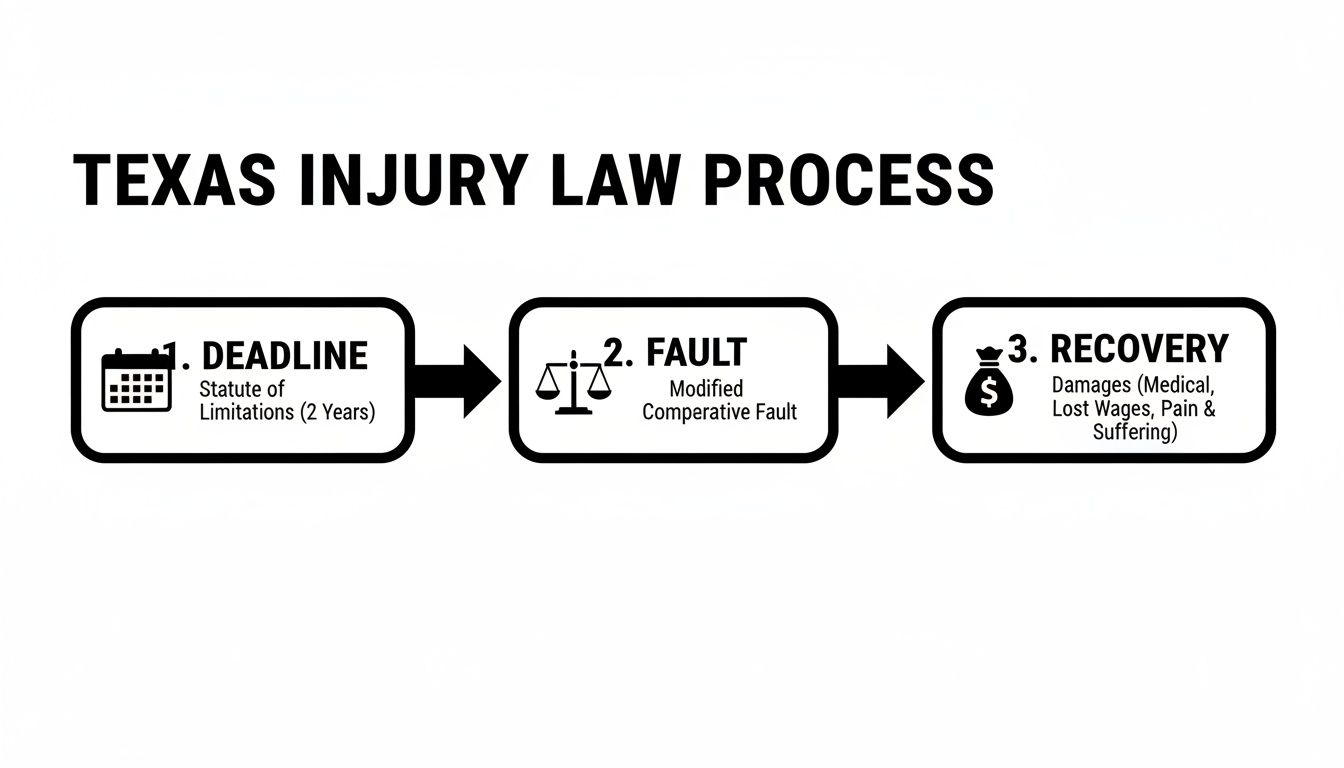
This process is why acting fast and sticking to the letter of Texas law is so vital for getting the outcome you deserve.
Document Everything Meticulously
Hard evidence is the muscle behind any successful settlement negotiation. From the second the accident happens, you need to switch into documentation mode. The more proof you have, the less room an insurance company has to argue with the facts.
To build a strong case, you'll need a comprehensive collection of documents and evidence. The table below outlines the essential items to start gathering right away.
Essential Documentation Checklist for Your Whiplash Claim
| Document Type | Purpose and Importance |
|---|---|
| Police Accident Report | Provides an official, third-party account of the crash, often including a preliminary determination of fault. |
| Accident Scene Evidence | Photos and videos of vehicle damage, skid marks, traffic signals, and the overall scene from multiple angles. This is your visual proof. |
| Witness Information | Names and contact details of anyone who saw what happened. Their testimony can be incredibly powerful in supporting your side of the story. |
| Complete Medical Records | Every bill, doctor's note, prescription receipt, and test result. This file documents the extent and cost of your injuries. |
| Proof of Lost Wages | Pay stubs and a letter from your employer detailing missed work and lost income directly tied to the injury. |
| A Pain Journal | Daily notes on your pain levels, how the injury impacts your daily life, and any emotional distress. This is crucial for non-economic damages. |
This checklist is your starting point for painting a clear, undeniable picture of how this accident has impacted every corner of your life, from your finances to your well-being.
The Recorded Statement Trap
It won’t be long before you get a call from the at-fault driver's insurance adjuster. They'll sound friendly, concerned, and helpful. Then they'll ask you to give a recorded statement about the accident. Politely refuse until you've spoken with a lawyer.
An insurance adjuster has one job: protect their company's bottom line by paying you as little as possible. They are trained professionals who ask leading questions designed to trick you into downplaying your injuries or admitting partial fault.
Even an innocent comment like "I'm doing okay" can be twisted later to argue your whiplash wasn't severe. Anything you say in that recording can, and absolutely will, be used to chip away at the value of your claim.
The steps you take right now are critical. By getting immediate medical care, documenting everything, and sidestepping common insurance traps, you are taking back control. The Law Office of Bryan Fagan, PLLC, is here to stand with you through this entire process, making sure your rights are defended every step of the way.
How Insurance Companies Devalue Whiplash Claims
You'd think the at-fault driver's insurance company would play fair after an accident. The hard truth is that insurance companies are businesses, and their number one goal is protecting their profits. That means their adjusters are trained professionals whose job is to find reasons to pay you as little as possible for your whiplash injury settlement.
Understanding their playbook is the first step toward protecting your own interests. Their tactics are predictable, but they're incredibly effective against people who are already stressed out and trying to recover from an injury. When you know what to look for, you can sidestep their traps and level the playing field.
The Quick and Low Settlement Offer
One of the oldest tricks in the book is the quick settlement offer. Don't be surprised if an adjuster calls you just days after the crash. They’ll sound friendly and concerned, offering you a check right away to cover your "immediate" costs. It might feel like a lifeline, but it’s almost always a trap.
This offer is a lowball amount, plain and simple. It’s made before you—or even your doctors—have any real idea how serious your whiplash is. Whiplash symptoms are notorious for taking days, sometimes weeks, to fully show up. If you take that early check, you sign away your right to ask for more money later, even if your injury turns into a chronic condition that needs years of treatment.
Crucial Insight: An insurance adjuster's job is to close your claim for the lowest amount of money their company can get away with. They are not your friend, and that first offer is rarely, if ever, a fair reflection of what your claim is actually worth.
Using Your Own Words Against You
Insurance adjusters are masters of conversation, specifically trained to get you to say things that can torpedo your claim. If you agree to a recorded statement, they will ask carefully worded, leading questions designed to get you to downplay your pain or even admit you were somehow at fault.
Even simple, polite answers can be twisted and used to deny you fair compensation.
- If you say: “I’m doing okay, thanks.”
- They hear: “The injury isn’t serious.”
- If you say: “I’m not sure exactly what happened.”
- They hear: “You might be partially to blame.”
This is exactly why we tell every client to politely refuse to give a recorded statement until they've talked to a Texas personal injury lawyer. Your attorney will handle all communications with the insurance company, making sure your words can't be weaponized against you.
Blaming Pre-Existing Conditions
Another go-to tactic is digging through your medical history to find a pre-existing condition they can blame for your current pain. Had a sore back a few years ago? They'll argue your pain is from that old issue, not the car crash their client caused.
This argument conveniently ignores a well-established principle in Texas law: the "eggshell skull" rule. This rule says that a negligent person is responsible for all the harm they cause, even if the person they hurt was more fragile or susceptible to injury than someone else. If their driver's carelessness flared up a dormant condition, they are still on the hook for the damage.
Trying to fight these tactics on your own is an exhausting, uphill battle. An experienced Houston car accident attorney at The Law Office of Bryan Fagan, PLLC, knows how to shut these arguments down with solid medical records and expert testimony. We’ll build a case that proves the accident was the direct cause of your suffering and ensure the insurance company treats you fairly.
Get Help from an Experienced Texas Injury Lawyer
One serious accident can turn your life upside down in a matter of seconds. But you shouldn’t have to face the overwhelming aftermath on your own.
Getting a fair whiplash injury settlement means dealing with complex Texas laws, collecting the right evidence, and pushing back against insurance companies whose only real goal is to protect their own profits. That’s a heavy burden to carry when you’re just trying to heal.
At The Law Office of Bryan Fagan, PLLC, our entire focus is on taking that weight off your shoulders. We handle every single part of your claim so you can put all your energy into your physical and emotional recovery. Our team is here to give you the support and aggressive advocacy you need right now.
How We Fight for You
The moment you partner with our firm, we get to work. We will:
- Launch a complete investigation into your accident to prove exactly who was at fault.
- Take over all communication with insurance adjusters, shielding you from their pressure tactics.
- Consult with medical experts to document the true extent of your injuries and what you’ll need for future care.
- Build a powerful, evidence-backed case that shows the total value of your economic and non-economic damages.
- Fight tirelessly for you—whether in negotiations or in court—to get the maximum compensation you deserve.
We know the last thing you need right now is another bill. That’s why we work on a contingency fee basis. Plain and simple, this means you pay us absolutely nothing unless we win your case. Our success is tied directly to yours.
Recovery is possible, and you have every right to seek justice. You don't have to accept an insurer's lowball offer or feel intimidated by the legal process. Legal help is available to level the playing field.
Choosing the right lawyer is one of the most important steps you'll take. To help you feel confident in your decision, you can learn more about what to look for in our guide on how to pick a personal injury attorney.
Your fight is our fight. Contact The Law Office of Bryan Fagan, PLLC today for a free, no-obligation consultation. Let us listen to what happened, answer your questions, and show you how we can help you start putting your life back together.
Answering Your Questions About Whiplash Settlements
After an accident, it’s completely normal to have a flood of questions. Getting clear, honest answers is the first step toward taking back control. Here are some of the most common questions we hear from clients navigating the whiplash injury settlement process right here in Texas.
How Long Will My Whiplash Settlement Take?
There’s no single timeline, as every case is different. A straightforward claim with minor injuries and obvious fault could wrap up in a few months. But if your injuries are more serious, require long-term treatment, or the insurance company tries to fight you on who’s to blame, it could easily take a year or more—especially if we have to file a lawsuit to get their attention.
The goal is never just to settle fast. We need to wait until you’ve reached what’s called maximum medical improvement. This critical point ensures we know the full, long-term cost of your injury before we even think about accepting an offer.
Do I Have to Go to Court for a Whiplash Claim?
It's highly unlikely. The overwhelming majority of personal injury claims, including whiplash cases, are settled through negotiations between your lawyer and the insurance adjuster. A courtroom is the last resort.
Filing a lawsuit is a strategic tool we use when an insurer simply refuses to offer what's fair. Even then, most cases settle before a trial ever begins. We prepare every single case as if it's going to trial, which sends a strong message to the insurance company that we mean business. This approach often brings them back to the table with a much better offer.
Can I Get a Settlement if I Was Partially at Fault?
Yes, in many cases, you can. Texas operates under a rule called modified comparative fault. This law says you can still recover money for your injuries as long as you are 50% or less responsible for the crash.
Your settlement, however, will be reduced by whatever percentage of fault is assigned to you. For example, if you’re awarded $50,000 but found to be 10% at fault, your final recovery would be cut to $45,000. This is exactly why it's so important to have a tough Houston car accident attorney fighting to protect you from unfair blame.
What if the Other Driver Was Uninsured?
This is a scary situation, but you may still have options. If the at-fault driver has no insurance, we can turn to your own auto policy for your Uninsured/Underinsured Motorist (UM/UIM) coverage. This is optional coverage in Texas, but it's an absolute lifeline when you need it.
Filing a UM/UIM claim means you’ll be dealing with your own insurance company. Unfortunately, that can be just as difficult as fighting the other driver’s insurer. A dedicated Texas personal injury lawyer can take over this entire process, making sure your own insurance company treats you fairly.
The road to recovery can feel overwhelming, but you don't have to navigate it alone. The experienced team at The Law Office of Bryan Fagan, PLLC is here to answer your questions and fight for the compensation you deserve. For a free, no-pressure consultation to discuss your case, contact us today at https://texaspersonalinjury.net.