A serious truck accident can change your life in seconds—but you don’t have to face it alone. In the chaos that follows a crash, your first priority is always safety and getting medical help. Once you've secured the scene and called 911, the steps you take can be crucial for protecting your rights.
Your Immediate Actions at the Accident Scene
The shriek of tires and the sickening crunch of metal—the moments after colliding with an 18-wheeler are terrifying, leaving you disoriented and shaken. What you do next, with adrenaline pumping through your system, can have a massive impact on both your physical recovery and your fight for justice.
Truck accidents are different from a typical car crash. An 80,000-pound semi-truck can inflict catastrophic damage, even at low speeds. The forces involved are immense, and injuries are often severe, even if you don't feel them right away.
Prioritize Safety Above All Else
If your car is still drivable, the first thing you need to do is try to move it to the shoulder or a safer spot away from traffic. Picture a pile-up on I-10 in Houston during rush hour; staying in a live lane of traffic puts you in grave danger of a secondary collision, which can be even worse than the first.
Once you’re in a safer location, turn on your hazard lights to warn other drivers. Then, check on yourself and your passengers for any obvious injuries. It's critical to stay in your vehicle if it's not safe to get out, but if you can exit safely, do it and move well away from the wreckage.
Call 911 Immediately
No matter how minor the accident seems, always call 911. This one action accomplishes two vital things: it gets law enforcement on the way and summons emergency medical services. An official police report is one of the most important pieces of evidence you can have for a personal injury claim, providing a neutral, third-party account of the scene, weather, and initial statements.
When paramedics arrive, let them check you out. Even if you feel okay, adrenaline is a powerful painkiller that can mask serious injuries like internal bleeding, concussions, or whiplash. Refusing medical attention at the scene is a classic mistake that insurance companies love to use later to argue your injuries weren't caused by the crash.
Key Takeaway: A documented medical evaluation, starting at the scene, creates a direct link between the truck accident and your injuries. This is a cornerstone of a successful claim.
The danger in these collisions is stark. Statistics show that thousands of people are killed in U.S. crashes involving large trucks each year. The heartbreaking part? The vast majority of those fatalities are occupants of passenger vehicles, not the truckers. This happens because a commercial truck can weigh 20 to 30 times more than a typical car, turning what might have been a fender-bender into a life-altering event. You can dig deeper into these commercial truck accident statistics to see just how high the risks are.
At our firm, we've created a simple checklist to help you remember these critical steps when your mind is racing.
At-Scene Checklist for Texas Truck Accidents
This table is a quick reference guide for the most important actions to take right after a collision with a commercial truck. Keeping these points in mind can make a significant difference in the outcome of your case.
| Action to Take | Why It Matters for Your Case |
|---|---|
| Move to Safety | Prevents secondary accidents and shows you took reasonable steps to mitigate further harm. |
| Call 911 | Creates an official police report and ensures medical help is dispatched immediately. |
| Get Medical Attention | Adrenaline can mask serious injuries. A paramedic's report links your injuries directly to the crash. |
| Take Photos/Videos | Document everything: vehicle damage, road conditions, skid marks, and injuries. This is crucial visual evidence. |
| Exchange Information | Get the truck driver's name, license, insurance, and the trucking company's name and USDOT number. |
| Speak to Witnesses | Get names and contact info from anyone who saw what happened. Their testimony can be invaluable. |
| Do Not Admit Fault | Avoid saying "I'm sorry" or speculating on what happened. Stick strictly to the facts. |
Having this checklist handy, even just mentally, can help you stay focused and protect your rights during an incredibly stressful time.
Interacting with the Truck Driver and Police
Every word you say at the scene matters. When you're talking to the truck driver or law enforcement officers, do your best to stay calm and stick to the facts. Give them your name, contact information, and insurance details, but don't get into a detailed discussion about how the accident happened or who might be at fault.
Never apologize or say anything that could be twisted into an admission of guilt, like "I'm so sorry," or "I didn't even see you." The trucking company and its insurance carrier will jump on those statements and use them against you. Imagine you're in a crash on the Dallas High Five interchange and you apologize out of pure shock—that simple courtesy could later be framed as you taking responsibility for the collision.
When the police officer asks for your side of the story, just describe what you saw, heard, and felt.
- State which direction you were traveling.
- Describe your speed right before the impact.
- Explain where the truck came from and how it hit your vehicle.
Don't guess about speeds or distances if you aren't sure. Just state what you know for a fact. This calm, factual approach is the best way to protect your legal rights from the very start.
How to Gather Critical Evidence Yourself
While police will conduct an investigation, the evidence you can gather yourself in the moments after a truck accident is often the most compelling. If you're physically able to, your smartphone becomes a powerful tool for documenting the scene before it's cleared.
Your goal is simple: paint a clear, undeniable picture of what happened. Take more photos and videos than you think you need. Shoot from every possible angle. This visual proof can be a game-changer later on, especially when memories fade or official reports are missing key details.
Documenting the Scene with Your Phone
Think like an investigator. Your photos and videos need to capture the raw, immediate aftermath exactly as it is. Make sure you get shots of:
- All Vehicle Damage: Start with wide shots showing where every vehicle came to rest. Then, get close-ups of the damage to your car, the truck, and any other vehicles involved.
- The Entire Scene: Take pictures of any skid marks on the road, debris scattered across the lanes, and the general road conditions. Was it wet? Was there a construction zone? Document it.
- Relevant Signs and Signals: Snap photos of any nearby stop signs, traffic lights, speed limit signs, or other warnings that could have played a role.
- Your Injuries: It might be the last thing on your mind, but photograph any visible injuries to you or your passengers, like cuts, bruises, or swelling. This creates an immediate record of the harm done.
This infographic breaks down the absolute first things you should do at the scene.
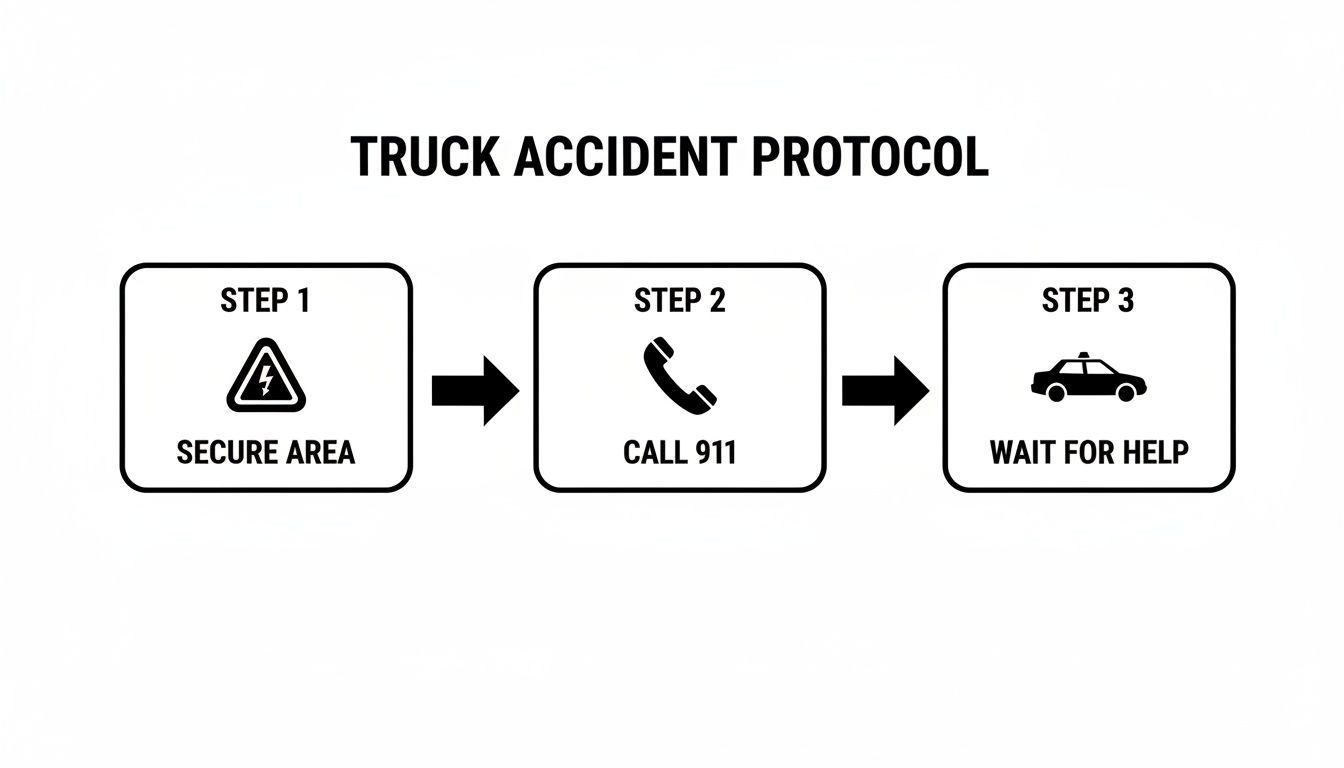
The protocol is straightforward: first, get to a safe location. Second, call 911 immediately. Third, wait for help to arrive before you do anything else.
Information from the Commercial Truck
That big rig is covered in valuable information that the trucking company won't hand over willingly. Use your phone to get clear pictures of:
- The trucking company’s name and logo on the cab and trailer.
- The license plate numbers for both the tractor and the trailer.
- Any U.S. Department of Transportation (USDOT) or Motor Carrier (MC) numbers you can find on the vehicle. These are unique identifiers that are critical for looking into the company's safety history.
This information is gold for a truck crash lawyer Houston. It helps us pinpoint every single party that could be liable—not just the driver, but the trucking company, a third-party maintenance shop, or even the company that loaded the cargo.
Expert Insight: In a complex truck accident case, there are often multiple layers of responsibility. Securing the truck's specific identifiers (like the USDOT number) allows your legal team to immediately begin investigating the carrier’s history of safety violations, hiring practices, and maintenance records.
The Power of Witness Testimony
Independent witnesses can be your best allies. Their unbiased accounts can support your story and counter any false narratives from the truck driver or their employer. If people stopped after seeing the crash, politely ask for their name and phone number.
You don't need a full statement on the side of the road. Just securing their contact info is a huge step. A simple, "Did you see what happened? Could I please get your name and number in case my attorney needs to follow up?" is all it takes.
It's also worth noting that having your own objective witness can make a world of difference. Consulting a dash cam buying guide can help you find a tool that provides indisputable video evidence.
Securing the Truck's "Black Box" Data
Almost every modern big rig has an Electronic Logging Device (ELD) or an Event Data Recorder (EDR) on board—what most people call a "black box." This device records a treasure trove of data: the truck’s speed, when the brakes were applied, the driver's hours on the road, and even steering inputs right before, during, and after a crash.
This data is digital gold, but it can disappear fast. Some systems can overwrite data in as little as 30 days. This is why you must contact a truck crash lawyer right away. One of the first things we do is send a spoliation letter—a legal demand—to the trucking company, ordering them to preserve that electronic data and the truck itself. Without that notice, the proof that the driver was speeding or fatigued could be lost forever.
Dealing with Medical Care and Insurance Adjusters
In the days and weeks after a serious truck accident, your number one priority must be your health. Adrenaline is powerful and can mask severe injuries, making you feel surprisingly okay right after a crash. Please, don't let that fool you—seeking a professional medical evaluation immediately is essential.
This isn't just about your physical well-being; it's a foundational step for protecting your legal rights. A documented medical record from an ER or your doctor creates an official timeline. It directly connects your injuries to the truck driver's negligence. Without this proof, the trucking company's insurer will argue your injuries happened somewhere else.

That Inevitable Call from the Adjuster
It won't be long before your phone rings. It might even happen while you’re still in the hospital. On the other end will be an insurance adjuster from the trucking company, and they will likely sound friendly and concerned. Their job is to protect their company’s bottom line by minimizing or denying your claim.
They will almost certainly ask you for a recorded statement. You need to politely decline. Adjusters are trained to ask leading questions. Their goal is to get you to say something that can be twisted to downplay your injuries or suggest you were partially at fault.
Let's play out a real-world scenario. Imagine you were hit by a semi on Loop 410 in San Antonio. An adjuster calls, offering a quick $5,000 settlement to help with your "immediate bills." When you're stressed and out of work, that might sound tempting. It’s a trap.
Critical Warning: If you accept a quick settlement, you'll have to sign away your right to any future compensation. When you find out a month later that you need surgery for a herniated disc, that $5,000 won't come close to covering the cost, and you'll have no legal recourse.
Why You Should Speak to a Lawyer First
After handling your immediate medical needs, your focus must shift to protecting your legal and financial future. Truck accident cases are far more complex than a standard car crash, involving federal regulations and massive commercial insurance policies. The trucking company’s adjuster knows this and will push hard for a lowball settlement before you grasp the true value of your claim.
It is absolutely essential to have an experienced truck accident lawyer in your corner before you speak with the other side. We know their tactics, we know how to handle these calls, and we can shield you from their pressure. For a deeper dive into these interactions, check out our guide on how to deal with insurance adjusters.
Reporting to Your Own Insurance Company
While you should never give a recorded statement to the trucking company’s insurer, you do have a duty to report the accident to your own insurance company promptly. When you make that call, keep it simple and stick to the facts.
- State the date, time, and location of the crash.
- Provide the other driver’s information and the police report number, if you have it.
- Do not guess about who was at fault or discuss the extent of your injuries.
Just report the facts. This fulfills your obligation under your policy without giving away any information that could be used against you later. Your attorney can guide you through this process to make sure your rights are protected every step of the way.
Understanding Your Legal Rights Under Texas Law
Trying to understand the legal system after a traumatic truck crash can feel overwhelming. But grasping your basic rights under Texas law is a powerful step toward justice. These rules are in place to ensure a fair process, and knowing them helps you make smart decisions from the start.
A major accident can leave you feeling powerless. Knowledge is the key to taking that power back. The law in Texas provides a path for holding negligent trucking companies accountable and getting the compensation you need to put your life back together.
How Fault is Determined in Texas
Texas uses a legal principle called modified comparative fault, sometimes known as the 51% bar rule. This is one of the most critical concepts in any personal injury claim.
In simple terms, it means you can still recover money even if you were partially to blame for the accident, as long as your share of the fault is 50% or less. If you are found to be 51% or more responsible, you are barred from recovering anything.
Let's walk through a real-world example. Say you were on a Houston freeway, going just five miles over the speed limit. A truck driver, exhausted from pushing past their federal hours-of-service limits, drifts into your lane and sideswipes your car, causing a devastating wreck.
The trucking company's lawyers will seize on the fact you were speeding. A jury might agree and assign you 10% of the fault. Under the 51% rule, this doesn't kill your case. Instead, your final compensation award is reduced by your percentage of fault. So, if your total damages were $500,000, you could receive $450,000 (90% of the total).
How Long Do You Have to File a Claim in Texas?
After a truck accident, time is not on your side. Texas has a strict statute of limitations, which gives you exactly two years from the date of the crash to file a personal injury lawsuit.
Two years might sound like a long time, but it disappears quickly when you're dealing with surgeries, doctor's appointments, and physical therapy. Waiting is one of the biggest mistakes you can make.
Key evidence, like the truck's black box data, driver logs, and maintenance records, can be lost or legally destroyed within weeks. Witness memories also fade. Acting fast lets your lawyer send out legal preservation letters to lock down that evidence.
If you miss this two-year deadline, you lose your right to seek compensation in court forever, no matter how strong your case is. To get a better handle on these timelines, you can learn more about how long after an accident you can claim an injury in our detailed guide.
Proving Negligence is the Foundation of Your Claim
To win your case, your attorney must prove the truck driver and their company were negligent. "Negligence" is a legal standard that requires proving four distinct elements:
- Duty: The truck driver had a legal duty to operate their commercial vehicle safely to avoid harming others.
- Breach: The driver breached that duty. This could mean they were speeding, texting, driving while fatigued, or violating federal trucking regulations.
- Causation: The driver's careless actions (the breach) directly caused the crash and your injuries.
- Damages: You suffered real harm because of the crash, such as medical bills, lost wages, and pain and suffering.
Your legal team will work immediately to gather the evidence needed to prove each of these points and build an airtight case against everyone responsible. As you go through this process, it can also be helpful to look at Texas-specific legal information and resources for additional guidance.
Why Truck Accident Claims Are So Much More Complicated
Many people assume that a collision with a commercial truck is just a bigger version of a car crash. While the damage is more severe, the legal side is a completely different and incredibly complex world. When you're dealing with a truck accident, you're not just up against a driver. You're facing a large corporation, its team of lawyers, and aggressive insurance carriers whose job is to protect their bottom line.
A standard car accident usually involves two drivers and their insurance companies. A truck accident, however, opens up a web of potential liability. The driver may be at fault, but the responsibility often goes much higher up the chain.
Multiple Parties Can Share the Blame
One of the first jobs for a skilled Texas truck accident lawyer is figuring out every party that could be responsible. Depending on the cause of the crash, fault could lie with:
- The Trucking Company (Motor Carrier): They are often liable for negligent hiring, failing to train drivers, or pushing them to break safety rules to meet deadlines.
- Maintenance Contractors: If an outside company was hired to service the truck and did a poor job on the brakes or tires, they can be held liable.
- Cargo Loaders: Improperly loaded or unsecured cargo can shift mid-journey, causing the driver to lose control. The loading company could be at fault.
- Vehicle or Parts Manufacturers: A defective tire, a faulty braking system, or a steering component that fails can lead to disaster on the road.
Because so many parties could be involved, gathering evidence is everything. Federal data reveals that many of these wrecks are caused by driver fatigue and speeding—problems often directly linked to company pressure. In cases where a loved one is lost, a wrongful death lawyer Texas can help families navigate these complex claims.
The Role of Federal Trucking Regulations
Unlike passenger cars, the entire trucking industry is governed by extensive laws from the Federal Motor Carrier Safety Administration (FMCSA). These rules exist to prevent accidents by holding trucking companies and drivers to high standards. An experienced truck crash lawyer knows these regulations and uses them to build a powerful case.
Key FMCSA regulations that frequently come into play include:
- Hours-of-Service (HOS) Rules: These laws strictly limit how long a driver can be on the road before they must take a rest break to fight deadly driver fatigue.
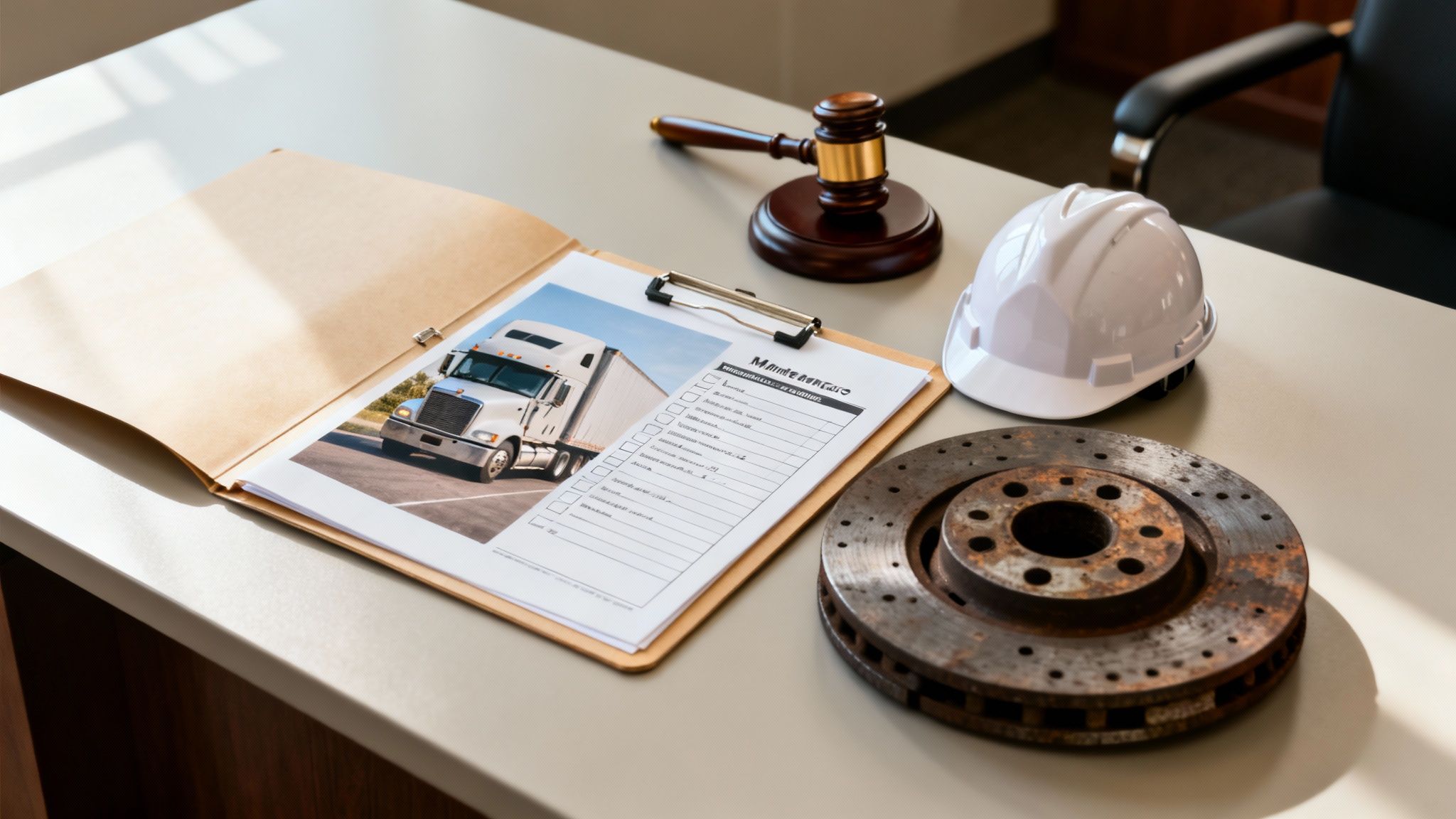
- Vehicle Inspection and Maintenance: Carriers are required to keep detailed logs of all inspections and maintenance performed on their trucks.
- Hiring and Training Standards: Trucking companies must run background checks and ensure their drivers are qualified, properly trained, and safe.
A violation of an FMCSA safety rule isn't just a mistake—it's powerful proof of negligence. When we can show that a trucking company broke federal law, it can become the cornerstone of your personal injury claim.
Imagine a crash on a busy Dallas highway caused by brake failure. The driver claims it was a sudden mechanical issue. But a proper investigation by a qualified attorney uncovers maintenance logs showing the trucking company had been skipping mandatory brake inspections to cut costs.
That violation of federal law creates a clear line of negligence straight to the company, making them liable for the harm they caused. This is why you need a legal advocate who understands the nuances of these cases.
To learn more about how we handle these intricate situations, you can read about our experience with truck accident claims in Texas. The sheer complexity is a major reason why you should never try to handle a truck accident claim on your own.
Common Questions After a Texas Truck Accident
When you're dealing with the aftermath of a commercial truck wreck, your mind is probably racing with questions. The uncertainty can be overwhelming, but getting clear answers is the first step toward getting back on your feet. Here are direct responses to the most common questions we hear from victims and their families.
Our goal is to cut through the confusion and show you that you have rights and options. You're not in this alone.
How Much Does It Cost to Hire a Texas Truck Accident Lawyer?
This is usually the first question people ask, and the answer should bring some relief. We handle all truck accident cases on a contingency fee basis.
This means you pay absolutely no upfront costs for us to get to work on your case. We only get paid if and when we win, either through a settlement or a trial verdict. This levels the playing field, ensuring everyone has access to top-tier legal help when going up against massive trucking corporations.
Should I Give a Statement to the Trucking Company's Insurer?
Our advice is a firm "no." The insurance adjuster for the trucking company is not on your side. Their job is to protect their company's profits by finding ways to minimize or deny your claim.
Adjusters are trained to ask tricky, leading questions designed to get you to say something that could hurt your case. The best response is to politely decline and tell them to speak with your lawyer. Let a Houston car accident attorney be the shield between you and the insurance companies.
After a Houston freeway crash, an adjuster might ask, "You were in a bit of a hurry, weren't you?" Even a simple "I guess so" can be twisted into an admission of partial fault. This is a common tactic we shield our clients from every day.
What Is My Truck Accident Claim Really Worth?
Every truck accident is unique, so it's impossible to give a specific number without a detailed review of your case. What a skilled Texas personal injury lawyer will do, however, is fight to recover compensation for all of your losses.
This includes both economic and non-economic damages, such as:
- All current and future medical bills, including surgeries and physical therapy.
- Lost wages from time you couldn't work.
- Loss of future earning capacity if your injuries have long-term effects.
- The cost to repair or replace your vehicle.
- Compensation for your pain and suffering, emotional distress, and loss of quality of life.
We build a case that paints a full, honest picture of how this accident has impacted your life.
How Long Do I Have to File a Claim in Texas?
The clock is ticking. In Texas, the statute of limitations for personal injury claims is generally two years from the date of the accident. While that might sound like a long time, it disappears fast when you’re focused on healing.
More importantly, crucial evidence can disappear much faster. A truck’s black box data and the driver's logs can be legally destroyed in just weeks. The best thing you can do to protect your rights is to contact an attorney right away. It allows us to preserve that evidence and build the strongest case possible from day one.
A serious accident can change your life in seconds—but you don’t have to face the future alone. The legal system can seem complicated, but with the right advocate, recovery is possible and justice is within reach. At The Law Office of Bryan Fagan, PLLC, our experienced team is here to provide the compassionate guidance and aggressive representation you need.
We invite you to schedule a free, no-obligation consultation to discuss your case and learn how we can help. Let us handle the legal fight so you can focus on healing.
Schedule Your Free Consultation with a Texas Personal Injury Lawyer Today