Skip to content
A serious accident can change your life in seconds—but you don’t have to face it alone. Underinsured Motorist (UIM) coverage is a critical piece of your own auto insurance policy, designed to pay for your damages when the at-fault driver's insurance is simply not enough to cover all your bills. Think of it as your financial safety net, stepping in to bridge the gap left by someone else's negligence and giving you a path to recovery.
Your Financial Safety Net After a Texas Car Wreck
The moments after a crash on a busy Texas freeway can be a blur of confusion and fear. As medical bills start arriving, that fear can quickly turn into overwhelming financial anxiety. This is especially true when you learn a painful truth: the driver who hit you has insurance, but not nearly enough to cover the harm they caused.
It’s a devastatingly common problem. Texas law only requires drivers to carry a minimum of $30,000 in liability coverage for a single injured person. After a catastrophic injury from a truck crash or a multi-car pileup, that amount can be wiped out by the first ambulance ride and emergency room visit alone. This is what we call being "underinsured."
Why UIM Coverage Is So Important in Texas
You shouldn't have to carry the financial burden of another driver's poor choices. This is precisely why Underinsured Motorist (UIM) coverage is so essential. This isn't insurance for the other driver; it is protection you buy for yourself and your family. When the at-fault driver's policy hits its limit, your UIM coverage can step in to cover the rest, ensuring you have the resources to heal.
The risk of being hit by an underinsured driver is alarmingly high. According to the Insurance Research Council, one in eight drivers on U.S. roads was uninsured in 2019, and countless more carry only the bare minimum coverage. This staggering reality makes having solid UIM coverage a necessity, not a luxury.
Here's a quick way to see how UIM works compared to the other driver's liability policy.
UIM vs. Liability Coverage At a Glance
| Coverage Type | Who It Protects | When It Applies |
|---|---|---|
| Liability Insurance | You and others injured by the at-fault driver. | When the at-fault driver causes an accident. |
| UIM Coverage | You and your passengers. | When the at-fault driver's liability insurance is not enough to cover all your damages. |
Navigating these policies can feel overwhelming, especially while you’re trying to recover from your injuries. Understanding how much UIM coverage you need is a critical first step. Our experienced team is here to bring clarity to the process and empower you with knowledge.
At The Law Office of Bryan Fagan, PLLC, our Houston car accident attorneys help injured Texans understand their rights and fight for the full compensation they deserve.
Understanding Uninsured vs. Underinsured Motorist Coverage
On your insurance documents, Uninsured Motorist (UM) and Underinsured Motorist (UIM) coverage might look the same, and they are often bundled together. But in practice, they are two different types of protection, each one solving a unique—and equally serious—problem after a crash. Knowing how they work is absolutely critical for protecting your family’s financial future.
Think of Uninsured Motorist coverage as your shield against a driver with no insurance at all. It also kicks in during a hit-and-run, where the at-fault driver vanishes and can’t be identified. In these situations, there is no insurance policy on the other side to pursue for your damages. Your UM coverage steps in to fill that gaping hole.
Underinsured Motorist coverage, on the other hand, acts as a vital booster for your recovery. It comes into play when the at-fault driver does have insurance, but their policy limits are too low to cover the full cost of your injuries and losses. This happens all the time in Texas, where the state minimum liability coverage is just $30,000 per injured person.
The Critical Difference in Action
Let's look at a real-world example. Imagine you're in a serious multi-car pileup after a Houston freeway crash. Your medical bills, lost wages, and other damages quickly rocket to $150,000. The driver who caused the entire wreck only carries that bare-bones $30,000 policy.
- Without UIM coverage, you can only get that $30,000 from the other driver's insurance. That leaves you responsible for the remaining $120,000.
- With UIM coverage, you can turn to your own insurance policy to help cover that massive shortfall. It's the safety net that keeps a bad situation from becoming a financial catastrophe.
The distinction is simple but powerful. UM is for when there's no insurance; UIM is for when there's not enough insurance. To learn more, check out our detailed guide on uninsured motorist coverage in Texas.
In Texas, insurance companies are legally required to offer you UM/UIM coverage when you buy a policy. If you choose to decline it, you must sign a formal rejection in writing. This law shows just how essential state lawmakers believe this protection is for every single driver.
Why Both Are Essential for Texas Drivers
On Texas roads, you're sharing space with millions of other drivers. A scary number of them are driving without any insurance—or with policies so minimal they're practically useless in a serious crash. You can't control their actions, but you can control how well you and your family are protected.
Carrying both UM and UIM means you’re prepared for either scenario. Whether you're hit by someone with zero coverage or someone whose cheap policy can't even cover a single night in the ICU, your own insurance can step up to provide the funds you need. It’s a powerful tool that puts you in charge of your own recovery, no matter how irresponsible the other driver was.
What Damages Does My UIM Cover?
When a serious crash throws your life into chaos, the last thing you should be worrying about is how you'll pay the bills. If the driver who hit you didn't have enough insurance, your Underinsured Motorist (UIM) coverage steps in to bridge the gap.
Your UIM policy allows you to seek the same full range of compensation you would have been entitled to from the at-fault driver if they had carried adequate insurance. It's not just for the ER visit; it's designed to cover the total impact of the accident—physical, financial, and emotional—to help you rebuild your life.
Economic Damages: The Tangible Costs of an Accident
The most immediate losses after a wreck are the ones with a clear price tag. We call these economic damages, and they can pile up alarmingly fast. Your UIM coverage is there to handle these costs when the other driver's policy is exhausted.
These expenses often go far beyond what you might initially expect:
- Medical Bills (Past and Future): This is more than just the ambulance ride. It covers your hospital stay, surgeries, MRIs, specialist appointments, and prescriptions. Crucially, it also accounts for the future care you’ll need, like ongoing physical therapy, rehabilitation, or long-term medical equipment.
- Lost Wages: If your injuries keep you out of work, UIM can reimburse you for the income you've lost. This isn’t just your salary; it includes hourly wages, overtime, and any bonuses or commissions you would have earned.
- Loss of Earning Capacity: For someone who suffers a catastrophic injury, the impact is often permanent. If you can no longer do your job or have to switch to a lower-paying role, this part of the claim compensates you for the lifelong reduction in your ability to earn a living.
These tangible losses are the foundation of your claim. It is absolutely vital to keep meticulous records of every bill, receipt, and pay stub to build a strong case for the compensation you need to get back on your feet financially. A Texas personal injury lawyer can help you organize and present this evidence effectively.
Non-Economic Damages: The Human Cost of the Wreck
While economic damages add up the financial losses, they do nothing to address the profound human toll of a traumatic accident. Non-economic damages are meant to compensate you for the immense personal suffering that doesn't come with a neat invoice.
These damages are deeply personal, but they are just as real as any medical bill. Your UIM coverage can provide compensation for:
- Pain and Suffering: This acknowledges the physical pain and discomfort you're forced to endure because of your injuries—both in the immediate aftermath and during the long months or years of recovery.
- Mental Anguish: A serious crash often leaves deep emotional scars. This can include anxiety, depression, post-traumatic stress disorder (PTSD), insomnia, and a persistent fear of getting back behind the wheel.
- Physical Impairment: This addresses the loss of use of a part of your body or a general limitation on your physical activities. For example, a severe back injury might mean you can never again pick up your children or enjoy hobbies like gardening or sports.
- Disfigurement: This provides compensation for scarring, burns, or amputations that permanently change your physical appearance.
Understanding the full value of both your economic and non-economic damages is essential. An experienced Texas personal injury lawyer can help you accurately calculate these losses to ensure your claim reflects the true impact the accident has had on your life.
Unfortunately, far too many drivers on our roads simply can't cover these costs. You can read the full report on underinsured motorist trends to learn more about this growing problem. This is why so many responsible drivers are forced to turn to their own policies to find justice.
How a Texas UIM Claim Works in The Real World
Theory is one thing, but seeing how insurance coverage plays out in a real-life crash is what really matters. Let’s walk through a scenario to show exactly what underinsured motorist coverage is designed to do—and why it’s so critical for Texas drivers.
Imagine you're driving home on I-10 in Houston. Suddenly, a distracted driver runs a red light and T-bones your car. The impact is severe, leaving you with serious injuries that require surgery and months of physical therapy. Before you know it, the costs—medical bills, lost income from being unable to work, and vehicle repairs—have skyrocketed to $120,000.
Facing the Insurance Shortfall
Things get worse when you discover the at-fault driver only carried the bare minimum liability insurance Texas law requires: $30,000 per person for bodily injury. This is a clear case of negligence. After your attorney secures the full $30,000 from their insurance company, you're still facing a massive $90,000 gap between what they paid and what this crash actually cost you.
It's a terrifying, and unfortunately common, situation. Without UIM coverage, you'd be on the hook for that remaining $90,000 yourself.
How Your UIM Coverage Steps In
Thankfully, you had the foresight to protect yourself with a solid auto policy that includes $100,000 in UIM coverage. This is where your own insurance policy becomes your lifeline. You can now file a UIM claim with your own insurance company to cover that $90,000 shortfall.
The process involves proving the full extent of your damages to your insurer, just as you did with the other driver's carrier. Having an experienced Houston car accident attorney is absolutely essential here to properly document your losses and negotiate forcefully on your behalf.
Understanding Offsets and Credits
A key concept in Texas UIM law is the "offset" or "credit." This is part of the state's comparative responsibility rules. Your insurance company gets to reduce what it pays you by the amount you already received from the at-fault driver's insurance.
Let's break down the numbers from our example:
- Total Damages: $120,000
- At-Fault Driver's Policy Pays: $30,000
- Remaining Damages (Your UIM Claim): $90,000
- Your UIM Policy Limit: $100,000
Because your remaining damages of $90,000 are less than your $100,000 UIM limit, your policy has enough room to cover the entire amount. Your insurer gets a "credit" for the $30,000 already paid, which prevents a double recovery but ensures you are made whole.
This example makes it crystal clear: UIM coverage isn't a luxury. It’s a fundamental shield against the financial ruin a serious accident can cause.
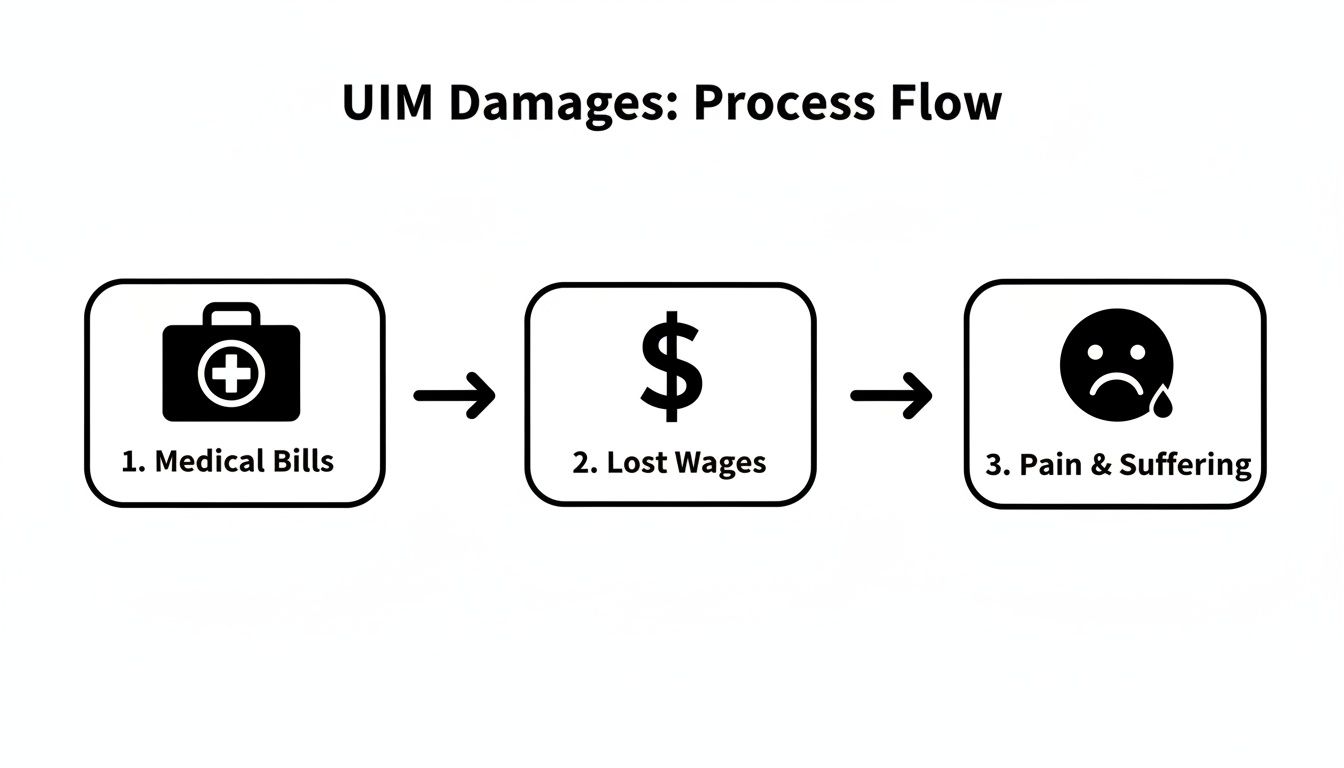
As the chart shows, your UIM claim can compensate you for the full spectrum of your losses. This includes the tangible costs like medical bills and lost wages, but also the profound human cost of your pain and suffering.
The potential for recovery in these cases is significant and often necessary for a family's financial survival. To give you a clearer picture, just look at real-world examples where jury awards in underinsured motorist claims have been substantial. In one case, a Beaumont jury returned a verdict of $231,340 for the injured victim.
This process might seem complicated, but you don't have to face it alone. At The Law Office of Bryan Fagan, PLLC, we help victims of car and truck crashes hold all responsible parties accountable—and that includes their own insurance companies. We are here to make sure you get the full and fair compensation you are owed.
Critical Steps for Navigating Your UIM Claim
What you do in the hours and days after a serious crash is absolutely vital. The right moves protect your rights and lay the groundwork for a successful Underinsured Motorist (UIM) claim. An accident can leave you feeling disoriented, but following these practical steps can help you focus on what really matters for your recovery and your case.
Your first priority, always, is your health. Seek medical attention immediately, even if you think you’re “fine.” Serious injuries like internal bleeding or brain trauma don't always show immediate symptoms. Going to the ER or seeing a doctor creates an official medical record tying your injuries to the crash—this is critical evidence for your claim.
Next, get an official record of the accident itself. Call 911 from the scene. The responding police officer will create a crash report, which is a crucial piece of evidence that documents the basic facts, identifies everyone involved, and often includes the officer's initial thoughts on who was at fault.
Document Everything Meticulously
From the second the crash happens, you become the most important investigator for your own case. The more evidence you can gather and preserve, the stronger your position will be when it's time to handle the insurance companies.
Your documentation should include:
- Photos and Videos: Use your phone. Take pictures of everything—the accident scene, the damage to both cars from different angles, skid marks, road conditions, and any visible injuries.
- Witness Information: If anyone saw what happened, get their name and phone number. An independent witness can be incredibly powerful for proving negligence.
- A Personal Journal: Start a simple notebook or a note on your phone. Jot down your daily pain levels, every doctor's appointment, challenges with simple tasks, and the emotional toll this is taking on you and your family.
This personal log tells the true human story of your injuries in a way that a stack of medical bills never can.
The Most Important Rule for Protecting Your UIM Claim
After you've notified both the at-fault driver's insurance and your own carrier about the crash, you must proceed very carefully. There is one mistake that can completely prevent you from recovering anything from your UIM policy.
You must never settle your claim or sign any release forms with the at-fault driver's insurance company without getting written permission from your own UIM carrier first.
If you take a settlement from the other driver's insurer without your company's consent, they will argue that you've destroyed their subrogation rights—their right to go after the at-fault driver themselves to get their money back. In Texas, this legally gives them a powerful reason to deny your UIM claim entirely, leaving you with only what the other driver’s small policy paid out.
An experienced Texas personal injury lawyer handles these critical communications for you, making sure every step is taken correctly to protect your right to full compensation. At The Law Office of Bryan Fagan, PLLC, we guide our clients through this tricky process, preventing these costly errors so you can focus on getting better.
Why You Need a Lawyer for Your Own Insurance Claim

It seems counterintuitive, doesn't it? Filing a claim against your own Underinsured Motorist (UIM) policy can often feel like you’re going up against an adversary. You've paid your premiums on time for years, trusting your insurer to have your back. But the reality can be a harsh wake-up call.
At the end of the day, your insurance company is a business, and its main goal is to protect its bottom line. This means their adjusters are trained to keep payouts as low as possible, even for loyal customers like you. They might downplay your injuries, question your medical treatments, or push a quick, lowball offer that won't cover your future needs.
Leveling the Playing Field
Hiring an experienced Houston car accident attorney changes the entire dynamic. Your lawyer becomes your champion, leveling the playing field and forcing the insurance company to take your claim seriously. We handle all the phone calls, paperwork, and negotiations, shielding you from the stress so you can focus on healing.
One of the most vital roles an attorney plays is determining the true, full value of your claim. We work with medical and financial experts to project your future costs, ensuring your compensation covers not just today's bills, but the ongoing care and lost wages you'll face down the road.
At The Law Office of Bryan Fagan, PLLC, we handle complex catastrophic injury and wrongful death cases where UIM coverage is often the only path to securing justice for a family's future. Our wrongful death lawyer Texas team understands the profound loss families face and fights tirelessly on their behalf.
We build a strong, evidence-backed case to prove the full extent of your damages and fight to make the insurer honor the policy you paid for. If you're wondering if it's the right time, you can learn more about when to hire a personal injury lawyer in our detailed guide.
Our firm operates on a contingency fee basis, which means you pay absolutely nothing out of your own pocket. We only get paid if we secure a financial recovery for you.
You don’t have to go through this fight alone. Recovery is possible, and help is available. Contact our team for a free, no-obligation consultation to understand your rights and see how we can help you get your life back on track.
How Long Do You Have to File a UIM Claim in Texas?
After an accident, you are facing many challenges, and legal deadlines can be the last thing on your mind. However, understanding the timeline for your claim is critical. While the general statute of limitations for filing a personal injury lawsuit against the at-fault driver in Texas is two years from the date of the accident, your UIM claim operates under a different set of rules.
Your insurance policy is a contract, and it contains its own specific deadlines for providing notice of the accident and filing your claim. These deadlines are often much shorter than the two-year lawsuit window and must be followed precisely.
Furthermore, you must first resolve the claim against the at-fault driver (typically by receiving their policy limits) before you can finalize your UIM claim. An experienced truck crash lawyer in Houston will manage these complex deadlines, ensuring every notice is sent on time so your right to recovery is fully protected. Don't risk missing a crucial deadline; it's always best to act quickly and speak with an attorney who can safeguard your rights.
The moments after a crash are overwhelming, but you don’t have to figure it all out by yourself. The compassionate attorneys at The Law Office of Bryan Fagan, PLLC are here to give you the clarity, support, and expert guidance you need. We want you to know that recovery is possible, and dedicated legal help is available to you.
We invite you to schedule a free, no-obligation consultation to discuss your case and understand your options. Let us help you take the first step toward recovery and justice. Schedule your free consultation by calling us today or by visiting us at https://texaspersonalinjury.net.