Skip to content
A serious accident can change your life in seconds—but you don’t have to face it alone. When an accident caused by someone else’s carelessness turns your world upside down, understanding your rights is the first step toward reclaiming your life. In Texas, the legal term for the money you can recover for your losses is damages. Think of it as compensation meant to help you rebuild and move forward.
This compensation is typically broken down into three main categories: economic damages for your financial costs, non-economic damages for your human suffering, and in rare cases, exemplary (or punitive) damages to punish extreme negligence.
Your Guide to Compensation After a Texas Accident
A sudden injury can change everything. One minute, life is normal; the next, you're facing physical pain, emotional trauma, and a growing pile of bills. The aftermath can feel completely overwhelming, but you do not have to navigate this alone.
Understanding the types of damages available under Texas law is the first crucial step. It empowers you to hold the responsible party accountable and secure the resources you need to focus on one thing: your recovery. This guide will walk you through the main categories of compensation you may be entitled to after an accident.
The Three Pillars of Personal Injury Compensation
In a Texas personal injury claim, compensation is designed to cover the full scope of your losses—both the ones with a clear price tag and the ones that are deeply personal and hard to quantify.
Here are the core concepts you need to know:
- Economic Damages: These cover your direct financial losses. Think of them as the calculable, out-of-pocket costs that resulted directly from the accident, like medical bills and lost wages.
- Non-Economic Damages: These address the intangible, human costs of an injury. This is compensation for things like your physical pain, emotional distress, and the negative impact the injury has had on your quality of life.
- Exemplary (Punitive) Damages: Reserved for the most serious cases, these aren't about compensating you. Instead, they are intended to punish the at-fault party for extreme recklessness or malicious behavior and to deter others from similar conduct.
This visual gives you a simple breakdown of these three essential categories.
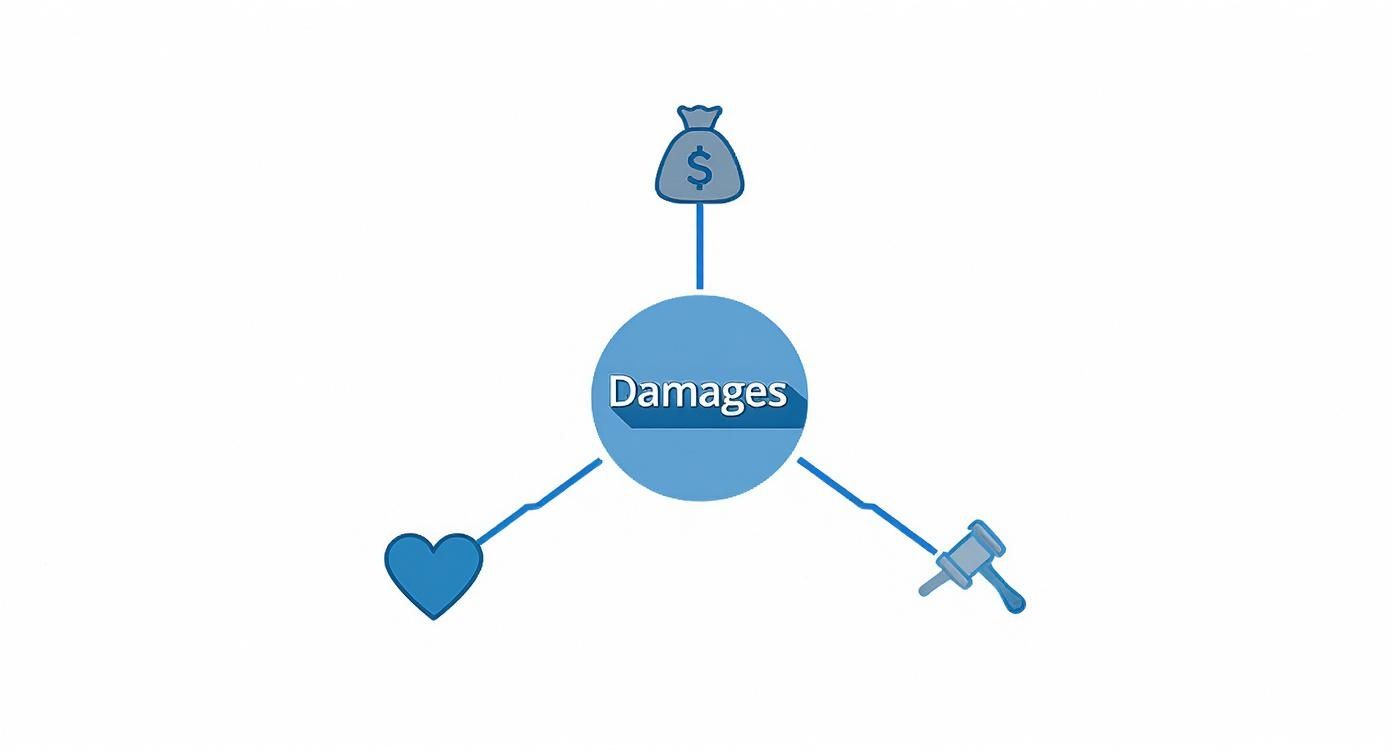
As the diagram shows, Texas law separates damages into tangible financial losses (economic), intangible human suffering (non-economic), and punishment for extreme wrongdoing (exemplary). For many accident victims, knowing how to file an auto insurance claim step-by-step is the first practical step toward recovering these damages.
Calculating Your Financial Losses or Economic Damages
After an accident, the bills start piling up almost immediately. That's where economic damages come in. Think of them as the law's way of creating a detailed, itemized invoice for every single dollar you've lost because someone else was negligent. These are the real, tangible costs you can prove with receipts, pay stubs, and medical statements.
If the accident created a financial loss you can put a number on, it most likely counts as an economic damage. The goal is simple: to make you financially whole again—to put you back in the same position you were in moments before the injury. This means we must meticulously track down and account for every expense, no matter how small.
Documenting Your Current and Future Medical Needs
For most people, the biggest financial hit comes from medical care. This isn't just about the initial ambulance ride or the ER visit. It covers the entire scope of your medical journey—from what you've already paid to what you'll need for the rest of your life.
This category is broad and can include all sorts of healthcare expenses:
- Emergency services and hospitalizations
- Surgeries and follow-up visits with specialists
- Physical therapy and long-term rehabilitation
- Prescription drugs and necessary medical devices
- In-home nursing care or modifications to make your home accessible
- Projected costs for any future medical procedures or care
For example, after a Houston freeway crash, you might need emergency surgery right away, followed by months of physical therapy and ongoing pain management. An experienced Houston car accident attorney will bring in medical experts to map out a life care plan, which projects these future costs to ensure your settlement is enough to cover your needs for years to come.
Practical Advice: Keep a dedicated file with every single medical bill, receipt, and insurance statement. Each piece of paper helps paint a clear, undeniable picture of the financial toll your injuries have taken and strengthens your claim.
Recovering Lost Income and Earning Potential
A serious injury doesn’t just hurt your body; it can impact your ability to work and support your family. Economic damages are designed to cover this loss, which really breaks down into two separate parts.
First, there are lost wages. This is straightforward: it covers the paychecks you missed while you were out of work recovering. We calculate this using your pay stubs or employment records to show exactly what you would have earned if you hadn't been hurt.
The second part, which is often much larger, is the loss of earning capacity. This applies when your injuries are permanent and prevent you from returning to your old job or earning the same kind of money you did before. For example, a construction worker who suffers a catastrophic injury to their back can’t just go back to the job site. In that situation, we work with vocational and economic experts to calculate the difference in their lifetime earnings, ensuring their family's financial future is secure.
You can learn more about the specifics in our detailed guide on how to calculate a car accident settlement.
Common Types of Economic Damages in Texas
To help you get a clearer picture, here is a breakdown of the most common types of economic damages that victims can claim in Texas. This table shows you what each category covers and the kind of proof you'll need to build a strong case for compensation.
| Type of Economic Damage | What It Covers | Examples of Evidence |
|---|---|---|
| Past Medical Expenses | All medical care from the date of injury until now. | Hospital bills, ambulance invoices, receipts for prescriptions, physical therapy records. |
| Future Medical Expenses | Projected costs for ongoing and future medical needs. | Life care plans from medical experts, doctor's testimony, cost estimates for future surgeries. |
| Lost Wages | Income lost while unable to work during recovery. | Pay stubs, W-2 forms, letter from employer confirming time off and pay rate. |
| Loss of Earning Capacity | Reduced ability to earn income in the future due to permanent injury. | Expert reports from vocational specialists and economists, tax returns, employment history. |
| Property Damage | Cost to repair or replace your damaged vehicle or other property. | Repair estimates from body shops, vehicle valuation guides (e.g., Kelley Blue Book), receipts. |
| Out-of-Pocket Costs | Other miscellaneous expenses directly caused by the injury. | Receipts for rental cars, mileage logs for doctor visits, invoices for household help. |
Having the right documentation is everything. The more organized your evidence, the stronger your claim for full and fair compensation will be.
Accounting for Property Damage and Other Costs
Beyond the big-ticket items like medical bills and lost paychecks, economic damages also cover all the other out-of-pocket costs you've had to pay. For car accidents, the most obvious one is the cost to repair or replace your car, truck, or motorcycle.
But don't forget about the smaller, miscellaneous expenses. They can add up fast. These can include:
- Rental car fees you paid while your vehicle was in the shop.
- Travel and mileage expenses for driving to and from doctor’s appointments.
- The cost of hiring household help because you can't manage daily tasks like cleaning or yard work.
It’s crucial to understand just how massive economic losses can be. For example, global natural disasters in the first half of 2025 caused an estimated US$131 billion in economic losses, with the United States shouldering over US$126 billion of that. You can see more insights on this from Munich Re, which shows just how financially devastating unexpected damage can be. While your personal injury claim is on a different scale, the principle holds true: every single dollar of financial loss must be accounted for.
Valuing Your Human Losses or Non-Economic Damages
Some losses from an accident don’t have a price tag, but they are every bit as real and devastating as a stack of medical bills. While economic damages cover your tangible, out-of-pocket costs, non-economic damages are meant to address the human cost of your injury.
These damages compensate you for the profound, personal ways an accident has turned your life upside down—altering your happiness, your relationships, and your future.
In Texas, the law recognizes that your suffering matters. This isn't just about the bills; it's about acknowledging the invisible wounds. It’s about the physical pain, the emotional trauma, and the loss of joy you now endure every single day. Your life is more than a collection of financial transactions, and your compensation should reflect that.

Understanding Pain and Suffering
The most common type of non-economic damage is for physical pain and suffering. This isn’t just about the immediate agony from the injury itself. It's about the chronic pain, the constant discomfort, and the physical limitations that stick with you long after you've left the hospital.
For instance, after a serious truck crash on I-45, you might be left with daily back pain that makes it impossible to get a good night's sleep, sit at a desk, or even stand for more than a few minutes. That ongoing suffering has a real, tangible impact on your quality of life, and the law provides a way for you to seek justice for it.
The Emotional and Mental Toll of an Accident
An accident's impact goes far beyond the physical. Mental anguish and emotional distress are very real consequences that deserve to be taken seriously. This can include feelings of fear, crippling anxiety, depression, grief, or even post-traumatic stress disorder (PTSD) that surface after a traumatic event.
Imagine being terrified to get behind the wheel after a violent car wreck or waking up from nightmares that force you to relive the crash. These emotional burdens can be just as disabling as a physical injury, damaging your relationships, your career, and your ability to simply enjoy life. Your story—and the testimony of your loved ones—are powerful tools for showing a jury the true depth of this suffering.
Your personal story is crucial. It’s not just about what happened in the accident, but how it has changed your life since. Sharing the details of your daily struggles helps a judge or jury understand the full human cost of the negligence you endured.
When an Injury Changes How You Live
Some injuries leave permanent, life-altering marks. Texas law allows you to seek compensation for these specific, profound types of losses.
- Physical Impairment: This addresses the loss of use of a part of your body or a permanent limitation on your physical abilities. For instance, a construction worker who suffers a catastrophic injury and can no longer lift his child or enjoy hobbies like fishing has experienced a significant physical impairment.
- Disfigurement: This compensates victims for scarring, burns, or amputations that permanently alter their physical appearance. It acknowledges the emotional pain and social challenges that can come with being forced to live with a visible reminder of a traumatic event.
- Loss of Consortium: This is a unique claim that can be brought by the spouse of an injured person. It’s designed to compensate them for the loss of companionship, support, affection, and intimacy that results from their partner’s severe injuries.
How Is a Value Placed on Human Suffering?
Putting a dollar amount on pain is one of the most challenging parts of any personal injury claim. There’s no simple calculator or formula. Instead, insurance companies and juries in Texas have to consider several factors to determine what’s fair.
One common approach is the "multiplier method." It's an informal calculation where the total amount of your economic damages (like medical bills and lost wages) is multiplied by a number, typically between 1.5 and 5. The more severe and permanent your injuries, the bigger the impact on your daily life, and the stronger your evidence, the higher the multiplier.
This process is highly subjective, which is why having an experienced Texas personal injury lawyer fighting for you is so important. We help you gather the right evidence—from your own testimony to statements from family and friends—to build a compelling case for the full value of your human losses. For a deeper look into this topic, you can explore our guide on how to calculate pain and suffering damages.
Understanding Exemplary (Punitive) Damages in Texas
Most of the damages we talk about are meant to compensate you for a loss—medical bills, lost paychecks, and pain and suffering. But another type of damages, known in Texas as exemplary damages, is reserved for cases that go far beyond simple carelessness. You may know them as punitive damages.
Their purpose is not to pay you back for your losses. It is to punish the at-fault party for truly awful behavior and to send a clear, powerful message: conduct like this will not be tolerated in our community. Think of them as a tool for justice, meant to deter others from ever thinking about doing something similar. These awards are rare and only come into play when the wrongdoing is so bad it shocks the conscience.

When Are Exemplary Damages Awarded?
You won’t see exemplary damages in a routine fender-bender. Texas law is very specific, reserving them for cases where the defendant’s actions involved gross negligence, malice, or fraud. This is not just a mistake; it is a much higher and harder-to-prove standard than the ordinary negligence found in most personal injury claims.
So, what does that look like in the real world? Here are a few examples that might qualify:
- A trucking company intentionally skips mandatory brake inspections on its fleet to cut costs, causing a brake failure that leads to a catastrophic pileup on I-10 in Houston.
- A drunk driver with several prior DWI convictions gets behind the wheel again, causing a head-on crash that results in a wrongful death.
- A corporation discovers a dangerous defect in its product but actively conspires to hide that information from regulators and the public, leading to multiple consumers suffering serious injuries.
In each of these situations, the defendant didn't just make a mistake. They showed a conscious and shocking disregard for the lives and safety of others.
To win exemplary damages, your attorney must prove the defendant’s gross negligence, malice, or fraud by "clear and convincing evidence." This is a much tougher legal standard than the "preponderance of the evidence" used for other damages. It means the jury must have a high degree of certainty that the claim is true.
Texas Caps on Exemplary Damage Awards
It's crucial to have realistic expectations about these awards. Because their purpose is punishment, not compensation, the Texas legislature has placed limits, or "caps," on how much a jury can award in exemplary damages. The formula is complex, but it essentially prevents the award from exceeding a certain amount based on your economic and non-economic damages.
To put the scale of different types of damages into perspective, consider the aftermath of a massive natural disaster. The physical destruction from Hurricane Melissa in Jamaica, for example, was estimated at US$8.8 billion. Of that staggering amount, 41% hit residential buildings and 33% wiped out critical infrastructure. While a hurricane is an act of God, you can read more about the assessment of these large-scale damages to see how the impact on individual lives and entire communities is calculated. Your case is different, but this illustrates how various types of harm are valued.
Figuring out if exemplary damages are on the table requires a deep dive into the specific facts of your case. An experienced truck crash lawyer Houston can investigate the defendant’s conduct to see if their actions meet the high standard required to pursue these damages in Texas.
How Texas Laws Can Impact Your Compensation
Knowing the types of damages you can claim is just the first step. To recover the compensation you deserve, you must also navigate the specific Texas laws that control every personal injury case. Two rules, in particular, can make or break your claim: proportionate responsibility (comparative negligence) and the statute of limitations.
This isn’t just legal jargon. It’s practical, crucial information that puts you in control and helps you protect your rights from day one. Misunderstanding these rules can mean losing your right to recover anything at all.
Texas’s Proportionate Responsibility Rule (Comparative Fault)
Texas uses a concept called proportionate responsibility—often called the "51% bar rule"—to determine how to assign fault after an accident. This rule directly impacts how much compensation you can receive if you are found to be even partially at fault.
The rule is straightforward: your total compensation award is reduced by your percentage of fault. If your total damages are $100,000 but a jury decides you were 20% to blame for the accident, your award is cut by $20,000, leaving you with $80,000.
However, there is a strict cutoff.
The 51% Bar: Under Texas Civil Practice and Remedies Code § 33.001, you are completely barred from recovering any damages if you are found to be 51% or more responsible for the accident. As long as your fault is 50% or less, you can still recover compensation.
This rule is exactly why insurance companies work so hard to shift blame onto you. Every percentage point of fault they can pin on you either reduces what they have to pay or, if they can push it past that 50% mark, eliminates their responsibility entirely.
Real-World Example of the 51% Rule
Let’s say you’re in a car wreck in Dallas. The other driver ran a stop sign, but their insurance adjuster claims you were speeding. A jury reviews the evidence and decides:
- Your total damages (medical bills, lost income, pain and suffering) are $200,000.
- The other driver was 70% at fault for running the stop sign.
- You were 30% at fault for speeding.
Because your share of the blame (30%) is below the 51% bar, you can still recover compensation. Your $200,000 award is reduced by your 30% of fault, meaning you would receive $140,000. If that jury had found you 51% at fault, you would get absolutely nothing. This is why a skilled Texas personal injury lawyer focuses on gathering the evidence needed to minimize your assigned fault and protect your right to compensation.
How Long Do You Have to File a Claim in Texas?
The second critical rule is the statute of limitations. In Texas, you generally have just two years from the date you were injured to file a personal injury lawsuit.
This is a hard deadline. If you miss it by even one day, the court will almost certainly throw out your case. You lose your right to seek compensation forever, with only a few very rare exceptions.
Two years might sound like a long time, but it disappears quickly when building a strong case. Your legal team needs this time to:
- Thoroughly investigate the accident
- Gather all medical records and bills
- Interview witnesses
- Consult with medical or financial experts
- Negotiate with the insurance company
Waiting to seek legal help can harm your case. Evidence can be lost, witnesses' memories fade, and the insurance company gets more time to build its defense against you. The sooner you act, the stronger your position will be.
It’s easy to get overwhelmed by the legal system, but understanding these two rules puts you ahead of the game.
Key Texas Laws Impacting Your Claim
| Legal Rule | What It Means for You | Action to Take |
|---|---|---|
| Proportionate Responsibility (51% Bar) | If you are found to be 51% or more at fault for the accident, you cannot recover any money. Your recovery is reduced by your percentage of fault if you are 50% or less to blame. | Never admit fault. Be cautious when speaking to insurance adjusters, as they will try to use your words to assign you more blame. |
| Statute of Limitations (Two-Year Deadline) | You have a strict two-year deadline from the date of your injury to file a lawsuit. If you miss this window, your claim is lost forever. | Contact an attorney as soon as possible after your injury. This gives them the maximum amount of time to build a strong case and preserve evidence before it disappears. |
Don't let a legal technicality prevent you from getting the justice and financial support your family needs to move forward. Acting quickly and understanding your rights are the two most powerful things you can do to protect your claim.
Navigating Damages in a Wrongful Death Claim
Losing a family member is an unimaginable tragedy. When that loss is caused by someone else's negligence, the legal process that follows must be handled with the utmost care and compassion. The types of damages available in these situations are different from a standard personal injury case, but Texas law provides a clear path for grieving families to seek justice and financial stability.
The legal system recognizes that the loss is twofold: there are the losses your family now suffers, and there are the losses the deceased person endured before they passed. Because of this, Texas law allows for two distinct but related legal actions to be filed.
The Wrongful Death Action for the Family
A wrongful death claim is filed by the surviving family members—specifically the spouse, children, or parents of the person who died. This legal action is designed to compensate you for your own profound losses that stem from your loved one's absence.
The goal here is to acknowledge the immense emotional and financial void that has been left behind. Damages in a wrongful death claim can include:
- Loss of Companionship and Society: For the loss of the unique love, comfort, and companionship that has been taken from your family.
- Mental Anguish: This covers the grief, sorrow, and emotional trauma you have been forced to endure.
- Lost Financial Support: For the income and other financial contributions your loved one would have provided for the family’s future.
- Loss of Inheritance: For the financial assets the deceased would have likely accumulated and passed on to their family had they lived a full life.
The Survival Action for the Deceased
The second type of claim is a survival action. This can be thought of as the personal injury claim your loved one could have filed themselves if they had survived the accident. This action is brought on behalf of their estate to recover for the suffering they personally experienced.
Damages in a survival action are meant to cover the losses the deceased endured between the moment of injury and their death. This typically includes:
- The deceased’s conscious pain and suffering.
- Medical expenses that were incurred before they passed away.
- Funeral and burial expenses.
The loss of a life has devastating consequences that ripple through families and communities. The economic impact of such a tragedy is also significant. Globally, the loss of life and human capital has profound social and economic consequences, undermining everything from agricultural productivity to food security.
A compassionate wrongful death lawyer Texas can help you understand which family members are eligible to file these claims and ensure all potential damages are accounted for, allowing you to focus on healing.
These cases are emotionally charged and legally complex. Understanding your family’s rights is the first step toward seeking accountability and justice for your loss. You can learn more about the process in our guide on how to file a wrongful death lawsuit in Texas.
Frequently Asked Questions About Injury Damages

After learning about the different types of damages and legal rules, it's natural for practical questions to come up about your own situation. Here are answers to some of the most common concerns we hear from accident victims and their families.
How Long Do I Have to File a Personal Injury Claim in Texas?
In Texas, you generally have two years from the date of the accident to file a lawsuit. This isn't a suggestion; it's a strict deadline known as the statute of limitations. If you miss this window, you will likely lose your right to recover any compensation at all. There are very few exceptions to this rule, which is why it's so critical to speak with a Texas personal injury lawyer as soon as possible to protect your rights.
Do I Have to Go to Court to Get Paid?
Probably not. The vast majority of personal injury cases are resolved through settlement negotiations with the insurance company without ever seeing a courtroom. An experienced attorney can often negotiate a fair settlement on your behalf. However, if an insurance company refuses to make a fair offer, your lawyer should be prepared to take them to court. At our firm, we prepare every case as if it's going to trial. This approach sends a clear message to the insurance company and puts us in a much stronger position to negotiate for you from day one.
How Much Is My Case Actually Worth?
Every case is unique, so there's no magic calculator to determine its value. The final value depends on many factors, including:
- The severity and permanency of your injuries.
- The total of your economic damages, including all medical bills and lost wages.
- The extent of your non-economic damages, such as your pain and suffering.
- The insurance policy limits of the at-fault party.
An experienced attorney can evaluate the details of your case to give you a realistic assessment of what it could be worth and fight for the maximum compensation you deserve.
Understanding the different types of damages is the first step toward getting the justice you deserve. The next step is getting experienced legal advice tailored to your specific situation. At The Law Office of Bryan Fagan, PLLC, we are here to provide clarity, support, and aggressive representation to fight for the full compensation you need to rebuild your life. We invite you to schedule a free, no-obligation consultation to discuss your case and learn how we can help you move forward. Your recovery is possible, and legal help is available.