A serious truck accident can change your life in seconds—but you don’t have to face it alone. After a crash with an 18-wheeler or another large commercial truck, the steps you take are critical for protecting your health and your right to seek justice. The moments after a collision are chaotic and overwhelming, but knowing what to do can provide a clear path forward for you and your family.
Your Guide to the Critical First Steps After a Truck Accident
When you've just been in a collision with a massive commercial truck on a Texas highway, it's easy to feel disoriented and completely overwhelmed. These accidents are unfortunately common on our state's busy roads. In 2022 alone, Texas saw 38,621 commercial vehicle accidents, making it one of the most dangerous states for truck crashes. Harris County was a significant hotspot, with over 6,113 of those incidents.
In the middle of the chaos, a few key actions can safeguard both your physical well-being and your future legal rights. This guide breaks down the most important things you can do to protect yourself.
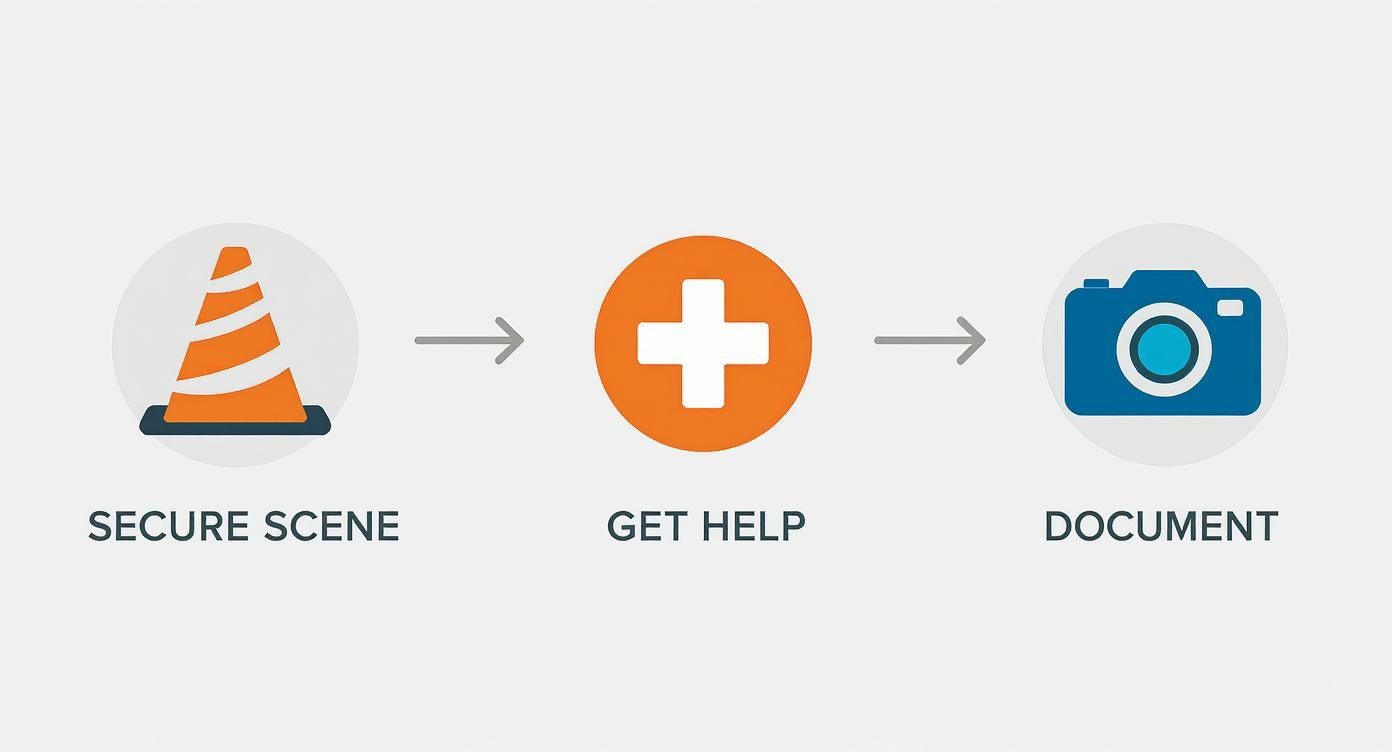
Your priorities are simple but vital: ensure everyone is safe, seek immediate medical attention, and document everything you can at the scene.
Prioritize Your Health and Safety
First, check yourself and your passengers for injuries. If you can, move your vehicle to a safe location away from traffic. If your car is too damaged or you are injured, turn on your hazard lights and stay put until emergency services arrive.
Even if you feel fine, please do not assume you are uninjured. The adrenaline from a crash can easily mask serious conditions like a concussion or internal bleeding.
A serious accident is a life-altering event, but you are not powerless. The actions you take to document the scene and protect your health provide the foundation for holding negligent parties accountable and beginning your path toward recovery.
Getting a full medical evaluation as soon as possible is crucial. A doctor’s visit creates an official, time-stamped record of your injuries, which will be essential evidence if you decide to file a personal injury claim.
Gather and Preserve Crucial Evidence
While you wait for first responders, and only if it is safe to do so, start documenting the scene with your phone. Take photos and videos of everything from multiple angles.
Be sure to capture details like:
- Damage to all vehicles involved
- Skid marks on the road
- The weather and road conditions
- License plates and any company logos on the truck
- Spilled cargo or debris on the highway
You will need to exchange information with the truck driver, but keep the conversation brief and stick to the facts. Get their name, contact information, driver’s license number, and insurance details. Also, get the name of their employer and the truck's license plate number. Do not discuss who was at fault or apologize for anything.
Report the Accident and Understand Your Rights
Always call 911 to report the crash. A formal police report is a critical piece of evidence. When the officer arrives, give them a clear, factual account of what happened. Before you leave, make sure you get the officer’s name, badge number, and the police report number.
Trying to handle the aftermath of a truck accident is overwhelming. Seeking guidance from an experienced Texas personal injury lawyer is a vital step. Figuring out how to choose a personal injury attorney is one of the most important decisions you will make. The right legal partner can untangle the complexities of your case so you can focus on healing. The team at The Law Office of Bryan Fagan, PLLC can provide the support and experience needed to protect your rights from day one.
Understanding Who Is Liable for the Crash
After a devastating truck crash on a Texas highway, one of the first questions you may have is, "Who is responsible for this?" Unlike a simple car accident, the answer is often far more complex. It's almost never just about the driver.
An 18-wheeler is a massive piece of commercial machinery operated by a network of companies and individuals, each with a legal duty to ensure safety. When one link in that chain fails, innocent people get hurt. A thorough investigation, often led by a skilled truck crash lawyer in Houston, is the only way to uncover every negligent party.
Uncovering All Responsible Parties
Determining fault means looking beyond the person behind the wheel. It requires investigating the systems, training, and companies that put that truck on the road. An experienced legal team knows exactly where to look to build a strong case for you.

It takes a deep dive into the details to identify everyone who shares the blame. Below is a look at the different parties that could be held responsible after a commercial truck accident.
Potential Liable Parties in a Texas Truck Accident
| Liable Party | Common Reasons for Liability |
|---|---|
| The Truck Driver | Speeding, distracted driving, driving under the influence (DUI), falsifying hours-of-service logs to drive longer than legally allowed, aggressive driving. |
| The Trucking Company | Negligent hiring (e.g., not running background checks), poor driver training, pressuring drivers to violate safety rules, failure to properly maintain the fleet. |
| The Cargo Shipper/Loader | Improperly secured cargo, overloaded trailers, or unbalanced freight that shifts during transit, causing the driver to lose control of the vehicle. |
| Maintenance/Repair Shops | Negligent repair work performed by a third-party mechanic, such as faulty brake jobs, improper tire installation, or other mechanical failures. |
| Vehicle/Parts Manufacturers | A critical component fails due to a design or manufacturing defect (e.g., tire blowouts, brake system failure, steering mechanism defects). |
Identifying every party is more than just a legal detail—it's critical for ensuring you can recover the full compensation you need to rebuild your life.
For example, imagine a tire blows out on a Houston freeway, causing an 18-wheeler to swerve across three lanes and hit your car. A detailed investigation might reveal the tire manufacturer knew about a defect but failed to issue a recall. In that scenario, both the trucking company (for poor maintenance) and the manufacturer could be held liable for your injuries.
How Texas Negligence Law Applies
In Texas, personal injury cases operate under a rule called modified comparative fault, also known as the "51 percent bar rule." This law is crucial because it determines how your compensation might be affected if you are found to share any blame for the accident.
Under this rule, you can recover damages as long as you are 50 percent or less at fault for the crash.
However, your total compensation will be reduced by your percentage of fault. For example, if a jury awards you $100,000 in damages but finds you were 10% at fault, your final award is reduced by 10%, leaving you with $90,000. If you are found to be 51% or more at fault, you are barred from recovering any compensation at all.
Insurance companies for large trucking corporations are experts at trying to shift blame onto victims to reduce or deny a payout. They might claim you were speeding, changed lanes improperly, or braked suddenly. This is why having an experienced Texas personal injury lawyer is so important. We anticipate these tactics and build a strong case to prove the defendants' negligence while protecting you from unfair accusations.
How Trucking Regulations Impact Your Case
The trucking industry is governed by a complex web of federal and state safety regulations designed to protect everyone on the road. When a trucking company or its driver cuts corners on these rules, the results are often catastrophic. For you, understanding these regulations provides the power to hold them accountable. A skilled truck crash lawyer in Houston can pinpoint exactly where they failed and build a powerful case on your behalf.
These rules are not suggestions; they are legally binding requirements. The Federal Motor Carrier Safety Administration (FMCSA) sets the safety standards for the entire country, and Texas adds its own transportation codes. A violation of these rules is often direct evidence of negligence.

Key Federal and Texas Trucking Rules
For someone injured in a crash, these regulations are the foundation of a solid personal injury claim. An experienced legal team knows how to obtain company records and analyze them for violations that contributed to your accident. A violation is a clear sign that the system broke down.
Here are some of the most critical regulations we investigate:
- Hours-of-Service (HOS) Limits: Federal law strictly limits how long a truck driver can be on the road before they are required to take a rest break. This is one of the most important rules for preventing driver fatigue.
- Maintenance and Inspection Records: Trucking companies must keep detailed logs of all repairs, maintenance checks, and inspections for every vehicle in their fleet.
- Driver Qualifications and Screening: Companies are required to run thorough background checks, review driving histories, and conduct regular drug and alcohol testing for their drivers.
- Cargo Securement Rules: Federal standards dictate how different types of cargo must be loaded, balanced, and secured to prevent dangerous shifts or spills.
Consider a real-world example: A truck driver, pressured to meet a delivery deadline, falsifies their electronic logbook to hide the fact they skipped a mandatory 10-hour rest break. Exhausted, they drift into another lane on a Houston freeway and cause a devastating collision. That falsified logbook is definitive proof of negligence that can hold both the driver and their employer accountable.
Using Violations to Prove Negligence
When we take on a case involving truck accidents in Texas, one of the first things we do is send a spoliation letter to the trucking company. This legal notice demands they preserve all critical evidence—driver logs, maintenance records, drug test results, and data from the truck’s “black box” recorder.
Finding a violation is a major breakthrough. It shifts the argument from a simple disagreement to a clear breach of federal or state law, making it very difficult for the trucking company’s insurer to deny responsibility. Understanding these regulations and the details of commercial vehicle insurance requirements is central to building a winning legal strategy. Proving a violation shows the trucking company failed in its legal duty to operate safely, which directly strengthens your claim for the compensation you deserve.
You shouldn't have to become an expert in federal transportation law. That's our job. At The Law Office of Bryan Fagan, PLLC, we handle these complexities so you can focus on what matters most—your recovery.
Dealing with Trucking Insurance Companies
Soon after a serious truck accident, you can expect a phone call from an insurance adjuster representing the trucking company. They may sound friendly and concerned, but it is critical to remember their job: to protect their company's bottom line by minimizing or denying your claim.
Navigating these conversations while you are recovering from injuries and emotional trauma is incredibly difficult. The adjuster is a trained negotiator, skilled at using your words against you. This is why having an experienced Texas personal injury lawyer handle all communication from the very beginning is one of the most important steps you can take.

Common Tactics Used by Insurance Adjusters
Insurance companies have a playbook. They know you are vulnerable and worried about medical bills, and they use that to their advantage. Recognizing their strategies is the first step toward defending your rights.
You should be prepared for them to:
- Push for a recorded statement. They will say it's a routine step, but the goal is to get you on record saying something they can use to assign you fault or downplay your injuries. You are not required to provide one.
- Offer a quick, lowball settlement. Adjusters often offer an immediate check, hoping your financial stress will lead you to accept. This first offer almost never covers the true long-term costs of a serious injury. Once you accept, you lose your right to seek any further compensation.
- Ask seemingly innocent questions. An adjuster might ask, "How are you feeling today?" If you reply, "I'm okay," they will note it in their file to argue your injuries were not severe.
It is crucial to understand that anything you say can be used to weaken your claim. For more information, you can read our guide on how to deal with insurance adjusters.
What to Say and What to Avoid
If an adjuster calls before you have hired an attorney, your best strategy is to be polite but firm. You can provide basic information but should never offer opinions or details about the crash or your health.
A serious accident can change your life in seconds—but you don’t have to face it alone. Letting a legal professional manage communication with insurers allows you to focus completely on your physical and emotional recovery without the stress of navigating complex negotiations.
Here is a simple approach you can follow:
- Provide your name, address, and the date and location of the accident.
- Do not discuss how the accident happened or who was at fault.
- Do not discuss your injuries. Simply state that you are under a doctor's care.
- Never admit any fault or apologize for anything related to the crash.
- Politely decline to give a recorded statement.
- Tell them your attorney will be in contact, and then end the conversation.
Imagine you were in a multi-vehicle pile-up on a Houston freeway. The adjuster will probe for details about what you were doing right before the crash. Instead of being drawn into that discussion, just stick to the facts and refer them to your lawyer. This approach protects you from accidentally damaging your own case. The powerful insurance companies representing the trucking industry have teams of lawyers working for them. You deserve to have a dedicated advocate fighting just as hard for you.
How Long Do You Have to File a Claim in Texas?
While you focus on healing, a legal clock is ticking. Texas law sets a strict time limit, known as the statute of limitations, for filing a personal injury lawsuit. Understanding this deadline is critical to protecting your right to seek justice.
In most Texas personal injury cases, you have two years from the date of the truck accident to file a formal lawsuit. While that may sound like a long time, building a strong case against a trucking company is a complex process that requires significant investigation and preparation.
If you miss this two-year deadline, the court will almost certainly dismiss your case, and you will lose your right to recover compensation for your injuries, lost income, and suffering—forever. This is not a flexible guideline; it is a hard legal cutoff.
The Dangers of Delaying Action
Beyond the legal deadline, there are urgent, practical reasons why waiting puts your claim at risk. The evidence needed to prove a trucking company’s negligence can disappear quickly.
- Black Box Data: Commercial trucks have an Electronic Control Module (ECM), or "black box," that records data like speed and braking. Trucking companies often overwrite this data within weeks.
- Driver Logs: Hours-of-service logs can prove driver fatigue. These records can be legally destroyed by the trucking company after a certain amount of time.
- Witness Memories: What an eyewitness remembers clearly a week after a crash on a Houston freeway can become hazy a year later.
A serious accident can change your life in seconds—but you don’t have to face it alone. Acting quickly isn’t about rushing your recovery; it’s about preserving your ability to hold the responsible parties accountable while the evidence still exists.
Are There Any Exceptions to the Rule?
Texas law allows for a few rare exceptions that might extend the two-year deadline. For example, if the injured person was a minor, the two-year clock might not start until they turn 18. The "discovery rule" may also apply if you could not have reasonably known about your injury right away.
These exceptions are very specific and narrowly applied. You should never assume one applies to your situation without speaking to an experienced Texas personal injury lawyer. The details can get complicated, especially in cases involving catastrophic injuries or the loss of a loved one. For families who have lost someone, it is vital to understand the specifics of the wrongful death statute of limitations in Texas.
The most important takeaway is this: do not wait. The sooner you seek legal advice, the stronger your position will be. Contacting an attorney promptly allows them to send a spoliation letter to the trucking company, legally demanding that they preserve all critical evidence. This single action can make all the difference.
Common Questions After a Truck Accident
After a traumatic event like a truck accident, it’s completely normal for your mind to be racing with questions. You are likely in pain, stressed, and uncertain about the future. Below, we've answered some of the most common questions we hear from accident victims and their families.
How Much Does It Cost to Hire a Truck Accident Lawyer?
You do not need to worry about adding another bill to your pile. Our Houston car accident attorneys handle truck accident cases on a contingency fee basis. This means you pay no upfront costs or attorney’s fees. We only get paid if we successfully recover money for you. Your first consultation is always free, so there is no risk in calling us to understand your rights and options.
What Compensation Can I Recover in My Claim?
In Texas, you have the right to seek compensation for your losses, which are legally known as damages. Our goal is to ensure you recover every penny you are entitled to, so you can focus on getting better.
Compensation typically covers:
- Economic Damages: These are your direct financial losses, such as past and future medical bills, lost wages from time off work, and loss of future earning capacity if your injuries affect your career.
- Non-Economic Damages: This is compensation for the real but less tangible suffering you have endured, including physical pain, mental anguish, disfigurement, and the loss of your ability to enjoy life.
- Punitive Damages: In rare cases where a trucking company’s conduct was outrageously reckless—like knowingly keeping a dangerously defective truck on the road—a court may award punitive damages to punish them and deter similar behavior.
For families grieving the loss of a loved one, a wrongful death lawyer in Texas can help pursue a claim to recover for lost financial support, emotional trauma, and loss of companionship.
Should I Accept the Insurance Company’s Settlement Offer?
When bills are piling up, a quick check from the insurance company can be tempting. However, accepting it is often a trap. Once you cash that check, you sign away your right to seek any further compensation. It does not matter if you later discover your injuries are more serious than you first thought. An experienced attorney can calculate the true, long-term value of your claim to ensure you receive the fair compensation you need.
How Long Will My Truck Accident Case Take?
Every case is different, so there is no single answer. The timeline depends on factors like the complexity of the crash, the severity of your injuries, and whether the insurance company is willing to negotiate fairly. Some cases may settle in a few months, while others involving catastrophic injuries might need to go to trial, which takes longer. Our priority is always to achieve the best possible outcome for you, not just the fastest one. We will keep you informed every step of the way.
A serious truck accident can turn your world upside down, but you don’t have to go through this alone. Recovery is possible, and legal help is available.
At The Law Office of Bryan Fagan, PLLC, our team is here to provide the compassionate support and strong legal representation you need to move forward. We invite you to schedule a free, no-obligation consultation to discuss your case. Let us fight for the justice you and your family deserve.