A serious accident can change your life in seconds — but you don’t have to face it alone. When you are hit by a commercial truck, it's not just another car accident. It's a life-changing event that can leave you reeling with serious injuries, mounting medical bills, and a level of uncertainty that's hard to describe. Tackling truck accident claims in Texas comes with a unique set of challenges, but with the right legal team in your corner, you can get the resources you need to recover.
Your World Turned Upside Down After a Truck Crash

One minute you’re driving down a familiar Houston freeway like I-10 or I-45, and the next you're surrounded by chaos, confusion, and the pain of devastating injuries. We’ve seen this scenario play out countless times, and we understand the fear you're feeling. Our job is to provide a clear, supportive path forward.
Crashes involving large commercial trucks are fundamentally different from typical car wrecks. The sheer size and weight of an 80,000-pound semi-truck often lead to catastrophic damage and life-altering injuries. The legal battle that follows is also far more complex, demanding a deep understanding of the state and federal regulations that govern the entire trucking industry.
Why Truck Accident Claims Are So Complex
Unlike a simple fender-bender, investigating a truck crash means peeling back multiple layers of potential liability. It’s almost never just about the driver. Several parties could share the blame, and identifying every single one is absolutely crucial for securing the full compensation you deserve. This complexity is why having a dedicated advocate is so important.
A proper investigation into truck accidents in Texas means digging deep and asking the tough questions about:
- The Truck Driver: Was the driver distracted, fatigued, or under the influence? Did they ignore federal hours-of-service rules designed to prevent tired driving?
- The Trucking Company: Did the company push the driver to meet impossible deadlines? Did they cut corners on background checks or fail to provide proper training? Were maintenance logs faked to keep a dangerous truck on the road?
- The Cargo Loader: Was the truck’s cargo loaded improperly or left unsecured, causing it to shift and leading to a loss of control?
- The Manufacturer: Did a defective part, like faulty brakes or a cheap tire that blew out, contribute to the wreck?
Navigating a truck accident claim means you’re going up against powerful corporations and their aggressive insurance companies. Their primary goal is to protect their profits, not your well-being. Our goal is to level the playing field and fight for your future.
We wrote this guide for you and your family. We'll walk you through every step of this difficult process, from what to do immediately at the scene to how to build a rock-solid foundation for your claim. You are not just another case file to us; you are a person who deserves justice and the resources needed to heal. Recovery is a long road, but it's possible—and dedicated legal help is right here in Texas.
What to Do Immediately After a Texas Truck Accident
The chaos and confusion in the moments after a collision with a commercial truck are overwhelming. With the screech of tires still ringing in your ears, it's hard to think straight, but the actions you take next are absolutely critical for your health and the strength of your future truck accident claim.
Your first priority is always your safety.
Adrenaline is a powerful chemical, and it can easily mask serious injuries right after a crash. Conditions like internal bleeding or even a traumatic brain injury might not show immediate symptoms, but they can be life-threatening. Getting checked out by a medical professional right away does two things: it protects your health and creates an official record linking your injuries directly back to the accident—vital evidence for your claim.
Imagine a driver in Dallas who feels just a bit shaken up after being sideswiped by a semi on I-35. He waves off the ambulance, thinking he's fine. The next morning, he can barely get out of bed due to debilitating back pain and a pounding headache. Because he went to the doctor immediately, he was diagnosed with a herniated disc and a concussion, creating a crystal-clear timeline for his injury claim.
Secure the Scene and Gather Key Information
Once you’re safely out of the way of traffic and have called 911, it’s time to switch gears and document everything you possibly can. The scene of a truck accident is cleared away shockingly fast, and crucial evidence can disappear right along with the wreckage. Your smartphone is your most powerful tool here.
Start taking photos and videos from every angle imaginable. Your goal is to paint a complete picture of what happened.
- Vehicle Positions: Get shots of where your car, the truck, and any other vehicles ended up.
- Property Damage: Document the damage to all vehicles involved. Get close-ups of the impact points.
- The Big Picture: Capture skid marks on the road, scattered debris, nearby traffic signs, and even the weather conditions.
- Visible Injuries: If you have cuts, bruises, or anything else visible, take clear photos of them.
Besides pictures, you need to collect specific information from the truck driver. This is about more than just a name and insurance card.
You need to understand that the trucking company and its insurer likely have a rapid-response team of investigators heading to the scene immediately. They are not there to help you. Their one and only job is to protect their company's bottom line. Documenting everything yourself helps level the playing field.
The trucking industry is heavily regulated, and commercial trucks are required to display certain information. Look on the truck’s doors or cab for these details, and be sure to get:
- The driver’s name, commercial driver's license (CDL) number, and contact info.
- The name of the trucking company (the carrier).
- The USDOT number and Motor Carrier (MC) number.
- The truck’s license plate number and the license plate for any trailer it’s hauling.
This information is the bedrock of your claim. It helps a skilled Texas personal injury lawyer quickly identify every party that might be held responsible for your injuries.
To help you remember what to gather in those stressful first moments, here is a simple checklist. Keep it handy, as it can make a huge difference in protecting your rights.
On-Scene Evidence Gathering Checklist
| Action to Take | Why It's Critical for Your Claim |
|---|---|
| Call 911 Immediately | Creates an official police report and gets medical help on the way. |
| Take Photos & Videos | Preserves a visual record of vehicle positions, damage, and road conditions. |
| Get Driver & Truck Info | Collect the driver's CDL, the company name, USDOT/MC numbers, and license plates. |
| Talk to Witnesses | Get names and phone numbers of anyone who saw what happened. |
| Seek Medical Attention | Documents your injuries and links them directly to the time of the crash. |
| Don't Admit Fault | Avoid saying "I'm sorry" or anything that could be used against you later. |
Following these steps provides a solid foundation for your case and prevents crucial evidence from being lost forever.
Protecting Your Legal Rights from the Start
It's important to cooperate with the police officers who arrive at the scene, but you have to be very careful about what you say. Stick to the simple, objective facts of what happened. Don't guess or speculate about what caused the crash. Most importantly, never, ever admit fault. Even a simple, polite "I'm sorry" can be twisted by an insurance adjuster and used to deny your claim.
Within hours or days, you'll almost certainly get a call from the trucking company’s insurance adjuster. They're trained to sound friendly and concerned, but their job is to minimize their company's financial payout. They will likely push you to provide a recorded statement before you've even had a chance to think, let alone speak with an attorney.
You are under no obligation to give them a recorded statement.
Politely decline their request. Tell them you will have your lawyer contact them, and then hang up. That one simple action can protect you from saying something that could unintentionally torpedo your entire case. The initial moments after a crash really do set the stage for your entire recovery journey, and taking these careful, deliberate steps ensures you're building the strongest possible foundation for the compensation you deserve.
Uncovering All Liable Parties in a Commercial Wreck
When a commercial truck slams into a passenger car, it's almost never just one person's fault. Unlike a typical fender bender where you might just swap insurance with the other driver, a commercial wreck opens up a complex web of corporate and individual responsibility. Figuring out every single party who played a role in the crash is one of the most important things we do to build a powerful truck accident claim and fight for the full compensation you and your family need.
The truck driver's actions are obviously a big piece of the puzzle. But any experienced Houston truck crash lawyer knows the investigation has to go much, much deeper. The driver is often just the final link in a long chain of carelessness that starts in a corporate office.
Beyond the Driver: The Company and Its Responsibilities
Trucking companies—legally known as motor carriers—have a serious duty to make sure their operations are safe. When they start cutting corners to pad their profits, they put every single person on the road in danger. Our investigation digs into the carrier’s role from top to bottom.
Time and time again, we find evidence of negligence that runs through the whole company, like:
- Negligent Hiring: Did the company even bother to check if the driver had a history of DUIs, reckless driving tickets, or a string of prior accidents?
- Inadequate Training: Was the driver properly trained to handle that specific rig and the type of cargo it was hauling? A tanker truck is a world away from a flatbed.
- Poor Maintenance: We look for records of skipped inspections or ignored repair orders for critical parts like brakes, tires, or steering systems.
- Pressure to Violate Rules: Did the company push drivers to break federal hours-of-service rules to meet impossible delivery deadlines? Sometimes they even turn a blind eye to it.
These aren't just simple paperwork mistakes; these are conscious decisions that lead directly to catastrophic injuries on our highways.
The visual guide below shows the first things you need to do after a crash. These actions are vital for preserving the evidence we'll need to track down everyone who is liable.
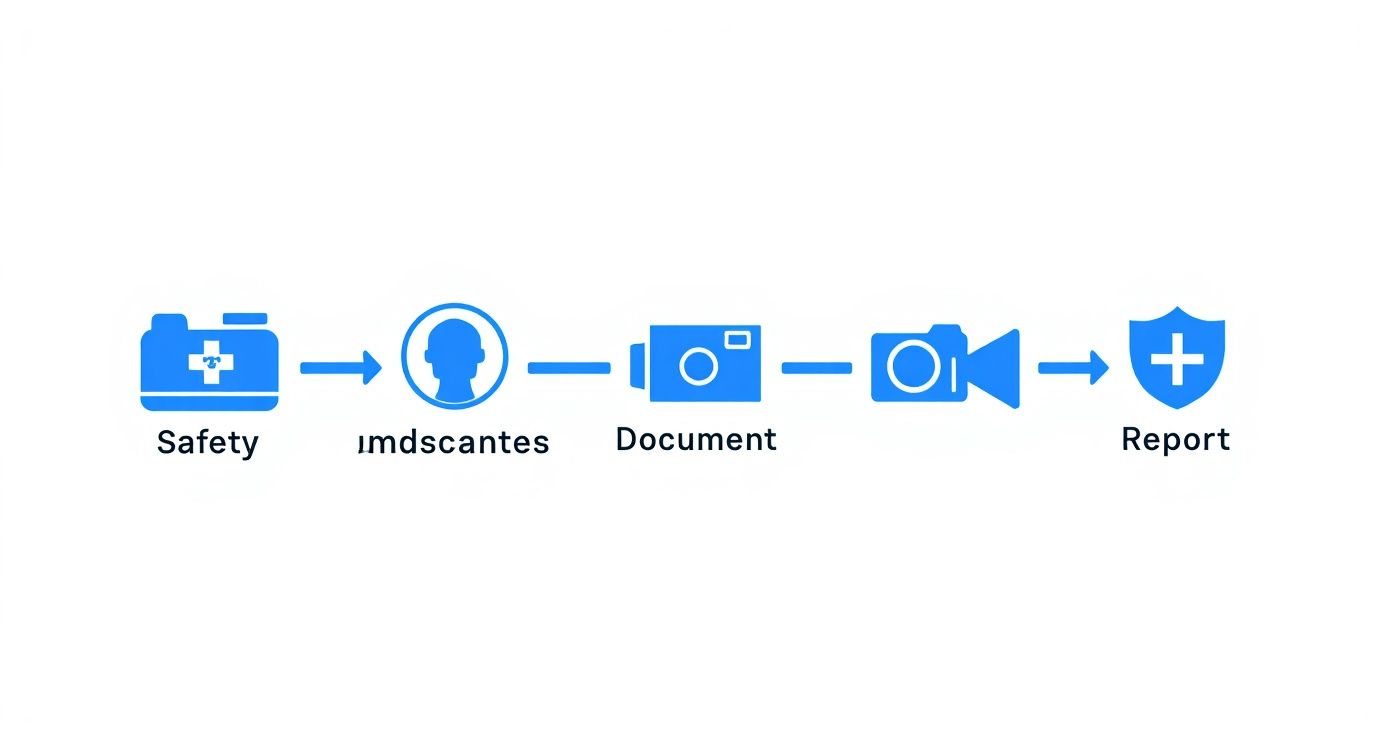
This process makes it clear: what you do in the moments after a wreck—ensuring safety, documenting everything, and reporting the incident—lays the groundwork for a successful claim.
Defective Parts and Manufacturing Flaws
Sometimes, the blame doesn't lie with the driver or the trucking company but with the truck itself. A sudden mechanical failure can make a driver lose control in a split second, causing a devastating wreck. If a bad part is the culprit, the manufacturer of that part or the entire truck can be held responsible.
Think about it: a tire that blows out on I-45 in Houston because of a defect can send a fully loaded semi careening into oncoming traffic. In these situations, we bring in engineering experts to analyze the failed component and prove that a flaw in its design or manufacturing was the real cause of the crash.
A thorough investigation isn't optional—it's everything. We recently handled a case where a third-party cargo loading company didn't secure a heavy load properly. It shifted halfway through the trip, causing the truck to flip. By identifying this third party, we opened up an entirely separate source of recovery for our client.
The Dangers on the Road: A Statistical Look
The risks these massive commercial trucks pose are frighteningly clear when you look at the national numbers. Over the past decade, the fatality rate from large truck crashes has been a major concern. While the number of truck-involved fatalities climbed by 43% through 2023, reaching 5,375 fatal crashes, there was a slight silver lining: the fatality rate per 100 million vehicle miles traveled actually dropped by 8% from 2022 to 2023.
But here's the statistic that really hits home: most of the people who die in these crashes are occupants of other vehicles (70%). The truck occupants themselves only account for 18%, while pedestrians and cyclists make up the remaining 12%. This shows just how disproportionate the danger is for everyone else on the road. You can dive deeper into the federal trucking data for more insights.
At The Law Office of Bryan Fagan, PLLC, we leave no stone unturned. From the driver’s logbooks to the manufacturer’s recall history, we chase down every lead to make sure all negligent parties are held accountable for the harm they’ve caused. This diligent, comprehensive approach is absolutely essential for seeking justice, especially in tragic cases that result in a wrongful death or a catastrophic injury.
How Long Do You Have to File a Claim in Texas?
When you're dealing with the aftermath of a truck accident, the legal system can feel like a maze. But to protect your rights, you must understand the rules of the road—the legal principles that will either make or break your claim. Think of it like a foundation; without a solid grasp of these concepts, your entire case could crumble.
In Texas, a few key legal doctrines shape every truck accident claim. We're talking about the strict deadlines for filing a lawsuit, how blame is divided up, and what you actually have to prove to hold a trucking company accountable. Let's break down what you need to know.
The Clock is Ticking: The Texas Statute of Limitations
There's no rule in personal injury law more unforgiving than the statute of limitations. It's a hard deadline. In Texas, you generally have just two years from the date of the crash to file a lawsuit.
Miss that deadline, even by a day, and the courthouse doors will likely slam shut on your case forever. It doesn't matter how severe your injuries are or how clear the truck driver's fault was. This is precisely why you can't afford to wait. The sooner you speak with an experienced Texas personal injury lawyer, the better you can protect your right to seek compensation.
What if They Blame You? Understanding Texas Comparative Responsibility Rules
It's one of the oldest tricks in the insurance adjuster's playbook: shifting the blame onto you, the victim. They'll argue you were somehow responsible for the crash to reduce what they have to pay. Texas law has a specific way of handling this, called modified comparative fault (or proportionate responsibility).
Here’s how it works in the real world:
- Your compensation can be reduced by your percentage of fault. If a jury awards you $100,000 but finds you were 10% to blame, your final award gets cut by $10,000, leaving you with $90,000.
- But here's the critical part: if you are found to be 51% or more responsible for the accident, you get nothing. Zero. You are completely barred from recovering any compensation.
This 51% bar is a massive battleground in truck accident cases. Insurers know if they can push just enough blame onto you, they can walk away without paying a dime.
After a Houston freeway crash, a trucking company’s insurer might claim you "failed to yield," even though their driver was clearly reckless. Their goal is to muddy the waters and assign you enough fault to kill your claim entirely.
Proving Negligence: The Heart of Your Truck Accident Claim
At the end of the day, winning a truck accident claim comes down to one core legal concept: negligence. It’s a legal term, but the idea is simple. You have to prove that another party was careless and that their carelessness is the direct reason you were hurt.
To do this, we have to establish four specific elements:
- Duty: The truck driver and their company had a legal obligation to operate their massive vehicle safely and follow all state and federal trucking regulations. This isn't just a suggestion; it's the law.
- Breach: They failed in that duty. This could be anything from speeding to save time, driving while exhausted, texting behind the wheel, or operating a rig with faulty brakes.
- Causation: You have to connect the dots and show that their failure—their breach of duty—is what directly caused the crash and your injuries.
- Damages: You must prove you suffered actual harm. This includes things you can count, like medical bills and lost paychecks, as well as the very real but less tangible harm like pain, suffering, and emotional trauma.
These aren't just isolated incidents. Nationally, about 494,000 crashes involve large trucks every year. These wrecks lead to around 5,700 deaths and 110,000 injuries, highlighting the immense danger on our highways. You can explore the latest semi-truck accident data to see the full scope of the problem.
Knowing these legal principles gives you power. It helps you understand the fight ahead and why every piece of evidence we gather is so critical. At the Law Office of Bryan Fagan, PLLC, our job is to take these rules and use them to build an ironclad case on your behalf.
Calculating the Full Value of Your Truck Accident Claim

How do you even begin to put a dollar amount on everything you’ve been through? A serious truck accident leaves behind a lot more than just a stack of medical bills. When we build a truck accident claim, we have to account for every single way the crash has derailed your life, your family, and your future.
You can be sure the first settlement offer from the insurance company won’t come close to covering the true cost. To build a powerful case that reflects your total losses, we break down the damages into two key categories. This helps ensure nothing gets missed.
Economic Damages: The Tangible Costs
First, we tally up the economic damages. These are the straightforward, out-of-pocket financial losses you’ve suffered because of the crash. Think of these as the costs you can prove with receipts, bills, and pay stubs.
A complete calculation has to include:
- All Medical Expenses: This isn't just the emergency room bill. It's the ambulance ride, surgeries, hospital stays, physical therapy, medications, and any medical gear you now need.
- Future Medical Care: For serious injuries, the recovery journey is long. We consult with medical experts to project the costs of future treatments, follow-up appointments, and potential long-term care.
- Lost Wages: We calculate every single dollar of income you lost because you couldn't work while recovering.
- Diminished Earning Capacity: What if your injuries mean you can’t go back to your old job or work at the same level? You deserve to be compensated for this loss of future income.
For example, imagine a Houston construction worker who suffers a severe back injury in a wreck on the 610 Loop. He can't perform the physical labor his job demands anymore. A proper claim must account not just for his immediate lost paychecks, but for the lifetime of reduced earning potential he's now facing.
Non-Economic Damages: The Human Cost
Next, we look at non-economic damages. These are the losses that don’t come with a neat price tag, but they are often the most devastating. This is where we account for the immense human cost of the accident—the physical pain and emotional trauma you’ve been forced to live with.
These damages are very real and include things like:
- Pain and Suffering: This is compensation for the actual physical pain and discomfort your injuries have caused.
- Mental Anguish: This addresses the emotional fallout—anxiety, depression, PTSD, and the fear that often haunts victims of a violent crash.
- Loss of Enjoyment of Life: You deserve compensation if your injuries keep you from hobbies, activities, or family moments that once brought you joy.
- Disfigurement and Impairment: This covers permanent scarring, amputations, or physical limitations that have changed your appearance and abilities.
The landscape for these claims is constantly evolving. Data from 2020 to 2025 shows that rising vehicle repair costs and increased litigation are pushing settlement values higher. The severity of claims keeps climbing, driven by factors like heavy freight demand and workforce challenges.
Understanding what a fair settlement looks like is a critical part of this process. To get a better sense of what's possible, you can learn more about the average settlement for a truck accident in our detailed article.
At The Law Office of Bryan Fagan, PLLC, we work closely with medical and financial experts to meticulously calculate both economic and non-economic damages. Our goal is to make sure your final settlement truly reflects the total impact this accident has had on your life.
Why an Experienced Truck Crash Lawyer Is Your Best Ally
A catastrophic truck wreck can turn your world upside down in an instant. But you don't have to navigate the aftermath alone.
From the second that crash happens, you can bet the trucking company and its massive insurance carrier have a team of lawyers already working to protect their bottom line. Their primary goal is simple: pay you as little as possible or, even better, deny your claim entirely. You can't afford to face that kind of opposition by yourself.
Hiring a seasoned truck crash lawyer in Houston is the single most important step you can take to level the playing field. These corporations act fast, working to control the story and lock down evidence that helps them. We move faster to protect you.
One of our very first moves is to send a legal demand letter to preserve critical evidence. Without it, companies can legally destroy vital information in as little as 30 days. This evidence includes:
- The truck's "black box," or event data recorder (EDR), which holds key data on speed and braking.
- The trucker's electronic logbooks, which can expose illegal hours-of-service violations.
- Vehicle inspection reports and crucial maintenance records.
- Dashcam footage that may have recorded the entire collision.
An Advocate to Manage the Entire Process
Our team doesn't just rely on the police report. We launch our own independent investigation, often bringing in accident reconstruction experts to analyze the scene and physical evidence. We take over every single phone call, email, and letter from insurance adjusters, shielding you from their pressure tactics so you can focus on what truly matters: your recovery.
Trying to handle a complex truck accident claim while dealing with serious injuries is more than just overwhelming—it's a recipe for disaster. One simple mistake, like giving a recorded statement to an adjuster who twists your words, can do irreparable harm to your case.
Having a dedicated advocate in your corner is not a luxury; it is a necessity. We manage the deadlines, build the case, and fight the legal battles, ensuring your rights are protected at every turn and giving you the best possible chance to secure the full compensation you deserve.
Finding the Right Legal Partner for Your Case
Choosing the right attorney is one of the most critical decisions you'll make. You need a law firm with a proven track record of winning these specific, high-stakes cases. A general personal injury lawyer, however well-intentioned, may not have the resources or the deep knowledge of federal trucking regulations required to go toe-to-toe with a major corporation. For guidance on this critical choice, you can explore how to choose the right personal injury lawyer in our detailed guide.
The Law Office of Bryan Fagan, PLLC, is here to offer the clarity, trust, and hope you need during this difficult time. Recovery is possible, and dedicated legal help is available right here in Texas.
Common Questions We Hear About Texas Truck Accident Claims
A wreck involving a commercial truck can turn your life upside down in an instant. The uncertainty that follows is often overwhelming, and you're bound to have questions. We’ve put together a few of the most common ones we hear from our clients to give you the straightforward answers you need right now.
How Much Is My Truck Accident Claim Worth?
This is the number one question, and the honest answer is: it depends. There’s no simple calculator because every single case is different. The final value of a claim hinges on several critical factors—the severity of your injuries, the full scope of your medical bills (both now and in the future), how much income you’ve lost, and just how negligent the trucking company was.
A claim for minor injuries might settle for a smaller amount. But when you're dealing with catastrophic injuries that require a lifetime of care, the settlement needs to be substantial enough to cover that reality. A skilled Texas personal injury lawyer will dig deep to document every single loss you've suffered to build a case for the full and fair value you deserve.
How Long Will It Take to Settle My Claim?
The timeline for a truck accident claim can be anywhere from a few months to well over a year. If the fault is crystal clear and everyone is cooperating, things might move relatively quickly. However, the process will naturally take longer if liability is being disputed, the trucking company is dragging its feet, or your injuries require ongoing medical treatment to fully understand the long-term prognosis.
Our goal is always to secure the best possible outcome for you, not just the fastest one. Rushing to accept a quick, lowball offer from an insurer can leave you on the hook for future medical bills and without the financial stability you need down the road.
What if the Insurance Company Tries to Blame Me?
Don't be surprised if they do—it's a standard playbook tactic for insurance adjusters to try and shift the blame onto the victim. They know that under Texas’s modified comparative fault rule, you can't recover a dime if you are found to be 51% or more responsible for the crash.
This is precisely why you should never, ever give a recorded statement to an insurance company without speaking to an attorney first. They are trained to ask questions designed to trip you up. A dedicated wrongful death lawyer Texas or personal injury attorney will step in, shut down these unfair accusations, and fiercely protect your right to compensation.
The moments after a crash are a blur of confusion, but your next steps don't have to be. The legal team at The Law Office of Bryan Fagan, PLLC is here to provide the clarity and strength you need to move forward. We handle the entire legal battle so you can put all your energy into healing.
Schedule your free, no-obligation consultation today and let us help you reclaim your future. Your recovery is possible, and we are here to help.