
A serious accident can change your life in seconds—but you don’t have to face it alone. After a crash, you're left with pain, medical bills, and a lot of uncertainty. One of the first questions many injured people ask is, “What is the minimum payout for whiplash?”
The simple truth is that there is no set minimum payout for whiplash injuries in Texas. Every single case is valued based on its own unique circumstances, because your experience and your losses are unique to you.
The Myth of a Minimum Whiplash Payout in Texas
If you're dealing with neck pain, stiffness, and headaches after a car accident, your focus is naturally on your physical and financial recovery. It's completely understandable to search for a specific settlement number to ease your uncertainty, but Texas personal injury law doesn't work that way.
Instead of a predetermined amount, the value of your claim is built from the ground up, using the specific details of your injuries and the real-world impact they've had on your life.
This means the compensation for a minor strain that heals in a few weeks will look very different from an injury that requires months of physical therapy and forces you to miss work. For example, after a Houston freeway crash, a construction worker with a severe whiplash injury that prevents them from working will have a much higher claim value than someone with a mild sprain who can return to their office job. A compassionate Houston car accident attorney understands that your pain is real, and their goal is to calculate the full value of your losses—not just settle for some imaginary baseline number.
Understanding How Whiplash Claims Are Valued
Several key factors determine the final settlement offer you'll get from an insurance company or what a jury might award in court. Together, these elements paint a complete picture of how the injury has affected you.
Nationally, settlement amounts for whiplash can vary widely. Mild cases often result in payouts from $2,500 to $10,000, while more moderate injuries needing extensive treatment can settle for between $10,000 and $50,000. You can explore more about how whiplash settlements are determined across the country to see how these figures compare.
Ultimately, your potential recovery in Texas hinges on clearly documenting the following:
Here's a breakdown of the primary elements insurance companies and courts use to figure out what a whiplash injury claim is truly worth.
Key Factors That Determine Your Whiplash Settlement
| Factor | How It Impacts Your Payout | Real-World Example |
|---|---|---|
| Injury Severity | The more severe the injury and the longer the recovery, the higher the potential settlement value. | A simple neck sprain versus a herniated disc that requires surgery. |
| Medical Treatment | Comprehensive medical records prove the injury and its costs, which directly increases the claim's value. | Emergency room visits, physical therapy, chiropractic care, and specialist consultations. |
| Lost Wages | If the injury prevents you from working, you can claim the income you lost during your recovery. | Missing two months of work as a construction worker due to debilitating neck pain. |
| Pain & Suffering | This accounts for the physical pain and emotional distress caused by the accident and your injury. | Chronic headaches that prevent you from enjoying time with your family. |
Each of these factors contributes to the final number. A strong claim provides clear, compelling evidence for each category, leaving little room for an insurer to downplay what you've been through.
How Insurance Companies Calculate an Initial Offer
After a car wreck, you’ll likely get a call from the other driver's insurance adjuster. It’s critical to remember their primary job is to protect their company's bottom line, which means closing your claim for the least amount of money possible. That first offer they make is almost never a fair reflection of what you've gone through, and it certainly isn't based on some official "minimum payout" for whiplash.
Many large insurance carriers rely on computer programs to generate these lowball initial offers. The software scans your medical billing codes and treatments to spit out a settlement range. What this automated process completely misses is the human side of your injury—your actual pain, the emotional toll, and how this has turned your daily life upside down.
To build a solid claim that truly reflects your losses, you need to understand the two main types of compensation, or damages, available under Texas law.
Economic and Non-Economic Damages
Your claim is a combination of tangible, out-of-pocket costs and the intangible, personal impact of the injury. A skilled Texas personal injury lawyer will help you calculate both so that nothing gets missed.
- Economic Damages: These are the straightforward, verifiable financial losses you’ve incurred. This includes all your medical bills, prescription costs, lost wages from being unable to work, and any future medical care you’re expected to need.
- Non-Economic Damages: This category is about the immense personal cost of the injury. It’s compensation for your physical pain, mental anguish, emotional distress, and the loss of enjoyment of life you’re experiencing because of the whiplash.
This graphic shows the simple path from a crash to a potential payout, which is ultimately determined by how severe your injury is and other key details of your case.
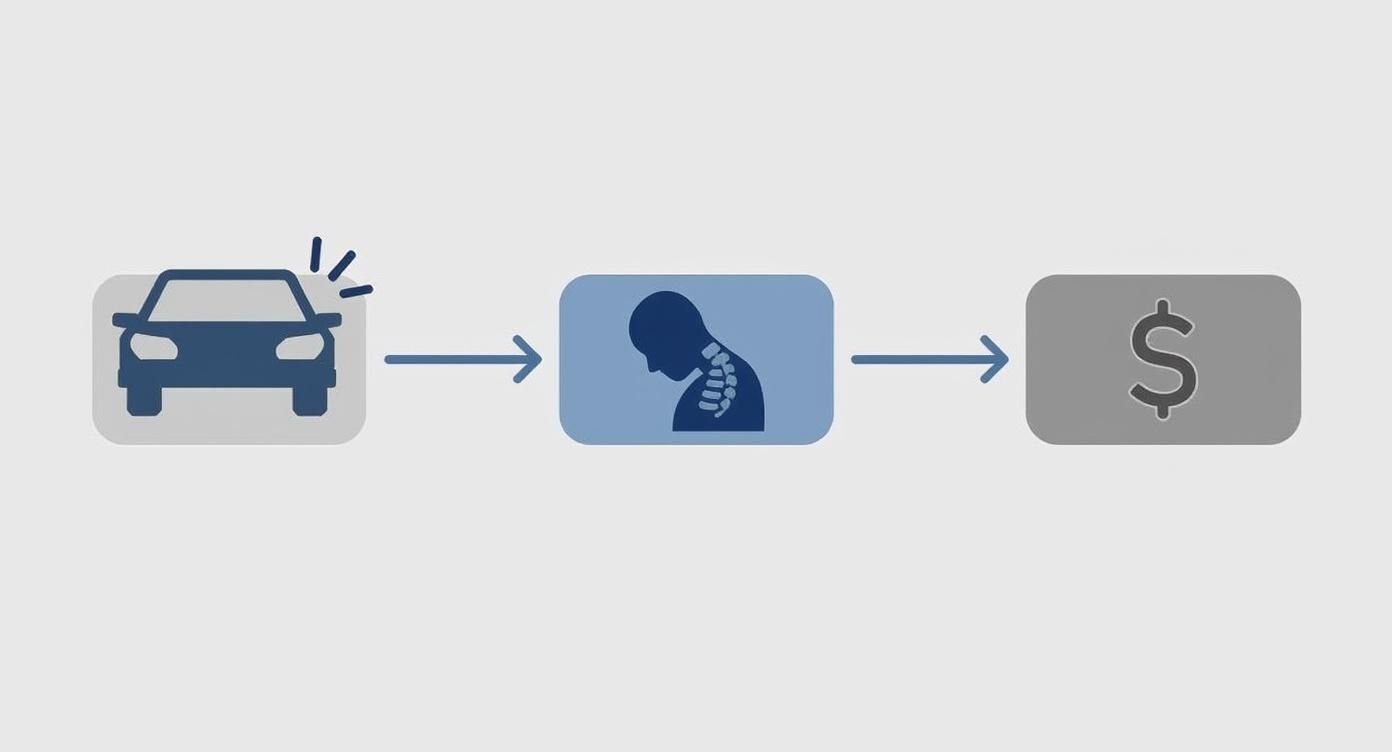
The image makes it clear that the financial recovery flows directly from the injury you suffered in the accident, reinforcing the idea that every single payout is unique.
An insurer’s initial offer is a starting point for negotiation, not the final word. It is a business calculation designed to protect their bottom line, which is why having an experienced advocate on your side is so critical to securing fair compensation.
Let's say you were rear-ended on a packed Houston freeway. Your medical bills for the ER visit and follow-up physical therapy come to $4,000. An adjuster might use a simple formula—perhaps a 1.5x multiplier on your medical bills—to offer you $6,000. This calculation completely ignores the chronic headaches that are affecting your work and the neck pain that keeps you from picking up your children.
While Texas doesn't use official "grades" for injuries, data from other areas reveals clear patterns. For example, a minor Grade 1 whiplash might settle for $5,000 to $10,000, while a more serious Grade 2 injury often settles for between $10,000 and $25,000. You can learn more about how injury severity impacts compensation from other experts. This is exactly why documenting the full story of your suffering is so important.
Critical Evidence That Increases Your Settlement Value
While there’s no official "minimum payout for whiplash," you have more control than you think over strengthening your claim and getting the compensation you deserve. The insurance company's first offer is almost never their best—it’s just a starting point. The final amount you receive will be built on the quality and depth of the evidence you provide.
Think of it this way: you are telling the story of what happened to you. A well-documented case leaves no doubt about the true impact the injury has had on your life, making your story impossible to ignore. Every piece of evidence proves how severe your injuries are and the full extent of your losses.

Proving the Severity of Your Injury
Not all whiplash injuries are created equal. An insurance company will value a mild strain that heals in a few weeks very differently from an injury that leads to chronic pain and physical limitations. Your medical records are the single most important tool you have to prove the difference.
- Diagnostic Imaging: MRIs or CT scans can uncover underlying damage that a standard X-ray might miss, such as herniated discs or soft tissue tears. This objective proof elevates your claim beyond a simple "sprain."
- Specialist Reports: An opinion from a neurologist or an orthopedic specialist carries significant weight. A detailed report from an expert outlining your condition is far more convincing than general notes from a family doctor.
- Range of Motion Tests: Documenting your physical limitations is critical. It’s one thing to say your neck hurts; it’s another to show exactly how much movement you’ve lost. Learning how to measure range of motion accurately provides the kind of concrete data that strengthens your claim.
Documenting the Full Scope of Your Treatment
Consistent medical care is non-negotiable for a fair settlement. Gaps in your treatment history are red flags for insurance adjusters, who will use them to argue your injuries weren't that serious. A complete timeline of your treatment shows you are committed to recovery and validates the severity of the injury.
Your records need to tell the whole story, including:
- Initial Emergency Room Visit: This creates an immediate link between the car accident and your injury.
- Follow-up Primary Care Appointments: This shows you are diligently managing your condition.
- Physical Therapy or Chiropractic Care: These records detail the hands-on treatment needed to regain function.
- Pain Management Injections: This proves that more conservative treatments were not enough to manage your pain.
The narrative of your medical journey—from the crash scene to ongoing physical therapy—paints a vivid picture of your suffering. Comprehensive documentation ensures that your story is heard and properly valued.
Calculating Your Total Financial Losses
A fair settlement must cover more than just your medical bills. It must account for every dollar you lost because of someone else's negligence. This requires meticulous record-keeping.
Keep a detailed file of your lost wages. Gather pay stubs to show your earnings before the accident and log every day you missed from work. If you had to use paid time off or sick leave, that counts as a loss. For self-employed individuals, an experienced Houston car accident attorney or truck crash lawyer Houston can help calculate your lost income using tax returns and business records.
Beyond wages you've already lost, you must consider your diminished earning capacity. If your whiplash injury prevents you from returning to your old job or limits your future career options, you may be entitled to compensation for that future loss. This is a complex calculation, but it is a critical piece of the puzzle for anyone with a long-term or permanent injury, including those with catastrophic injuries or who have lost a loved one and are pursuing a wrongful death claim.
Finally, documenting your non-economic damages is just as important. Our guide on how to prove pain and suffering explains how to translate your daily struggles into compelling evidence that strengthens your claim.
How Texas Law Impacts Your Whiplash Claim
When you file a whiplash claim, the evidence you collect is just one part of the puzzle. The other, equally important part is how Texas law applies to your specific situation. Two legal principles, in particular, can make or break your case: the statute of limitations and comparative responsibility. Understanding these is crucial for protecting your right to a fair settlement.
How Long Do You Have to File a Claim in Texas?
The clock on your claim starts ticking the moment the accident happens. In Texas, you generally have just two years from the date of the injury to file a personal injury lawsuit. This is known as the statute of limitations. While two years might seem like a long time, it can fly by when you're busy investigating the crash, gathering medical records, and negotiating with insurance companies.
If you miss that two-year deadline, the courthouse doors will almost certainly be closed to you forever. This is why it's so critical to talk to a Texas personal injury lawyer as soon as possible. They can ensure your legal options are preserved while you focus on healing.
Texas Follows a Modified Comparative Responsibility Rule
Another Texas law that heavily influences your potential payout is the "modified comparative responsibility" rule, sometimes called the 51% bar rule. This rule comes into play when there's a question about who was at fault for the accident. It means you can still receive compensation even if you were partially to blame—but your final award will be reduced by your percentage of responsibility.
In Texas, being partially at fault doesn't automatically kill your claim. However, if a judge or jury decides you were 51% or more to blame for the crash, you are completely barred from recovering any money at all.
Let's look at how this works in the real world.
Imagine you were in a wreck in Houston, and a jury decides your total damages amount to $50,000. However, they also find that you were 20% at fault because you were driving a few miles over the speed limit when the other driver ran a red light.
- Under the comparative fault rule, your $50,000 award would be reduced by your 20% share of the blame.
- This means your final recovery would be $40,000.
- But if that jury had decided you were 51% responsible, you would walk away with nothing.
Insurance adjusters often use this rule to their advantage. They will look for any reason to shift blame onto you to reduce their payout or deny your claim outright. This is one of the biggest reasons to have a skilled attorney in your corner. Your lawyer can fight back against unfair blame, protect the true value of your claim, and make sure you understand the different types of damages you are entitled to.
Practical Steps to Protect Your Claim After an Accident
The moments right after a car accident are often confusing and overwhelming. It's a difficult situation, but what you do in those first hours and days can make or break your whiplash claim. Building a strong case starts right at the scene. Taking these practical steps lays the groundwork for getting the fair compensation you deserve.
Your health is always priority number one. Seek medical attention right away, even if you feel "okay." Whiplash is notorious for delayed symptoms; neck pain, stiffness, and headaches might not appear for hours or even days. Going to an ER or your doctor immediately creates a direct, undeniable link between the crash and your injuries. That's evidence an insurance adjuster can't easily dismiss.
Gather Evidence at the Scene
If you're physically able, start collecting evidence right where the accident happened. This information will be invaluable later.

- Take Photos and Videos: Use your smartphone to document everything. Snap pictures of the damage to both vehicles, skid marks on the road, traffic signals, and the general area.
- Exchange Information: Get the other driver's name, phone number, driver's license number, and their insurance policy details.
- Talk to Witnesses: If anyone saw what happened, get their name and contact information. A statement from an independent third party can be incredibly powerful in proving who was at fault.
Long before an accident even happens, one of the smartest things you can do is take the time for understanding your own car's insurance policy. Knowing if you have protections like Personal Injury Protection (PIP) or Uninsured/Underinsured Motorist coverage gives you a critical safety net.
Document Everything and Be Cautious
Once you're home, the work of documenting your case continues. Keep a simple journal of your symptoms. Write down your pain levels each day and make notes about how the injury is affecting your daily life—like being unable to lift your children or sit comfortably at your desk. This personal record is key to demonstrating your pain and suffering.
You also need to become a meticulous bookkeeper. Keep every medical bill, pharmacy receipt, and any other out-of-pocket cost related to your recovery. Log any days you miss from work and hold onto your pay stubs to prove your lost income. This paperwork is vital when you or your attorney calculate the full value of your claim. A detailed guide on writing a demand letter for personal injury can show you how all of this documentation eventually comes together.
Finally, be very careful when speaking to the other driver’s insurance adjuster. They may sound friendly, but their job is to pay out as little as possible. Politely decline to give a recorded statement or sign any documents until you’ve spoken with a Houston car accident attorney. An experienced lawyer can handle all communications for you, protecting your rights from the very beginning.
Why an Attorney Is Key to Maximizing Your Recovery
It can be tempting to handle a whiplash claim on your own, especially if it seems minor. But you're not just dealing with an adjuster—you're going up against a massive insurance corporation with a team of lawyers whose job is to minimize your payout.
An experienced Texas personal injury lawyer completely levels that playing field. We ensure your voice is heard and your rights are protected from day one.
If your injury involves ongoing pain, forces you to miss work, or if there's any dispute over who was at fault, you need professional legal guidance. Insurance companies know that people without a lawyer are far more likely to accept a quick, lowball offer that won't cover their future needs.
Fighting for Your Full and Fair Compensation
Hiring an attorney from The Law Office of Bryan Fagan, PLLC, is about more than just filing paperwork. We become your dedicated advocate, handling every call, email, and negotiation with the insurance company so you can focus all your energy on healing.
Our role is to build an undeniable case on your behalf. This includes:
- Gathering Critical Evidence: We immediately get to work collecting police reports, tracking down witness statements, and securing expert medical testimony that draws a clear, undeniable line between the accident and your whiplash injury.
- Calculating Your True Losses: We don't just add up your current medical bills. We meticulously calculate the full, long-term value of your claim, accounting for future treatments, lost wages, and the very real impact of your pain and suffering.
- Negotiating Aggressively: Armed with powerful evidence, a Houston truck crash lawyer or wrongful death lawyer Texas can effectively shut down the insurer's lowball tactics. We negotiate from a position of strength to demand the maximum compensation you rightfully deserve.
The gap between what an insurance company first offers and the final settlement an attorney secures can be staggering. Simply having a lawyer involved signals to the insurer that you are serious and will not be pushed around.
This isn't just true in Texas; it's a reality everywhere. In the UK, for example, severe whiplash injuries can lead to payouts from £25,000 to over £200,000. Hitting those higher figures almost always depends on having extensive medical proof and strong legal backing. You can discover more about how legal representation impacts severe injury claims and see how universal this principle is.
Our commitment is simple: we fight to secure the recovery you need to truly rebuild your life—not just the bare minimum the insurance company hopes you’ll settle for.
Common Questions We Hear About Texas Whiplash Claims
When you're dealing with the aftermath of a car accident, you will have a lot of questions. It's completely normal to feel unsure about what to do next. Here are some straightforward answers to the questions we hear most often from clients like you.
Should I Accept the First Settlement Offer from the Insurance Company?
Almost never. You should think of that first offer from the insurance adjuster as their opening bid in a negotiation. It's strategically low, designed to close your case as quickly and cheaply as possible for them.
It rarely accounts for the full picture—like potential future medical needs, all the income you've lost, or the real impact of your pain and suffering. Before you consider signing anything, you should have a dedicated Texas personal injury lawyer review it. Signing that document means signing away your right to any future compensation for this injury.
How Long Does It Take to Settle a Whiplash Claim in Texas?
There’s no one-size-fits-all timeline. A minor injury where fault is clear might settle in just a few months.
However, if your injury is more severe and requires ongoing medical care, or if there is a disagreement over who caused the crash, the process can easily take a year or more. This is especially true if a lawsuit has to be filed to get the insurance company to take the claim seriously.
Can I Still Get Money If I Was Partially at Fault for the Wreck?
Yes, you can. Texas law follows a “modified comparative fault” rule. As long as you are not found to be 51% or more responsible for the accident, you can still recover damages.
The rule is simple: your final settlement amount is reduced by whatever percentage of fault is assigned to you. For example, if you're deemed 10% to blame, your total recovery is cut by 10%. This is a key area where an attorney is vital—we fight back against unfair attempts by the insurer to shift more blame onto you to reduce their payout.
A serious accident can flip your world upside down in an instant—but you don’t have to go through it alone. The experienced and compassionate team at The Law Office of Bryan Fagan, PLLC, is here to offer the supportive guidance and tough advocacy you need to get the compensation you deserve.
We take care of every detail, from investigating the crash to going toe-to-toe with insurance companies, so you can put all your energy into getting better. For a free, no-obligation consultation to discuss your case, contact us today. Your recovery is possible, and legal help is available. Visit us at https://texaspersonalinjury.net.