A serious motorcycle accident can change your life in seconds — but you don’t have to face it alone. Suddenly, you're dealing with physical pain, emotional shock, and a mountain of financial worries. The steps you take right after a crash are critical, not just for your health but for laying the groundwork for a successful injury settlement claim. At The Law Office of Bryan Fagan, PLLC, our goal is to provide clear answers so you can make empowered decisions about your future.
What to Do After a Motorcycle Wreck in Texas
The minutes following a motorcycle crash can feel chaotic. Your adrenaline is pumping, and clear thinking feels impossible. But what you do at the scene and in the hours afterward can make or break your ability to get fair compensation. Protecting your health and your legal rights starts now.
Think about a rider we helped who was hit by a car that ran a red light on a busy Houston freeway. He was shaken up, but he had the presence of mind to pull out his phone and snap pictures of the intersection, the vehicles, and the other driver’s license plate before the ambulance arrived. That quick thinking locked in crucial evidence that later proved the other driver was 100% at fault.
Prioritize Your Health Above All Else
Your first and most important job is to take care of yourself. Even if you think you can walk it off, some of the most serious injuries—like internal bleeding or traumatic brain injuries—don't show symptoms right away.
- Get Medical Help Immediately: Call 911 or have someone else do it. Let the paramedics check you out on the scene, and if they recommend a trip to the hospital, go. Your health is the priority.
- Follow Your Doctor's Orders: Stick to the treatment plan they give you. That means going to every follow-up appointment, taking your medications, and completing your physical therapy.
- Keep Every Piece of Paper: Start a file for every doctor's visit, medical bill, and pharmacy receipt. This documentation is the backbone of your claim, proving the full extent of your medical damages.
This infographic breaks down the simple, critical steps to take after a wreck.
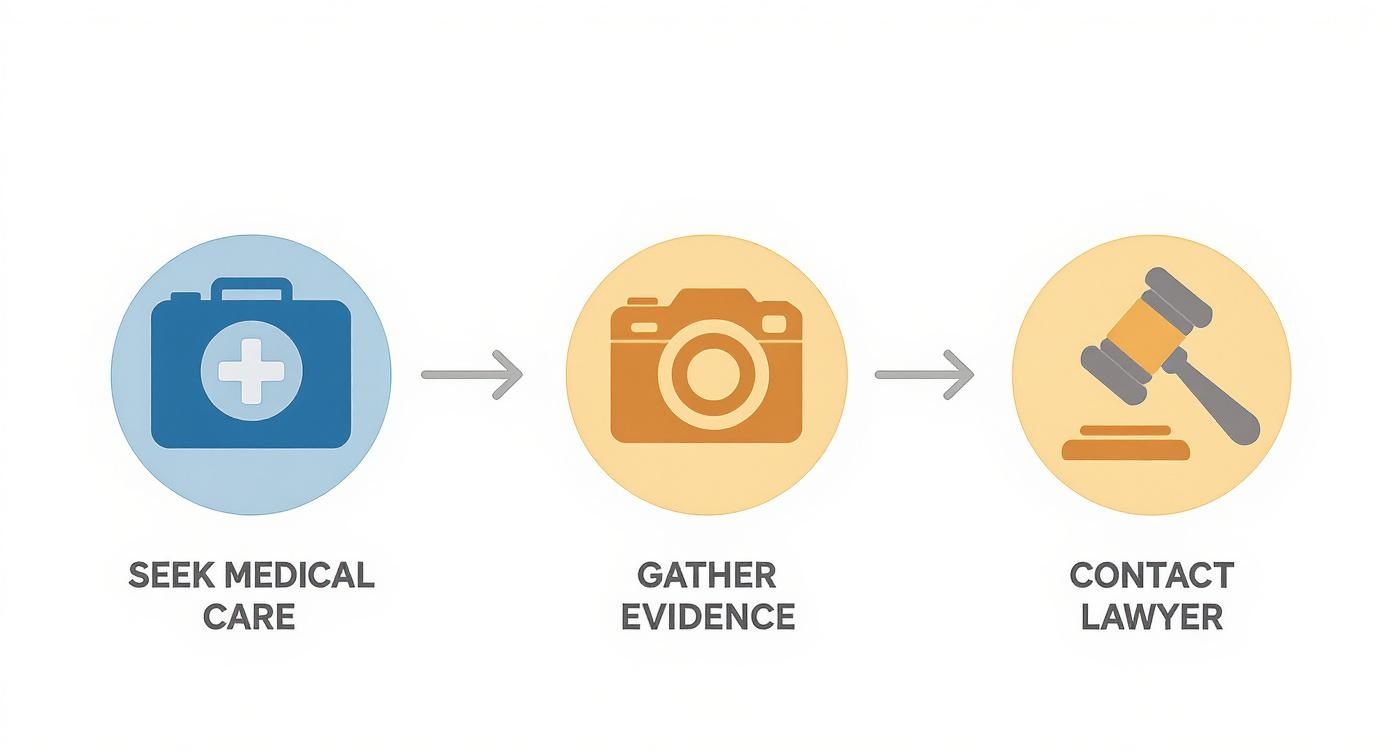
As the graphic shows, your health and gathering key information are the top priorities to protect your rights from the very beginning.
Understanding Negligence in a Texas Motorcycle Claim
To get a settlement, we have to prove the other party was negligent. In plain English, negligence means someone else failed to be reasonably careful, and their carelessness caused your injuries.
Under Texas law, every driver has a duty to operate their vehicle safely and avoid hurting others. When they fail in that duty by speeding, texting while driving, or making a reckless lane change, they're considered negligent.
Proving they broke this duty of care is the foundation of your personal injury claim. Evidence from the scene—photos, witness statements, and the official police report—is absolutely essential for establishing who was at fault.
While the steps are similar for any vehicle crash, bikers often face a unique, unfair bias from insurance companies and juries. You can learn more about the general process in our detailed guide on what to do after an accident. Having an experienced Texas personal injury lawyer who knows how to fight back against that bias is crucial. We’re here to hold the responsible driver accountable so you can focus on your recovery.
How to Calculate Your Motorcycle Settlement Value

After a crash, one of the first questions every rider has is, "What's my claim actually worth?" It's a fair question. You’re suddenly buried under a mountain of bills with an uncertain road ahead, and you need to know what financial recovery is possible.
You can find plenty of online settlement calculators, but the truth is those tools can't grasp the full human impact of a serious motorcycle wreck. A real settlement isn't just a number; it's a careful calculation of every loss you've suffered—the obvious and the hidden.
In Texas, personal injury law splits these losses into two main categories, known as damages. Understanding these is the first step to knowing the true value of your case.
Economic Damages: The Tangible Costs
Economic damages are the most concrete part of any settlement calculation. Think of these as all the "receipts" and hard costs that pile up because of the accident. These are the specific, provable financial losses you’ve been forced to shoulder.
This isn’t just about the ER bill. It’s everything, including:
- Medical Expenses: Every penny, from the ambulance ride and initial surgery to follow-up appointments, physical therapy, prescription drugs, and any future care you’ll need.
- Lost Wages and Income: If you were out of work while recovering, you're entitled to that lost income. This also covers lost earning capacity if your injuries mean you can't go back to your old job or make the same living you once did.
- Property Damage: This is the cost to either repair or completely replace your bike, helmet, riding gear, and anything else that was destroyed in the crash.
Imagine a rider in Dallas gets sideswiped by a distracted driver and ends up with a shattered leg. His economic damages would include the hospital bills, the cost of his orthopedic surgery, months of physical therapy, and the three months of paychecks he missed while he couldn't work his construction job.
Non-Economic Damages: The Human Cost
This is where online calculators fall completely flat. Non-economic damages are designed to compensate you for the intangible—but very real—human suffering the crash inflicted on you. These are the losses that don't come with a price tag, but they are often the most devastating part of a serious injury claim.
A fair settlement has to account for the ways an accident shatters your quality of life. This means putting a value on your physical pain, the emotional trauma, and the loss of joy you feel when you can no longer do the things you love.
Valuing these damages is complex because they are deeply personal to your experience. This is why having an experienced Texas injury lawyer in your corner is so critical. A Houston car accident attorney knows how to demonstrate the true depth of these losses.
The different types of compensation you can claim are designed to cover every aspect of how the accident has affected your life.
Types of Compensation in a Motorcycle Accident Claim
| Type of Damage | What It Covers | Example |
|---|---|---|
| Pain and Suffering | The physical pain from your injuries and the emotional distress that comes with it. | The constant, throbbing pain from a broken bone or severe road rash. |
| Mental Anguish | Conditions like anxiety, depression, PTSD, or a new fear of riding that develops after a traumatic crash. | Experiencing flashbacks of the accident or having panic attacks near traffic. |
| Physical Impairment | Compensation for any permanent physical limitation you now have to live with. | Not being able to lift heavy objects, walk without a limp, or use your hand properly. |
| Disfigurement | Payment for scarring, the loss of a limb, or other permanent changes to your appearance. | Severe scars on your arms or face from sliding on the pavement. |
| Loss of Consortium | The negative impact your injuries have had on your relationship with your spouse. | The loss of companionship, affection, and intimacy due to your injuries. |
| Loss of Enjoyment of Life | The inability to take part in hobbies or daily activities that once brought you joy. | No longer being able to go for weekend rides, play sports, or work in your garden. |
This table shows just how many different ways a motorcycle accident can turn your world upside down, and the law provides a path to seek compensation for each one.
Let's go back to our Dallas rider with the broken leg. His physical pain was relentless. He couldn't play with his kids or hop on his bike for a weekend ride. These non-economic damages are a vital piece of his settlement because they acknowledge the profound, personal toll of his injuries. To get a better sense of how this works, you can read our guide to learn more about calculating pain and suffering damages in Texas.
Arriving at a Fair Settlement Value
So, how does this all come together? A final settlement figure is reached by adding up all your economic damages and then assigning a fair, justifiable value to your non-economic damages.
It’s important to note that settlement values are not static. With rising medical costs and a better understanding of long-term injuries, national trends show that average payouts are increasing. Data compiled from law firms in November 2025 shows the average motorcycle accident settlement ranging from $66,000 to $185,000, with a nationwide average hovering around $99,000.
That massive range tells you everything you need to know: every case is different. A claim involving some minor road rash is going to be worth far less than one involving a catastrophic injury that demands lifelong care. Our job is to meticulously document every single one of your losses to ensure the demand we send to the insurance company reflects the true, total cost of what happened to you.
Navigating Talks with Insurance Adjusters

It won’t be long after your accident before the phone rings. On the other end will be an insurance adjuster for the at-fault driver. They’ll sound friendly and helpful—but you need to understand one thing very clearly: they are not on your side. Their job is to protect their company's bottom line by paying you as little as possible.
Going up against a trained insurance professional is often the most frustrating part of getting a fair motorcycle accident settlement. These are skilled negotiators who deal with claims like yours every single day. They know exactly what to say to chip away at the value of your case.
Common Tactics Insurance Adjusters Use
Insurance companies have a playbook of tactics designed to undermine your claim from that very first phone call. Knowing what to expect can help you avoid costly mistakes.
One of the most common moves is the quick, lowball settlement offer. An adjuster might call you within a few days of the crash, offering a few thousand dollars to "help with your immediate bills." When you’re out of work and medical expenses are showing up, that offer can feel like a lifeline. It’s a trap.
If you accept that initial offer, you’ll sign away your right to seek any more money, ever. When you later discover your injuries are worse than you thought and require long-term physical therapy, you'll have no way to get compensation for it. This strategy is designed to close your case for pennies on the dollar before you grasp what your claim is truly worth.
Another tactic is pressuring you into giving a recorded statement. The adjuster will ask seemingly innocent questions about the crash and your recovery. The real goal is to get you to say something they can twist and use against you later, like downplaying your pain or accidentally admitting partial fault.
You have no legal obligation to give a recorded statement to the other driver's insurance company. It is almost always in your best interest to politely decline until you’ve spoken with an experienced Texas personal injury lawyer.
The Impact of Comparative Responsibility in Texas
A huge part of the adjuster's job is to shift as much of the blame for the crash as they can onto you. They do this because of a Texas law called modified comparative responsibility (also known as proportionate responsibility).
Under this rule, any settlement you receive can be reduced by your percentage of fault. For example, if your total damages are $100,000 but you are found to be 20% responsible for the crash, your recovery is cut by 20%, leaving you with only $80,000.
If the insurance company can successfully argue that you were 51% or more at fault, Texas law completely bars you from recovering any compensation. This is why it’s so critical to never guess, speculate, or admit any fault when speaking to an adjuster.
Why You Need an Attorney to Handle Negotiations
Having an experienced motorcycle accident attorney in your corner flips the script. Once we represent you, all communication from the insurance company must come through our office. We handle the adjusters for you, shielding you from their tactics.
We level the playing field by:
- Investigating the crash to gather the evidence needed to prove the other driver was at fault.
- Calculating the full value of your claim, including future medical care, lost earning capacity, and your pain and suffering.
- Negotiating aggressively with the adjuster to demand a settlement that truly covers your losses.
- Preparing your case for trial from the beginning, sending a clear message that we’re ready to fight if they won't be fair.
Negotiating with insurance companies is a minefield. For a deeper dive into this critical stage, we've created a guide on how to effectively negotiate with an insurance adjuster. By letting a qualified truck crash lawyer Houston families trust manage these conversations, you can focus on your recovery.
How Long Do You Have to File a Claim in Texas?
After a serious motorcycle crash, it feels like the world stops. Your focus narrows to just getting through the day. But in the background, a legal clock starts ticking. This deadline is the statute of limitations, and in Texas, it’s one of the most unforgiving parts of any personal injury case.
This isn’t a flexible guideline. It's a hard, legal cutoff. If you miss it, you lose your right to demand financial compensation forever—it doesn't matter how clear-cut your case is or how badly you were hurt.
The Two-Year Deadline in Texas
For the vast majority of motorcycle accident claims in Texas, you have two years from the date of the crash to either settle your case or file a lawsuit. That two-year window applies to your personal injuries and the damage to your bike.
Two years might sound like a long time, but it disappears quickly when you're caught up in doctor's appointments, surgeries, and physical therapy. Putting together a powerful case takes time. Waiting until the last minute puts you at a huge disadvantage.
Consider a rider we worked with who was hit on a San Antonio highway. He spent the first year consumed by his medical recovery, figuring he’d get to the legal stuff "later." By the time he called us, critical evidence was gone, witness memories were fuzzy, and we had to scramble to file a lawsuit just days before his time ran out. It added stress and risk that was completely avoidable.
Why Acting Quickly Is So Important
The statute of limitations is the final deadline, but the real reasons to act fast start the moment of the crash. The sooner you get the legal process moving, the more solid your case will be.
Here's why moving with urgency is critical:
- Evidence Disappears. Skid marks wash away. Nearby security camera footage gets recorded over. A lawyer can immediately send out preservation letters to make sure crucial evidence isn't destroyed.
- Memories Fade. A witness's account of a crash is sharpest in the days right after it happens. If you wait months, you’ll be left with vague, unreliable statements.
- Building a Case Takes Time. Your legal team needs to do a deep dive. That means a full investigation, gathering every medical record, and weaving it all into a compelling story that proves the other driver was at fault.
The absolute best time to talk to a Texas personal injury lawyer is right after you’ve been seen by a doctor. Let your legal team handle the evidence and the insurance adjusters so you can put 100% of your energy into getting better.
Don't let a legal deadline become another source of anxiety. The Law Office of Bryan Fagan, PLLC can get to work right away to protect your rights and make sure every deadline is met, giving you one less thing to worry about.
What Happens When Your Case Goes to Court?
The goal for every motorcycle accident claim is to get you a fair settlement without ever having to step inside a courtroom. The reality is, the vast majority of cases—well over 90%—end exactly this way. But a settlement is only the right move when the insurance company’s offer is just and covers everything you've lost.
Sometimes, though, an insurer refuses to be reasonable. They might deny fault, argue your injuries aren’t as bad as you say, or just throw out a lowball offer that’s an insult to what you and your family have been through.
When negotiations hit a wall, filing a lawsuit becomes a necessary tool to force them to pay what’s fair. Deciding to file a lawsuit doesn't mean your case is destined for a dramatic trial. It's a strategic step that shifts your claim into the formal legal system, forcing the other side to take you seriously.
Why Your Claim Might Go to Litigation
Filing a lawsuit is never our first choice, but it is a powerful one. We typically recommend taking this step only when specific roadblocks prevent a fair, out-of-court resolution for your motorcycle accident settlement.
Common reasons we file a lawsuit include:
- The Insurance Company Makes a Lowball Offer: This is when their "final" offer doesn't even come close to covering your medical bills and lost wages, let alone your pain and suffering.
- A Dispute Over Fault: The other driver’s insurer might try to pin some or all of the blame on you, using Texas’s comparative fault rules to deny your claim.
- The Insurer Flat-Out Denies Your Claim: In some situations, an adjuster will deny the claim altogether, claiming their client wasn't negligent or that your injuries were pre-existing.
- The Statute of Limitations is Approaching: If the two-year deadline is getting close and a fair settlement hasn't been reached, we have to file a lawsuit to protect your right to compensation.
Taking this step sends a clear signal to the insurance company: we are fully prepared to present your case to a jury if we have to. More often than not, the simple act of filing the lawsuit is enough to bring them back to the table with a much more realistic offer.
Demystifying the Legal Process
The idea of "going to court" can sound intimidating, but it's really just a structured process designed to get to the truth. If we file a lawsuit on your behalf, your case officially enters a phase called litigation. Here’s a simple breakdown of what that involves.
1. Filing the Petition
It all starts when your attorney files a formal document called a "Petition" with the court. This document clearly lays out who you are suing, why you are suing them, and the damages you've suffered.
2. The Discovery Phase
This is the longest and most important part of litigation. During discovery, both sides exchange information and evidence. It's a fact-finding mission where we learn everything about their case, and they learn about ours. Key activities include:
- Interrogatories: These are written questions sent to the other party, which they are legally required to answer under oath.
- Requests for Production: We send formal requests for documents, like the other driver’s cell phone records or vehicle maintenance logs.
- Depositions: This is an in-person interview where your attorney questions the at-fault driver under oath, and their attorney gets to question you. It’s a critical step where we lock in sworn testimony.
Discovery is where strong cases are built. It's our opportunity to systematically dismantle the insurance company’s arguments by gathering undeniable proof of their client’s negligence.
3. Mediation and Trial
Even after a lawsuit is filed, a settlement is still the most likely outcome. Most Texas courts will require both parties to attend mediation—a formal settlement conference led by a neutral third-party mediator. This is often the last, best chance to resolve the case before a trial becomes necessary.
If mediation fails, the final step is trial. This is where having a skilled trial lawyer from a firm that handles everything from motorcycle wrecks to complex wrongful death claims in Texas becomes essential. As your wrongful death lawyer Texas, we will present all the evidence and testimony to a judge and jury, who will then decide the final outcome. While a trial always carries uncertainty, sometimes it’s the only way to hold a negligent driver fully accountable.
Got Questions About Your Motorcycle Settlement? We've Got Answers.
When you're trying to heal after a serious motorcycle wreck, the last thing you need is more confusion. The legal process can feel overwhelming, and it's normal to have questions. Let’s tackle some of the most common ones we hear from our clients with clear, straightforward answers to give you back a sense of control.
How Long Is This Going to Take? The Honest Timeline for a Texas Motorcycle Settlement
This is almost always the first question clients ask, and the only honest answer is: it depends on your specific case. A fairly simple claim with minor injuries and clear proof of fault might settle in just a few months.
However, more complicated cases take longer. If you’ve suffered serious injuries that need ongoing medical care, it is critical that we wait until your doctor says you’ve reached Maximum Medical Improvement (MMI). That’s the point where your condition is stable. Settling before MMI is a massive gamble because we wouldn’t know the true, long-term costs of your medical needs.
Cases with disputed fault or catastrophic injuries can easily take a year or more, especially if we have to file a lawsuit to get the insurance company to make a fair offer.
The single most important thing to remember is not to rush. A quick settlement is almost never a good settlement. Our job is to get you the maximum compensation you’re owed, and we’ll take the time needed to do it right.
What if the Other Driver Was Uninsured?
It’s a frustrating moment when you find out the driver who hit you either has no insurance or a bare-bones policy that won't cover your bills.
This is exactly why your own policy should include Uninsured/Underinsured Motorist (UM/UIM) coverage. You pay for this protection to cover your own losses when you're hit by someone who is uninsured, underinsured, or takes off in a hit-and-run. We open a claim with your own insurance company to tap into these benefits.
Navigating a UM/UIM claim can be tricky. You’re now in a position where you have to negotiate against your own insurance company. Having a skilled Texas personal injury lawyer manage this for you is key to making sure they treat you fairly.
What’s This Going to Cost Me? A Look at Lawyer Fees
This is a huge concern, especially when you’re already dealing with medical bills and can't work. At The Law Office of Bryan Fagan, PLLC, we handle every personal injury case on a contingency fee basis.
This ensures anyone can get expert legal help, regardless of their financial situation. Here’s what that means for you:
- No Upfront Costs: You don’t pay us a dime out of your pocket to get started.
- We Get Paid When You Get Paid: Our fee is a percentage of the settlement or jury award we win for you, agreed upon upfront.
- If You Don’t Win, You Don’t Pay: If we don't secure a recovery for you, you owe us nothing for our legal work.
This system aligns our goals with yours. We are both motivated to get the largest possible financial recovery for you. It means you can afford top-tier legal representation with zero financial risk.
Do I Really Have to Go to Court?
The short answer is: probably not. The vast majority of motorcycle accident claims—well over 90%—are resolved through a settlement agreement. You’ll likely never have to step foot inside a courtroom. Our primary goal is always to secure a fair settlement for you through solid investigation and tough negotiation.
Going to court is the last resort. We only take that step when an insurance company refuses to negotiate in good faith. That said, we prepare every single case from day one as if it’s headed for trial. This sends a loud and clear message to the insurance company: we are prepared to fight it out in front of a jury. Often, just knowing we're ready for that fight is what brings them back to the negotiating table with a better offer.
A serious accident can flip your world upside down—but you don’t have to pick up the pieces alone. We know that recovery is possible, and legal help is available. The team at The Law Office of Bryan Fagan, PLLC is here to answer your questions, defend your rights, and fight for the justice you deserve.
If you or someone you love has been hurt, contact us today for a free, no-obligation consultation to go over your legal options. Let us shoulder the legal burden so you can focus on what matters most: getting better.