Skip to content
A serious accident can change your life in seconds—but you don’t have to face it alone. The moment a motorcycle crash happens, the clock starts ticking on your claim. What you do in those first chaotic minutes is critical for protecting both your health and your legal rights. Your first priority is always safety, but right after that comes documenting what happened and getting legal advice before you talk to an insurance adjuster. These early actions lay the groundwork for getting the compensation you deserve.
What To Do Immediately After a Motorcycle Crash
One second you're riding, the next your life is turned upside down. The aftermath of a motorcycle accident is a painful, confusing blur. Adrenaline is pumping, which can easily hide how badly you're actually hurt. How you handle this critical window of time can make or break your physical recovery and the strength of your future motorcycle accident claim.
Your well-being has to come first. We've seen it time and time again—riders feel like they can just walk it off, only to discover serious internal injuries hours or even days later. Getting checked out by a medical professional immediately creates a direct, official link between your injuries and the crash. This medical record is one of the most powerful pieces of evidence you can have.
Preserve Your Health and Your Rights
After a terrifying wreck on a Houston freeway, pulling out your phone to take pictures is probably the last thing on your mind. But it’s one of the most important things you can do to protect yourself. If you're physically able, document everything you can.
The following infographic breaks down the essential actions to take.
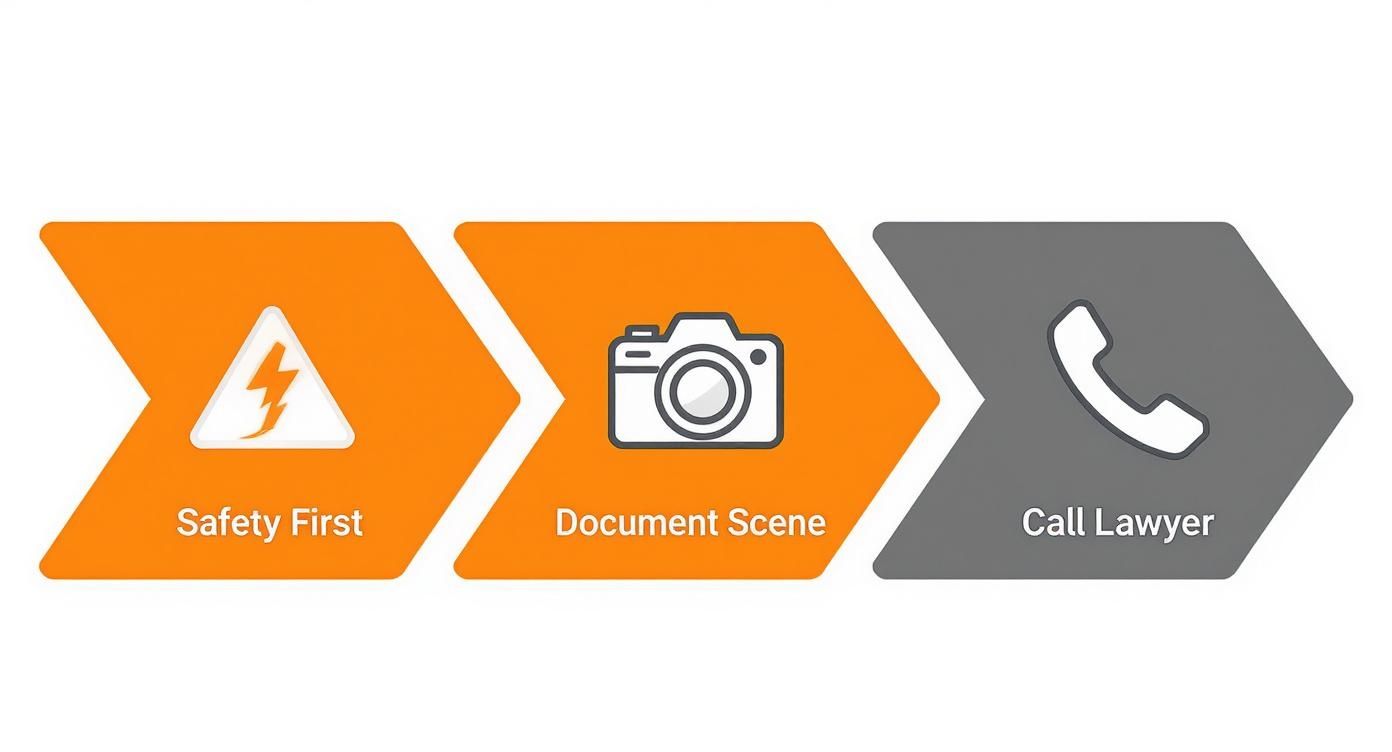
It really boils down to a clear sequence: get safe, gather evidence, and then get professional legal help to protect your claim.
Documenting The Scene
Trying to gather information methodically when you're shaken up is tough, but it gives your attorney the solid facts needed to build your case.
Here's what our Texas personal injury lawyers always tell clients to focus on if they can:
- Photos and Videos: Snap pictures of everything. Get wide shots of the whole scene, then zoom in on the vehicle damage, skid marks, road debris, and any traffic signs or signals nearby.
- Driver and Witness Info: Swap insurance and contact details with the other driver. Do not discuss fault. Just stick to the basic facts. If anyone saw what happened, get their name and number. An independent witness can be a game-changer for your case.
- The Police Report: Always, always call the police. An official report creates a formal record of the incident. When you talk to the officer, just state what happened from your perspective without guessing or speculating.
Accurate records are everything. From the start, focusing on avoiding data entry errors when you collect information can make a huge difference in the integrity of your claim. The stakes are just so much higher for motorcyclists. Motorcyclists are a staggering 29 times more likely to die in a crash than people in cars.
Crucial Tip: Never admit fault or even apologize at the scene. A simple "I'm sorry" can be twisted by an insurance company and used against you later on. Even saying "I think I'm okay" can damage your claim if injuries show up later.
Before you give any recorded statement to an insurance adjuster, you need to speak with an experienced motorcycle accident attorney. We offer a free consultation to go over your case and make sure you understand your rights. For more immediate tips, you can also learn more about what to do after a car accident in our general guide.
The minutes following a crash are overwhelming. To make it easier, here is a quick checklist to keep in mind.
Your Post-Accident Action Plan
| Priority | Action | Why It Matters for Your Claim |
|---|---|---|
| Immediate | Check for Injuries & Call 911 | Creates an official record of the accident and ensures you and others receive immediate medical care, which is vital for both health and your claim. |
| High | Move to a Safe Location (If Able) | Prevents further injury or a secondary accident. Your safety is paramount. |
| High | Document the Scene with Photos/Videos | Visual evidence is powerful. It captures vehicle positions, damage, road conditions, and other details that can prove fault. |
| Medium | Exchange Information with the Other Driver | Collect their name, contact info, driver's license number, and insurance details. This is essential for filing the claim. |
| Medium | Get Witness Contact Information | Independent witnesses provide unbiased accounts that can strongly support your version of events and counter the other driver's claims. |
| Crucial | Do NOT Admit Fault or Apologize | Any admission of guilt, even a simple apology, can be used by insurance companies to deny or reduce your settlement. |
| Crucial | Seek a Medical Evaluation | Even if you feel fine, some serious injuries have delayed symptoms. A medical report officially links your injuries to the crash. |
| Post-Scene | Contact a Motorcycle Accident Attorney | An attorney protects you from insurance adjusters and ensures you don't make mistakes that could jeopardize your right to fair compensation. |
Having a plan can help bring a little bit of order to a chaotic situation, ensuring you take the right steps to protect yourself physically and financially.
Understanding Texas At-Fault Laws and Your Claim

After a motorcycle crash, the first thing you need to understand is how Texas law approaches these situations. Texas is an “at-fault” state, which is a straightforward way of saying whoever caused the wreck is responsible for the damages.
This means your entire motorcycle accident claim will focus on proving the other driver was at fault. We do this by establishing a legal concept called negligence.
Imagine a common scenario: you're riding on I-10 in Houston when a car swerves into your lane without looking, causing you to crash. To get you the compensation you deserve, your attorney has to prove four specific things about that driver's actions.
Proving Negligence in Your Claim
Building a solid claim isn't just about telling your side of the story; it's about legally proving that the other person's carelessness was the direct cause of your injuries. This involves establishing four key elements:
- Duty: First, we show the other driver had a basic legal duty to operate their vehicle safely and watch out for others on the road, including you.
- Breach: Next, we prove they breached that duty. This could be anything from texting while driving to speeding or making an unsafe lane change.
- Causation: Then, we have to connect the dots and show that their failure—their breach of duty—is what directly caused the accident and your injuries.
- Damages: Finally, we demonstrate that you suffered actual losses because of the crash, like medical bills, lost income, and pain and suffering.
When we line up these four points and back them with hard evidence like a police report, witness accounts, or traffic camera footage, we build a compelling case. This is the foundation of any successful claim. For a deeper dive, you can explore our guide on how to file a personal injury claim.
What if You Are Partially to Blame?
One of the first things an insurance adjuster will try to do is pin some of the blame on you. It's a classic tactic, especially with motorcyclists—they might claim you were weaving through traffic or going too fast.
But Texas has a specific rule for this called the modified comparative fault rule, also known as the 51% bar.
This rule is a game-changer. It means you can still recover money for your injuries even if you were partially at fault, as long as your share of the responsibility is 50% or less.
For instance, say a jury decides your total damages are $100,000 but finds you were 20% at fault. Your award would simply be reduced by that 20%, and you'd still recover $80,000. If, however, they decide you were 51% or more to blame, you get nothing under Texas law.
A Texas personal injury lawyer is your best defense against unfair blame. We know the tactics adjusters use and how to build a strong case that demonstrates the other driver’s primary responsibility, protecting your right to a fair recovery.
This legal protection is vital. With more bikes on the road, claim volumes have risen, and about 42% of all motorcycle insurance claims in recent years have been for collision coverage. An experienced attorney knows this landscape and is ready to fight for every penny your claim is worth.
Calculating the Full Value of Your Claim

To an insurance adjuster, your motorcycle accident claim is just a file full of numbers. But you know it's about much more than that. It’s the missed shifts at work, the nights you can't sleep because of the pain, and the life you now have to piece back together.
A serious crash creates ripple effects that go far beyond the initial ER bill. To get the compensation you truly deserve, you have to account for every single loss—both the ones with a price tag and the ones that are deeply personal.
In Texas, the law recognizes two main categories of damages: economic and non-economic. Understanding both is critical. It’s the only way to stop an insurance company from lowballing you with an offer that covers a fraction of what you actually need to recover.
Tallying Your Economic Damages
Economic damages are the tangible, out-of-pocket costs you’ve paid and the money you've lost because of the crash. Think of these as the "receipts" part of your claim. They're the most straightforward because you can prove them with bills, invoices, and pay stubs.
But here’s where people often get it wrong: they only think about the current costs, not the future ones. For instance, a catastrophic injury from a truck crash in Houston isn't just about the first surgery. It’s about the years of physical therapy, the medical equipment, and the home modifications that will follow.
A complete calculation of your economic damages has to include:
- Current and Future Medical Bills: This isn't just the ambulance ride. It's every co-pay, every prescription, every future surgery, and any long-term physical therapy or in-home care.
- Lost Wages: We calculate every dollar you lost from being unable to work during your recovery.
- Diminished Earning Capacity: What if your injuries mean you can't go back to your old job? Or you can't work as many hours? We fight for compensation for that lost future income.
- Property Damage: This covers the cost to repair your bike or, if it’s a total loss, its fair market replacement value. It also includes your damaged helmet, riding gear, and anything else that was destroyed in the wreck.
These numbers add up fast, and an insurer's first offer rarely, if ever, accounts for the true long-term financial hit.
Accounting for Non-Economic Damages
While economic damages cover your wallet, non-economic damages are meant to compensate you for the human cost of the accident. These losses don’t have a receipt, but their impact on your life is often even more profound.
These are the damages that really tell the story of how a crash turned your world upside down.
Insurance adjusters will almost always try to downplay or even ignore these damages because they are harder to put a number on. An experienced Texas personal injury lawyer knows how to build a case that shows a claims adjuster—or a jury—the real depth of your suffering.
Non-economic damages address the devastating personal impact of your injuries, including:
- Pain and Suffering: This is compensation for the actual physical pain and discomfort you've had to live with and will continue to face.
- Mental and Emotional Anguish: A serious wreck is traumatic. This covers conditions like anxiety, depression, fear, and the PTSD that so many riders experience.
- Physical Impairment and Disfigurement: This is for the loss of use of a part of your body, permanent scarring, or other lasting physical changes.
- Loss of Enjoyment of Life: You used to love getting out on the road, playing with your kids, or just living without constant pain. If you can't do those things anymore, you deserve to be compensated for that loss.
Figuring out a dollar amount for these personal losses is incredibly complex. To get a better handle on the process, you can learn more about how to calculate pain and suffering damages in our detailed guide.
Dealing with the Insurance Company
After a motorcycle crash, you can bet the phone will start ringing. It'll be an insurance adjuster from the other driver’s company, and they will sound incredibly friendly and concerned. Don't be fooled.
It’s critical to remember that this person’s job is to protect their company's bottom line. That means paying you as little as possible—or nothing at all. They are not on your side.
The most important rule is this: you are not required to give a recorded statement to the other driver's insurance company. Adjusters are pros at asking seemingly innocent questions designed to trap you. They can and will twist your words to devalue or completely deny your motorcycle accident claim.
When you're sending and receiving sensitive documents for your claim, you also need to protect your personal information. Following basic digital security best practices is crucial during this vulnerable time.
What to Say and What to Avoid
Your words carry a lot of weight in these calls. An adjuster might ask a simple question like, "How are you feeling today?" If you instinctively reply, "I'm okay" or "Doing better," they'll note it down as an admission that your injuries aren't severe, even if you’re actually in a world of pain.
The best strategy is to stick to the bare facts and keep your answers short and direct.
- What they want to hear: "It all happened so fast, I'm not really sure. I think I'm okay, just a little sore."
- What you should say: "The crash is under investigation. I'm receiving medical care for my injuries and can't discuss the details right now."
This response protects your rights without being hostile. You're just stating facts and making it clear you won't be discussing anything further until you’ve consulted with an experienced Texas personal injury lawyer.
Pro Tip: Never guess, offer opinions, or speculate about what happened. If you don't know the answer, it's perfectly fine to say, "I don't know," or "I'm not able to discuss that at this time."
When the Other Driver Is Uninsured (or Underinsured)
What if the driver who hit you has no insurance, or their policy isn't nearly enough to cover the devastating costs of your injuries? It’s a terrifying scenario many riders face. This is where your own Uninsured/Underinsured Motorist (UM/UIM) coverage comes into play.
But be careful. Even though it's your insurance company, their role instantly becomes adversarial. Their goal is still to minimize the payout. Handling a UM/UIM claim requires just as much caution and legal know-how as dealing with the at-fault driver's insurer.
The insurance landscape is also getting more complex. With electric motorcycle policies jumping by 24% recently, adjusters are dealing with new claim types involving battery damage and specialized repairs. Many are also using telematics data from usage-based policies, which now make up 18% of new policies, to scrutinize rider behavior. An attorney who understands these modern tactics can be a huge advantage.
For families dealing with the ultimate tragedy, this process is unbearable. If you've lost a loved one, you need a compassionate wrongful death lawyer in Texas to take over these communications. We can step in right away, shielding you from the insurance companies so you can focus on what matters most. You don't have to do this alone.
Why You Need an Experienced Motorcycle Accident Lawyer

A serious accident can flip your life upside down in an instant. While you might be able to handle a minor fender bender yourself, a serious motorcycle accident claim is a whole different beast. From the second the crash happens, you can bet the at-fault driver's insurance company is already working against you.
Their objective is simple: protect their bottom line by paying you as little as possible. They have entire teams of adjusters and lawyers trained to poke holes in your story and downplay your injuries. Hiring a lawyer immediately puts a dedicated advocate in your corner—someone whose only job is to fight for you.
Leveling the Playing Field Against Insurers
An experienced lawyer does so much more than file paperwork. We act as your shield and your sword, managing every detail of your claim so your only job is to recover.
Here’s a look at the critical work we do behind the scenes:
- Digging Deeper: We don't just take the police report at face value. We launch our own investigation, often bringing in accident reconstruction experts to prove exactly how the other driver’s carelessness caused your crash.
- Securing Evidence: We track down and preserve evidence that can vanish quickly—think traffic camera footage, cell phone records, and crucial witness statements. We also gather testimony from medical experts who can clearly explain the long-term consequences of your injuries.
- Calculating the True Cost: We partner with financial and medical specialists to paint a complete picture of your losses. This isn't just about current medical bills; it’s about future surgeries, lost earning potential, and the personal, human cost of your pain and suffering.
- Negotiating from Strength: Armed with a mountain of evidence, we demand a fair settlement. We know all the lowball tactics adjusters use, and we won’t let them bully you into accepting a settlement that's a fraction of what you deserve.
Cases involving catastrophic injuries or, tragically, a wrongful death, absolutely require this level of legal skill. The stakes are just too high to go it alone.
You are not just another claim number to us. We understand that your case represents your future, and we fight to protect it with the dedication and compassion you deserve.
The difference in outcome when you have a professional advocate is often night and day. It's about moving from a position of defense to a position of strength.
How Legal Representation Transforms Your Claim
| Claim Task | Handling It Alone | With an Experienced Attorney |
|---|---|---|
| Investigation | Relying solely on the police report. | Conducting a private investigation with accident reconstruction experts. |
| Evidence | Struggling to gather witness statements or secure footage. | Proactively preserving all evidence, from video to expert medical reports. |
| Communication | Facing constant calls and pressure from insurance adjusters. | All communication is handled by your lawyer, protecting you from mistakes. |
| Damage Valuation | Guessing at the future costs of your injuries. | Working with medical and financial experts for a precise lifetime cost analysis. |
| Negotiation | Accepting a lowball offer out of frustration or necessity. | Negotiating from a position of strength, backed by a solid case. |
| Final Outcome | Risking an unfair settlement that doesn't cover future needs. | Maximizing your compensation to secure your financial and medical future. |
Having a legal team on your side ensures every angle is covered, every deadline is met, and every opportunity to strengthen your claim is seized.
No Upfront Costs, Just Expert Representation
We know the last thing you need after a crash is another bill. That's why we handle all personal injury cases on a contingency fee basis.
What does that mean for you? It means you pay absolutely nothing upfront. We cover all the costs of building and pursuing your claim, from expert witness fees to court filing costs. You only pay our fee if and when we win a settlement or verdict for you. If we don’t get you a recovery, you owe us nothing.
This approach eliminates the financial risk and allows you to access the powerful legal help you need right away. Whether you need a skilled truck crash lawyer in Houston or a dedicated motorcycle accident attorney, we're here to make sure your rights are aggressively defended.
Common Questions We Hear from Texas Riders
After a crash, your mind is racing with questions. It's a confusing, stressful time, and getting clear answers is the first step toward feeling in control again. We've been through this with countless riders and their families, and we’ve compiled answers to the questions that come up most often.
Think of this as your starting point for understanding where you stand and what to do next.
How Long Do I Have to File a Motorcycle Accident Claim in Texas?
Texas law gives you a two-year window to file a personal injury lawsuit. This is called the statute of limitations, and it starts on the day of the accident.
Two years might sound like plenty of time, but it disappears fast when you're juggling doctor's appointments, physical therapy, and just trying to get your life back on track. In the meantime, evidence gets lost, witnesses move or forget key details, and the insurance company digs in its heels.
If you miss that two-year deadline, your case is almost certainly over before it begins. The court will likely dismiss it, and you’ll lose the right to seek compensation forever.
The single most important thing you can do to protect your rights is to act quickly. Getting a lawyer involved early ensures all deadlines are met, which keeps the pressure on the insurance company to make a fair offer. If they refuse to be fair, you'll have preserved your right to take them to court.
While there are a few very rare exceptions to this rule, you should never count on them. The sooner your legal team starts building your case, the better your chances of a successful outcome.
What if I Wasn't Wearing a Helmet?
This is a big worry for a lot of riders we talk to, and it's completely understandable. Here’s the bottom line: whether you were wearing a helmet or not does not stop you from filing a claim and recovering money for your injuries.
In Texas, only riders under 21 are required to wear a helmet. If you're over 21, you can ride without one if you've taken a safety course or have specific health insurance coverage.
Now, you can bet the at-fault driver's insurance company will try to use this against you. They'll argue that your decision not to wear a helmet is what really caused your head injury, using Texas’s “comparative fault” rules to try and shift the blame onto you. Their goal is simple: pay you less.
An experienced Texas personal injury lawyer knows this playbook inside and out. We immediately steer the focus back to the real issue—the other driver's negligence is what caused the crash. The helmet issue might play a role in how damages for a head injury are calculated, but it absolutely does not excuse the person who hit you.
The Other Driver's Insurance Offered a Quick Settlement. Should I Take It?
Be very, very careful here. A fast settlement offer can seem like a blessing when bills are piling up, but it's a classic insurance company tactic. They are hoping to close your case for pennies on the dollar before you understand the full extent of your injuries and financial losses.
Ask yourself these questions:
- Have I completed all my medical treatments?
- Do I know for sure if I'll need surgery or long-term physical therapy down the road?
- Have I calculated all my lost wages, including future income I might lose?
Once you accept that offer, it's final. You sign away your right to ever ask for more money for this accident. If it turns out your "sore back" is actually a herniated disc requiring surgery a year from now, you're on your own.
Never accept an offer or sign anything without first talking to an attorney who can properly value your motorcycle accident claim.
How Much Does It Cost to Hire a Lawyer for My Claim?
You’re already dealing with enough financial stress. The last thing you need is another bill. That's why The Law Office of Bryan Fagan handles all personal injury cases on a contingency fee basis.
This is a straightforward way of saying you don't pay us anything upfront.
Here’s exactly what it means for you:
- You pay zero upfront fees. No retainers. No hourly bills. Nothing.
- We front all the costs needed to build a strong case—from hiring accident reconstruction experts to paying court filing fees.
- Our fee is a percentage of the money we win for you.
It’s that simple. If we don’t get you a financial recovery, you owe us nothing. This way, our goals are perfectly aligned with yours: getting you the absolute maximum compensation you deserve.
The road to recovery can feel daunting, but you don’t have to walk it alone. The team at The Law Office of Bryan Fagan, PLLC is ready to take the legal weight off your shoulders so you can focus on what matters most—your healing. We invite you to schedule a free, no-obligation consultation to discuss your case and understand your options. Recovery is possible, and legal help is available. Call us or visit https://texaspersonalinjury.net to take the first step today.