A serious accident can change your life in seconds—but you don’t have to face it alone. At The Law Office of Bryan Fagan, PLLC, we understand that a car or truck crash throws your life into chaos. We step in to represent people just like you—good people who have been injured because of someone else's mistake. Our job is to handle the complicated claims process and fight the insurance companies so you can focus on what matters most: your recovery.
When you're hurt and unsure of your rights, a skilled Texas personal injury lawyer becomes your advocate, fighting to get you the money you need for medical bills, lost income, and everything else you’ve been forced to endure. We're here to offer clarity, trust, and hope.
The Moments After a Crash and What to Do Next
The sound of twisting metal and shattering glass is something you never forget. One second you’re driving down a familiar Texas highway, and the next, you’re surrounded by chaos and confusion. It’s an overwhelming experience, but what you do in these first few moments is critical for your health and your ability to recover financially.
Think about a typical drive down a Houston freeway. A distracted driver suddenly veers into your lane, and in that split second, your world is turned upside down. The hospital bills start piling up, you can't go to work, and the pain is constant. We've seen this exact scenario play out countless times. It's heartbreaking, but it's important to know that recovery is possible, and legal help is available.
These crashes are a devastating reality on our busy Texas roads, like I-10 and I-35. The National Safety Council's full report on motor vehicle accident estimates shows just how widespread this problem is.
Your First Priorities at the Scene
In the minutes after a wreck, adrenaline and shock can make it hard to think clearly. It’s crucial to focus on a few key steps to protect everyone’s safety and preserve your legal rights down the road.
If you can, pull your vehicle over to the shoulder and turn on your hazard lights. Before anything else, check on yourself and your passengers for injuries. Even if you feel okay, the shock can easily mask serious injuries that won't show up for hours or even days.
The infographic below highlights the three most important things you need to do immediately after a crash.
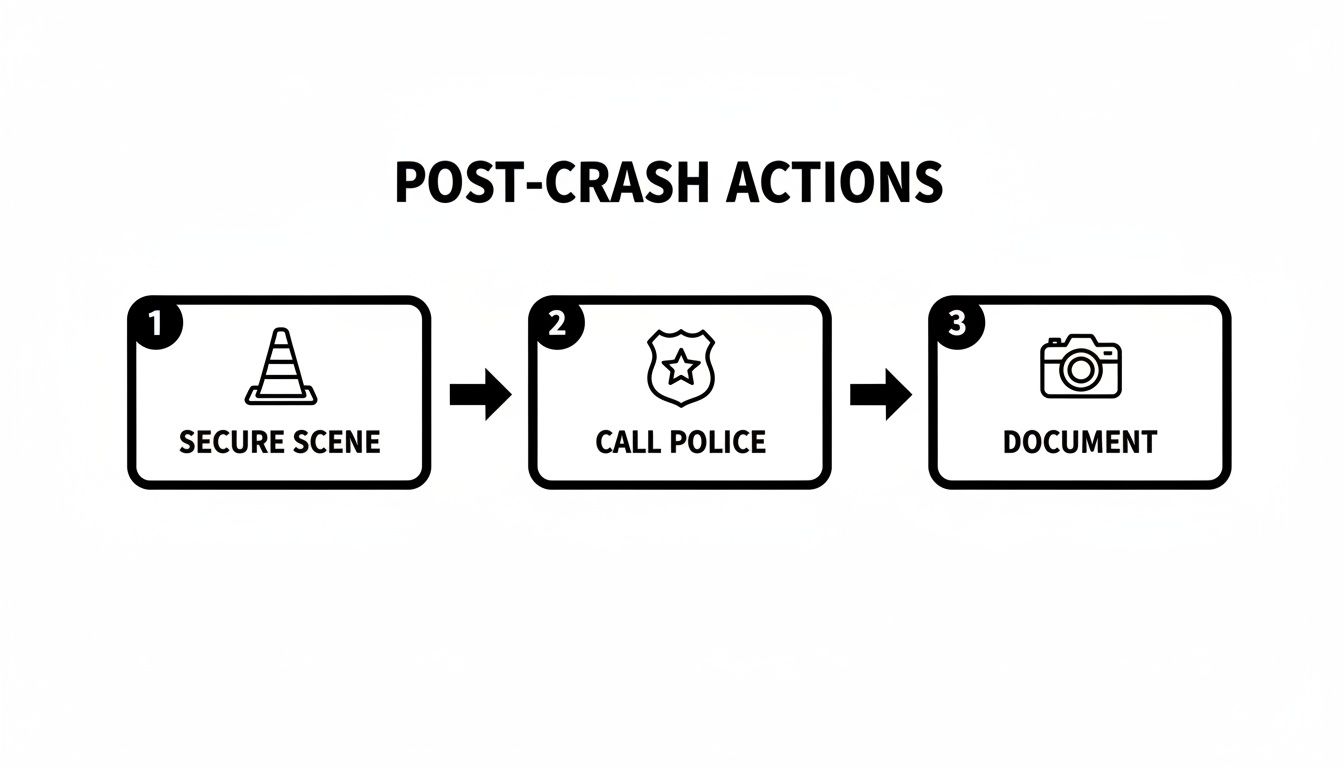
These actions—securing the scene, calling the police, and documenting everything—are the building blocks of a solid personal injury claim.
Why You Must Call the Police
In Texas, you are legally required to report any accident that involves an injury, death, or vehicle damage that appears to be $1,000 or more. Don't try to eyeball the damage; always call the police.
A police report is one of the most vital pieces of evidence you can have. It creates an official, unbiased record of the incident, often including diagrams, witness information, and the officer’s initial thoughts on who was at fault. Insurance companies lean heavily on this report. Without it, proving your side of the story becomes much more difficult.
Never agree to handle a crash "off the record," no matter how minor it seems. The other driver might seem cooperative at the scene, but their story can change later. You can find more details in our guide on what to do after a car accident.
Gathering Evidence to Build a Strong Claim
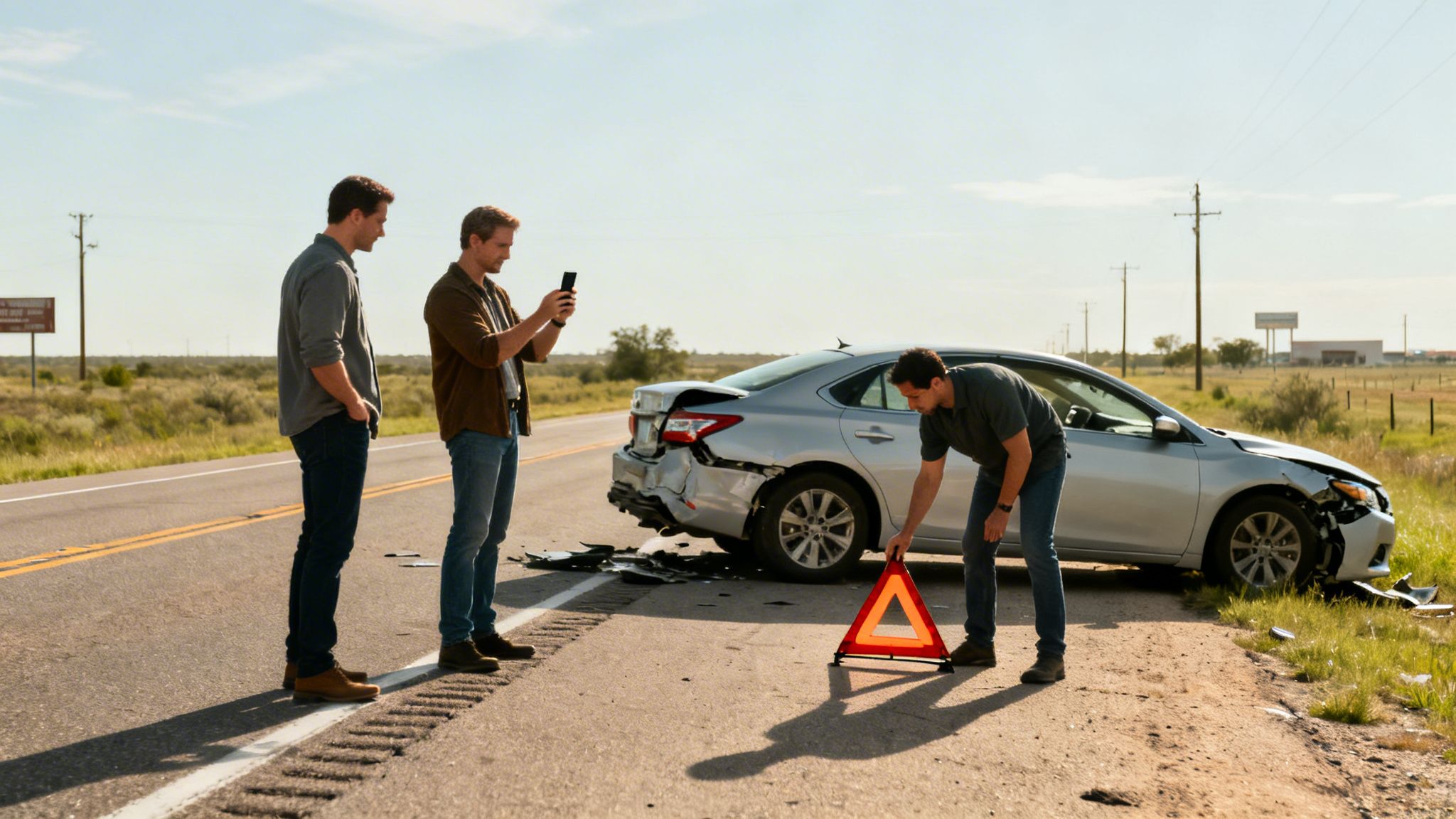
Once everyone is safe and the police are on their way, what you do next can make or break your injury claim. Texas is a fault state, meaning the person who caused the wreck is legally responsible for the damages. Proving that fault rests on having solid evidence.
Much of that critical proof is only available in the first few minutes and hours after a collision. While you’re likely shaken up, taking a few deliberate actions right then and there will create a clear record of what happened. It’s the single best thing you can do to protect your right to compensation.
Document Everything at the Scene
Your phone is your best friend after a crash. The photos and videos you take can paint a picture that words alone never could for an insurance adjuster or a jury. Don’t just snap a quick photo of the dent in your door.
You need to document the entire scene like you’re building a case—because you are.
- The Big Picture: Take wide-angle shots of the scene from every direction. Show where the cars ended up, how they are positioned relative to each other, and the general layout.
- All Vehicle Damage: Get close-ups of the damage to your car and the other vehicles involved. Capture license plates in these shots.
- The Surroundings: Photograph any skid marks on the pavement, debris from the cars, broken glass, and nearby traffic signs or signals.
- Road and Weather Conditions: Was the sun creating a blinding glare? Was the road wet from a recent rain? Was there a pothole or construction that played a role? Capture it.
These details are gold. They help a motor vehicle accident lawyer reconstruct the moments leading up to the impact and dismantle any attempts by the other driver to shift the blame.
Exchanging Information and Talking to Witnesses
When you talk to the other driver, stay calm and stick to the facts. The absolute worst thing you can do is apologize or say something like, "I should have seen you." In Texas, we have a rule called comparative responsibility, which means your final settlement can be reduced if you’re found even partially at fault. An innocent comment can be twisted and used against you.
Politely get their information. You'll need:
- Full name and phone number
- Insurance company and policy number
- Driver’s license number
- License plate number
- Make, model, and color of their car
If anyone saw what happened, their testimony is priceless. A neutral witness can shut down a dishonest story from the other driver. Get their name and number before they leave.
A common mistake we see is clients trusting the other driver to be honest later. People’s stories change once they speak to their insurance company. Getting witness contact information at the scene provides a crucial, unbiased perspective that can protect you from false accusations.
The Importance of Seeking Immediate Medical Care
After any crash, you must see a doctor right away. We cannot stress this enough. Even if you think you’re fine, the adrenaline coursing through your system can easily mask serious injuries like whiplash, a concussion, or even internal bleeding. Symptoms can take hours or days to appear.
For example, after a Houston freeway crash, our client felt just a little sore, so he went home. The next morning, he couldn't get out of bed because of excruciating back pain from a herniated disc. Because he went to the ER that day, he created a clear, documented link between the crash and his injury.
If you wait, the insurance company will jump at the chance to argue your injuries came from something else. A prompt medical evaluation is the foundation of your injury claim. The police report is another critical piece of the puzzle; you can learn more about how to understand a police accident report in our detailed guide. Additionally, as you gather your proof, it can be useful to conduct a vehicle accident check to uncover a vehicle's history, which can sometimes play a role in a claim.
How to Handle Communications with Insurance Companies

It won’t be long before your phone starts ringing. On the other end will be an insurance adjuster from the at-fault driver’s insurance company, and they’ll sound incredibly friendly and concerned.
Remember this: they work for the insurance company, not for you. Their primary job is to protect their company's bottom line by getting you to settle your claim for the lowest amount possible. Often, they try to do this before you even know the full extent of your injuries.
These adjusters are trained negotiators, skilled at getting you to say things that can seriously damage your own case. A common tactic is asking for a recorded statement. You should never agree to give a recorded statement without speaking to a lawyer first.
The Insurance Adjuster's Playbook
Navigating this first call is like walking through a minefield. You aren't obligated to give them anything more than the bare-bones facts. Your goal is to be polite but firm, providing nothing they can twist and use against you down the road.
Imagine you were in a wreck on a busy Dallas highway. In that first call, you might say, "I'm a little sore, but I think I'll be okay." The adjuster makes a note of that. When you later find out you need surgery for a herniated disc, they'll bring up your own words to argue your injury wasn't that serious.
Instead, stick to a simple script. When they call, provide only this information:
- Your full name and contact information.
- The date and location of the crash.
- The type of vehicle you were driving.
If they push for details about how you're feeling or how the accident happened, you can politely say, "I am still processing everything and am not prepared to discuss the details at this time." This simple phrase protects you without creating a confrontation.
When dealing with insurance adjusters, knowing what to say—and what to hold back—is critical. Here’s a quick guide to help you protect your rights during these conversations.
Communicating with Insurance Adjusters What to Do vs What to Avoid
| What You Should Do | What You Should Avoid |
|---|---|
| Stick to the basic facts: your name, contact info, date/location of the crash. | Giving a recorded statement without legal counsel. |
| Be polite but firm and brief. | Discussing your injuries or speculating on how you feel. |
| Keep a log of all communications with the insurer. | Admitting any fault or apologizing for the accident. |
| Tell them you will have your lawyer contact them. | Guessing about facts like speed, distance, or time. |
| Get the adjuster’s name, phone number, and claim number. | Signing any documents, especially medical releases or settlement offers. |
Remember, the adjuster’s goal is to close the claim quickly and cheaply. Following these tips helps ensure your words aren’t used against you.
How Texas Law Can Be Used Against You
One of the main reasons adjusters press for details is to find a way to pin some of the blame on you. Texas operates under a legal rule called modified comparative responsibility, also known as proportionate responsibility.
This rule says you can only recover damages if you are found to be 50% or less at fault for the crash. On top of that, your final compensation will be reduced by whatever percentage of fault is assigned to you. So, if you are awarded $100,000 but found to be 20% at fault, you would only receive $80,000.
An adjuster might ask seemingly innocent questions like, "Were you listening to music?" or "Were you in a hurry to get somewhere?" These questions are bait, designed to get you to admit to something that suggests you were distracted or speeding. If they can assign you just 10% of the fault, it can save their company thousands.
Never guess or speculate. It is perfectly fine to say, "I'm not sure" or "I'd have to check my records." A skilled Houston car accident attorney can take over these communications for you, protecting your rights from the very start.
It's always wise to consult an attorney before you sign anything from an insurance company, whether it's a medical release form or an early settlement offer. That first offer might look tempting, but it almost never accounts for future medical care, lost earning capacity, or the true value of your pain and suffering. A motor vehicle accident lawyer will make sure any settlement you accept is a fair one.
Calculating the Full Value of Your Accident Claim
Don't be fooled by the insurance company’s first offer. It's a business calculation, plain and simple, and it almost never reflects what you've truly lost in a serious car wreck. To get the compensation you actually deserve, you need to understand that your recoverable damages in Texas go way beyond the initial ER bill and the first estimate to fix your car.
The real value of your claim is a sum of every single way the crash has upended your life, both financially and personally. A skilled car accident lawyer’s job is to hunt down and document every one of these losses to build a case that shows the full picture of your suffering.
Economic Damages: The Tangible Costs
Economic damages are the most straightforward because they come with a price tag. These are the direct, out-of-pocket financial losses you’ve already paid for—and the ones you’ll face down the road—all because someone else was negligent. It is absolutely critical to keep a detailed record of every single expense.
These tangible costs typically include:
- Medical Bills: This isn’t just the ambulance ride. It covers everything from hospital stays and future surgeries to physical therapy, prescriptions, and medical devices you might need.
- Lost Wages: If your injuries have kept you from working, you are entitled to be paid back for the income you’ve already missed out on.
- Lost Future Earning Capacity: This is one of the most important and frequently overlooked damages. If your injuries permanently limit your ability to do your job or force you into a lower-paying career, you can be compensated for that lifetime loss of income.
Think about a construction worker in San Antonio who suffers a severe back injury in a truck crash. He can no longer do manual labor. A complete claim wouldn't just cover the wages he lost while recovering; it would project the difference in his earnings over the entire course of his career. This is precisely where a Texas personal injury lawyer can add tremendous value to your case.
Non-Economic Damages: The Human Cost
Non-economic damages are just as real as the bills you can hold in your hand, but they are much harder to assign a dollar value to. This is the compensation for the human toll of the accident—the pain, the trauma, and the simple loss of joy that doesn't come with a receipt.
Insurance adjusters love to minimize these damages, but under Texas law, they are a legitimate and significant part of your claim.
These damages are meant to compensate you for:
- Pain and Suffering: For the physical pain and discomfort your injuries have caused and will continue to cause.
- Mental Anguish: This covers the emotional fallout of a crash, like fear, anxiety, depression, and PTSD.
- Physical Impairment: If you can no longer play with your kids, work in your garden, or enjoy the hobbies that once brought you happiness, that loss has value.
- Disfigurement: Compensation for scars or other permanent, life-altering changes to your appearance.
While headlines sometimes focus on declining traffic fatalities, the human cost for those who survive is staggering. Globally, 20 to 50 million people suffer non-fatal injuries from crashes each year, with these incidents costing most countries 3% of their gross domestic product.
To get fair compensation, you have to present these personal losses with a compelling story backed by solid proof. When communicating with the insurer, knowing how to structure a powerful demand letter to an insurance company for an auto accident is a critical step in clearly laying out both your economic and non-economic damages.
Knowing the full scope of what you’re owed is the first step in recognizing and rejecting a lowball offer. For a closer look at the formulas and methods used, you can learn more about how to calculate a car accident settlement in our in-depth guide. An experienced attorney will make sure no part of your loss is ignored or left on the table.
When You Need a Motor Vehicle Accident Lawyer on Your Side
After a crash, one of the first questions people ask is, "Do I really need a lawyer?" Honestly, for a simple fender-bender where no one got hurt, you can probably handle the claim on your own.
But when the crash is serious, and the insurance company starts giving you the runaround, a motor vehicle accident lawyer isn't just a good idea—it's necessary. Many people worry about the cost, but the reality is you can't afford not to have an expert on your side when you’re up against a powerful insurance carrier determined to pay out as little as possible.
Key Signs You Should Call an Attorney
Certain red flags should tell you it’s time to get professional legal help. If any of these sound familiar, your next call should be to an experienced attorney.
- Serious Injuries: If your accident led to a hospital stay, surgery, or the need for long-term care, you need a lawyer. This is non-negotiable for life-altering injuries like brain trauma or spinal cord damage, which fall under the category of catastrophic injuries.
- Disputed Fault: Is the other driver lying about what happened or trying to pin the blame on you? A lawyer is critical. We can launch our own investigation to get to the truth and prove who was really at fault.
- An Unfair Insurance Company: If the adjuster is dragging their feet, pushing you to accept a quick, lowball offer, or refusing to approve necessary medical treatments, you're seeing signs of bad faith. Don't let them bully you.
- Multiple Parties Involved: Wrecks involving commercial trucks, several cars, or government entities are a legal minefield. A truck crash lawyer Houston understands the complex federal regulations and multiple layers of insurance that come into play.
In every one of these situations, you can bet the insurance company has a team of lawyers ready to fight. You deserve the same level of dedicated advocacy.
What a Lawyer Does for You
Hiring an attorney is about so much more than filing paperwork. We step in and take the entire legal weight off your shoulders so your only job is to focus on getting better.
For example, after a multi-car pileup on a busy Dallas freeway, figuring out who is at fault can feel impossible. An attorney gets to work immediately to preserve evidence, brings in accident reconstruction experts to map out the scene, and tracks down witnesses before their memories start to fade. We handle every phone call and email from the insurance companies, shielding you from their pressure tactics.
Our role is to build an undeniable case that documents the full extent of your losses. We handle the deadlines, the negotiations, and, if necessary, the courtroom battle, all while you focus on getting your life back.
How Long Do You Have to File a Claim in Texas?
In Texas, the law gives you a strict deadline to take legal action. You generally have only two years from the date of the accident to file a personal injury lawsuit. This deadline is known as the statute of limitations.
If you miss it, you almost certainly lose your right to recover any compensation for your injuries, no matter how devastating they are.
Two years might seem like a long time, but building a powerful case doesn't happen overnight. Evidence disappears, witnesses move away, and crucial details are forgotten. The sooner you act, the better your chances are of securing justice. This is especially critical if you've lost a family member, which is why calling a wrongful death lawyer Texas right away is so important.
Our No-Fee-Unless-We-Win Promise
We know the last thing you need to worry about after an accident is another bill. That’s why our firm works on a contingency-fee basis.
It’s simple: you pay absolutely nothing upfront. We cover all the costs of investigating your case, hiring experts, and taking it to court if we have to. Our fee is just a percentage of the final settlement or verdict we win for you.
If we don’t win, you owe us nothing. This promise ensures that everyone has access to top-quality legal help, no matter their financial situation.
Your Path Forward Begins With a Single Step
The aftermath of a car accident is overwhelming, and it's a journey you shouldn't have to navigate on your own. While the path to recovery can feel long and uncertain, a few key actions can protect your rights and your future.
Act quickly. Document everything. Be cautious of quick settlement offers from insurance companies, and take the time to understand the true cost of your damages—both the financial bills and the personal toll.
Recovery is possible, and you don’t have to carry this weight by yourself. Having a dedicated legal team in your corner lets you focus on what truly matters: your health and your family.
At The Law Office of Bryan Fagan, PLLC, our team is ready to take on the legal fight for you. We provide the compassionate guidance and aggressive representation that Texans from Houston to Dallas deserve when they need it most.
Your path to justice starts with one simple step. We invite you to schedule a free, no-obligation consultation with one of our experienced motor vehicle accident lawyers. Let us hear your story and explain how we can help you move forward.
Frequently Asked Questions About Texas Motor vehicle Accidents
After a serious car crash, your head is probably spinning with a thousand questions. It's a confusing, overwhelming time, and we've found that most people have the same urgent concerns. Here are some straightforward answers to the questions we hear most often from accident victims and their families across Texas.
How Much Does It Cost to Hire a Motor Vehicle Accident Lawyer?
This is often the first question people ask, and for a good reason. Many hesitate to call a lawyer because they’re worried about the cost, but we believe everyone should have access to top-tier legal help, no matter their financial situation.
That’s why The Law Office of Bryan Fagan, PLLC works on a contingency-fee basis.
Simply put, you don’t pay us a dime upfront. Our firm advances all the necessary costs to build and fight your case—from hiring accident reconstruction experts to covering court filing fees. We only get paid when we win you a settlement or a court verdict.
Our Promise to You: If we don't recover money for you, you owe us nothing. This approach completely removes the financial risk, so you can focus on your recovery while we focus on getting you justice.
Should I Accept the Insurance Company's First Settlement Offer?
It is almost always a mistake to accept an insurance company’s first offer. You have to remember their goal: to close your case as quickly and for as little money as possible.
Those initial offers are intentionally low. They rarely, if ever, account for the full, long-term costs of a serious injury, like future medical treatments or lost earning capacity.
Once you sign that release, it’s over. You lose your right to seek any more compensation for that accident, even if your injuries turn out to be much worse than you first realized. Always talk to an experienced Texas personal injury lawyer to understand the true value of your claim before you even think about signing anything.
What if the At-Fault Driver Was Uninsured or Fled the Scene?
Getting hit by a driver who has no insurance—or worse, one who just takes off—is an incredibly frustrating and scary situation. But you still have options. This is exactly what Uninsured/Underinsured Motorist (UM/UIM) coverage is for.
UM/UIM is a part of your own auto insurance policy that steps in to cover your damages when the at-fault driver can’t. By filing a UM/UIM claim, you can seek compensation from your own insurer for your medical bills, lost wages, and pain and suffering.
A skilled motor vehicle accident lawyer can handle this entire process for you. We make sure your own insurance company treats you fairly and pays you what you’re owed. Our team has extensive experience handling these specific types of crashes, especially those involving catastrophic outcomes like wrongful death.
The path to recovery after an accident can feel long and overwhelming, but you absolutely do not have to walk it by yourself. The Law Office of Bryan Fagan, PLLC is here to provide the support and expert legal guidance you need. We invite you to schedule a free, no-obligation consultation to discuss your case by visiting us at https://texaspersonalinjury.net or calling our office today.