Skip to content
A serious accident can change your life in seconds—but you don’t have to face it alone. One moment you’re driving, the next you’re left with severe leg injuries and a future that suddenly feels uncertain. The physical pain, emotional trauma, and financial stress can be completely overwhelming. You are not alone. This guide is for you—to give you clear answers about your rights and show you a path forward after a crash in Texas.
Your Life Changed After The Crash. Now What?
When a negligent driver causes a crash, the impact on your legs can be devastating. We're talking about fractures, torn ligaments, and nerve damage that can take away your ability to walk, work, and simply live your life. At The Law Office of Bryan Fagan, PLLC, we understand what you're going through, and we're here to help you navigate the long road to recovery.
This guide will walk you through the most critical steps to protect both your health and your legal rights. We'll break down:
- The types of leg injuries that commonly happen in car accidents.
- What you are entitled to under Texas personal injury law.
- How to fight for the full compensation you need to recover.
Reclaiming Control After an Injury
Imagine you’re driving home from work on a Houston freeway when another car runs a red light and slams into your driver-side door. The impact crushes the side of your vehicle, trapping your leg. In that single moment, your life is altered. You’re now facing hospital stays, surgeries, and a long, painful rehabilitation process. This is the reality for countless Texans every year.
The journey to recovery can feel long and isolating, but understanding your rights is the first step toward regaining control. When someone else’s carelessness causes you harm, Texas law is on your side.
The Law Office of Bryan Fagan is here to provide the clear, compassionate guidance you need. We believe that recovery is possible and that expert legal help should be accessible to everyone. Your journey toward healing and justice starts right here.
If you or a loved one has suffered leg injuries from a car accident, please contact us for a free, no-obligation consultation to discuss your case.
What Are The Most Common Leg Injuries After A Car Wreck?
When you’re in a car, truck, or motorcycle crash, your legs are incredibly exposed. The sheer force of a collision can cause devastating damage, whether it’s the dashboard slamming into your knees or the vehicle's crumpled frame crushing your lower body.
Knowing the specific type of injury you've sustained is the first real step in your recovery. It empowers you to have clear conversations with your doctors and helps you grasp the seriousness of what you're up against.
A car crash sets off a terrible ripple effect, triggering physical, emotional, and financial challenges that can feel completely overwhelming.
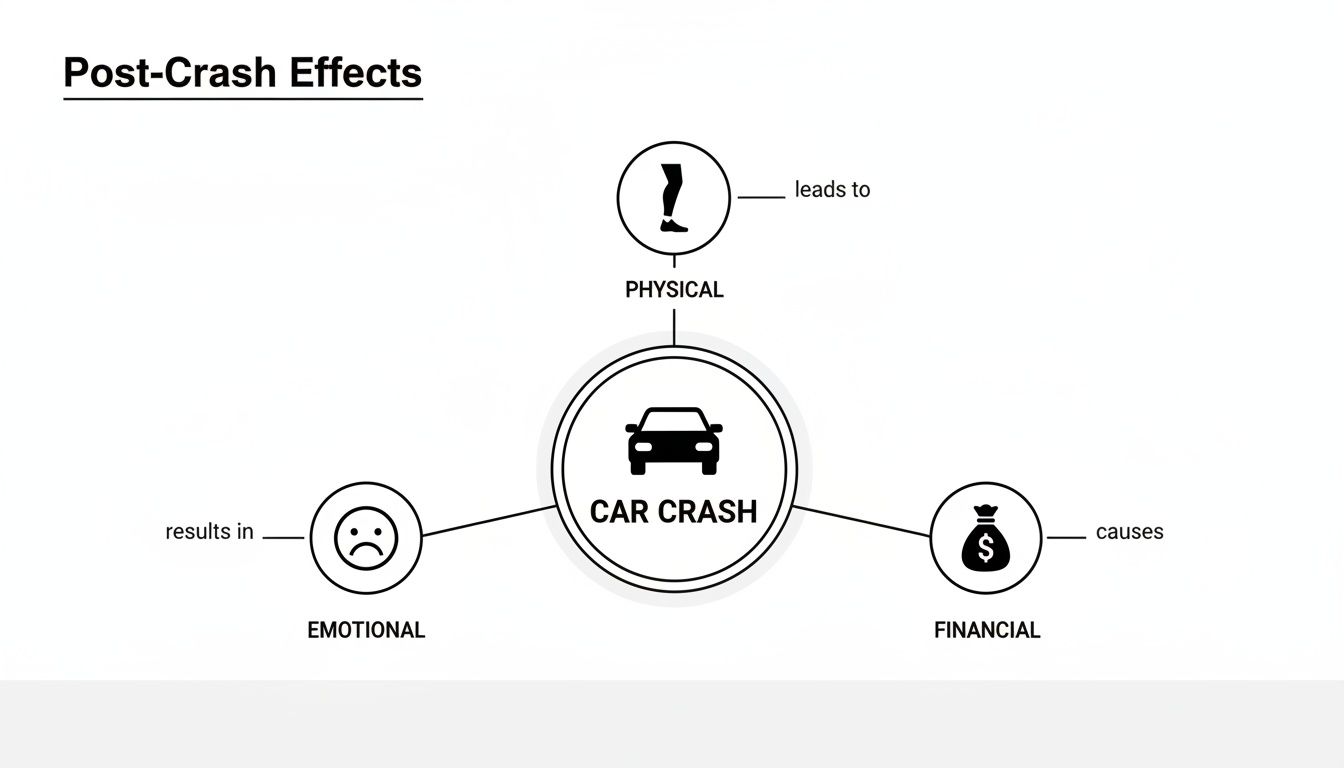
As you can see, a single event—the accident—branches out to touch every part of your life. This shows that your leg injury is so much more than just a physical problem; it's a life-altering event.
Bone Fractures From Violent Impacts
The bones in your legs—the femur (thigh bone), tibia (shin bone), and fibula—are incredibly strong, but they are simply no match for the violent forces in a high-speed collision. It’s all too common for drivers and front-seat passengers to suffer severe fractures when their knees are thrown into the dashboard.
For example, a driver in a Houston freeway pile-up might end up with a shattered kneecap (patella) or a complex femur fracture. These injuries almost always mean surgery, often involving rods, plates, and screws just to hold the bone together. The recovery is long, painful, and unfortunately, can lead to permanent mobility problems.
Knee Ligament and Meniscus Tears
Your knee is an intricate joint, held together by ligaments like the ACL (anterior cruciate ligament) and cushioned by cartilage called the meniscus. A sudden, violent twist during a T-bone accident or a direct blow can easily tear these vital tissues.
- ACL/PCL Tears: These ligament injuries create severe instability, often described as the knee "giving out." Surgery is usually needed to reconstruct the ligament and restore stability.
- Meniscus Tears: Damage to this cartilage can cause pain, swelling, and a locking sensation in the knee. While some minor tears might heal with rest, many require arthroscopic surgery to repair.
These types of injuries can sideline you for months, making it impossible to work, care for your family, or do the things you love. The road back often involves extensive physical therapy to rebuild strength and function. You can learn more about various motor vehicle accident injuries and their treatments in our detailed guide.
Crush Injuries and Compartment Syndrome
In the most horrific accidents, especially side-impact or rollover crashes, a leg can get pinned or crushed by twisted metal. This kind of trauma isn't just excruciatingly painful—it's also extremely dangerous.
Crush injuries can lead to a life-threatening condition called compartment syndrome. This happens when swelling inside a muscle group gets so intense it cuts off blood flow. If not treated immediately, it can cause permanent muscle and nerve damage or even require amputation.
Soft Tissue and Nerve Damage
Beyond broken bones, the muscles, tendons, and nerves in your legs can be seriously harmed. Deep cuts from broken glass or metal can sever tendons, while the force of the impact can cause deep bruising and muscle strains that result in chronic, nagging pain.
Nerve damage is another major concern. For instance, a herniated disc in your lower back from the crash can press on the sciatic nerve, sending sharp, shooting pain all the way down your leg—a condition known as sciatica. It’s a perfect example of how an injury in one part of your body can cause debilitating pain somewhere else.
To help you understand these injuries at a glance, we've summarized them below.
Common Leg Injuries and Their Impact
| Injury Type | Common Cause in a Car Accident | Potential Long-Term Impact |
|---|---|---|
| Bone Fractures | Direct impact from dashboard, pedals, or crushing of the vehicle frame. | Chronic pain, arthritis, permanent limp, need for future surgeries. |
| Ligament Tears (ACL/PCL) | Sudden twisting of the knee during impact, common in T-bone crashes. | Knee instability, decreased range of motion, increased risk of arthritis. |
| Meniscus Tears | Forceful twisting or direct blow to the knee. | Persistent pain, swelling, locking of the knee joint, mobility issues. |
| Crush Injuries | Limb being pinned by vehicle wreckage in severe collisions. | Compartment syndrome, amputation, permanent nerve and muscle damage. |
| Nerve Damage (Sciatica) | Herniated disc from the crash pressing on the sciatic nerve. | Chronic shooting pain, numbness, weakness in the leg and foot. |
This table shows just how varied and serious these injuries can be, each with its own path to recovery and potential for lasting consequences.
Research backs up just how vulnerable our legs are. One major study found that lower limb injuries were the most frequent type, showing up in 43.0% of crash victims who required hospitalization. The risk was even higher for pedestrians, who were 2.41 times more likely to suffer leg damage than drivers, often from being struck directly by a car. This data highlights why getting an immediate medical evaluation after any accident is so critical.
Critical Steps To Protect Your Injury Claim Immediately

In the chaos right after a car accident, it’s almost impossible to think straight. But what you do in those first few hours can make or break both your physical recovery and your ability to get fair compensation for your leg injuries. Protecting your rights starts at the scene.
Your absolute number one priority is your health. Seek medical attention right away. It doesn't matter if you think you can "walk it off"; adrenaline is a powerful painkiller that can mask serious injuries like internal bleeding or compartment syndrome.
Going to the ER or an urgent care clinic creates an official medical record tying your leg injury directly to the crash. This document is one of the most powerful tools in your claim. Without it, the insurance company will almost certainly argue your injuries happened somewhere else, long after the accident.
Secure the Scene and Gather Evidence
Picture this: you’ve just been in a wreck on I-45 in Houston during rush hour. It’s frantic and loud, but this is your one chance to capture what happened before the scene is cleared.
If you’re physically able to, use your smartphone to take pictures and videos of everything.
- Vehicle Damage: Get shots of both cars from every angle. Make sure you capture the points of impact clearly.
- Your Injuries: Take photos of any visible cuts, bruises, or swelling on your legs or anywhere else.
- The Scene: Get wide shots of the intersection, any traffic signals or stop signs, skid marks on the road, and even the weather conditions.
Next, exchange contact and insurance information with the other driver. It’s also incredibly important to talk to anyone who saw what happened. Eyewitnesses provide unbiased accounts that can be invaluable, so get their names and phone numbers. Always call the police to the scene so they can create an official accident report—this document will be the foundation of your claim.
Why You Should Not Speak to the Other Driver's Insurance Company
It won’t be long before you get a call from the other driver's insurance adjuster. They might sound friendly and concerned, but make no mistake—their goal is to pay you as little as possible. They are trained to ask tricky questions designed to get you to downplay your pain or even admit you were partly at fault.
Never give a recorded statement to the at-fault driver's insurance company without first speaking to a Houston car accident attorney. Anything you say can and will be used against you to lower the value of your claim or deny it outright.
Simply tell them you aren't ready to discuss the accident and that your attorney will be in touch. That one simple step protects you from their tactics. Taking these measures is a crucial part of filing a car accident claim in Texas and ensuring you have the evidence to build a strong case. You’ve been through enough; let a professional handle the insurance companies while you focus on getting better.
How Texas Law Defines Your Right To Compensation
Trying to make sense of the legal system after a traumatic car crash is overwhelming, especially when you’re focused on healing from a serious leg injury. The good news is that Texas law is on your side when someone else’s carelessness causes you harm, and knowing a few key principles can empower you to get the justice you deserve.
At its heart, every personal injury claim in Texas boils down to one simple concept: negligence. This means that another driver had a duty to drive safely, they breached that duty, and their failure caused your injuries.
Think of it this way: everyone on a Dallas-Fort Worth highway has a duty to follow the rules of the road. That means stopping at red lights, putting their phone down, and driving at a safe speed. When someone ignores those duties and causes a wreck, they have acted negligently. Proving this is the cornerstone of your entire case.
Understanding Comparative Responsibility in Texas
Texas uses a rule for accidents where more than one person may be partly at fault. It’s called modified comparative fault, or the "51% bar rule." It’s a fair system, but you need to know how it works because the insurance company will try to use it against you.
Basically, you can still recover compensation even if you were partially at fault for the crash, as long as your share of the blame is 50% or less. If so, your final compensation is simply reduced by your percentage of fault.
- Real-World Example: After a Houston freeway crash, you suffer a severe tibia fracture. The other driver ran a stop sign, but an investigation shows you were driving a few miles over the speed limit. A jury might decide the other driver was 90% at fault and you were 10% at fault. If your total damages are $200,000, you would receive $180,000 ($200,000 minus your 10% share of fault).
Here's the critical part: if you are found to be 51% or more responsible for the wreck, Texas law bars you from recovering anything. Zero. This is precisely why having an experienced Texas personal injury lawyer is so important. We fight back against unfair blame and work to prove the other driver carries the overwhelming responsibility for your injuries.
How Long Do You Have to File a Claim in Texas?
Of all the rules in a personal injury case, the most important one is the statute of limitations. This is a strict legal deadline for filing a lawsuit. In Texas, you generally have just two years from the date of the car accident to file your claim.
Waiting too long is one of the biggest mistakes you can make. If you miss that two-year window, the court will likely dismiss your case permanently. It won’t matter how strong your evidence is or how severe your injuries are—your right to seek compensation will be gone.
This deadline is unforgiving, which is why it is vital to speak with an attorney as soon as possible. Evidence disappears, witness memories fade, and video footage gets erased. A prompt investigation is key to building a winning case. A Houston car accident attorney ensures every deadline is met so you can focus on what matters most—your recovery.
Your attorney's job is to fight for every penny you're owed for all your losses, which are split into two categories: economic and non-economic damages. To see how we add it all up, check out our guide on understanding the difference between economic vs. non-economic damages.
Calculating The Full Value Of Your Leg Injury Claim

A serious leg injury from a car crash creates costs that go far beyond the initial ER visit. A fair settlement isn't just about covering today's bills; it's about securing your financial future for the entire recovery journey, no matter how long it takes.
To get the full compensation you deserve, we must calculate every single loss you've suffered—and will suffer in the future. In legal terms, these losses are called damages, and they fall into two main categories. Understanding both is the key to grasping what your claim is truly worth.
Economic Damages: The Tangible Costs
Economic damages are the straightforward, calculable financial losses you’ve taken because of the accident. Think of these as anything with a clear price tag attached. They are the most obvious costs, but figuring out their future impact requires experience and attention to detail.
These damages typically include:
- All Medical Expenses: This covers everything from the ambulance ride and hospital stay to surgeries, follow-up appointments, prescriptions, and medical equipment like crutches or a wheelchair.
- Future Medical Care: A severe leg injury rarely heals quickly. We account for the projected costs of future surgeries, long-term physical therapy, pain management, and any other ongoing care you’ll need.
- Lost Wages: This is the income you’ve already lost from being unable to work while recovering.
- Loss of Earning Capacity: This is one of the most critical components. If your injury prevents you from returning to your old job or limits your ability to earn a living in the future, we calculate that long-term financial loss.
It's essential to prove how these long-term impacts affect your ability to work and handle daily tasks. Objective assessments like functional capacity evaluations (FCEs) can provide the hard data needed to demonstrate exactly how the injury has diminished your physical capabilities, offering powerful evidence for your claim.
Non-Economic Damages: The Human Cost
Non-economic damages are just as real as economic ones, but they don’t come with a receipt. These damages are meant to compensate you for the immense personal, physical, and emotional toll the injury has taken on your life. They acknowledge the human side of your suffering.
These intangible losses often represent the heaviest burdens an accident victim carries. They include your physical pain, emotional distress, and the loss of joy in everyday activities.
Think about the real-world impact. A construction worker in Dallas suffers a complex femur fracture after a distracted driver hits him. His economic damages are clear—medical bills and lost wages. But what about the fact he can no longer coach his son's baseball team, enjoy weekend hikes with his family, or live without chronic pain? That is the devastating human cost, and Texas law says you deserve to be compensated for it.
We work to calculate fair compensation for:
- Pain and Suffering: For the physical pain you have endured and will continue to face.
- Mental Anguish: For the anxiety, depression, fear, and trauma resulting from the accident.
- Physical Impairment: For the loss of function in your leg and how it affects your daily life.
- Loss of Enjoyment of Life: For the inability to participate in hobbies and activities you once loved.
Data consistently shows that lower extremity trauma is a leading consequence of vehicle crashes. In fact, leg injuries are suffered by 43.0% of hospitalized road crash victims, a figure that highlights just how vulnerable our lower limbs are in a collision.
The National Safety Council estimated that total motor-vehicle injury costs reached an astounding $513.8 billion in 2023, and a significant portion of that is tied to these life-altering leg injuries.
At The Law Office of Bryan Fagan, we partner with medical professionals, vocational experts, and economists to build a complete picture of your losses. We don’t just look at the bills you have now; we project the lifelong costs of a catastrophic injury to ensure the settlement you receive is enough to protect you and your family for years to come.
How An Experienced Attorney Strengthens Your Case
Trying to recover from a serious leg injury while fighting an insurance company is an exhausting battle you shouldn't have to face alone. Let's be clear: the other driver’s insurance adjuster isn’t on your side. Their job is to protect their company's bottom line by paying you as little as possible. This is where a dedicated Texas personal injury lawyer becomes your most powerful advocate.
The moment you hire us, we step in and take over all communication with the insurance companies. No more stressful calls or pressure tactics. You can finally focus 100% on what matters most—your physical and emotional recovery—while we handle the legal heavy lifting.
Building a Foundation for Maximum Compensation
Our first step is to launch a full investigation into the crash. We don’t just take the police report at face value; we dig deeper to build an ironclad case proving the other driver’s negligence.
This process involves:
- Securing Critical Evidence: We immediately work to preserve time-sensitive evidence like traffic camera footage, data from the vehicles' "black boxes," and cell phone records that can prove distracted driving.
- Interviewing Witnesses: We track down and interview everyone who saw the accident to get independent, unbiased accounts of what really happened.
- Consulting Experts: We often bring in accident reconstruction specialists who can scientifically prove how the collision occurred and who was truly at fault.
If you decide to take legal action, choosing the right personal injury attorney is one of the most critical decisions you'll make. A skilled legal team has the resources and experience to build a powerful case from the start.
Proving Your Losses and Fighting for a Fair Settlement
Once we have established liability, our focus shifts to proving the full, true extent of your damages from the leg injury. We work hand-in-hand with your doctors and other medical experts to create a detailed picture of your past, present, and future medical needs. We leave no stone unturned, calculating every single loss, from missed paychecks to the costs of future surgeries and long-term physical therapy.
Our commitment is simple: We will not let an insurance company bully you into taking a lowball offer that doesn't cover your needs. We prepare every single case as if it's headed for trial, which gives us maximum leverage at the negotiating table.
If the insurance company refuses to make a fair offer, our seasoned trial attorneys are always prepared to take the fight to a Texas courtroom. We handle every case on a contingency fee basis, which means you pay us absolutely nothing unless and until we win your case. This promise removes all financial risk from your shoulders, giving you access to top-tier legal representation when you need it most.
Common Questions About Texas Leg Injury Claims
After a serious car accident, it’s completely normal to have questions and concerns. The path forward can feel overwhelming, but you don't have to figure it out on your own. Here, we provide clear, straightforward answers to some of the most common questions we hear from clients dealing with serious leg injuries.
What If The Other Driver Was Uninsured or Underinsured?
This is a scenario we see all too often. If the driver who hit you has no insurance—or not enough to cover the massive costs of your leg injury—you still have options. Your own auto insurance policy likely includes Uninsured/Underinsured Motorist (UM/UIM) coverage, which was created for this exact situation.
We can help you file a UM/UIM claim with your own insurance company. It's important not to go it alone, because even your own insurer may try to minimize what they pay. A skilled Houston car accident attorney from our firm will make sure you get every dollar you're entitled to under your policy.
How Much Is My Leg Injury Claim Worth?
There is no simple formula—every case is unique. The value of your claim depends on many factors, including:
- The severity and type of your leg injury.
- The total of your past and future medical bills.
- How much income you've lost and may lose in the future.
- The long-term impact on your ability to work and live your life.
- The extent of your physical pain and emotional suffering.
An experienced Texas personal injury lawyer will investigate all these details, often consulting with medical and financial experts, to provide a clear, realistic assessment of your case's value. Our goal is to fight for the maximum compensation possible to cover all of your needs, now and in the future.
Should I Accept The Insurance Company’s First Settlement Offer?
Almost never. The insurance company's first offer is usually a lowball offer, far below what your claim is actually worth. The adjuster’s goal is to settle your claim quickly and cheaply, before you know the full extent of your injuries and their long-term financial impact.
A significant leg injury often means long-term care, months of physical therapy, or even more surgeries down the road. Once you sign that settlement agreement, you can't go back and ask for more money, even if your medical needs increase.
Before you sign anything, speak with a qualified attorney, such as a truck crash lawyer in Houston if your accident involved a commercial vehicle. We offer a completely free consultation to review any offer you've received and give you honest advice on how to protect your rights and your future.
A severe leg injury can turn your world upside down, but you don’t have to face the legal fight alone. Recovery is possible, and legal help is available. The team at The Law Office of Bryan Fagan, PLLC is here to offer the compassionate support and tenacious representation you need to get your life back on track. We handle the legal complexities so you can focus on healing.
If you’re ready to take the next step, schedule a free, no-pressure consultation with us today. Let us show you how we can help.