
A serious accident can change your life in seconds—but you don’t have to face it alone. In the aftermath of a traumatic injury, your world can feel uncertain and overwhelming. One of the first questions you likely have is, "How long is this going to take?"
While there’s no single, simple answer, most straightforward personal injury claims in Texas resolve within 6 to 12 months. It’s also reassuring to know that the vast majority of cases—around 95%—settle without ever going to trial. Our goal is to provide clarity and hope, guiding you through each step of the process with experience and compassion.
Understanding the Timeline for Your Texas Injury Claim
After a traumatic event like a crash on a Houston freeway, the legal process can feel like a confusing maze. Your most important job is to focus on your recovery. Our job is to handle the legal complexities, protect your rights, and give you peace of mind by explaining what you can expect along the way.
Think of building your case like building a house. You can’t rush the foundation, or the whole structure will be unstable. We must take it one careful step at a time to ensure your claim is solid and that you receive the full compensation you deserve.
Several key factors will shape how long your case takes:
- The Severity of Your Injuries: More severe injuries require longer medical treatment. We cannot begin to negotiate a fair settlement until you have reached what Texas law calls Maximum Medical Improvement (MMI). This is the point where your doctors have a clear picture of your long-term medical needs and costs.
- Who Was At Fault (Liability): When it's clear who caused the accident—for example, a straightforward rear-end collision where the other driver was texting—things tend to move faster. However, if the other driver tries to blame you or there’s a dispute over fault, our investigation will need to be more thorough, which takes more time. This is where Texas's rules on negligence and comparative responsibility come into play.
- The Insurance Company's Attitude: Some insurance adjusters are reasonable and will negotiate in good faith. Others may use delay tactics, deny valid claims, or make lowball offers hoping you’ll give up. Their approach can significantly extend the timeline, which is why having an experienced Texas personal injury lawyer is so crucial.
To give you a better sense of what to expect, here’s a quick overview of typical timelines.
Quick Look: Average Personal Injury Case Timelines in Texas
This table provides a high-level overview of estimated timelines for different types of personal injury cases, helping you set initial expectations.
| Case Type | Average Time to Settle (Post-Treatment) | Key Factors |
|---|---|---|
| Simple Car Accident | 3 – 6 Months | Clear fault, minor to moderate injuries. |
| Complex Car Accident | 6 – 18+ Months | Disputed fault, multiple parties, severe injuries. |
| Commercial Truck Wreck | 12 – 24+ Months | Federal regulations, multiple liable parties, catastrophic injuries. |
| Wrongful Death | 12 – 36+ Months | Complex probate issues, multiple dependents, extensive investigation. |
Remember, these are just averages. Your case is unique, and its timeline will depend entirely on its specific facts.
While most car accident claims resolve within a year, the worst thing you can do is rush the process. Settling too soon, before you know the full extent of your injuries, could leave you paying for future surgeries or therapy out of your own pocket. Industry data shows that 95-96% of all cases are resolved before trial, often within that one-year window, which proves the importance of a well-prepared claim.
An experienced Texas personal injury lawyer ensures every detail is handled correctly so you can put all your energy into healing. For a more detailed look at the factors involved, you can check out our guide on how long it takes to settle a car accident claim in Texas.
The Four Main Stages of a Personal Injury Case
Thinking about a personal injury case can feel overwhelming, but the process is more structured than it might seem. Every claim in Texas generally moves through four distinct stages. Knowing these phases helps you see the road ahead and understand what to expect as your case progresses.
Each stage builds on the one before it, giving us the evidence we need to build the strongest possible claim for you. Some cases move quickly through these steps, while others require more time—especially if the injuries are severe or the facts are complicated.
Stage 1: Investigation and Evidence Gathering
This is where we lay the foundation for your entire case. Immediately after an accident, our team gets to work gathering every piece of evidence. This phase is crucial because memories fade and physical evidence can disappear. Practical advice for you: do not speak to the other party's insurance company before talking to a lawyer.
This initial stage typically takes one to three months and involves:
- Obtaining the official police or accident report.
- Interviewing witnesses who saw what happened.
- Collecting photos and videos from the accident scene.
- Securing medical records to document your initial injuries.
- Identifying every potential source of insurance coverage.
For example, after a serious Houston-area car accident, we might hire an accident reconstruction expert to analyze skid marks and vehicle damage to prove the other driver was negligent. This upfront work is what sets the stage for proving who was at fault.
Stage 2: Medical Treatment and Reaching MMI
Your health is the absolute top priority. During this phase, your only job is to follow your doctor’s orders and focus on getting better. While you're healing, we monitor your progress and collect all related medical bills and records.
This is often the longest part of the journey and can last anywhere from a few months to over a year. The timeline depends entirely on the severity of your injuries and the treatment you need to reach Maximum Medical Improvement (MMI).
MMI is the point at which your doctors determine you've recovered as much as you're medically expected to. Only then can we truly understand the full scope of your past, present, and future medical costs.
We cannot responsibly put a number on your claim or begin settlement talks until we know the full extent of your damages. Settling before you reach MMI is a huge risk, as you could be left with future medical bills that the settlement won't cover.
Stage 3: The Demand and Negotiation
Once you’ve reached MMI, we shift into the negotiation phase. We will compile a comprehensive "demand package" that tells the complete story of your accident and its impact on your life. This package includes all your medical records, bills, proof of lost wages, and a detailed letter explaining why the other party is liable and calculating the full value of your damages.
This stage usually takes one to four months. After we send the demand, the insurance adjuster will review it and provide an initial offer—which is almost always too low. From there, your attorney will negotiate back and forth to reach a fair number that covers all your losses.
The following infographic illustrates the typical path for many personal injury cases, from the incident itself toward either a settlement or, less commonly, a court proceeding.
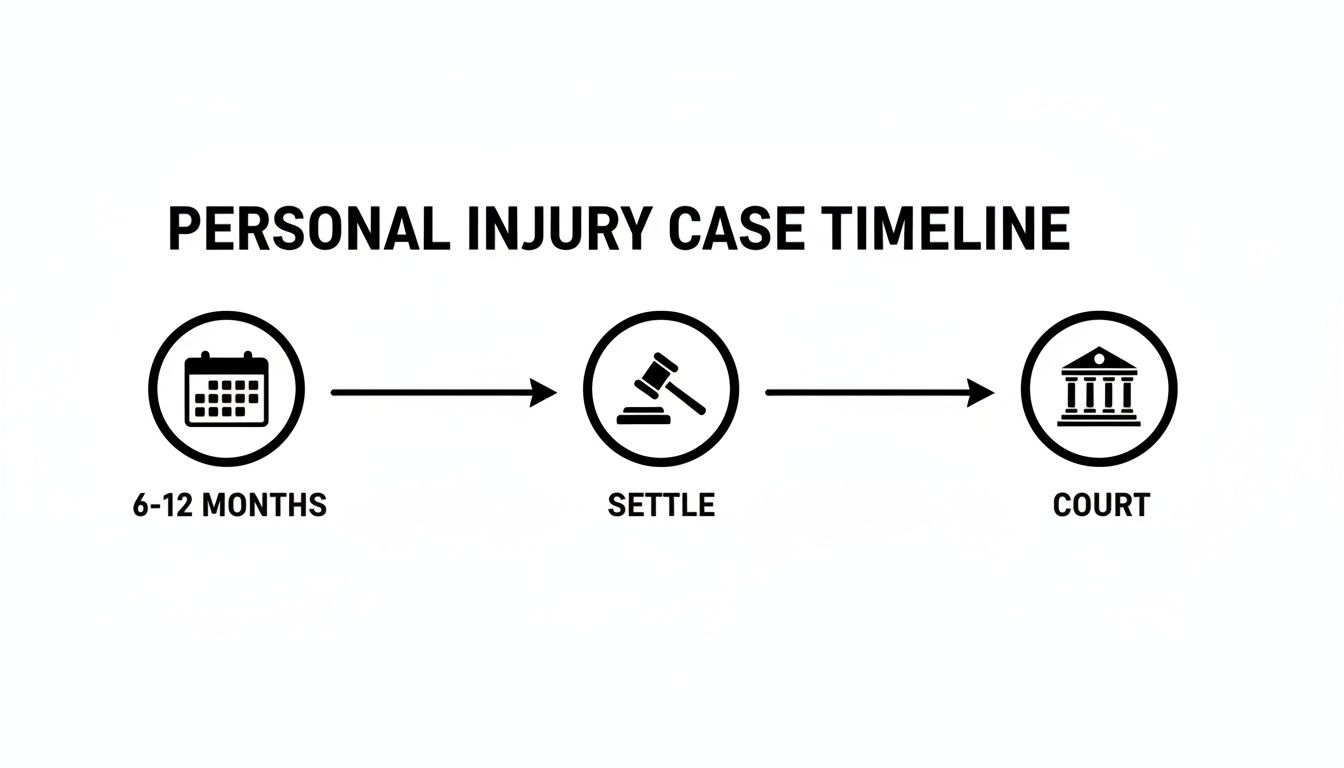
As you can see, the process is designed to reach a resolution, with most cases settling within a 6 to 12-month window without ever stepping inside a courtroom.
Stage 4: Filing a Lawsuit and Litigation
If the insurance company refuses to make a fair offer, the next step is to file a lawsuit. It’s important to know that filing a lawsuit doesn't automatically mean your case will go to trial. In fact, negotiations often continue—and even intensify—after a suit is filed.
This litigation phase can last anywhere from six months to two years or more. It involves formal legal processes like discovery (the official exchange of evidence), depositions (sworn testimony taken out of court), and various court hearings.
While we prepare every single case as if it will go to trial, the vast majority—over 95%—still settle before a verdict is reached. Often, the strength of our case becomes undeniable once the other side sees all the evidence we've put together.
Key Factors Affecting Your Case Timeline
While every personal injury case is unique, a few key factors almost always shape how long it takes to get from the accident to a final resolution. Understanding these variables helps set realistic expectations and shows why a patient, thorough approach is the best way to get the full and fair compensation you are owed.
Think of it less like a sprint and more like a carefully planned journey. The timeline isn’t random; it’s directly tied to building the strongest possible case for you. Rushing through critical steps could mean leaving money on the table—money you’ll need for future medical care or to make up for lost income.
Severity of Your Injuries and Medical Treatment
The single biggest factor driving your case's timeline is the seriousness of your injuries. We can't begin meaningful settlement talks until you've reached Maximum Medical Improvement (MMI). This is the point where your doctors have a clear, complete picture of your long-term prognosis.
Reaching MMI is critical because it allows us to accurately calculate the total cost of your medical care—what you've already paid and what you'll need in the future. Settling before you hit MMI is a huge gamble. If you later discover you need another surgery or years of physical therapy, those costs won't be covered. To get a better handle on this, you can learn more about Maximum Medical Improvement and why it matters so much to your claim.
Disputes Over Liability (Who Was at Fault)
How clear is it who was at fault? The answer to that question can dramatically speed up or slow down your case.
- Clear Liability: When fault is obvious—like a rear-end collision on a Houston freeway where the other driver was clearly negligent—the case can move much faster. The insurance company has little room to argue, so negotiations can focus on the value of your claim.
- Disputed Liability: In Texas, if you are found to be partially at fault, your compensation can be reduced under the rule of comparative responsibility. If fault is unclear, like in a multi-car pileup, the timeline will stretch out because we'll need to conduct a deeper investigation, sometimes hiring accident reconstruction experts to prove the other party was primarily at fault.
Insurance Company Tactics
Unfortunately, insurance companies are not in the business of paying claims quickly or fairly. Their goal is to protect their profits, which often means using delay tactics. They might drag things out to pressure you into accepting a lowball offer out of frustration or financial desperation.
An insurer might intentionally slow-walk the process, hoping you'll get so tired of waiting that you'll take less than your claim is really worth. It's a common strategy, and having an experienced Houston car accident attorney is your best defense against it.
An attorney levels the playing field. It sends a clear signal to the insurance company that these delay tactics won't work and that we are prepared to go to court if they refuse to be fair. While straightforward car wreck cases often settle within 6 to 9 months after medical treatment is finished, more complex disputes can easily stretch to 1-2 years.
How Long Do You Have to File a Claim in Texas?
When it comes to personal injury law, the clock is always ticking. Texas has a strict, non-negotiable deadline for filing a lawsuit called the statute of limitations. If you miss this window, you could lose your right to seek compensation forever—no matter how strong your case is.

The single most important deadline you need to know is this: for most personal injury cases in Texas, you have just two years to take legal action.
The Two-Year Statute of Limitations
In most situations, you have two years from the date of the accident to file your lawsuit. For instance, if you were hurt in a Houston car wreck on May 1, 2024, you must file your suit no later than May 1, 2026. This two-year clock is firm and unforgiving.
This is why it's so critical to contact a Texas personal injury lawyer as soon as possible after an accident. Building a strong case takes time, and waiting until the last minute puts your ability to gather crucial evidence and witness statements at risk. We’ve put together a more detailed guide that explains the statute of limitations for Texas car accidents and the rare exceptions that might apply.
In Texas, the law is clear: with very few exceptions, you have exactly two years from the incident date to file a personal injury lawsuit. Missing this deadline means the courthouse doors are closed to you.
Exceptions and Special Circumstances
While that two-year rule is standard, Texas law recognizes a few specific situations that can change the timeline:
- The Discovery Rule: What if you couldn't have reasonably known about your injury right away? The two-year clock might start from the date you discovered (or should have discovered) the injury, not the date of the accident.
- Wrongful Death Claims: For families grieving the loss of a loved one, the two-year deadline starts from the date of the person's death, not the date of the accident that caused their passing.
- Claims Against Government Entities: Suing a city, county, or state agency in Texas has much shorter notice deadlines. You might have as little as 90 days just to formally notify the government agency of your claim.
These deadlines are complex and absolute. An experienced Houston car accident attorney will ensure every filing is handled correctly and on time, protecting your right to seek justice.
Sample Timelines for Common Texas Accident Cases
Knowing the legal theory is helpful, but seeing how it plays out in real-world examples makes the process much clearer. Every case has its own unique path. Still, looking at a few common scenarios can give you a much better feel for the road ahead and why some cases take longer to resolve than others.
Let's walk through a few real-world examples, from a relatively straightforward Houston car wreck to more complex situations involving commercial trucks or the tragic loss of a loved one.

Houston Car Accident With Moderate Injuries
Imagine you were rear-ended on I-610 in Houston. The other driver was clearly at fault, but the impact left you with a herniated disc. Your recovery involves several months of physical therapy and steroid injections to manage the pain.
A typical timeline might look like this:
- Medical Treatment: You will likely need 5-7 months to complete physical therapy and reach Maximum Medical Improvement (MMI), where your doctors have a clear picture of your long-term prognosis.
- Demand & Negotiation: Once you've reached MMI, it takes your attorney about 2-3 months to gather all records, calculate your damages, and negotiate with the insurance company.
- Settlement: In a clear-fault case like this, it is very likely to settle without needing to file a lawsuit.
Total Estimated Timeline: A case like this one often resolves in about 10 to 14 months from the day of the crash to the day you receive your settlement check.
This is a fairly standard timeline for cases where liability isn't in question, but the injuries require significant medical care.
Commercial Truck Crash on a Texas Highway
Now, let's consider a collision with an 18-wheeler on I-35 outside of Dallas. This is a far more complex case. The trucking company is disputing who was at fault, and your injuries are severe, requiring surgery and a long rehabilitation.
An experienced Texas truck crash lawyer or a truck crash lawyer Houston must dig deep, investigating potential violations of federal trucking regulations. The investigation is extensive and may involve:
- Demanding the truck driver’s logbooks to check for hours-of-service violations (was the driver fatigued?).
- Sending a preservation letter to ensure the trucking company doesn't destroy data from the truck’s “black box” recorder.
- Scrutinizing company hiring practices and maintenance records for safety shortcuts.
Because of the deep-dive investigation, the millions of dollars often at stake, and the aggressive defense from the trucking company’s insurer, these cases take longer. The total timeline for a complex truck accident case often stretches from 18 to 24 months, and sometimes longer if it goes into litigation.
Wrongful Death Claim After a Fatal Accident
When a family loses a loved one due to someone else's negligence, the legal journey involves extra steps that extend the timeline. A wrongful death lawyer in Texas isn't just handling a personal injury claim; they are also guiding the family through the complexities of probate court.
This process involves legally establishing who has the right to file the claim on behalf of the estate and dependents. Calculating damages is also far more involved, requiring projections of a lifetime of lost income, loss of companionship, and the profound emotional suffering of the family. These calculations often require expert economists and life care planners to build a solid case.
Given these added legal and financial layers, a wrongful death lawyer Texas case can easily take 24 months or more to resolve fairly.
Example Case Timelines Start to Finish
To put it all together, here’s a comparative look at how different accident scenarios can affect the overall case timeline, from the initial crash to the final resolution.
| Milestone | Standard Car Accident (Clear Fault) | Complex Truck Accident (Disputed Fault) | Wrongful Death Claim |
|---|---|---|---|
| Investigation | 1-2 Months: Gather police report, witness statements, basic medicals. | 4-6 Months: Deep dive into trucking logs, black box data, company records. | 4-6 Months: Accident investigation plus probate court filings. |
| Medical Treatment | 5-7 Months: Reach Maximum Medical Improvement (MMI) for moderate injuries. | 12-18+ Months: Extensive treatment for severe injuries, including surgeries. | N/A (Focus shifts to calculating economic/non-economic loss for survivors). |
| Demand & Negotiation | 2-3 Months: Straightforward negotiation with the at-fault driver's insurer. | 4-6 Months: High-stakes negotiation with corporate insurers and legal teams. | 5-7 Months: Complex negotiations involving expert reports on lifetime losses. |
| Lawsuit & Litigation | Unlikely. Most settle pre-suit. | Often Necessary: Litigation is common due to high stakes and fault disputes. | Often Necessary: High-value claims almost always require filing a lawsuit. |
| Total Estimated Time | 10-14 Months | 18-24+ Months | 24+ Months |
As you can see, the facts of your case—from the severity of your injuries to the type of vehicle involved—are the single biggest factor in how long it will take to get the justice you deserve.
Let Us Help You Navigate Your Case
A serious accident can flip your world upside down—but you don’t have to face the insurance adjusters, mountains of paperwork, and legal deadlines alone. While you focus on what truly matters—your physical and emotional recovery—our team at The Law Office of Bryan Fagan, PLLC, will handle every detail of your case.
We get to work immediately, investigating the accident, gathering evidence, and taking over all communication with the insurance companies. Our goal is to build the strongest claim possible and fight for the maximum compensation you deserve for your medical bills, lost wages, and pain and suffering.
No Fees Unless We Win Your Case
The last thing you should worry about is affording expert legal help. That’s why we handle every personal injury claim on a contingency-fee basis. It’s simple: you pay us absolutely nothing upfront, and we only collect a fee if and when we win your case.
Your recovery is our priority. Let us shoulder the legal burden so you can concentrate on healing. We are here to answer your questions and provide the support you need, every step of the way.
Don't wait to get the answers and reassurance you need. Your path to justice and healing can start today. Schedule a free, no-obligation consultation with an experienced Texas personal injury lawyer. Professional, compassionate support is just a call or click away, and we are ready to help.
Your Top Questions About the Personal Injury Timeline
When you're dealing with an injury, you deserve straightforward answers. We understand you have questions. Here are some of the most common concerns we hear from our clients as they navigate the personal injury process in Texas.
Will My Case Go to Trial?
It's one of the first questions on everyone's mind, and the answer is: probably not. While we prepare every case as if it's heading to a courtroom, the reality is that about 95% of Texas personal injury claims settle out of court.
By building an ironclad case from day one—backed by solid evidence, expert opinions, and meticulous documentation—we create a situation where the insurance company must make a choice. They can either offer a fair settlement or risk facing our strong case before a jury. More often than not, they choose to settle.
Can I Do Anything to Speed Up My Case?
Absolutely. You play a huge role in how smoothly your case moves forward. Your cooperation isn't just helpful; it's a critical part of the strategy.
Here’s how you can make a real difference:
- Stick to your treatment plan. Follow every piece of medical advice from your doctors and attend all appointments. This shows the insurance company you're serious about your recovery.
- Keep good records. Jot down notes about your daily pain levels, keep receipts for out-of-pocket expenses, and document how your injuries affect your life. No detail is too small.
- Be responsive. When we reach out for information or a document, getting it back to us quickly keeps the case from stalling.
Your active involvement helps us put the pieces together faster, giving us the leverage needed to push for a better settlement sooner.
Why Do We Have to Wait Until My Treatment Is Done to Settle?
This is a critical point, and it's all about protecting your future. Once you settle a claim, it's final. You cannot go back and ask for more money later if it turns out your injuries are more severe or require more care than you initially thought.
We must wait until you reach what doctors call Maximum Medical Improvement (MMI). This is the point where your medical condition has stabilized, and we have a clear picture of the full, long-term impact of your injuries. Once you’re at MMI, we can gather all final medical bills and get expert opinions on future care needs. This ensures the compensation we demand covers everything—not just your bills today, but the costs you'll face for years to come.
At The Law Office of Bryan Fagan, PLLC, we believe that recovery is possible and that expert legal help should be accessible to everyone. We are here to bring clarity and confidence to a difficult time. You don't have to figure this out on your own. For a free, no-pressure review of your case, reach out to us today at https://texaspersonalinjury.net.