A serious accident can change your life in seconds — but you don’t have to face it alone. The screech of tires, the violent jolt of impact—a car accident flips your world upside down in a heartbeat. If you’re feeling chest pain following a car accident, your body is sending up a flare. It's a serious warning sign, not just a simple bruise. This guide will help you understand what that pain could mean, the immediate steps you must take to protect your health, and how Texas law gives you the power to seek justice.
Your Life Changed in an Instant. Now What?
A serious crash can alter your life forever, but you don't have to navigate the aftermath alone. In the shock and confusion, you might feel a sharp pain or even just a dull ache in your chest. Dismissing this as a simple seatbelt bruise is a critical mistake. That pain is your body telling you something is wrong, and listening to it is the most important thing you can do right now.
Think of this as the first step on the road to recovery. We'll walk you through the crucial actions you need to take immediately to safeguard both your health and your legal rights.
The Danger of Pain That Shows Up Later
It’s incredibly common to feel "fine" right after a crash. Your body is flooded with adrenaline, a powerful hormone that can completely mask pain and injury. But as the adrenaline wears off, hours or even days later, the true extent of the damage starts to surface. This is especially true for chest injuries. What starts as minor soreness can quickly become severe pain, pointing to a much more significant problem.
Picture this: After a Houston freeway crash, you're thrown forward against the steering wheel or your seatbelt locks tight against your chest. You might only feel a little sore at first, but this is a classic mechanism for a serious chest injury.
Sadly, these injuries are devastatingly common. A detailed analysis of fatal traffic accidents found that chest injuries accounted for 44.5% of all injuries and a shocking 25% of deaths resulting from those injuries. You can read more about this in a study on traffic accident injuries.
Your absolute first priority after any car wreck, especially one causing chest pain, is to get to a doctor or an emergency room right away. A professional medical evaluation is the only way to find out what’s really going on and get the treatment you need.
This isn't just about your health—it's also a critical step for any future legal claim. Seeing a doctor creates an official medical record that directly links your injuries to the accident. This documentation becomes the foundation of your case if you decide to pursue a personal injury claim to cover your medical bills, lost wages, and other damages.
A car crash is a deeply traumatic event, but what you do next is within your control. Recognizing the potential seriousness of your chest pain and getting prompt medical care are the first, most vital steps toward recovery. At The Law Office of Bryan Fagan, we're here to guide you through every step that follows.
Why You Must Never Ignore Chest Pain After a Crash
After a car wreck, it’s easy to focus on the obvious injuries—the scrapes and bruises you can see. But some of the most dangerous damage is hidden. Your chest acts as armor for your most vital organs, like your heart and lungs, and the sheer force of a collision can cause devastating internal injuries that go far beyond simple soreness.
Ignoring chest pain following a car accident is a serious gamble. What feels like a deep bruise could actually be a sign of a life-threatening condition. Taking a "wait and see" approach is a mistake you can't afford when your heart and lungs are on the line.
This chart shows the direct line from the crash impact to the potential for severe, unseen harm.
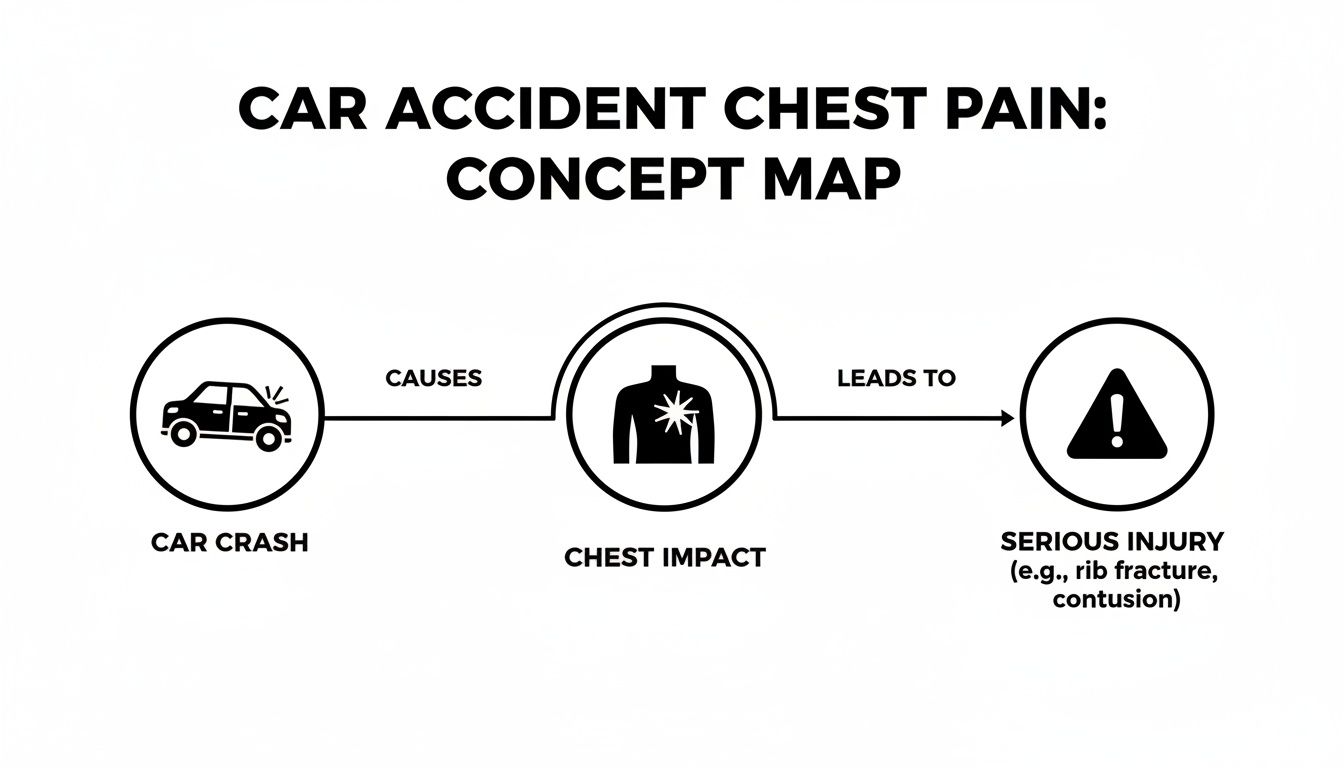
As you can see, the force from a wreck transfers directly to your chest, putting your internal organs at significant risk.
Common Causes of Chest Pain You Cannot See
The sudden, violent stop of a car accident can slam your body into a seatbelt, steering wheel, or airbag with incredible force. This blunt trauma can lead to a whole range of injuries, and every single one demands immediate medical attention for a proper diagnosis and treatment plan.
The table below breaks down some of the most common—and serious—causes of chest pain after a collision. These are the "invisible" injuries that make a medical evaluation so critical.
Common Causes of Chest Pain After a Car Accident
| Injury Type | Common Symptoms | Why It's Serious |
|---|---|---|
| Fractured Ribs or Sternum | Sharp pain that gets worse when you breathe, cough, or move. Tenderness over the bone. | A broken rib can be jagged and sharp enough to puncture a lung, the heart, or other major blood vessels. |
| Pulmonary Contusion (Bruised Lung) | Shortness of breath, chest pain, coughing up blood, and wheezing. | The lung tissue is bruised and can fill with fluid, preventing your body from getting enough oxygen. This can lead to respiratory failure. |
| Cardiac Contusion (Bruised Heart) | Chest pain, rapid or irregular heartbeat, shortness of breath, and fatigue. | A bruised heart muscle may not pump blood effectively. It can disrupt the heart's rhythm and lead to a heart attack or cardiac arrest. |
| Aortic Dissection or Rupture | Sudden, severe, and tearing pain in the chest or upper back. Dizziness, fainting. | The aorta is the body's largest artery. If it tears from the shearing forces of a crash, it causes massive internal bleeding that is almost always fatal without immediate surgery. |
Think about it this way: you’re in an SUV crash on a busy San Antonio road. Your chest aches where the seatbelt locked up. That pain could easily be from multiple fractured ribs, which are the most common thoracic injuries in car accidents. One major study found chest wall injuries in 62.1% of traffic accident trauma cases, and more than half of those involved multiple rib fractures.
Adrenaline is a powerful natural painkiller. During a traumatic event like a car crash, your body is flooded with it, and it can completely hide the pain of a serious injury for hours, or even days. That's why you have to get checked out by a doctor, even if you think you feel fine.
Physical Pain and Emotional Trauma
It's also important to remember that the emotional trauma from a wreck can cause physical symptoms, including chest pain linked to anxiety. Getting the right care means figuring out whether the pain is from a physical injury or an emotional response. Learning more about Chest Pain Anxiety Symptoms can help, but it’s not a substitute for a professional diagnosis.
Only a doctor can truly determine what’s causing your pain. Getting a medical evaluation isn’t just for your health—it creates a crucial medical record. This is the evidence a Houston car accident attorney will use to connect your injuries directly back to the crash.
You can learn more by checking out our guide on motor vehicle accident injuries and their treatment. Your well-being is the top priority, and a medical evaluation is the single most important first step you can take.
Your First Steps to Protect Your Health and Legal Rights
In the chaotic moments after a car crash, it’s tough to think clearly. Your mind is racing, adrenaline is pumping, and you might be feeling that first twinge of chest pain. What you do right now is critical, not just for your health, but for protecting your legal right to compensation down the road.

Think of the following steps as your game plan for taking back control. By following them, you build a strong foundation for your recovery and make sure you don't accidentally hurt your chances of getting the fair compensation you deserve.
Step 1: Your Health Comes First—No Exceptions
If you feel any chest pain, tightness, or pressure, your only priority should be to seek immediate medical attention. Call 911 or get to the nearest ER right away. The shock and adrenaline from a crash are powerful—they can easily hide serious injuries like a fractured rib or bruised heart that could become life-threatening if you wait.
Even if the pain feels minor, getting checked out by a doctor is non-negotiable. A medical professional is the only one who can figure out what’s really going on. This visit also creates an official medical record, which is the cornerstone evidence linking your injury directly to the accident.
Step 2: Document Everything You Can at the Scene
If you're physically able to, it’s time to start gathering evidence. What you collect now can be priceless for a Texas personal injury lawyer building your case. Your smartphone is your best friend here.
- Take Photos and Videos: Get pictures of the damage to all cars from every angle. Don't forget the wider scene—capture skid marks, traffic signals, road conditions, and anything else that tells the story.
- Exchange Information: Get the other driver’s name, address, phone number, driver’s license number, and their insurance policy details.
- Look for Witnesses: If anyone saw what happened, politely ask for their name and contact information. A statement from an impartial witness can be incredibly powerful.
- Jot Down the Details: Write down everything you remember about how the crash happened, the time, and the location. Memories fade fast, so getting it on paper is crucial.
At the scene, never discuss who was at fault or apologize. A simple "I'm sorry" can be twisted by insurance companies into an admission of guilt that they will use against you.
Step 3: Report the Crash and Be Smart with Insurers
You are required to report the accident to the police. A police report creates an official, third-party narrative of the incident. When an insurance adjuster calls—even if it's your own insurer—be extremely cautious. Their job is to find ways to pay you as little as possible.
Stick to the basic facts of the crash. Do not give a recorded statement, sign any forms, or accept a quick settlement offer without first talking to an attorney. Their first offer is almost always a lowball amount that doesn't come close to what you truly need.
Taking these steps can feel like a lot to handle, especially when you’re in pain and feeling shaken up. The decisions you make today will have a huge impact on your future, and our team is here to help you make the right moves from the very start.
How Texas Law Defines Your Path to Compensation
When you're dealing with chest pain and endless doctor visits after a crash, the idea of a legal fight can feel like the last thing you want to take on. But it’s important to know that Texas personal injury law isn't designed to be confusing. It lays out a clear path for you to get justice and the financial help you need to recover.
At its core, your right to compensation is built on a simple idea: negligence. In Texas, this means proving the other driver had a basic duty to operate their vehicle safely. When they failed to do that—by texting, speeding, or being otherwise careless—they breached that duty. If their actions caused the crash that left you with a chest injury, they are legally responsible, or at fault.
Proving Negligence Was the Cause
Holding the at-fault driver accountable isn't just about pointing fingers. It's about proving their carelessness with solid evidence.
For example, after a Houston freeway crash with a commercial truck, a skilled truck crash lawyer Houston would get to work proving the driver was negligent by:
- Pulling the official police report, which might cite the trucker for making an unsafe lane change.
- Securing the truck's "black box" data, which can show if the driver was speeding or slammed on the brakes too late.
- Finding witnesses who saw the truck driving erratically moments before the collision.
This is how you build a case—by connecting the dots between the other driver's bad decisions and the injuries you're now forced to deal with.
What Is Texas Comparative Responsibility?
Don't be surprised if the other driver's insurance company tries to shift some of the blame onto you. It’s a common tactic. When this happens, a specific Texas law called comparative responsibility (or the 51% Bar Rule) comes into play.
This rule means you can still recover money for your injuries, as long as a jury finds you are 50% or less at fault for the crash. However, if you are found to be 51% or more at fault, you get nothing.
If you are found partially to blame (but under that 51% cutoff), your final compensation is simply reduced by your percentage of fault. So, if you have $100,000 in damages but are found 10% responsible, you can still recover $90,000. An experienced attorney is vital here to fight back against unfair blame and protect your right to a full recovery.
How Long Do You Have to File a Claim in Texas?
Texas law also imposes a strict time limit, known as the statute of limitations, for filing a personal injury lawsuit. For nearly all car accident claims, you have only two years from the date of the crash to file your case in court. You can learn more about the Texas car accident statute of limitations in our detailed guide.
If you miss this deadline, the courthouse doors slam shut. You lose your right to seek compensation forever, no matter how strong your case is. This is why it is so important to speak with a lawyer as soon as possible.
As you navigate the claims process, you'll also need a firm grasp of your own insurance coverage. Understanding the differences between Personal Injury Protection Vs Uninsured Motorist Bodily Injury can make a huge difference in your ability to cover your expenses right away.
How a Texas Personal Injury Lawyer Builds Your Case
When you hire a personal injury lawyer after a crash, you’re not just getting legal advice. You’re bringing in a dedicated team to take over the fight for you. While you focus on what really matters—recovering from your chest pain following a car accident—we get to work building a solid case to secure the compensation you're owed. Here at The Law Office of Bryan Fagan, we have a proven process for that.

From the moment you hire us, we move quickly to protect your rights and lock down the evidence we need to prove the other driver was negligent.
Launching an Immediate Investigation
Evidence has a short shelf life. After a crash, it can vanish in days, if not hours. That’s why we don’t waste a single moment. Our first move is always to launch a rapid, thorough investigation to preserve every piece of the puzzle.
Think about a multi-car pileup on I-45 in Houston. While you’re getting medical attention, we’re already on the move. Our team works to:
- Preserve Physical Evidence: We fire off legal notices to stop the at-fault party from destroying key evidence. This could be a commercial truck's "black box" recorder or a rideshare driver's trip data—information that can prove exactly what happened.
- Interview Witnesses: We track down everyone who saw the accident. We get their recorded statements while the details are still sharp in their minds, locking in testimony that backs up your side of the story.
- Document the Scene: We often send investigators back to the crash site for detailed photos and measurements. Sometimes, we even use drone footage to create a complete reconstruction of the scene.
Organizing and Managing Your Medical Treatment
Your medical records are the backbone of your injury claim. They are the official proof of your chest injury and the crucial link connecting it back to the crash. But trying to manage all the appointments, bills, and paperwork on your own is a nightmare.
We step in to coordinate your care and make sure every detail is documented perfectly. Our team ensures your medical file tells the complete story of your injury, from the ER visit right after the crash to your ongoing physical therapy sessions and specialist consults. This level of detail is absolutely critical for proving the full extent of your damages.
We take over all communications with the insurance companies, acting as a shield against their tactics. This frees you up to speak openly with your doctors, without having to worry that some innocent comment will be twisted and used against you by an adjuster.
Calculating the Full Value of Your Claim
The first offer from an insurance company is almost never fair. It’s a lowball number designed to close your case quickly and cheaply. They’ll look at your initial medical bills and maybe throw in a tiny amount for your "trouble."
This is where an experienced Texas personal injury lawyer makes all the difference. We don’t just look at the bills you have today; we calculate the true and full value of your claim.
We fight for compensation that covers:
- All Medical Expenses: This includes everything from the ambulance ride and surgery to future physical therapy, medication, and any long-term care you might need.
- Lost Wages and Earning Capacity: We calculate every dollar of income you've lost. If your chest injury is severe enough to prevent you from returning to your old job, we also calculate the impact on your future earning potential.
- Pain and Suffering: This is compensation for the physical pain, emotional trauma, and the overall loss of enjoyment of life you’ve been forced to endure.
- Disfigurement and Impairment: If the accident left you with permanent scars or physical limitations, you deserve to be compensated for that.
By building a case on a foundation of solid evidence and a comprehensive damage calculation, we put you in the strongest possible position to negotiate. We prepare every single case as if it's headed to trial. That sends a powerful message to the insurance company: we’re ready to fight for every last dollar you deserve.
Your Recovery Starts Here. You Are Not Alone.
The path forward after a serious accident can feel overwhelming. We hope this guide has made one thing clear: chest pain is a serious warning sign, and Texas law provides a clear path to justice for those harmed by someone else's carelessness. The road ahead might seem long, but taking the first step is the most powerful move you can make.
At The Law Office of Bryan Fagan, we blend aggressive legal representation with genuine compassion. We get what you’re going through, and we’re here to give you hope and help you take back control.
Our Commitment to Your Recovery
Your recovery—physical, emotional, and financial—is our top priority. We know that dealing with chest pain following a car accident can turn your world upside down, affecting everything from your job to your peace of mind. Our mission is simple: we lift the legal burden off your shoulders so you can focus completely on getting better. We’ll handle the insurance adjusters, the legal deadlines, and the fight for the compensation you deserve.
A serious accident can change your life in an instant—but you don’t have to face it by yourself. Recovery is possible, and dedicated legal help is available right here in Texas.
Whether you need a truck crash lawyer in Houston after a commercial vehicle collision or a wrongful death lawyer Texas because you lost a loved one, our firm has the experience to stand up for you. We are committed to holding negligent people accountable and securing the resources you need to start rebuilding.
Take the First Step Today with No Risk
We invite you to reach out for a free, no-obligation consultation to discuss your case. Let us listen to what happened, answer your questions, and explain exactly how we can help.
You will never pay us a dime unless we win your case. This means there is absolutely no financial risk in getting the skilled legal help you need right now. Your journey toward justice and healing starts with a simple phone call or message. Let us help you move forward.
Frequently Asked Questions About Chest Injury Claims
After a serious crash, your mind is likely racing with urgent questions about your health, your future, and your legal rights. When you're dealing with something as frightening as chest pain, you need clear, straightforward answers. We’ve addressed some of the most common questions we hear from clients to help you find some clarity.
How Much Is My Chest Injury Claim Worth in Texas?
There's no "average" settlement amount for a chest injury claim, because no two accidents are exactly alike. The value of your case depends entirely on the unique facts of your situation.
Several key factors will determine what your claim is worth:
- The severity of your chest injury (a few cracked ribs versus a life-threatening cardiac contusion).
- The total cost of your medical treatment, from the initial ER visit to any future therapy or care you might need.
- How much income you've lost because the injury kept you from working.
- The real-world impact the injury has had on your daily routines and overall quality of life.
An experienced Houston car accident attorney will meticulously analyze every one of these elements to calculate the full and fair compensation you are truly owed, making sure nothing gets overlooked.
What if My Chest Pain Appeared Days After the Accident?
This is incredibly common. The rush of adrenaline that floods your system during a crash is a powerful, natural painkiller that can easily hide serious injuries. It’s often hours or even days later that the pain from deep bruising, internal inflammation, or hairline fractures finally makes itself known.
Delayed-onset pain does not hurt your claim. The most important thing to do is get a medical evaluation the moment you notice any pain and then contact a lawyer. This creates a professional medical record and officially connects your delayed symptoms back to the collision.
Over 95% of personal injury cases are resolved through settlement negotiations before ever seeing the inside of a courtroom. However, the best settlements are almost always won when the insurance company knows your lawyer is fully prepared and willing to go to trial if they refuse to make a fair offer.
Can I Still File a Claim if I Was Partially at Fault?
Yes, you absolutely can in many situations. Texas law follows a rule known as "modified comparative fault," sometimes called the 51% Bar Rule. In simple terms, this means you can still recover damages from the other driver as long as you are found to be 50% or less responsible for causing the accident.
If you are found partially at fault, your final compensation is simply reduced by your percentage of fault. For example, if you have $100,000 in damages but are found 10% to blame for the crash, you can still recover $90,000.
The road to recovery after an injury can feel confusing and overwhelming, but you don’t have to walk it alone. At The Law Office of Bryan Fagan, PLLC, we are here to offer the experienced guidance and compassionate support you need to move forward.
Contact us today for a free, no-obligation consultation to talk about your case. We work on a contingency-fee basis, which means you pay absolutely nothing unless we win for you. Schedule your free consultation now.