Skip to content
A serious car accident can change your life in seconds — but you don’t have to face it alone. The confusion, pain, and financial stress can feel overwhelming. What you do in the moments and hours following a crash is absolutely critical—not just for your health, but for protecting your family’s financial stability and your legal right to pursue a car accident lawsuit for the compensation you deserve.
Your First Steps After a Texas Car Accident

The moments after a collision are chaotic. Everything feels disorienting, and it’s hard to think straight. After a Houston freeway crash or being T-boned at a quiet intersection, knowing what to do can make all the difference. The actions you take at the scene build the foundation for your potential legal claim, giving you the proof needed to hold the at-fault driver accountable.
Your well-being is always priority number one. Even if you feel okay, the rush of adrenaline can easily mask serious injuries like whiplash or internal damage. Getting checked out by a medical professional right away is essential, both for your health and to create an official record of any harm the crash caused.
Protecting Your Health and Legal Rights at the Scene
Once you've made sure everyone is safe and that medical help is on its way, your focus should shift to gathering evidence. This information will become invaluable when your attorney starts dealing with the insurance companies.
If you are physically able to, these are the practical steps you should take:
- Call 911 Immediately: Always report the accident to the police. A formal police report is a powerful piece of evidence because it provides an official, unbiased account of what happened.
- Document Everything: Use your phone to take photos and videos of the entire scene from every angle. Get shots of the damage to all vehicles, skid marks on the road, traffic signs, and any visible injuries.
- Exchange Information: Get the other driver’s name, phone number, driver's license number, and their insurance details. Don’t forget to get the names and contact info for any witnesses who saw the crash—their perspective can be crucial.
- Avoid Admitting Fault: This is a big one. Never apologize or say anything like, "It was my fault," even if you're just trying to be polite. Stick to the facts when you talk to the other driver and the police.
A serious accident is overwhelming, but remember this: the steps you take in those first few hours are your most powerful tools for building a strong case.
How to Handle the First Call from an Insurance Adjuster
It won’t take long for the other driver’s insurance adjuster to call you. They often sound friendly and concerned, but make no mistake—their job is to protect their company’s bottom line by paying out as little as possible. Be careful.
You only have to give them basic information. Politely but firmly decline to give a recorded statement or sign any documents until you’ve spoken with a Houston car accident attorney. Anything you say can be twisted and used against you to weaken your claim. This is especially important when you realize that car accidents are the number one cause of personal injury claims in the country. In fact, crashes are behind over 50% of all personal injury lawsuits. You can find more insights about personal injury claim statistics to see just how common these situations are.
If you or a loved one has been hurt, your only job is to focus on recovery. Let a skilled legal team take on the fight for you. Schedule a free, no-obligation consultation with The Law Office of Bryan Fagan, PLLC today to find out what your options are and take the first step toward getting justice.
How Do You Prove Fault in a Texas Car Accident Lawsuit?

Winning a Texas car accident lawsuit isn’t as simple as telling a judge the other driver was wrong. You have to legally prove they were negligent. That’s a legal term, but the idea behind it is simple: someone didn't act with reasonable care, and their carelessness hurt you.
To build a solid case, your attorney must establish four specific elements of negligence. Think of them as the four legs of a table—if one is missing, the whole thing comes crashing down. You must show the other driver had a duty to be safe, they failed that duty, their failure caused the crash, and you suffered real harm because of it.
The Four Elements of Negligence in Texas Law
Understanding these four points is the first step in knowing how strong your case really is. Let's break down what each one looks like in the real world.
- Duty of Care: Every single person who gets behind the wheel in Texas has a legal duty to drive safely. This means following traffic laws, paying attention, and not driving while impaired. It’s an automatic responsibility that comes with a driver's license.
- Breach of Duty: This is where the carelessness comes in. A driver breaches their duty when they do something unsafe, like texting, speeding, running a red light, or getting behind the wheel after drinking. It's the specific action (or inaction) that violated their responsibility to be safe.
- Causation: It's not enough to show the other driver was being careless. You have to connect their specific careless act directly to the accident that injured you. Their breach of duty must be the direct cause—the reason the crash happened.
- Damages: Finally, you must show you suffered actual, measurable harm. This isn't just about a dented bumper. It includes your physical injuries, medical bills, lost paychecks from missing work, emotional distress, and the damage to your car.
Here’s a real-world example: After a Houston freeway crash, you’re driving through an intersection with a green light. Another driver, busy with their phone, blows through their red light and T-bones you. In that scenario, the driver breached their duty to obey signals, that breach caused the collision, and you were left with damages—injuries and a wrecked vehicle.
What Is Comparative Responsibility in Texas?
What if the other driver tries to flip the script and say you were partly to blame? Texas uses a rule for this called modified comparative responsibility, often called the "51% bar rule." This rule is incredibly important.
Under this system, you can still get compensation even if you were partially at fault—as long as your share of the blame is 50% or less. Your final payout will simply be reduced by your percentage of fault. So, if a jury finds you 20% at fault in a case worth $100,000, you would receive $80,000.
But here’s the critical part: if a jury decides you were 51% or more at fault, you get nothing. Zero. You are completely barred from recovering any money.
Insurance companies are experts at using this rule to their advantage. They will work hard to shift as much blame as possible onto you to either slash their payout or deny your claim entirely.
Sometimes, fault isn't just between the drivers. For example, a bar could be held liable if they knowingly over-served a drunk driver who then caused a crash. Understanding these intersecting laws is complex, which is where a skilled Houston car accident attorney becomes essential. To learn more about how fault can extend to other parties, you can read our guide on Texas Dram Shop Law.
How Long Do You Have to File a Claim in Texas?
After a serious wreck, you’re dealing with a mountain of stress—doctor's appointments, car repairs, and calls from the insurance company. Amid all that chaos, one of the most critical factors is something you can never get back once it's gone: time. Texas law puts a strict deadline on your right to file a car accident lawsuit, and if you miss it, you could lose your chance for financial recovery forever.
This legal deadline is known as the statute of limitations. For most personal injury claims in Texas, including those from car crashes, you have exactly two years from the date of the accident to file a lawsuit against the driver who caused it.
What Happens if You Miss the Deadline?
That two-year rule isn’t a friendly suggestion; it’s a hard cutoff. If you try to file your claim even a single day after that window closes, the court will almost certainly throw your case out. It won’t matter how clear the other driver’s fault was or how severe your injuries are. You will permanently lose the right to demand compensation.
Waiting too long is one of the most common—and heartbreaking—mistakes we see. The at-fault driver's insurance company knows this deadline is looming. They might even intentionally drag out settlement talks, hoping you’ll run out of time before you’re forced to take legal action.
Are There Any Exceptions to the Two-Year Rule?
While the two-year deadline is firm, Texas law does recognize a few rare situations that can pause, or "toll," the clock. It's crucial to understand these exceptions are uncommon and only apply in very specific circumstances.
- Injured Minors: If the victim was under 18 at the time of the crash, the two-year clock usually doesn’t start ticking until their 18th birthday.
- The "Discovery Rule": In some unique cases, an injury isn't obvious right away (think certain internal injuries or a slow-developing condition). Here, the clock might start on the date the injury was discovered, or reasonably should have been discovered.
- Claims Against Government Entities: This is a big one. If you were hit by a city bus, a county vehicle, or any other government employee, the rules are completely different and much stricter. You often have only six months to give them formal written notice of your claim.
Because these exceptions are so complex and narrowly interpreted, it is absolutely vital to speak with a Texas personal injury lawyer right away. An attorney can figure out exactly how the statute of limitations applies to your specific situation, protecting your right to seek justice. Don't risk losing everything by waiting.
What Kind of Compensation Can You Recover?
After a serious car accident, the focus isn't just on a wrecked car. It’s on the flood of medical bills, the income you're losing because you can't work, and the physical and emotional toll that turns your life upside down. When someone else’s carelessness causes this kind of chaos, Texas law allows you to demand financial compensation for your losses. In legal terms, this is called damages.
Figuring out what you're entitled to claim is a huge step toward putting your life back together. In a Texas car accident lawsuit, damages are generally broken down into three categories. Each one covers a different kind of loss you’ve suffered, making sure the final compensation truly reflects how the crash has impacted you and your family.
Economic Damages: The Tangible Costs
The first and most straightforward category is economic damages. Think of these as all the concrete, out-of-pocket expenses you can track with receipts, invoices, and pay stubs. The goal here is simple: to make you financially whole again by paying you back for every dollar the accident has cost you.
Common examples of economic damages include:
- Medical Expenses: This covers everything from the ambulance ride and ER visit to surgeries, physical therapy, medications, and any future medical care you'll need.
- Lost Wages: If your injuries keep you from working, you can recover the income you've already lost. This also includes your "loss of future earning capacity" if your injuries permanently impact your ability to earn a living.
- Property Damage: This is the cost to repair or replace your vehicle and any other personal items that were destroyed in the crash, like a phone or laptop.
These costs pile up fast, which is why keeping detailed records of every single expense is so important. Calculating these damages correctly is a detailed process. You can learn more about how to calculate a car accident settlement in our comprehensive guide.
Non-Economic Damages: The Human Toll
Next up are non-economic damages. These are meant to compensate you for the intangible losses—the personal struggles that don't come with a neat price tag. This is the human cost of a crash: the pain, the trauma, and the emotional suffering. Just because you can't put a number on them easily doesn't make them any less real or devastating than a medical bill.
These damages can provide compensation for:
- Pain and Suffering
- Mental Anguish and Emotional Distress
- Physical Impairment or Disfigurement
- Loss of Enjoyment of Life
Imagine you're left with chronic back pain after a major crash on a Houston freeway, and now you can't pick up your kids or enjoy your weekend hobbies. Non-economic damages are designed to acknowledge that profound loss. A skilled Houston car accident attorney knows how to build a powerful case that shows the true extent of this kind of suffering.
Punitive Damages: Punishing Extreme Recklessness
Finally, in some rare situations, a court might award punitive damages, which are also called exemplary damages in Texas. These aren't about compensating you for a specific loss. Instead, their entire purpose is to punish the at-fault driver for extremely reckless or malicious behavior and send a strong message to deter others from doing the same.
Punitive damages are reserved for cases where the defendant’s conduct was grossly negligent. A common example is a crash caused by a drunk driver who was multiple times over the legal limit, showing a conscious disregard for the safety of others.
While every case is different, it helps to have a general idea of claim values. The median settlement for personal injury cases is around $21,000, but claims with severe injuries can be worth much more. Recent industry data shows the average auto liability claim for bodily injury was approximately $26,501.
To give you a clear picture, here's a simple breakdown of the different types of damages you can pursue in a Texas car accident lawsuit.
Types of Recoverable Damages in a Texas Car Accident Claim
| Damage Category | What It Covers | Common Examples |
|---|---|---|
| Economic | Tangible, calculable financial losses. | Medical bills, lost wages, vehicle repair costs, rehabilitation expenses. |
| Non-Economic | Intangible, non-financial suffering. | Pain and suffering, emotional distress, scarring, loss of companionship. |
| Punitive | Punishment for extreme negligence. | Injuries caused by a drunk driver, a driver in a high-speed street race. |
Understanding these categories is the first step in knowing what your claim might truly be worth. An experienced attorney can help you identify and calculate all the damages you are entitled to, ensuring nothing is overlooked.
Navigating the Texas Lawsuit Process
The thought of filing a car accident lawsuit can be overwhelming. Let’s be honest, the legal system seems confusing and intimidating from the outside. But if you think of it as a roadmap—a clear path from the chaos of your accident to a resolution—it becomes much more manageable.
This journey starts long before you ever step foot in a courtroom. It begins with a deep-dive investigation and the formal filing of your case. An experienced Houston car accident attorney takes care of every detail, so you can pour all your energy into healing.
The Initial Investigation and Filing the Petition
First things first, your legal team gets to work. We launch a full-scale investigation into the crash, gathering every piece of evidence we can find. This means collecting photos from the scene, digging into the official police report, tracking down and interviewing witnesses, and compiling all of your medical records. The mission is simple: build an ironclad foundation for your claim.
Once we have solid proof that the other driver’s negligence caused your injuries, we draft an official document called a "petition." This is what we file with the court to formally kick off your lawsuit. The petition tells your story—it lays out what happened, why the other driver is responsible, and details the damages you’ve suffered.
What is the Discovery Phase?
After the petition is filed, the case enters a stage called discovery. This is usually the longest part of the entire process, and it’s often where cases are won or lost. During discovery, both sides are required to share information and evidence with each other under oath. It’s a structured process designed to make sure everyone has the same facts, eliminating any "gotcha" moments if the case eventually goes to trial.
Discovery involves a few key steps:
- Interrogatories: These are basically written questions that each side sends to the other. The answers must be provided in writing and under oath.
- Requests for Production: This is a formal request for documents. We might ask for things like the other driver’s cell phone records, vehicle repair bills, or photos they took at the scene, while they will request your medical bills and records.
- Depositions: Think of this as an out-of-court interview, but it’s done under oath. Attorneys from both sides get to ask questions of witnesses and everyone involved in the crash. Because every word matters, many legal teams rely on legal court transcription services to create a perfect written record of these conversations.
This infographic breaks down the different kinds of compensation—what the law calls "damages"—that we work to prove during discovery and throughout your case.
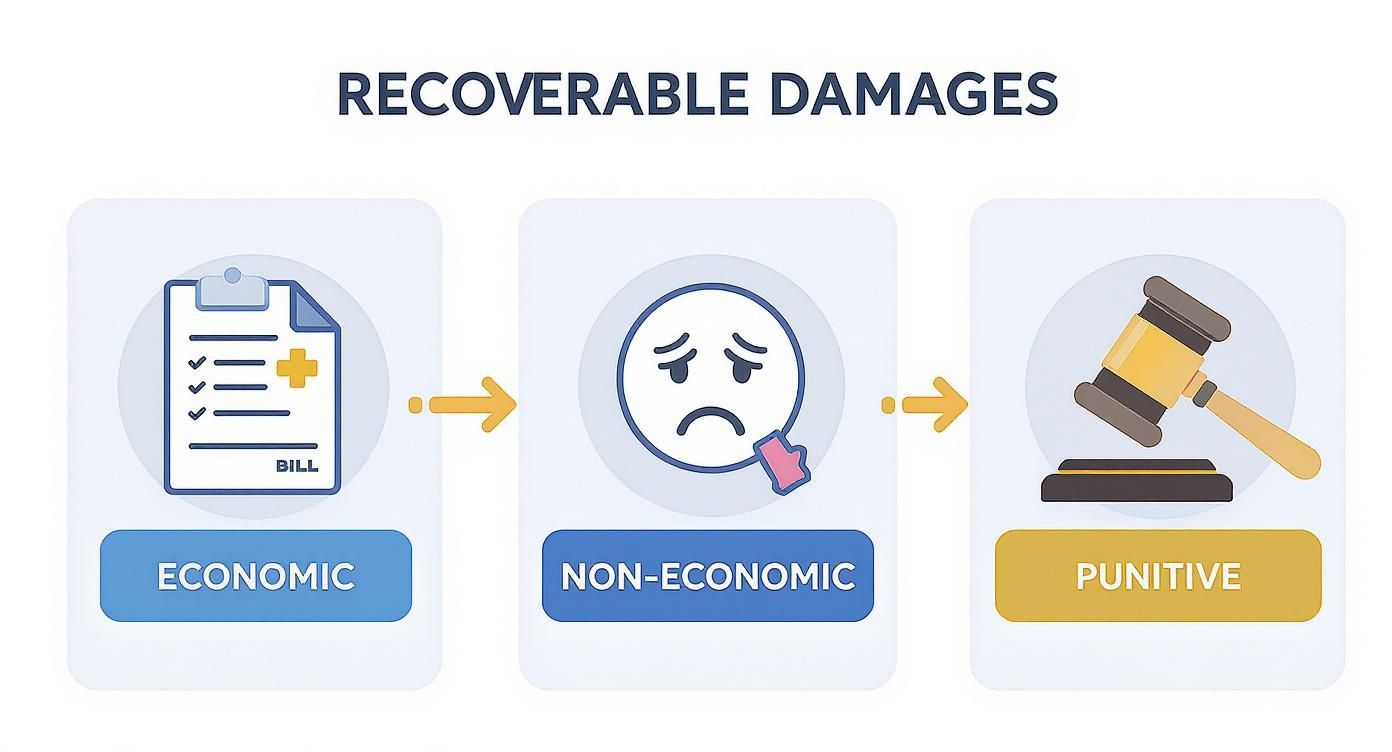
As you can see, a strong claim accounts for everything. It covers the concrete, easy-to-calculate costs like medical bills (economic damages), the intangible suffering like pain and emotional distress (non-economic damages), and in some rare cases, punishment for extreme recklessness (punitive damages).
Mediation and Settling Out of Court
It’s a huge myth that every lawsuit ends with a dramatic trial like you see on TV. The reality? The vast majority of personal injury cases—well over 90%—are resolved through a settlement long before they reach a jury.
In fact, most Texas courts will require both sides to try mediation before they’ll even schedule a trial date. Mediation is a confidential meeting where you, your attorney, the other party, and their attorney sit down with a neutral third-party mediator. The mediator’s only job is to help the two sides find common ground and work toward a settlement agreement that everyone can live with. It’s an incredibly effective way to resolve a case without the stress, expense, and risk of a trial.
What to Expect if Your Case Goes to Trial
Sometimes, the insurance company just won't offer a fair settlement. If that happens, your case moves toward trial. While it’s not the most common outcome, a dedicated truck crash lawyer Houston is always prepared to take the fight to the courtroom.
At trial, both sides will present their evidence, call on witnesses to testify, and make their final arguments to a judge and jury. The jury then takes over to decide two critical things: who was at fault for the crash and what amount of compensation the injured person deserves.
Having a skilled legal team in your corner means you’re protected every step of the way, no matter which path your case takes. You don't have to face this alone.
Why a Personal Injury Lawyer Is Your Strongest Ally
Trying to take on an insurance company by yourself after a serious accident is an unfair fight. It’s a battle you shouldn't have to face alone. Insurance adjusters are professional negotiators, and their primary job is to protect their company's bottom line—which means paying you as little as possible.
This is where having a dedicated personal injury lawyer changes everything. An experienced attorney becomes your most powerful advocate, leveling the playing field and fighting for the justice you deserve.
From the moment you hire us, we take over all communications. No more constant calls or pressure tactics from insurers. This frees you up to focus completely on your physical and emotional recovery without the added stress of navigating a complex legal system. You won't have to worry about saying the wrong thing or getting pushed into a quick, lowball settlement that fails to cover your future needs.
Building Your Strongest Possible Case
A skilled lawyer does a lot more than just field phone calls. They become your investigator, your strategist, and your champion, meticulously building a powerful car accident lawsuit on your behalf.
Here's what that process looks like:
- Deep Investigation: We get to work gathering every piece of evidence—police reports, witness statements, photos from the crash scene, and more—to establish exactly how the accident happened and who was at fault.
- Hiring Expert Witnesses: For more complicated cases, we might bring in accident reconstruction specialists, medical experts, or even financial analysts. Their expert testimony can be crucial in strengthening your claim.
- Calculating Your Total Damages: We dig deep to identify and calculate every single loss you have suffered. This includes current medical bills and lost wages, but also future treatment costs and the immense pain and suffering you’ve been forced to endure.
This exhaustive preparation is all designed to build a case so strong that the insurance company is often compelled to offer a fair settlement long before a trial is necessary. Knowing when to hire a personal injury lawyer is one of the most important decisions you can make, and it can dramatically impact your case's outcome.
A question we hear all the time is, "How can I afford a lawyer when I'm already drowning in bills?" We work on a contingency fee basis. Simply put, this means you pay us absolutely nothing unless we win your case. There are no upfront costs or hidden fees.
Hiring an experienced advocate, like a wrongful death lawyer Texas from our firm, sends a powerful message to the insurance company: you will not be intimidated, and you will not settle for a penny less than you are owed. You deserve a team that will fight relentlessly for your family's future.
Common Questions We Hear After a Car Wreck
When you’re trying to pick up the pieces after a serious car accident, the questions can feel endless and overwhelming. You deserve straight answers from a team that's been there and knows the ropes. Here are a few of the most common questions we get from people in your exact situation, answered plainly and simply.
How Much Does It Cost to Hire a Car Accident Lawyer?
This is usually the first thing people ask, and the answer brings a lot of relief. At The Law Office of Bryan Fagan, PLLC, we handle personal injury cases on a contingency fee basis.
What does that mean for you? It means you pay zero upfront costs or attorney's fees. We only get paid if we win your case by securing a settlement or a verdict at trial. This approach removes the financial risk, allowing you to get top-tier legal help without worrying about money. You can focus on healing while we focus on the fight.
Should I Accept the Insurance Company's First Settlement Offer?
It’s almost always a mistake to take the first offer from an insurance company. Think of it this way: their goal is to close your case as quickly and cheaply as possible. Those initial offers are intentionally low, often thrown out before you even know the full extent of your injuries and what your recovery will truly cost.
An adjuster might pressure you to sign on the dotted line right away. Don’t fall for it. It's critical to talk with an experienced Texas car accident attorney first. We can figure out what your claim is actually worth and negotiate for the full and fair compensation you’re owed.
What if the At-Fault Driver Was Uninsured?
Getting hit by a driver with no insurance (or not enough insurance) is a nightmare scenario, but you still have options. This is exactly why your own auto insurance policy likely includes Uninsured/Underinsured Motorist (UM/UIM) coverage.
Filing a claim against your own insurance company can be surprisingly tricky, though. At the end of the day, their goal is still to pay out as little as possible. An attorney can step in to manage this process, making sure you get every penny you’re entitled to under the policy you've been paying for.
A serious accident can change your life in seconds — but you don’t have to face it alone. Recovery is possible, and legal help is available. At The Law Office of Bryan Fagan, PLLC, we are here to offer the compassionate support and tough legal guidance you need right now. Let us handle the fight so you can focus on what truly matters: your health and your family.
To talk about your case with a dedicated Texas personal injury lawyer, schedule your free, no-obligation consultation today. You can reach us online or call our office anytime.