A serious accident can change your life in seconds — but you don’t have to face it alone. A t bone accident, also known as a side-impact or broadside collision, happens when the front of one car crashes into the side of another, forming a "T" shape. These crashes are often devastating because they strike the most vulnerable part of your vehicle, leaving you with little protection.
If you or a loved one has been injured in a t-bone crash, you are likely feeling overwhelmed and unsure of what to do next. This guide offers clear answers about your rights and the steps you can take to protect your family's future.
The Reality of a Texas T Bone Accident
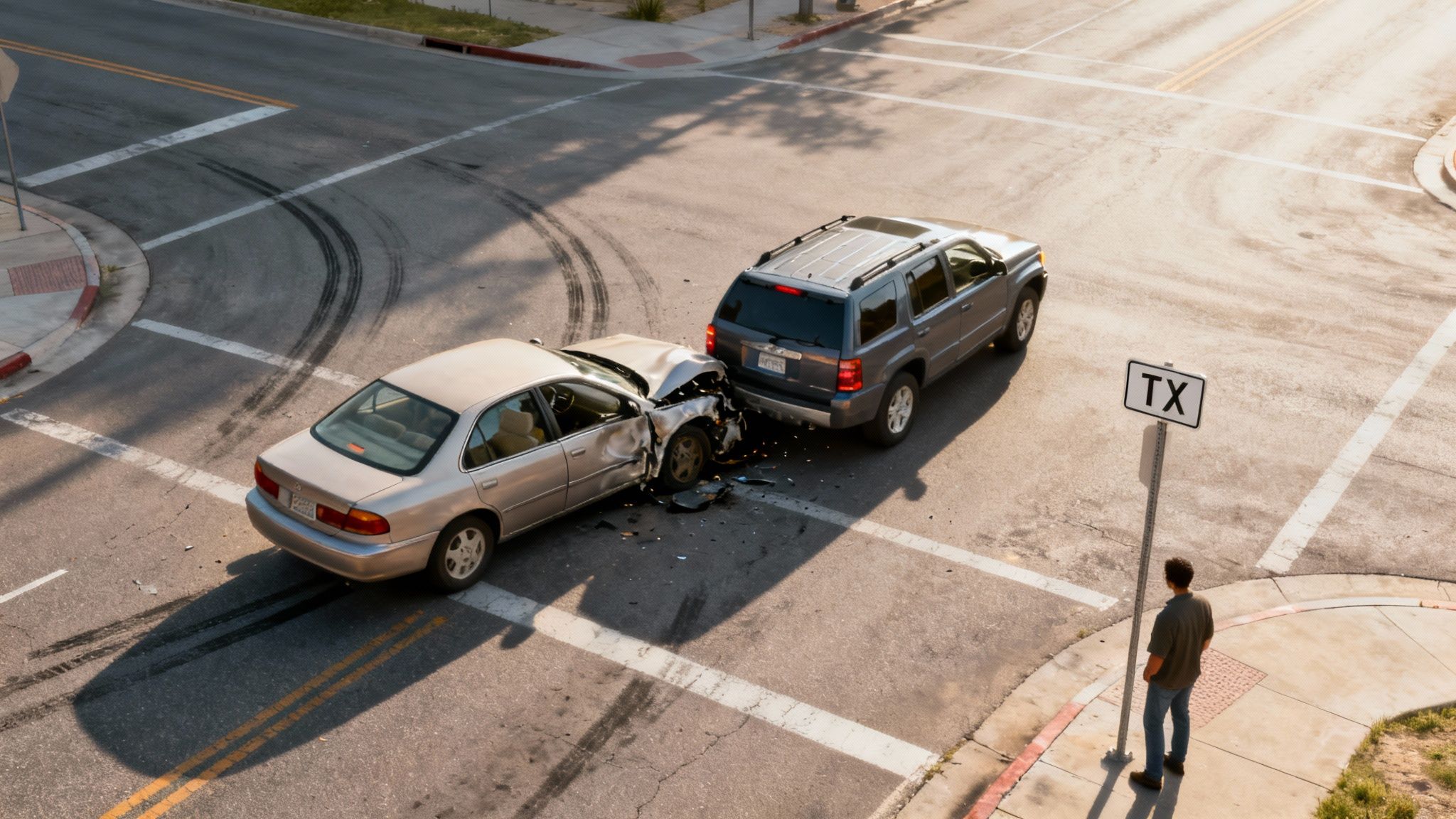
T-bone accidents are all too common at Texas intersections, usually when one driver ignores a stop sign or runs a red light. Picture this: you’re lawfully driving through a green light on a busy Houston freeway. Suddenly, another driver blows through their red light and slams directly into your driver's side door.
In that moment, there's nothing but a thin piece of metal and glass between you and the crushing force of another vehicle. The impact is often catastrophic.
This is exactly why side-impact collisions are so dangerous. Unlike a head-on or rear-end crash where a large engine block or trunk can absorb some of the energy, there's virtually no buffer in a t-bone crash. The force of the collision transfers almost directly to anyone inside the car.
Why These Accidents Cause Severe Injuries
The physics of a t-bone accident are violent. Your body is jolted sideways in a way it was never meant to move, which can lead to life-altering harm. This sudden, lateral impact often results in:
- Head and Brain Injuries: It’s easy for your head to strike the window or get whipped violently to the side, causing anything from a concussion to a severe traumatic brain injury.
- Spinal Cord and Neck Damage: This unnatural side-to-side motion can damage vertebrae and spinal discs, sometimes leading to paralysis.
- Internal Injuries: The force of the impact can cause broken ribs, punctured lungs, and serious damage to internal organs.
- Pelvic and Hip Fractures: When the impact is directly on the side of the car, severe fractures in the hips and pelvis are unfortunately common.
These crashes are tragically frequent and disproportionately deadly. National data shows that these types of angle collisions are a leading cause of death in multi-vehicle wrecks, accounting for roughly 8,700 fatalities in 2023 alone.
At The Law Office of Bryan Fagan, our Texas personal injury lawyers have seen the catastrophic harm caused by another driver's negligence. You have the right to hold them accountable. Understanding your legal options is the first step toward getting the justice and support you need to heal. You can learn more about the startling frequency of these collisions and how fault is determined.
Critical First Steps to Protect Your Injury Claim

In the chaos right after a t-bone crash, what you do next can make or break your ability to get fair compensation. Your first priority is always your health and safety, but the steps you take to document the scene and protect your legal rights are just as critical for what comes next.
If you are physically able to, use your smartphone to take pictures and videos from every possible angle. You'll want to capture the final resting positions of the cars, close-ups of the damage, any skid marks on the road, and the traffic lights or stop signs that control the intersection. These photos are often the most powerful evidence you'll have.
Documenting the Scene and Seeking Medical Care
When you talk to the other driver, stick to the basics. Exchange names, phone numbers, and insurance policy information. That's it. Don't discuss how the accident happened, and absolutely avoid saying anything that sounds like an apology, like "I'm so sorry." A simple, polite exchange is all that's needed.
Next, look around for anyone who saw the crash happen. Independent witnesses provide an unbiased perspective that can be invaluable for proving fault. Politely ask for their names and phone numbers—their testimony could be the key to your case.
The single most important thing you can do for both your health and your legal claim is to seek immediate medical attention. Adrenaline is powerful and can easily hide serious injuries like internal bleeding or a concussion.
Going straight to an ER or an urgent care clinic creates an official medical record that links your injuries directly to the accident. This documentation is absolutely vital for proving the other driver’s negligence caused the harm you've suffered. To understand why a prompt evaluation is so crucial, you can learn more about common motor vehicle accident injuries and treatment options.
Why Your Next Steps Matter
By preserving this early evidence, you're laying the groundwork for a strong personal injury claim. It gives your attorney the tools they need to reconstruct the accident and fight back against any attempts by the insurance company to blame you or downplay your injuries. For a deeper dive, it's helpful to review resources on what every client should know in the first 24 hours of their personal injury case.
Taking these deliberate steps can feel overwhelming when you're shaken and in pain, but think of it as your first line of defense. By carefully documenting everything and prioritizing your medical care, you’re taking control and setting yourself up to pursue the full compensation you deserve. An experienced Houston car accident attorney can then take this information and build a compelling case on your behalf.
How to Prove Fault in a Texas T-Bone Crash
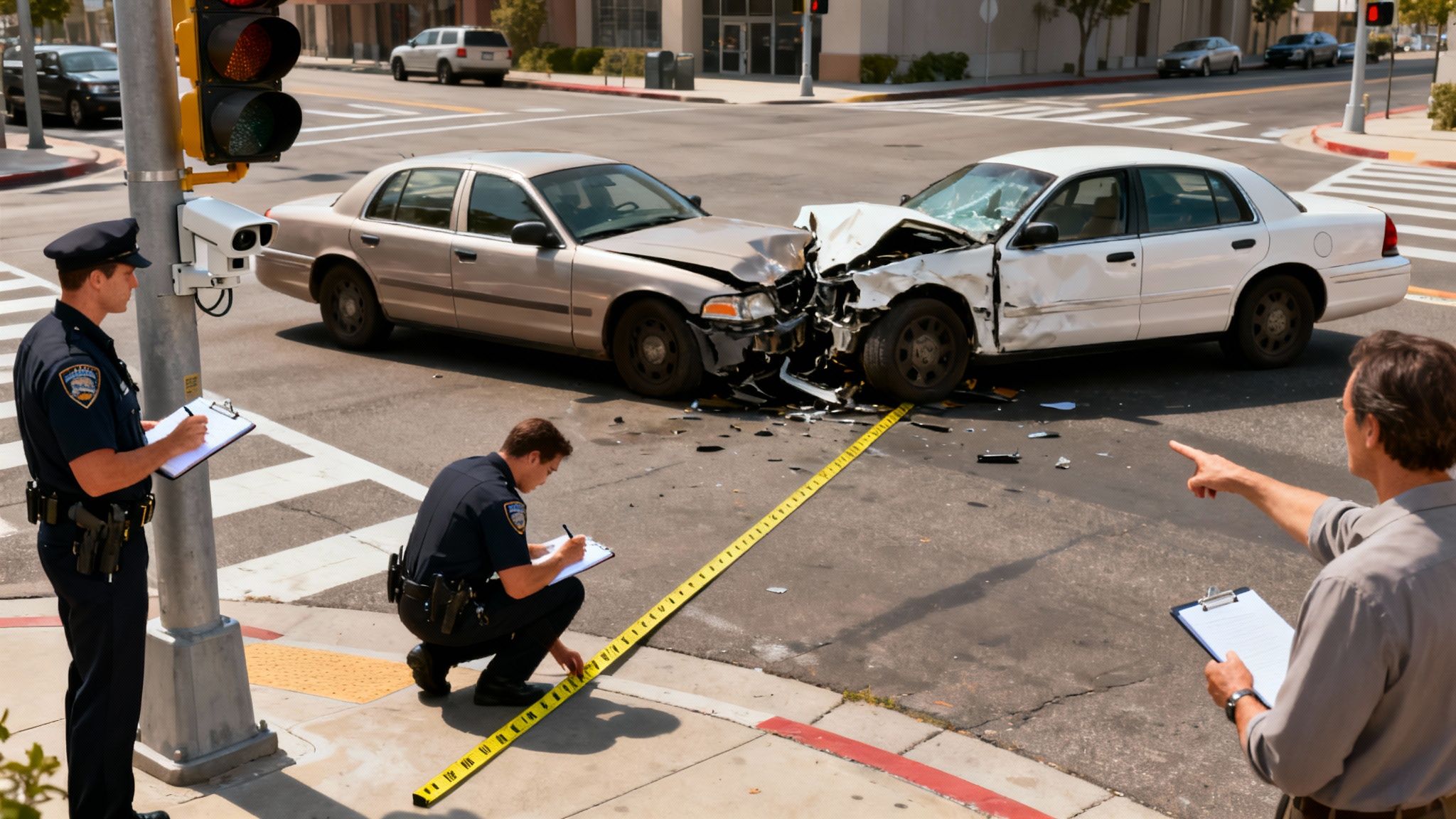
In Texas, winning your personal injury claim comes down to proving negligence. This means you must show that the other driver acted carelessly or broke a traffic law, and their mistake is the direct cause of your injuries.
When it comes to t-bone accidents, this almost always boils down to who had the right-of-way.
Imagine you’re driving through a Dallas intersection on a green light, and out of nowhere, another car blows through their red light and plows into your driver's side door. That driver's choice to ignore the traffic signal is a clear example of negligence. Proving it, however, requires solid evidence to make your case stick.
Gathering the Evidence That Wins Cases
Building a powerful claim isn't about just one piece of evidence; it's about weaving together a complete and undeniable story of what happened. A skilled Texas personal injury lawyer knows exactly what to look for to prove the other driver was at fault.
We pull from a variety of sources to build an airtight case:
- The Official Police Report: This is often the starting point. It contains the responding officer’s initial take on the crash, including any traffic tickets they issued and their professional opinion on who caused it.
- Witness Statements: An unbiased person who saw the whole thing happen can be incredibly powerful. Their testimony can confirm your version of events and shut down the other driver’s excuses.
- Traffic and Security Camera Footage: In many cases, video is the silver bullet. A clip from a nearby business's security camera or a city traffic cam showing the other driver running a stop sign is hard to argue with.
- Vehicle "Black Box" Data: Most modern cars have an Event Data Recorder (EDR). This little device captures critical data like the vehicle's speed, braking, and steering inputs just moments before the crash.
- Accident Reconstruction: For complex crashes, we may bring in an accident reconstruction expert witness. These experts analyze skid marks, vehicle damage, and other physical evidence to scientifically recreate the accident.
T-bone crashes aren’t just random acts of bad luck. The vast majority are caused by preventable mistakes. In fact, the National Highway Traffic Safety Administration (NHTSA) found that about 94% of all car accidents are tied to human error—things like speeding, distracted driving, and failing to yield. These aren't just statistics; they're the foundation for proving that another driver’s poor choice caused your harm.
Common Causes and Key Evidence in T-Bone Accidents
Most side-impact collisions happen because one driver makes a critical error at an intersection. Below is a breakdown of the most common negligent actions we see and the kind of evidence we use to prove them.
| Negligent Action (Driver Error) | How Fault Is Proven (Key Evidence) |
|---|---|
| Running a Red Light or Stop Sign | Traffic camera footage, eyewitness testimony, police reports citing a traffic violation, data from the vehicle's EDR showing no attempt to brake. |
| Failure to Yield the Right-of-Way | Dashcam video, witness statements confirming who had the green light or arrived first, analysis of the point of impact on both vehicles. |
| Distracted Driving (Texting, etc.) | Cell phone records obtained via subpoena, witness accounts of seeing the driver on their phone, admissions made by the driver at the scene. |
| Speeding Through an Intersection | EDR data showing excessive speed, accident reconstruction analysis based on the force of impact and vehicle damage, long skid marks. |
| Driving Under the Influence (DUI/DWI) | Police reports detailing failed sobriety tests, breathalyzer or blood test results, bar receipts, witness testimony about the driver's behavior. |
This evidence helps us build a narrative that leaves little room for the insurance company to argue. It's about showing, not just telling, who was responsible.
What If You Were Partially at Fault?
This is a common concern. What if the other driver ran a red light, but you were going a few miles over the speed limit?
Texas operates under a rule called modified comparative fault, or the 51% rule. This means you can still recover compensation for your injuries as long as your percentage of fault is 50% or less.
For example, if a jury decides you were 10% at fault for the accident and your total damages are $100,000, your award would be reduced by 10%. You would receive $90,000. You don't walk away with nothing.
Insurance adjusters often try to use this rule to pin blame on you and reduce their payout. This is precisely why having an experienced Houston car accident attorney is so critical. We know their tactics and will fight to ensure fault is assigned where it truly belongs.
Calculating the Full Value of Your Claim

The compensation you deserve after a t-bone accident is directly tied to the harm you've suffered. Because these crashes often cause devastating injuries with lifelong consequences, such as traumatic brain injuries, spinal cord damage, and internal bleeding, the financial and personal costs can be staggering.
Nationally, car crashes lead to about 2.1 million emergency room visits in the U.S. each year. We use this kind of data to show insurance companies that a side-impact crash is statistically more likely to cause life-changing harm. Your claim isn't just about your immediate bills; it’s about demanding full compensation for all your future care needs. The scope of this problem is massive, as you can explore more global insights about road safety statistics to understand.
Economic Damages: Your Financial Losses
The first part of your claim involves adding up all the tangible, out-of-pocket costs. These are called economic damages, and they represent every dollar the crash has taken from you.
This calculation goes far beyond the initial hospital bills. A thorough claim for a catastrophic injury accounts for:
- All Past and Future Medical Bills: This includes everything from the ambulance ride and surgery to ongoing physical therapy, medications, and even necessary home modifications.
- Lost Wages and Income: We calculate every paycheck you've missed while unable to work.
- Loss of Future Earning Capacity: If your injuries prevent you from returning to your old job or from working at all, we work with experts to calculate the lifetime value of the income you will no longer be able to earn.
- Rehabilitation and Therapy Costs: This covers specialized care needed for recovery, like speech therapy after a TBI or occupational therapy after a spinal injury.
Non-Economic Damages: The Human Cost of the Crash
The second part of your claim is just as important. Non-economic damages are designed to compensate you for the profound personal losses that don’t come with a receipt. Our comprehensive guide provides more detail on the crucial differences between economic vs non-economic damages.
Consider a Dallas construction worker who suffers a severe spinal injury in a t-bone crash. He can no longer perform physical labor, support his family, or enjoy hobbies like fishing with his kids. His settlement must cover not only his lost income but also the immense pain, emotional distress, and loss of enjoyment of life he now endures.
Non-economic damages provide compensation for losses like:
- Pain and Suffering
- Emotional Anguish and Mental Distress
- Physical Impairment or Disfigurement
- Loss of Companionship (especially important in wrongful death claims handled by a Texas wrongful death lawyer)
Calculating the true value of your claim requires a deep understanding of how to quantify both financial and personal losses. An experienced Texas personal injury lawyer will build a detailed, undeniable case to ensure your settlement covers the complete, lifetime impact of the accident.
Navigating Insurance Companies After an Accident
After a serious t-bone accident, you can expect a call from the other driver's insurance adjuster very quickly. It's crucial to understand their role: they are trained professionals whose job is to protect their company's profits by paying you as little as possible.
They are not on your side, no matter how friendly or concerned they sound. This is a common tactic designed to catch you off guard before you have had a chance to speak with a lawyer or understand the full extent of your injuries.
Common Insurance Adjuster Tactics to Watch Out For
One of their go-to moves is offering a quick, lowball settlement. They might offer a few thousand dollars right away, hoping you'll accept due to the immediate financial pressure from medical bills and missed work. Accepting this is almost always a mistake.
Why? Because you will have to sign a release form that permanently gives up your right to seek any more money for this accident. If you discover weeks later that you need surgery or long-term therapy, you're on your own. The case is closed forever.
Another tactic is asking for a recorded statement. You are not legally required to give one to the other driver’s insurance company. Adjusters are experts at using these statements to pick apart your story, find inconsistencies, and twist your words to blame you for the crash.
Leveling the Playing Field with an Experienced Attorney
This is where having a dedicated Texas personal injury lawyer becomes your greatest advantage. We immediately take over all communication with the insurance companies, putting a stop to the calls and pressure. This frees you to focus on what truly matters—your recovery.
A Houston car accident attorney will:
- Launch an independent investigation to gather the real evidence of what happened.
- Calculate the full and fair value of your claim, including not just current bills but also future medical needs and lost earning potential.
- Negotiate aggressively with the insurer, armed with the facts, evidence, and a deep understanding of Texas law.
When you're dealing with the insurance world, knowing the roles of different entities, like an Acceptance Agency Insurance, can be part of the puzzle. A legal professional guides you through all these complexities so you don't get taken advantage of.
How Long Do You Have to File a Claim in Texas?
In Texas, the clock starts ticking the moment the crash happens. You have a limited window of time to take legal action, which is known as the statute of limitations. For most personal injury claims, that deadline is two years from the date of the accident.
If you fail to file a lawsuit within that two-year period, you lose your right to recover any compensation for your injuries—permanently. This deadline is incredibly strict, with very few exceptions.
Waiting to contact an attorney is a risk you cannot afford. Key evidence like surveillance video gets erased, and witnesses' memories fade. The sooner you have a lawyer fighting for you, the stronger your case will be. We can immediately send preservation letters to ensure critical evidence isn't destroyed, building your claim from a position of strength from day one.
Got Questions About Your T-Bone Accident Claim in Texas?
After a violent t-bone crash, it’s normal to have a lot of questions. The road ahead can feel uncertain, but you don't have to walk it alone. Here are some straightforward answers to the questions we hear most often from our clients.
The Other Driver’s Insurance Adjuster Is Calling Me. What Should I Do?
Be very careful. It is their job to get you to say something that minimizes their payout.
You are not required to give them a recorded statement. You should never accept a settlement offer without first speaking to a lawyer. The best response is to politely decline to discuss the accident and tell them your attorney will be in touch. Letting an experienced Houston car accident attorney handle these conversations is the safest thing you can do for your claim.
What if the Driver Who Hit Me Was Uninsured or Drove Off?
This is a frustratingly common scenario. If you have Uninsured/Underinsured Motorist (UM/UIM) coverage on your own auto policy, you can file a claim with your own insurance company. This is exactly why you pay for that coverage.
If it was a hit-and-run, filing a police report immediately is the first critical step. A skilled Texas personal injury lawyer can then help you navigate the complex process of a UM/UIM claim or launch an investigation to find the driver who fled.
Your physical and financial recovery shouldn't depend on whether the other driver had insurance. We’ll explore every possible path to compensation to make sure you get the support you need.
How Long Will My T-Bone Accident Case Take to Settle?
There’s no one-size-fits-all answer. The timeline for settling a t-bone crash claim can vary depending on the severity of your injuries, how clear the evidence of fault is, and whether the insurance company is willing to negotiate fairly.
A straightforward case might be resolved in a few months. However, a complex claim involving a catastrophic injury or wrongful death could take more than a year, especially if a lawsuit is necessary to get you what you deserve.
Our priority is making sure you reach Maximum Medical Improvement (MMI). Rushing to settle before we know the full extent of your injuries and future medical needs is a mistake. We wait so we can calculate the true, long-term value of your claim.
I’m Worried I Can’t Afford a Lawyer. How Do Your Fees Work?
We believe everyone deserves exceptional legal representation, regardless of their financial situation. That’s why our firm handles all personal injury cases on a contingency fee basis.
Here’s what that means for you: you pay zero upfront costs. We cover all expenses of building your case, from hiring experts to filing court documents.
We only get paid if we win money for you, either through a settlement or a jury verdict. Our fee is a percentage of that recovery. This way, there is absolutely no financial risk to you. You can focus your energy on getting better while we focus on the fight.
A serious t-bone accident can throw your entire life off course, leaving you feeling lost and overwhelmed. But recovery is possible, and legal help is available. You don’t have to carry this weight by yourself. The legal team at The Law Office of Bryan Fagan, PLLC is here to offer the compassionate support and aggressive representation you need right now. We’ll handle the legal complexities so you can focus on healing.
To discuss your case with an experienced Texas personal injury lawyer, schedule your free, no-obligation consultation today.