A serious accident can change your life in seconds — but you don’t have to face it alone. There’s no magic number for the maximum compensation for a car accident in Texas. The truth is, it boils down to the unique, often painful, details of your specific situation—how severe your injuries are, how negligent the other driver was, and the full extent of your losses.
The goal isn’t just to get a check; it’s to secure the resources you need to cover everything the accident took from you, from the obvious medical bills to the profound, personal impact on your day-to-day life.
Your Life Changed in an Instant. You Are Not Alone.

One minute, you’re driving down a familiar Houston road. The next, your world is a chaotic mix of injuries, medical bills, and a crushing sense of what-if. It’s a disorienting and frightening place to be, but you don’t have to navigate it by yourself.
We put this guide together to give you clear, practical answers that can help you reclaim a sense of stability. Understanding your rights is the first and most powerful step you can take toward getting back on your feet.
What Does “Maximum Compensation” Really Mean?
Let’s be clear: “maximum compensation” is about more than just a dollar figure. It’s about having the means to piece your life back together. In Texas, the entire point of a personal injury claim is to make you “whole” again by covering every single loss you’ve suffered. That includes the losses you can see on a receipt and the ones you can’t.
Think about a multi-car pileup on I-10 in Houston. The victim isn’t just dealing with a totaled car. They’re suddenly facing a mountain of new challenges:
- Immediate Medical Bills: The ambulance ride, the ER visit, and any surgeries are just the beginning.
- Ongoing and Future Care: This could mean months of physical therapy, follow-ups with specialists, prescription drugs, or even long-term care.
- Lost Income: You’re losing wages while you recover. For some, a severe injury means a permanently diminished ability to earn a living.
- Pain and Suffering: This is the very real physical pain and emotional trauma caused by the crash and its aftermath.
A fair settlement has to account for every single one of these losses, not just the ones with a clear price tag. Insurance adjusters love to focus only on the immediate bills, but your recovery journey is so much bigger than that.
Our job as your advocate is to make sure no part of your struggle gets ignored. Whether you need a skilled Houston car accident attorney to fight for you or a compassionate wrongful death lawyer in Texas after losing a loved one, we’re here. We’ll help you calculate the true cost of the accident and fight for everything you need to heal.
Figuring Out What Your Car Accident Claim is Really Worth
The insurance company has its own playbook for valuing your claim, and it’s designed to pay you as little as possible. They’ll look at the obvious stuff—the ER bill, the first estimate from their preferred body shop—and call it a day. But the real cost of a car accident goes so much deeper than that.
To get the maximum compensation for a car accident, you have to think about every single way the crash has turned your life upside down. Texas law is on your side here; it says you have the right to be compensated for all the harm you’ve suffered. This compensation falls into two big buckets: economic and non-economic damages.
Economic Damages: The Tangible Costs
Economic damages are the most straightforward because you can usually point to a bill or a pay stub to prove them. These are the direct, out-of-pocket financial hits you’ve taken because someone else was careless behind the wheel.
Let’s imagine a construction worker gets hit in a wreck on I-45 in Houston. His economic damages aren’t just the first hospital bill. They include:
- All Medical Expenses: We’re talking about everything. The ambulance ride, the hospital stay, any future surgeries, physical therapy, prescription drugs, and even medical gear like crutches or a wheelchair.
- Lost Wages: If you couldn’t work while you were recovering, you’re owed that lost income. It’s a simple calculation based on what you earn and how much time you missed.
- Loss of Future Earning Capacity: This is a big one that adjusters love to ignore. If that construction worker’s injuries mean he can never go back to physically demanding jobs, he’s lost a lifetime of potential earnings. Proving this takes expert analysis, but for a catastrophic injury, it can be the single largest part of a claim.
- Property Damage: This is the cost to fix or replace your car. Getting an accurate assessment from quality auto repair services is key to making sure you’re not short-changed on your vehicle’s value.
These costs pile up fast. They are the financial bedrock of your claim, and if you miss even one, you could end up paying for someone else’s mistake for years.
Non-Economic Damages: The Human Cost
Non-economic damages are just as real, but you can’t put a price tag on them easily. This is the compensation for the personal, human suffering the wreck has put you through. An insurance adjuster will almost never bring these up on their own, but they are absolutely essential for a fair settlement.
An insurance company’s first offer rarely, if ever, accounts for the full extent of your pain and suffering. They count on you not knowing its true value.
These damages are unique to you and your experience. They can include:
- Pain and Suffering: Compensation for the physical pain and discomfort you’ve had to live with—and will continue to live with.
- Mental Anguish: This covers the emotional toll of the crash, like anxiety, depression, fear, or even PTSD.
- Physical Impairment: If your injuries stop you from walking, lifting, or enjoying the hobbies you used to love, you deserve to be compensated for that loss.
- Disfigurement: This is for any scars or permanent physical changes caused by the accident.
Figuring out a dollar amount for these losses is complex and is where having a seasoned Texas personal injury lawyer makes all the difference. They have seen hundreds of cases like yours and know how to put a monetary value on what you’ve been through in a way that reflects the true impact on your life.
Types of Compensation in a Texas Car Accident Claim
| Type of Damage | Description | Real-World Example |
|---|---|---|
| Economic | Medical Bills | The cost of an ambulance, emergency room treatment, hospital stays, surgeries, prescription medication, and follow-up doctor visits. |
| Economic | Future Medical Care | The projected cost of ongoing physical therapy, future surgeries, long-term medication, or in-home nursing care. |
| Economic | Lost Wages | The income you lost from being unable to work during your recovery period. |
| Economic | Loss of Earning Capacity | The difference in your lifetime earnings if your injuries prevent you from returning to your previous job or working at all. |
| Economic | Property Damage | The cost to repair your vehicle or, if it’s totaled, its fair market replacement value, plus the cost of a rental car. |
| Non-Economic | Pain and Suffering | Compensation for the physical pain, discomfort, and general hardship you have endured because of your injuries. |
| Non-Economic | Mental Anguish | Compensation for emotional distress, such as anxiety, depression, insomnia, or post-traumatic stress disorder (PTSD) stemming from the accident. |
| Non-Economic | Physical Impairment | Compensation for the loss of ability to do daily activities, hobbies, or recreational pursuits you enjoyed before the accident. |
| Non-Economic | Disfigurement | Compensation for permanent scarring, amputation, or other physical deformities that alter your appearance. |
As you can see, a comprehensive claim goes far beyond just the initial bills. It’s about making you whole again, both financially and personally.
Don’t ever let an insurance company tell you what your pain is worth. Your story matters. Every part of your struggle deserves to be acknowledged and compensated. A skilled lawyer makes sure your voice is heard and that your final settlement reflects the complete picture of your losses. For a deeper look at the formulas and methods we use, you can learn more about how to calculate a car accident settlement in our detailed guide.
How Texas Laws Can Make or Break Your Compensation Claim
When you’re trying to heal after a car wreck, the last thing you want to do is navigate a legal maze. But here’s the reality: understanding a few key Texas laws is one of the most powerful things you can do to protect your right to fair compensation. These laws are not just legal jargon; they are fundamental rules that can determine the outcome of your claim.
Two specific state laws have a massive impact on personal injury cases: the rule of comparative responsibility and the statute of limitations. If you’re not careful, they can stop you from recovering a single dime.
How Much Fault Do You Share? Understanding Comparative Responsibility
Here in Texas, we operate under a “modified comparative fault” rule, also known as the 51% bar rule. This law addresses situations where more than one person is partially to blame for a crash.
It’s a classic move for insurance adjusters to try and shift some of the blame onto you. Why? Because it saves them money. Even if the other driver blatantly ran a red light, their insurance company might dig for evidence that you were distracted or going a few miles over the speed limit.
This is where the 51% rule kicks in. It works like this:
- If you are found to be 50% or less at fault for the wreck, you can still recover compensation. However, your total award will be reduced by your percentage of fault.
- But if you are found to be 51% or more at fault, you are completely barred from recovering anything. You get nothing.
Here’s a real-world example: After a Houston freeway crash, it’s clear the other driver made an illegal lane change, causing the collision. However, their insurance company finds you were going five miles per hour over the speed limit. A jury might decide you were 10% responsible.
If your total damages add up to $100,000, that 10% fault reduces your final payout to $90,000. But if that same jury decided you were 51% at fault, you would get $0.
This rule is precisely why you need an experienced Houston car accident attorney in your corner. We fight back against these unfair blame-shifting tactics to protect the full value of your claim.
How Long Do You Have to File a Claim in Texas?
The other critical law you cannot ignore is the statute of limitations. In Texas, you generally have just two years from the date of the car accident to file a personal injury lawsuit.
Two years feels like a long time, but it disappears in a flash when you’re juggling doctor’s appointments, physical therapy, and financial stress. This deadline isn’t a suggestion; it’s a hard stop. If you miss it, the court will almost certainly throw your case out, and you lose your right to seek compensation forever.
Why is acting quickly so important?
- Evidence Vanishes: Skid marks fade, security camera footage is overwritten, and witness memories grow fuzzy. The sooner we start investigating, the more evidence we can preserve.
- Building a Strong Case Takes Time: Your legal team needs time to gather police reports, subpoena medical records, and consult with experts. Rushing this process never works in your favor.
- Don’t Give Insurers the Upper Hand: Waiting until the last minute puts you at a huge disadvantage. The insurance company knows you’re running out of time and will use that pressure to offer a low settlement, hoping you’ll take it out of desperation.
Knowing that two-year clock is ticking is the first step. Taking action promptly gives your legal team the time needed to build the strongest possible case for your injuries, whether they came from a car crash, a devastating truck accident, or another tragic event.
Gathering Evidence to Build an Unbreakable Claim
A strong personal injury claim isn’t just about what happened; it’s about what you can prove happened. It’s built on a foundation of solid, undeniable evidence. From the moment the crash occurs, you can be sure the insurance company is working to find ways to minimize your claim.
To get the maximum compensation for a car accident, you need to build your own case, piece by piece. Think of it as telling your story—the more detailed and organized your evidence is, the harder it is for an adjuster to argue that your injuries aren’t that serious.
The Immediate Aftermath: Your First Chance to Collect Proof
In the chaos right after a crash, it’s tough to think clearly. But if you’re physically able, the steps you take at the scene are incredibly valuable.
Here’s what to focus on:
- Photos and Videos: Use your smartphone to take pictures and videos of everything—damage to both cars, skid marks, traffic signs, debris on the road, and weather conditions. Crucially, photograph any visible injuries you have.
- Witness Information: If anyone saw what happened, get their name and phone number. A neutral witness who can confirm the other driver ran a stop sign can be a game-changer for proving fault.
- Driver and Insurance Details: Swap information with the other driver. Get their name, address, phone number, driver’s license number, and insurance policy details. The easiest way is to snap a quick photo of their insurance card and license plate.
Documenting Your Recovery Journey
The evidence-gathering doesn’t stop when you leave the scene. Some of the most compelling proof comes from documenting the long-term impact the crash has on your life. This is where you paint a clear picture of your pain, suffering, and the daily struggles you’re now facing—the kind of human details an insurance adjuster can’t easily dismiss.
This is a critical part of the claims process, as you can see below.
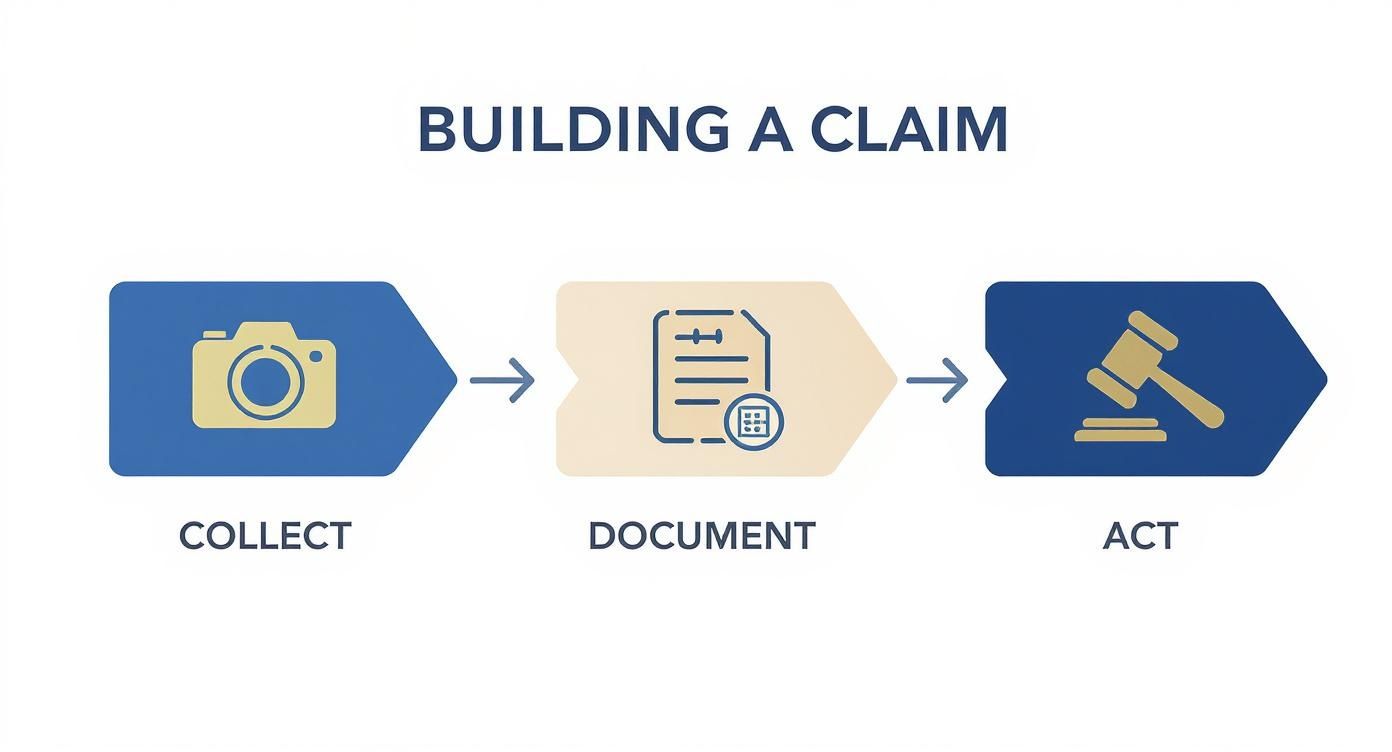
As this shows, building a powerful case is a continuous effort that moves from collecting initial evidence at the scene to ongoing documentation and, finally, taking decisive action.
One of the best tools you have is a personal injury journal.
Keep a simple notebook or a note on your phone where you jot down how you’re feeling each day. This journal becomes a powerful, running record of your non-economic damages—things like pain and suffering—which are often the most difficult to prove.
Be specific in your journal. Note your pain level on a 1-10 scale, list activities you couldn’t do, mention your doctor’s appointments, and describe your emotional state. Saying, “My back hurt,” is one thing. Writing, “Couldn’t lift my daughter today because of the sharp pain in my lower back,” is far more impactful. For a complete overview of the process, check out our guide on how to file a car accident claim.
Organizing Your Official Records
Beyond your personal journal, you need to keep every single piece of paper related to the accident. Get a folder or a binder and put everything in one place. Staying organized ensures your legal team has everything they need right away.
Your file should include:
- The Official Police Report: Get a copy as soon as it’s available.
- All Medical Records: This means ER reports, doctor’s notes, physical therapy records, and every single bill from every provider.
- Proof of Lost Wages: This includes pay stubs and a letter from your employer confirming the exact time you missed from work.
- Receipts for All Expenses: This covers everything from prescription co-pays to the cost of a rental car.
Trying to gather all this evidence while you’re also trying to heal can feel like a full-time job. A dedicated Texas personal injury lawyer can take this massive burden off your shoulders. We handle the investigation and the paperwork so you can put all your energy into what matters most: your recovery.
How to Handle Insurance Companies

It won’t be long after your accident before you get a call from the other driver’s insurance adjuster. They often sound friendly and concerned. But don’t be fooled. Their job is to protect their company’s profits by paying out as little as possible on your claim.
Dealing with an adjuster can feel like a high-stakes game where the rules seem to be in their favor. Knowing their playbook is the first step to leveling the playing field and fighting for the maximum compensation for your car accident. They rely on specific strategies to catch you off guard, but once you know what to look for, you can sidestep their most common traps.
Beware the Quick Settlement Offer
One of the oldest tricks in the book is the quick, lowball offer. An adjuster might call you just a few days after the crash, offering a check for a couple of thousand dollars to “help with your immediate bills.” When you’re out of work and medical bills are piling up, that offer can be incredibly tempting.
But accepting it is almost always a huge mistake. Cashing that check means signing away your right to seek any more money, ever. When you find out weeks or months later that you need surgery, it’s too late to go back. They are banking on your desperation and the fact that you don’t yet know the full extent of your injuries.
The Danger of Recorded Statements
Another classic move is asking for a recorded statement to “get your side of the story.” They will frame this as a routine step. The reality is that it’s a tool they use to find anything they can twist to use against you.
Imagine you’ve just been in a wreck on a Dallas freeway. The adjuster asks, “How are you doing today?” Most of us would politely answer, “I’m okay.” Later on, they’ll use that simple phrase as “proof” that your injuries couldn’t have been as severe as your doctor’s reports claim.
Crucial Tip: You are under no legal obligation to give a recorded statement to the at-fault driver’s insurance company. You can—and should—politely decline. A simple, “I will not be providing a statement at this time,” is all you need to say.
Common Tactics to Watch For
Adjusters have a whole arsenal of strategies designed to wear you down and minimize their payout. Here are a few to keep on your radar:
- Delay, Delay, Delay: They might intentionally drag their feet, hoping financial pressure will force you to accept a bad offer out of desperation.
- Questioning Your Medical Care: They may argue that your doctor-prescribed treatments weren’t necessary or claim your injuries were from a pre-existing condition.
- Requesting Your Entire Medical History: They may ask you to sign a blanket medical authorization. This gives them access to all your past health records, so they can dig for anything—no matter how unrelated—to pin your injuries on.
- Shifting the Blame: As we’ve discussed, they will look for any shred of evidence to assign partial fault to you to reduce their payout under Texas’s comparative fault rules.
The global scale of this problem is immense. According to the World Health Organization, road traffic accidents cause approximately 1.19 million deaths and tens of millions of injuries worldwide each year. This creates a staggering economic burden from medical costs and lost productivity. You can read the full fact sheet from the World Health Organization to learn more.
You don’t have to face these predatory tactics alone. A skilled Texas personal injury lawyer becomes your shield, handling all communication from the insurer. We know their playbook inside and out, and we know exactly how to counter their moves. For more in-depth advice, you can learn more about how to negotiate with an insurance adjuster in our dedicated guide.
When to Call a Lawyer: Your Strongest Advocate
After a serious wreck, it feels like your whole world has been turned upside down. You’re juggling doctor’s appointments, watching bills pile up, and dealing with the emotional fallout. The absolute last thing you need is a fight with an insurance company. This is precisely when an experienced Texas personal injury lawyer becomes your most crucial ally.
Hiring a lawyer isn’t about being aggressive; it’s about leveling the playing field. Insurance companies have armies of attorneys whose entire job is to protect their profits. A Houston car accident attorney steps in to protect your interests, handling every detail so you can focus on getting better.
Taking the Legal Burden Off Your Shoulders
The moment you hire a dedicated legal team, the entire dynamic of your case shifts. We immediately take over all communications with the insurance companies. No more harassing phone calls. No more pressure tactics. We handle it all.
Our job is to manage the entire legal process for you, from start to finish. That includes:
- A Thorough Investigation: We don’t just stop at the police report. We track down witnesses, pull traffic camera footage, and subpoena cellphone records to build an ironclad case that leaves no doubt about who was at fault.
- Calculating the True Value of Your Claim: We bring in medical and financial experts to map out the full, long-term impact of your injuries. This isn’t just about current medical bills; it’s about future surgeries, lost earning capacity, and all the hidden costs.
- Aggressive Negotiation: Armed with solid evidence and a precise valuation of your damages, we negotiate from a position of strength to get you the maximum compensation for your car accident.
A personal injury lawyer does more than just file paperwork. They become your advocate, your shield, and your strategist, ensuring your rights are protected at every turn.
This comprehensive approach is critical. A fascinating study by Swiss Re looked at payouts for the same severe car accident injury across 14 European countries. The total compensation for someone with total paralysis ranged from less than 5 million EUR to nearly 25 million EUR—all because of different legal frameworks. You can read more about these global compensation findings and see for yourself how much skilled legal representation can matter.
You Pay Nothing Unless We Win Your Case
Many people hesitate to call a lawyer because they’re worried about the cost. It’s a valid concern, but it’s one you can set aside. Reputable personal injury firms, like ours, work on a contingency fee basis.
Here’s what that means for you:
- There are zero upfront costs to get us started on your case.
- You will not pay any attorney’s fees unless and until we win you a settlement or verdict.
- Our fee is a pre-agreed percentage of the final compensation we recover for you.
This model puts us on the same team. Our goals are perfectly aligned with yours because we are invested in getting you the best possible result. If you don’t get paid, neither do we. It removes the financial risk from your shoulders, giving you access to top-tier legal help when you need it most.
Your Path to Recovery Starts Here
A bad accident can change your life in an instant, but you don’t have to navigate the aftermath alone. The right legal team can lift the overwhelming legal and financial weight off your family’s shoulders. This gives you the space and peace of mind you need to focus on what truly matters: your physical and emotional healing.
Whether you were hit by another car, need a tenacious truck crash lawyer Houston, or are grieving an unimaginable loss and need a compassionate wrongful death lawyer in Texas, we are here to help. We understand what you’re going through, and we’re ready to fight for the justice and financial security you deserve.
Recovery is possible, and legal help is available. You can get through this, and you have the right to a powerful advocate in your corner.
At The Law Office of Bryan Fagan, PLLC, your fight is our fight. We invite you to schedule a free, no-obligation consultation to discuss your case and learn how we can help you move forward with confidence. Visit us at https://texaspersonalinjury.net or call us today to get the clear answers and dedicated support you need.