Losing a family member is an unimaginable blow, a serious loss that can change your life in seconds — but you don’t have to face it alone. The grief is overwhelming, and when that loss was caused by someone else’s carelessness, it’s often mixed with anger and a lot of urgent questions. One of the first things families ask is, what is the average wrongful death settlement?
It’s a fair question, but the truth is, there’s no simple answer. Every family’s loss is deeply personal, and the legal system in Texas is designed to reflect that uniqueness. Our goal is to provide you with clear, practical advice about your rights and next steps.
The Unthinkable Has Happened What Does Justice Look Like?
A preventable accident can shatter a family in an instant. Whether it’s a catastrophic truck crash on a Houston freeway or a fatal incident at a workplace, no amount of money can ever truly fill the void left behind.
A wrongful death settlement, however, serves two critical purposes. First, it holds the negligent party accountable for their actions. Second, it provides the financial support your family needs to find stability and begin to move forward without your loved one.

The value of a claim isn’t pulled from a chart or a formula. It is a careful calculation of everything your family has lost—from the tangible financial contributions to the profound emotional devastation. An experienced wrongful death lawyer in Texas can help you understand what that looks like for your unique situation.
Understanding Why Settlement Values Vary
Every family’s circumstances are different, which is why you see such a wide range in settlement amounts. The Texas legal system examines several key factors to determine what fair compensation looks like. This process is meant to capture the full scope of your family’s loss, from immediate bills to the hardships you’ll face for years to come.
These factors are central to building a wrongful death claim:
- Economic Damages: This is the most straightforward part. It covers quantifiable losses like the income your loved one would have earned, medical bills from their final injury, funeral expenses, and any inheritance the family lost.
- Non-Economic Damages: This addresses the immense human cost. It includes your family’s mental anguish, the loss of your loved one’s companionship and guidance, and the pain and suffering they endured before passing.
- The At-Fault Party’s Actions: The degree of negligence or recklessness involved also matters. Gross negligence, such as a drunk driver causing a fatal crash, can significantly increase a settlement’s value.
To give you an idea of the spectrum, some cases might settle for enough to cover funeral costs—which average over $8,000 for a burial, according to the National Funeral Directors Association. Others, involving egregious negligence and significant financial loss, can reach multi-million dollar figures. You can see a wide range of wrongful death settlement outcomes that show just how much these factors can influence a final number.
A dedicated wrongful death lawyer in Texas will meticulously investigate every detail to build a case that reflects the true, total value of what your family has been forced to endure.
Calculating Your Family’s True Losses: Economic and Non-Economic Damages
When you're trying to figure out what a wrongful death settlement might look like, it’s important to understand how Texas law looks at the losses your family has suffered. Every claim is built on two core types of compensation: economic damages and non-economic damages. Together, they help paint the full picture of what this tragedy has cost your family.

You can think of it like this: economic damages are the tangible, on-paper losses you can add up with receipts and pay stubs. Non-economic damages, however, speak to the deep, personal, and emotional cost this loss has taken. In the eyes of Texas personal injury law, both are equally critical to securing justice for you.
Economic Damages: The Tangible Financial Costs
Economic damages are the most concrete part of any wrongful death claim. They cover the measurable financial losses your family has already faced and will continue to face now that your loved one is gone. Our job as your attorneys is to track down every single dollar to make sure nothing gets missed.
These losses almost always include:
- Lost Earning Capacity: This is often the biggest piece of the puzzle. We calculate the full scope of income, benefits, and retirement savings your loved one would have provided over their natural working life.
- Medical Expenses: Any medical bills that piled up between the accident and your loved one's passing are included here—things like ambulance rides, hospital stays, surgeries, and end-of-life care.
- Funeral and Burial Costs: The costs for a funeral, cremation, or burial service are recoverable. We make sure these final expenses are fully accounted for.
- Loss of Inheritance: This accounts for the assets and wealth your family would have inherited if your loved one had lived a full life.
- Loss of Household Services: We also put a value on the essential services your loved one provided, from childcare and home repairs to managing finances and simple daily support.
Thankfully, Texas law places no statutory caps on economic damages in wrongful death lawsuits. This allows families to pursue the full financial loss, which can easily be over $1 million for the lifetime earnings of a young parent.
A Real-World Example
After a Houston freeway crash, a family lost a 40-year-old electrician who was the sole provider for his wife and two young children. His economic damages would include his projected lifetime income, the value of his health insurance benefits, the loss of his handyman skills around the house, and the final medical and funeral expenses.
Non-Economic Damages: The Immeasurable Human Loss
While economic damages fill the financial hole, non-economic damages are meant to address the profound personal suffering your family is going through. These losses don’t come with a price tag, but they are devastatingly real and are recognized by Texas courts as a vital part of any wrongful death claim.
Putting a number on this kind of pain is never easy, but it’s a necessary step toward justice. We spend time with families to truly understand the impact of their loss so we can make a powerful case for these damages.
Common non-economic damages include:
- Mental Anguish: This covers the grief, sorrow, and emotional trauma that you and your family members are forced to endure.
- Loss of Companionship and Society: This is for the loss of the unique relationship you shared—the love, comfort, and simple presence of your loved one in your daily life.
- Loss of Consortium: Specifically for a surviving spouse, this claim covers the loss of intimacy, partnership, and emotional support within the marriage.
- Loss of Guidance and Nurture: For children who have lost a parent, this acknowledges the loss of their parent’s guidance, support, and wisdom as they grow up.
These two categories of damages are very different, but both are essential for arriving at a fair settlement. To get a better handle on this, you can learn more about the differences between economic and non-economic damages in our detailed guide. An experienced attorney will make certain that both are fully investigated to reflect the true weight of your family’s loss.
How Negligence and Texas Law Shape Your Settlement Amount
Figuring out the value of a wrongful death claim is about more than just adding up bills. It’s about proving exactly how and why the accident happened. In Texas, the law is clear: you must show that your loved one’s death was a direct result of another party’s negligence or wrongful actions.
Negligence isn’t a matter of simple bad luck; it’s a specific legal standard. It means someone had a duty to act with reasonable care, they failed in that duty, and their failure caused a devastating loss. This concept is the foundation of every wrongful death case.
What Does Negligence Look Like in the Real World?
Let's put this in context. Picture a commercial truck driver on I-35 in Austin, rushing to make a deadline during heavy traffic. He glances at his phone to read a text—just for a few seconds. But that’s all it takes. He doesn't see traffic slowing ahead and plows into the back of a family's car, causing a fatal crash.
This is a textbook case of negligence. The driver had a legal duty to operate his 80,000-pound rig safely and keep his eyes on the road. By texting while driving, he breached that duty, and his actions directly caused a family to lose a loved one. A skilled truck crash lawyer in Houston would use evidence like cell phone records, the truck’s black box data, and witness testimony to prove this negligence and hold both the driver and his employer accountable.
Texas Comparative Fault Rules Can Affect Your Claim
Texas law also looks at whether the victim shared any blame for the accident. This is called the modified comparative responsibility rule, often referred to as the 51% bar.
Here’s how it works: a jury assigns a percentage of fault to everyone involved. If your loved one is found to be partially at fault for the incident, your family’s total compensation is reduced by their percentage of blame.
For instance, if a jury decides your family’s damages total $1 million but finds your loved one was 10% responsible for the accident, your final award would be cut by 10%, down to $900,000.
But this rule has a strict cut-off point that can make or break a case:
- If your loved one is found to be 50% or less at fault, your family can still recover damages, though they will be reduced.
- However, if your loved one is found to be 51% or more at fault, Texas law completely bars your family from recovering any compensation at all.
Insurance companies are masters at exploiting this rule. They will dig for any piece of information they can use to shift blame onto the victim, hoping to reduce their payout or deny the claim outright. This is precisely why you need an experienced Texas personal injury lawyer fighting for you—we work tirelessly to protect your family from unfair blame and secure the full compensation you deserve.
How Long Do You Have to File a Claim in Texas?
Finally, it is absolutely critical to know that you do not have an unlimited amount of time to seek justice. In Texas, the statute of limitations for filing a wrongful death lawsuit is generally two years from the date of your loved one’s death.
Two years might sound like a long time, but it disappears in the blink of an eye when you are grieving and trying to put your life back together. In that time, vital evidence can be lost forever. Witnesses move away or their memories fade, and crucial physical evidence can be destroyed.
If you wait too long and miss this deadline, the court will almost certainly throw out your case. Your family will lose its one and only chance to hold the responsible party accountable.
Acting quickly allows your legal team to launch an immediate investigation, preserving the evidence needed to build the strongest possible claim. If you’ve lost someone you love, we urge you to speak with a wrongful death lawyer in Texas as soon as you feel able. The path to justice starts with a simple conversation.
The Wrongful Death Claims Process Step by Step
When you're grieving, the last thing you want to think about is a legal battle. But knowing what to do after an accident and what to expect from the wrongful death claims process can bring a small sense of control during an otherwise chaotic time. It allows your family to focus on healing while we handle the fight for justice.
Our entire goal at The Law Office of Bryan Fagan, PLLC, is to carry this legal burden for you. It all starts with a completely free, confidential consultation where we simply listen to your story, answer your questions, and walk you through your rights. From that moment on, we get to work building your case.
The process hinges on a few core legal ideas—negligence, shared fault, and critical time limits. This chart breaks down how they all fit together.
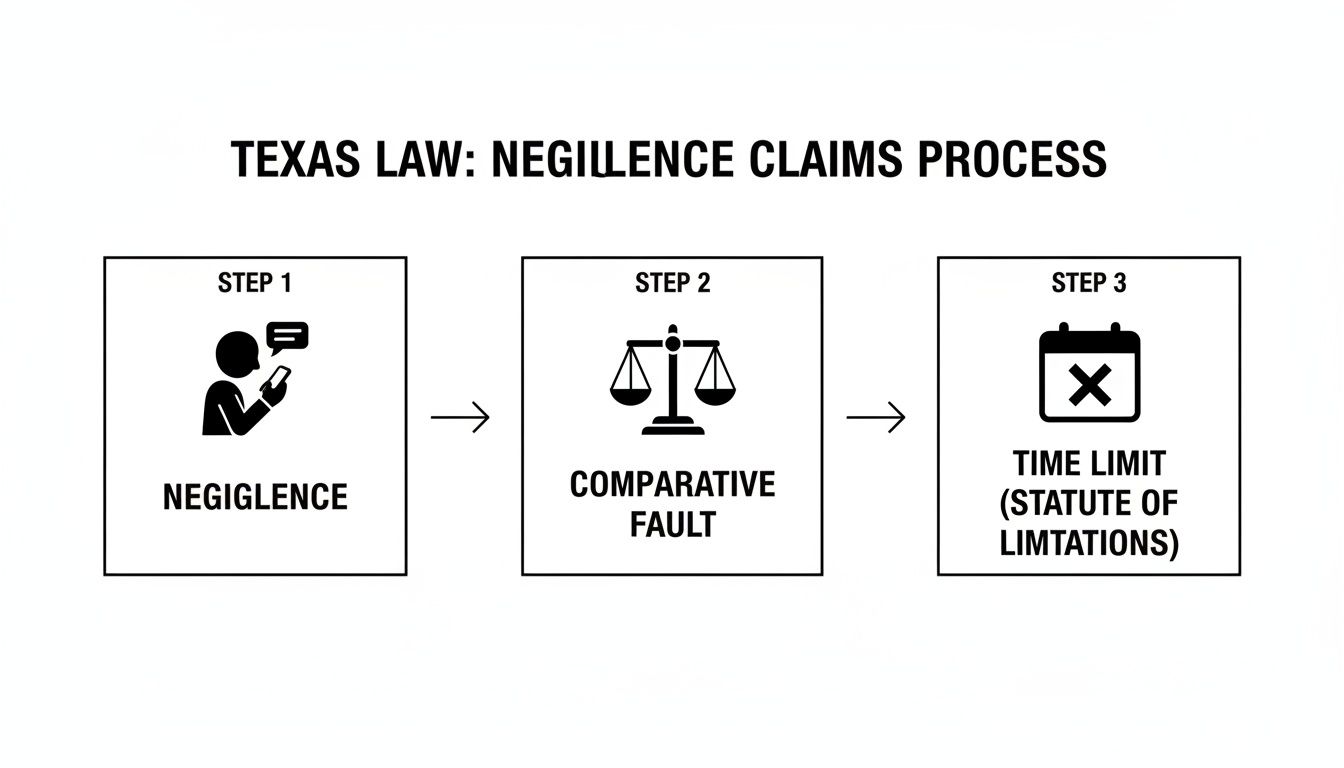
As you can see, proving the other party was negligent is our starting point. From there, we must defend against any attempt to shift blame while watching the clock on Texas’s strict filing deadlines.
Building Your Case: Investigation and Evidence
The moment you hire us, we move fast. This initial phase is all about building a rock-solid foundation for your claim by preserving crucial evidence before it’s lost forever.
This often means we are:
- Reconstructing the Accident: We bring in experts to visit the scene—whether it was a crash on a Houston freeway or an incident at a worksite—to piece together exactly what happened.
- Interviewing Witnesses: We find and speak with everyone who saw the event, getting their side of the story while the details are still sharp in their minds.
- Gathering Documents: Our team tracks down every piece of paper that matters, from police and coroner reports to medical records and employment files that prove lost income.
This detailed investigation helps us identify every single person or company that can be held responsible for your loved one's death.
Making it Official: Filing the Claim and Discovery
With a strong base of evidence in place, we will formally file a wrongful death claim on your family’s behalf. This is the official step that puts all at-fault parties and their insurance carriers on notice that you are seeking justice.
Once filed, the case enters a stage called discovery. This is where both sides are required to exchange all information and evidence under oath, ensuring there are no surprises down the road. It’s a very thorough process that includes:
- Interrogatories: Formal written questions that the other side must answer.
- Requests for Production: Demands for documents and other physical evidence.
- Depositions: Face-to-face interviews, recorded under oath, where we question defendants and key witnesses.
The Final Push: Negotiation and Taking the Fight to Court
Armed with all the facts uncovered during discovery, we put together a comprehensive demand package for the insurance company. This document lays out the full financial and emotional toll on your family and opens the door to settlement talks. Our lawyers are aggressive negotiators who will fight for a fair offer that reflects the true value of your loss.
Many wrongful death claims are settled at this point. But if the insurance company digs in its heels and refuses to do what’s right, we are always prepared to take them to court. While a trial can take more time, our team will not hesitate to stand before a judge and jury to get the justice your family deserves.
The entire process demands strict adherence to legal deadlines, which you can learn more about in our guide to the wrongful death statute of limitations in Texas.
Why You Cannot Trust the Insurance Company's First Offer
It can be jarring how quickly the at-fault party’s insurance company calls after you’ve lost a loved one. The adjuster on the phone will likely sound friendly and compassionate, offering a fast settlement to help with immediate funeral costs and other bills. When you’re overwhelmed with grief, accepting it can feel like a lifeline.
But you have to remember who they work for. The insurance adjuster's job is to protect their company's profits, and they do that by paying out as little as possible on claims. Their first offer is almost never their best—it's a calculated tactic designed to make your case go away for pennies on the dollar.
Common Tactics Insurance Companies Use
Knowing how to handle insurance companies is key. They have a well-worn playbook for reducing or flat-out denying legitimate claims. Just knowing their tactics is the first step in protecting your family’s right to be treated fairly. Be on guard if an adjuster pressures you for a quick decision or uses confusing language to get you to sign something you don't understand.
Some of their most common strategies include:
- The Quick, Lowball Offer: They love to dangle a check before your family has even had a moment to breathe, let alone figure out the full extent of your financial and emotional losses. They know that quick cash is tempting, but accepting it means you sign away your right to ever seek more compensation—even if you later realize your family’s true losses are far greater.
- Requesting a Recorded Statement: An adjuster might ask you to give a recorded statement about the accident. This is a trap. They are trained to ask tricky, leading questions to get you to say anything that could be twisted to pin some of the blame on your loved one. In Texas, this could drastically reduce your average wrongful death settlement under the state's comparative fault rules.
- Disputing Your Losses: The insurer will almost certainly push back on the numbers. They might question your loved one's lost income potential, downplay their contributions to the household, or try to put a low value on your family’s immense grief and suffering.
The most important piece of practical advice is this: you are not obligated to speak with the at-fault party's insurance company. You have the right to direct all their calls and questions to your attorney.
Why You Need an Advocate in Your Corner
Going up against a massive insurance corporation isn’t a fair fight—they have teams of lawyers and adjusters on their side. Success in any high-stakes negotiation requires a deep understanding of strategy. For example, learning how to negotiate with the IRS shows how critical it is to have expert guidance when dealing with powerful entities. An experienced Texas personal injury lawyer becomes your shield, handling every phone call and fighting back against their tactics.
Your attorney will do the hard work of calculating your family’s total damages—both the tangible financial losses and the profound non-economic ones—to make sure any offer is fair. We take over the aggressive negotiations, building a powerful, evidence-backed case that forces the insurance company to take your claim seriously.
Having a skilled lawyer levels the playing field and stops the insurer from taking advantage of you during this incredibly vulnerable time. Remember, once you sign their paperwork, your case is closed for good. Before you agree to anything, learn more about what a release of liability means and the rights you are giving up forever.
Taking the First Step: Your Path to Justice and Healing
Losing a family member due to someone else's negligence is a wound that never fully closes. The legal process might seem like an impossible burden right now, but it's a necessary step toward holding the responsible parties accountable and protecting your family's future. You don't have to face this alone.
As we've covered, there's no such thing as an "average wrongful death settlement." Every life is priceless, and every loss is deeply personal. True justice comes from carefully calculating every single impact—from the tangible loss of income to the immense pain of losing a loved one's companionship and guidance.
What We Have Learned Together
Understanding your rights is the first step toward regaining control. The most important takeaways are clear:
- Your Family's Loss is Unique: The value of any claim is built on the specific details of your economic and non-economic damages, not some generic formula.
- Texas Law is Complex: Critical details like comparative responsibility rules and the two-year statute of limitations can make or break a case. This is why you need an expert to act quickly.
- You Cannot Trust the Insurance Company: Their primary goal is to minimize their payout and protect their profits. An experienced advocate is the only way to level the playing field.
The journey toward justice is also a journey of personal healing. For many families, seeking professional support through services like grief counseling can be an invaluable part of navigating the overwhelming emotions that follow a tragic loss.
Let Us Carry the Burden for You
The thought of a lawsuit can be overwhelming, but you have already been through the worst imaginable. Let us help you find the path forward. At The Law Office of Bryan Fagan, PLLC, our compassionate and skilled wrongful death lawyers in Texas are here to listen to your story. We'll explain your options clearly in a free, no-pressure consultation.
We will manage every detail of the legal fight, so you can focus on what truly matters—your family. Recovery is possible, and legal help is available.
We work on a contingency fee basis. This means you will never owe us a single dime unless we win your case. There are no upfront costs or hidden fees, so there is no financial risk in getting the expert legal help your family deserves.
Your family deserves justice, and you deserve compassion. Recovery is a long road, but powerful legal support is just a phone call away. Contact The Law Office of Bryan Fagan, PLLC today to schedule your free, confidential consultation and take the first step toward finding peace of mind.
Frequently Asked Questions About Wrongful Death Settlements
When you’re grappling with the loss of a loved one, legal questions can feel overwhelming. We've put together answers to some of the most common concerns we hear from families navigating this difficult time in Texas.
Who Can File a Wrongful Death Lawsuit in Texas?
Texas law is very clear about who has the right to file a wrongful death claim. The law reserves this right for the closest surviving family members: the deceased person’s spouse, children (both biological and adopted), and parents.
If these immediate family members do not take legal action within three months of their loved one's passing, the personal representative or executor of the estate can then step in to file the claim on behalf of the estate.
How Long Does It Take to Get a Wrongful Death Settlement?
There’s no single timeline, as every case is unique. A straightforward case where the other party’s fault is clear might settle within a few months to a year.
However, more complicated situations—involving multiple at-fault parties, disputes over liability, or very high damages—can easily take two years or more to resolve. This is especially true if the case has to go to trial. A Houston car accident attorney can give you a much clearer estimate after learning the specific details of your case.
Is a Wrongful Death Settlement Taxable in Texas?
For the most part, the answer is no. The IRS generally does not treat compensation for wrongful death as taxable income. This protection covers damages awarded for things like lost future income, mental and emotional anguish, and the loss of companionship.
The one major exception is punitive damages. If a jury awards these damages specifically to punish the defendant for gross negligence or malicious actions, that part of the award could be taxed.
It's always a good idea to speak with your wrongful death lawyer and a financial professional about the tax implications of your settlement. Our team is here to guide you and make sure you have all the information you need.
At The Law Office of Bryan Fagan, PLLC, we know that no amount of money can ever replace your loved one. But a fair settlement can provide the financial security your family needs to begin healing without added stress. You don’t have to go through this alone. Schedule your free, no-obligation consultation with our compassionate Texas personal injury lawyers today at https://texaspersonalinjury.net.