A serious accident can change your life in seconds — but you don’t have to face it alone. If you've been injured or lost a loved one in an 18 wheeler crash, you are likely feeling overwhelmed, hurt, and unsure of what to do next. The most important thing to know is that you have rights, and help is available. What you do in the aftermath of a crash can significantly impact your health and your family's future.
What To Do After An 18 Wheeler Crash In Texas
A violent collision on a busy Texas highway, whether it's I-45 in Houston or I-35 near Austin, can turn your world upside down. The sheer size and weight of a commercial truck mean the consequences are often catastrophic. In the confusion that follows, it’s tough to think clearly. Following a few simple steps can help you manage the chaos and protect both your physical and legal well-being.

Prioritize Your Health and Safety
Your first and most important priority is your safety and the safety of your passengers. If it is safe to do so, move your vehicle to the shoulder to prevent another collision.
- Call 911 Immediately: Report the crash and request both police and an ambulance. Even if you think your injuries are minor, call for help. The adrenaline from the crash can easily mask serious injuries like concussions or internal bleeding.
- Get Medical Attention: Always allow paramedics to examine you at the scene and seek a full medical evaluation at an emergency room or with your doctor as soon as possible. This not only ensures you get the care you need for hidden injuries but also creates an official medical record linking your injuries directly to the crash. That record is a critical piece of evidence for any personal injury claim.
The danger these massive trucks pose is no secret. The National Safety Council reported that 5,375 large trucks were involved in fatal crashes in 2023. What’s truly sobering is that in those wrecks, 70% of the people who died were in the other vehicles, not the truck. You can review additional data and findings to understand the full scope of the problem.
Document Everything at the Scene
Once you are safe and help is on the way, the next step is to document everything you can. Evidence can disappear quickly, so capturing details at the scene is critical.
After a Houston freeway crash, for example, the trucking company’s rapid-response team and their insurer are already working to control the situation and limit their financial liability. The photos and information you gather in these first few moments can be the foundation for your entire case.
If you are physically able to, here’s what you should do to gather the raw information a Houston car accident attorney needs to prove who was at fault.
- Take Photos and Videos: Use your smartphone to document the entire scene. Take pictures of the damage to all vehicles from multiple angles, the final resting positions of the truck and your car, any skid marks on the road, and your own visible injuries.
- Exchange Information: Get the truck driver's name, contact information, their employer's name, and their insurance details. Also, be sure to note the truck’s license plate number and any USDOT numbers you see on the cab or trailer.
- Find Witnesses: If anyone saw the accident, politely ask for their name and phone number. An independent witness account can be incredibly powerful in establishing how the crash truly occurred.
- Don't Admit Fault: Be very careful what you say. Stick to the facts when speaking with the police. Never apologize or say anything that could be interpreted as admitting you were at fault, either to the truck driver or their company representatives.
Taking these steps is crucial for taking control of the situation. This checklist will help you remember the most important actions to take after a collision.
Immediate Steps After An 18 Wheeler Crash
| Action | Why It's Critical For Your Case |
|---|---|
| Call 911 | Creates an official police report and ensures emergency medical responders arrive to treat injuries. |
| Seek Medical Care | Documents injuries and links them directly to the crash, which is essential for proving damages. |
| Photograph the Scene | Preserves visual evidence of vehicle positions, damage, road conditions, and skid marks before it's gone. |
| Get Driver & Truck Info | Identifies the responsible parties, including the driver, the trucking company (motor carrier), and their insurer. |
| Talk to Witnesses | Gathers unbiased, third-party accounts of the crash that can help establish liability. |
| Avoid Admitting Fault | Protects you from having your own words used against you by the trucking company's insurance adjuster. |
| Contact a Lawyer | An experienced attorney can immediately start preserving key evidence, like the truck's black box data, before it's erased. |
By following this checklist, you are laying the groundwork for your physical and financial recovery. These actions give your legal team the tools needed to stand up to the trucking and insurance companies and fight for the justice you and your family deserve.
Understanding The Common Causes Of Texas Truck Accidents
Many people assume a crash with a semi-truck is a tragic, unavoidable accident. The truth is, the vast majority of 18 wheeler crashes are preventable. They are almost always caused by a specific failure—a negligent decision by the driver, a cost-cutting shortcut by the company, or a critical repair that was ignored.
When you understand the real causes, you realize that what happened to you wasn't just bad luck. It was likely the result of negligence, and Texas law provides a path for you to hold those responsible for your injuries accountable.
Driver Error: The Leading Factor
The operator of an 80,000-pound rig has an immense responsibility to everyone else on the road. When they fail in that duty, the results are often catastrophic. Driver-related issues are by far the most common cause of truck crashes.
- Driver Fatigue: Federal laws strictly limit how long a trucker can drive without taking a break (known as "Hours of Service" rules). However, intense pressure to meet delivery deadlines often pushes drivers and their companies to bend or break these rules. A drowsy driver is just as dangerous as an impaired one, with slowed reaction times and poor judgment.
- Distracted Driving: Texting, adjusting a GPS, or using a dispatch radio takes a driver’s eyes and mind off the road. At highway speeds, a truck can travel the length of a football field in just a few seconds. That’s more than enough time for a moment of distraction to lead to a life-altering crash.
- Speeding and Aggressive Driving: A fully loaded 18-wheeler requires a significant distance to stop safely. When a driver speeds or tailgates on busy Texas highways like I-10 or I-35, they eliminate that crucial safety cushion, making it impossible to react to sudden traffic changes.
These are not simple mistakes; they are examples of negligence—a failure to uphold the duty of care that every commercial driver owes to the public. For instance, if a driver is rushing to make a delivery in Dallas and speeds through a construction zone, causing a crash, they have acted negligently.
Company Negligence and Systemic Failures
Often, the driver is not the only party at fault. The trucking company that hired, trained, and dispatched the driver frequently shares the blame. When a company prioritizes profits over safety, it creates a dangerous environment where accidents are inevitable.
Under Texas law, a company can be held responsible for the negligent actions of its employees. This legal principle means that if a trucking company's policies or lack of oversight contributed to the crash, they can be held liable for your injuries.
Some of the most common examples of company negligence include:
- Inadequate Training: Failing to properly train drivers on how to handle their specific vehicle, drive defensively, or navigate dangerous road conditions.
- Negligent Hiring: Putting drivers on the road who have a history of reckless driving, DUIs, or other serious safety violations.
- Pressuring Drivers: Encouraging or forcing drivers to ignore Hours of Service rules to meet unrealistic delivery schedules.
- Poor Maintenance: Cutting corners on required inspections and repairs. Worn-out brakes, bald tires, and broken lights are common and preventable causes of 18 wheeler crashes.
Imagine a Houston-based trucking company that repeatedly postpones brake replacements to save money. When one of its trucks experiences brake failure and causes a multi-car pileup, the company is just as responsible as the driver. A skilled truck crash lawyer in Houston will investigate maintenance logs and company records to expose this type of corporate negligence.
The devastating scale of this problem is clear from national data. The Federal Motor Carrier Safety Administration (FMCSA) reports that a shocking 23% of all reported commercial truck crashes involve an injury or death. With over 125,000 people injured across the country in these wrecks in 2023 alone, the danger is undeniable. You can read more about the alarming trends in truck accident statistics to see just how widespread this issue has become.
Identifying the true cause of a truck accident is the first step toward seeking justice. It allows you to pinpoint who is truly responsible—whether it’s the driver, the careless company, or both—and build a strong case for the full compensation you need to heal.
Who Is Legally Responsible For Your Injuries
After a catastrophic crash with an 18-wheeler, one of the most complex questions is: who is at fault? In commercial truck accidents, the answer is rarely simple. The responsibility often extends beyond the driver to a web of other parties, including powerful companies that own the truck, loaded the cargo, or handled its maintenance.
Pinpointing every party who is legally responsible is a critical step in securing the full compensation you need to rebuild your life. A Texas personal injury lawyer with experience in these cases can investigate every link in the chain of responsibility.
More Than Just The Driver
While a truck driver’s error—like speeding, texting, or driving while fatigued—is often the direct cause of a wreck, their employer frequently shares the blame. Trucking companies, also known as motor carriers, have a legal duty to ensure their operations are safe. When their poor decisions or lack of oversight leads to a crash, they can be held legally accountable.
This diagram illustrates how the root causes of a truck crash often begin at the company level.
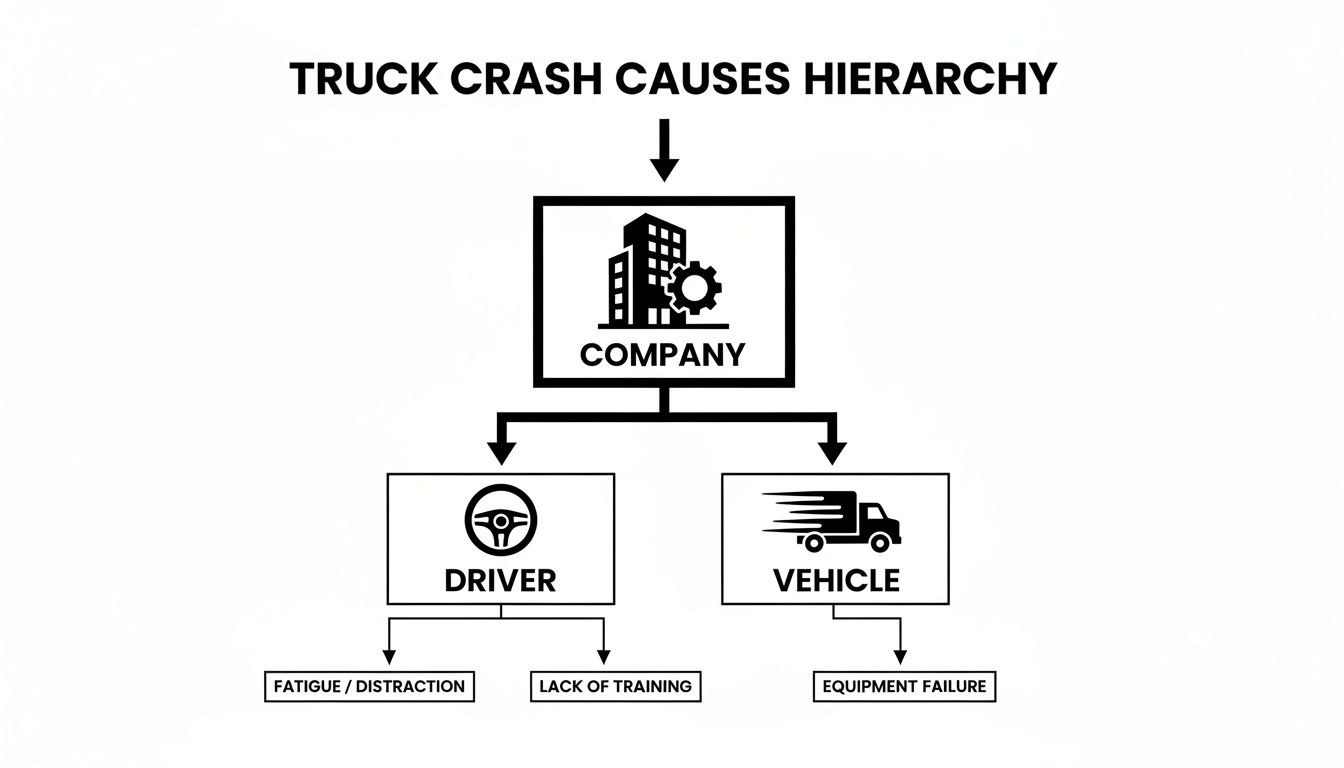
A company’s policies and priorities directly impact driver behavior and vehicle condition, which are often the final factors that lead to a tragic accident.
Several different parties could be held legally responsible, including:
- The Trucking Company: Liable for negligent hiring (e.g., hiring a driver with a poor safety record), inadequate training, or pressuring drivers to violate federal Hours of Service rules.
- The Cargo Loader: If a truck's trailer is overloaded or the cargo is not secured properly, it can shift during transit and cause the driver to lose control. The company that loaded the freight may be at fault.
- A Maintenance Shop: If a third-party mechanic performs shoddy work on critical systems like brakes or steering, they can be held liable when that negligence leads to a mechanical failure.
- The Truck or Parts Manufacturer: If a defective part—such as a tire that blows out or a faulty brake system—is the cause of the crash, the manufacturer can be held responsible.
Determining who is legally responsible requires a deep dive into the commercial trucking industry, including their specific owner-operator semi-truck insurance policies. An experienced attorney knows how to investigate each of these possibilities to ensure all responsible parties are held accountable.
Understanding Comparative Responsibility In Texas
It is a common tactic for the trucking company and its insurer to try to shift blame onto you, the victim. They will search for any reason—claiming you were speeding, changed lanes improperly, or had a broken taillight—to use a Texas law called "comparative responsibility" to reduce or deny your compensation.
In Texas, this rule, also known as proportionate responsibility, means your financial recovery can be reduced or eliminated if you are found to be partially at fault for the accident. However, what an insurance adjuster claims is not the final word.
Here’s how it works in practice:
- If you are found to be 50% or less at fault, you can still recover damages. However, your total financial award will be reduced by your percentage of fault. For example, if you have $100,000 in damages but are found 20% responsible, you can only collect $80,000.
- If you are found to be 51% or more at fault, you are barred from recovering any compensation under Texas law.
The trucking company’s insurance adjuster will use this rule as a weapon to devalue your claim. This is precisely why you need a strong advocate fighting for you. A knowledgeable truck crash lawyer in Houston will fight back against these unfair tactics, use evidence to establish the true fault of the other parties, and protect your right to full and fair compensation. In cases with multiple at-fault parties, it's also helpful to read about joint and several liability, as that can also affect your case.
Calculating The Full Value Of Your Truck Accident Claim
A serious truck accident can turn your world upside down in an instant—but you don’t have to pick up the pieces alone. After an 18-wheeler crash, one of the first calls you will likely get is from the trucking company’s insurance adjuster. They may sound friendly and concerned, perhaps even offering a quick check to cover your initial medical bills.
Be wary of these offers. They are almost always a lowball tactic intended to settle your case for as little money as possible. These initial offers rarely consider the full, long-term costs of your injuries. Once you accept that check, you lose your right to seek any more compensation, even if your injuries turn out to be far more severe than you first realized. Under Texas law, you are entitled to much more than just your first ER bill.
What Your Claim Is Actually Worth
Determining the true value of your claim is not a simple calculation. It requires a thorough assessment of the total impact the crash has had—and will continue to have—on every aspect of your life. A skilled Texas personal injury lawyer will meticulously calculate all of your losses, which Texas law divides into two main categories: economic and non-economic damages.
- Economic Damages: These are the tangible, verifiable financial losses you have incurred due to the crash, such as medical bills and lost income.
- Non-Economic Damages: These are the intangible but very real human costs of the accident, intended to compensate you for the physical pain and emotional suffering you have endured.
A fair settlement must include both types of damages. Anything less fails to cover the full scope of what was taken from you.
Breaking Down Economic Damages
Economic damages form the financial foundation of your personal injury claim. They include every dollar you have lost or will be forced to spend because of the other party's negligence.
This includes:
- All Medical Bills (Current and Future): This covers everything from the ambulance ride and emergency room visit to surgeries, hospital stays, physical therapy, prescription drugs, and any ongoing medical care you’ll need for the rest of your life.
- Lost Wages: This is the income you lost because you were unable to work while recovering from your injuries.
- Diminished Earning Capacity: This is one of the most critical and often overlooked types of damages. If your injuries prevent you from returning to your previous job—or from working at all—you are entitled to compensation for the income you would have earned over the course of your career.
For example, after a Houston freeway crash, a construction worker suffers a severe back injury. He can no longer perform physical labor and must take a lower-paying desk job. The difference in his lifetime earnings could amount to hundreds of thousands of dollars, and that loss is a vital part of his claim.
Valuing Your Pain and Suffering
Non-economic damages are designed to compensate you for the immense personal toll of the crash. While they don't come with a clear price tag, they are just as important as your medical bills.
The physical pain, the sleepless nights, the emotional distress, and the anxiety you feel are all real losses. Texas law recognizes that this suffering has value and that you deserve to be compensated for it.
These damages can include compensation for:
- Physical Pain and Suffering
- Mental Anguish
- Physical Impairment or Disfigurement
- Loss of Enjoyment of Life
The immense danger these trucks pose is reflected in the statistics. In 2023 alone, large trucks were involved in incidents that resulted in 153,452 injuries. While fatalities from these crashes sometimes dip, the long-term trend is alarming, with a staggering 43% increase over the last decade. Tragically, the victims are overwhelmingly those outside the truck; 70% of deaths are occupants of other vehicles. You can discover more insights about these large truck crash facts to understand the national scope of this risk.
For families whose loved one was killed in an 18-wheeler crash, Texas law allows them to file a wrongful death claim. This enables surviving family members to seek compensation for their own devastating losses, such as lost financial support, lost inheritance, and the loss of love and companionship. A compassionate wrongful death lawyer Texas can guide you through this difficult legal process with the dignity and respect your family deserves. To gain a clearer understanding of potential outcomes, you might be interested in our guide on the average settlement for a truck accident.
How To Protect Your Right To Compensation
In the difficult days following an 18-wheeler crash, your primary focus should be on your recovery. However, while you are healing, the trucking company and its insurer are already building a case to minimize their liability. Their goal is to pay as little as possible. It is essential to act quickly to protect your right to the compensation you deserve.
The clock starts ticking the moment the crash occurs. From that point forward, you are in a race against time to preserve critical evidence before the companies responsible for your injuries can legally destroy it.

The Race to Preserve Critical Evidence
Unlike a standard car accident, a commercial truck crash involves a vast amount of evidence—most of which is owned and controlled by the trucking company. This evidence is key to proving negligence, but federal regulations often allow companies to destroy it after a short period.
An experienced truck crash lawyer knows this and will immediately send a legal notice, called a spoliation letter, demanding that the company preserve all evidence related to the crash.
This is the only way to safeguard crucial proof like:
- The Truck's "Black Box": The Electronic Control Module (ECM) records vital data, such as the truck’s speed, braking, and RPMs in the seconds leading up to the impact.
- Driver's Logbooks: Whether electronic (ELDs) or paper, these logs document the driver's hours on the road and can reveal violations of federal Hours of Service rules.
- Maintenance and Inspection Records: These documents can uncover a pattern of neglected maintenance, faulty repairs, or known safety issues that the company ignored.
- Dispatch Records and Communications: These records can show if the company was pressuring the driver to speed, skip mandatory rest breaks, or drive beyond their legal limit.
Without this evidence, proving fault becomes incredibly difficult. Acting quickly is essential to building a strong case. You can learn more about what to expect when you file a truck accident claim.
Building a successful claim requires gathering the right evidence from the start. The table below outlines some of the most critical pieces of evidence, why they matter, and who is typically responsible for securing them.
Evidence To Preserve In A Truck Accident Case
| Type Of Evidence | Why It's Crucial | Who Secures It |
|---|---|---|
| Police Accident Report | Provides an official, objective summary of the crash scene, witness information, and initial fault assessment. | You or Your Attorney |
| Black Box/ECM Data | Offers unbiased electronic data on speed, braking, and engine activity in the seconds before the crash. | Your Attorney (via a preservation letter) |
| Driver's Logs (ELD/Paper) | Proves whether the driver violated Hours of Service rules, indicating driver fatigue was a likely factor. | Your Attorney (via a preservation letter) |
| Maintenance Records | Can expose a history of neglected repairs, faulty brakes, or other mechanical failures that caused the crash. | Your Attorney (via a preservation letter) |
| Photos/Videos of the Scene | Captures vehicle positions, property damage, road conditions, and skid marks before the scene is cleared. | You (if able) or Law Enforcement/Your Attorney |
| Medical Records & Bills | Documents the full extent of your injuries, treatment plan, and the total financial cost of your medical care. | You and Your Attorney |
| Witness Statements | Provides third-party accounts of what happened, which can corroborate your version of events and counter the truck driver’s story. | Law Enforcement and Your Attorney’s Investigator |
This checklist is a starting point. A thorough investigation led by your attorney will uncover additional evidence needed to hold all negligent parties accountable.
Your Immediate Action Plan
While your attorney works to secure evidence from the trucking company, there are several steps you must take to protect your own claim. Remember, the insurance adjuster is not your advocate. Their job is to find any reason to deny or devalue your case.
Crucial Warning: Never give a recorded statement to the other party's insurance company without speaking to a lawyer first. Adjusters are trained to ask leading questions designed to get you to say something that could undermine your claim, even if you are just trying to be helpful.
Here are the most important things you can do to protect your rights:
- Do Keep Detailed Records: Start a file for everything related to the accident. Keep all medical bills, pharmacy receipts, and records of out-of-pocket expenses. It is also helpful to keep a simple journal detailing your pain levels, doctor's appointments, and how your injuries are affecting your daily life.
- Don't Post on Social Media: Insurance companies will investigate your social media accounts. They are looking for anything they can use to argue that your injuries are not as severe as you claim. The safest approach is to refrain from posting on social media until your case is resolved.
- Do Follow Your Doctor's Orders: Attend all of your medical appointments and follow through with all recommended treatments, including physical therapy and prescriptions. Any gaps in your treatment can be used by the insurer to argue that your injuries were not serious or that you made them worse yourself.
How Long Do You Have to File a Claim in Texas?
Finally, you must be aware of Texas's statute of limitations. For most personal injury claims, including those from 18-wheeler crashes, you have only two years from the date of the accident to file a lawsuit.
Two years may seem like a long time, but it passes quickly. Building a strong truck accident case requires months of investigation and preparation. If you wait until the deadline is near, critical evidence may be gone, witnesses may be impossible to find, and you could lose your right to seek justice forever.
Why You Need A Proven Texas Truck Accident Lawyer
Trying to take on a multi-billion dollar trucking company and its insurance carrier by yourself is more than just an uphill battle—it’s what they are counting on. Their goal is simple: protect their bottom line by paying you as little as possible, or nothing at all.To have a fighting chance, you need a Texas personal injury lawyer who knows their exact playbook and isn't afraid to hit back. Hiring an experienced attorney immediately shifts the balance of power. We take that entire burden off your shoulders so you can focus on what truly matters: healing and putting your family first.
Our Immediate and Aggressive Process
The moment you hire The Law Office of Bryan Fagan, PLLC, we launch a rapid-response investigation. We know from experience that crucial evidence in an 18 wheeler crash can vanish in hours, so we move fast to preserve everything needed to build a powerful case.
Our process kicks off right away:
- Dispatching Investigators: We immediately send accident reconstruction experts to the crash scene. They get to work gathering physical evidence, taking precise measurements, and documenting the road and weather conditions before they can be cleaned up or changed.
- Issuing Legal Notices: We serve legally binding spoliation letters on the trucking company. This is a formal demand that they preserve every piece of critical evidence, from the truck’s black box data and driver logs to maintenance files and inspection reports.
- Handling All Communications: We take over completely. Every single phone call, email, and letter from the insurance companies comes to us. You will never have to speak to an adjuster again.
Knowing how to negotiate with insurance adjusters is a critical skill, but it's a fight you shouldn't have to wage alone. We handle it for you, using our deep experience to counter their lowball tactics.
Maximizing Your Compensation Through Trial-Readiness
Insurance companies are businesses that operate on risk assessment. They know which law firms settle cases quickly for a low amount and which firms are prepared to go to trial to achieve a just result.
Because insurers know we prepare every single case for the courtroom and won't hesitate to stand before a Texas jury, they are far more likely to offer a significant settlement. They would rather pay a fair amount now than risk a much larger verdict later.
Our reputation as aggressive trial lawyers is a powerful tool in securing the compensation you deserve. A dedicated truck crash lawyer in Houston from our firm will fight to secure the maximum compensation for all of your losses and protect your family’s future.
Finally, we believe everyone deserves access to top-tier legal representation, regardless of their financial situation. That’s why we work on a contingency fee basis. This is our promise to you: you pay absolutely nothing unless we win your case. No upfront costs, no retainers, and no hidden fees. Ever.
Frequently Asked Questions About 18 Wheeler Crashes
After a traumatic crash, your mind is probably racing with urgent questions. We’ve been there with countless families, and we know the confusion and fear you're facing. Below, we provide clear, straightforward answers to the concerns we hear most often from victims of 18-wheeler crashes.
How Long Do I Have to File a Lawsuit in Texas?
Texas law gives you a two-year window from the date of the crash to file a personal injury lawsuit. This deadline is known as the statute of limitations.
While two years might sound like a long time, crucial evidence can disappear almost overnight. The truck’s black box data and the driver's logs can be legally destroyed in just a matter of weeks. That’s why it’s so important to contact an attorney right away—it's the only way to preserve the proof you need to build a strong case.
Should I Accept the Trucking Company’s Settlement Offer?
No. You should never accept an initial settlement offer from an insurance company without first consulting with an experienced lawyer. These first offers are almost always a lowball tactic designed to resolve your claim as quickly and cheaply as possible for the trucking company.
These offers rarely account for the full, long-term costs of your injuries, including future medical treatments, lost earning capacity, and the very real pain and suffering you're enduring.
A fast settlement offer is a major red flag. It’s a sign the insurance company knows its client is at fault and wants to close the claim before you realize what your case is truly worth.
Do I Need to See a Doctor if I Feel Okay?
Yes, absolutely. After a violent collision, your body is flooded with adrenaline, which can easily mask serious injuries like internal bleeding, concussions, or spinal damage. Seeing a doctor immediately does two critical things: it protects your health and it creates an official medical record tying your injuries directly to the crash.
Without this medical documentation, it becomes much harder to prove your injuries were a result of the accident.
Can I Afford a Top Truck Accident Lawyer?
Yes, you can. Our firm works on a contingency fee basis, which is our “no-win, no-fee” promise to you.
This means you pay absolutely zero upfront costs. We cover all the expenses of investigating your case, hiring experts, and taking it to court. We only get paid if we win your case and recover compensation for you.
A serious accident can change your life in an instant—but you don’t have to face the aftermath alone. Recovery is possible, and the experienced team at The Law Office of Bryan Fagan, PLLC is here to help you get the justice and financial support you deserve.
Contact us today for a free, no-obligation consultation to discuss your rights. Schedule your free consultation online or call us now.