
A serious accident can change your life in seconds, but you do not have to face it alone.
One moment you are driving home on I-45 in Houston, heading through Dallas traffic, or taking your kids to school in San Antonio. The next, you are shaken, sore, and trying to figure out why the pain in your neck or lower back keeps getting worse instead of better.
For many people, the first few days are confusing. You may hear “it’s probably just soreness” from an insurance adjuster, only to learn later that the crash caused a herniated disc. By then, sleep hurts, sitting hurts, and work may be slipping out of reach.
A Serious Accident Can Change Your Life in Seconds
After a Texas crash, many injured people do everything they think they are supposed to do. They report the wreck. They see a doctor. They try to push through. Then the MRI comes back, and suddenly this is no longer a simple fender bender claim.

A herniated disc can turn ordinary tasks into a daily struggle. Getting out of bed becomes slow and careful. Driving across town feels risky. Picking up your child, carrying groceries, or standing through a work shift may no longer be possible without pain.
That is when the legal questions start hitting all at once. How serious is this injury? What is a fair settlement herniated disc case in Texas? Should you talk to the insurance company alone? What if the adjuster says your back was already bad before the crash?
The stress is real, and so is the injury
A Houston freeway crash can leave someone with neck pain that shoots into the arm. A rural road collision near Waco can trigger lower back symptoms that travel down the leg. A truck wreck in Dallas-Fort Worth can aggravate an old spinal problem and make it much worse.
Those experiences are common in serious injury cases. They are also exactly why these claims need to be handled carefully.
Insurance companies often treat disc injuries as negotiable from day one. They look for treatment gaps, prior complaints, delayed imaging, and anything else they can use to argue that the crash did not really cause your condition. That does not mean they are right.
Practical takeaway: If your pain is getting worse, radiating into an arm or leg, or affecting your ability to work, do not assume it will resolve on its own. Get evaluated and keep records.
A legal claim is part of recovery
A personal injury claim is not just about “suing someone.” It is about securing money for care, replacing lost income, and accounting for what this injury has taken from your daily life.
That matters whether you need help from a Texas personal injury lawyer, a Houston car accident attorney, a truck crash lawyer Houston, or even a wrongful death lawyer Texas if a spinal injury crash caused a fatal loss in your family.
You deserve clear answers. You deserve realistic expectations. You deserve a process built around what drives value in Texas, not misleading online calculators.
What Is a Herniated Disc and Why Is It So Serious
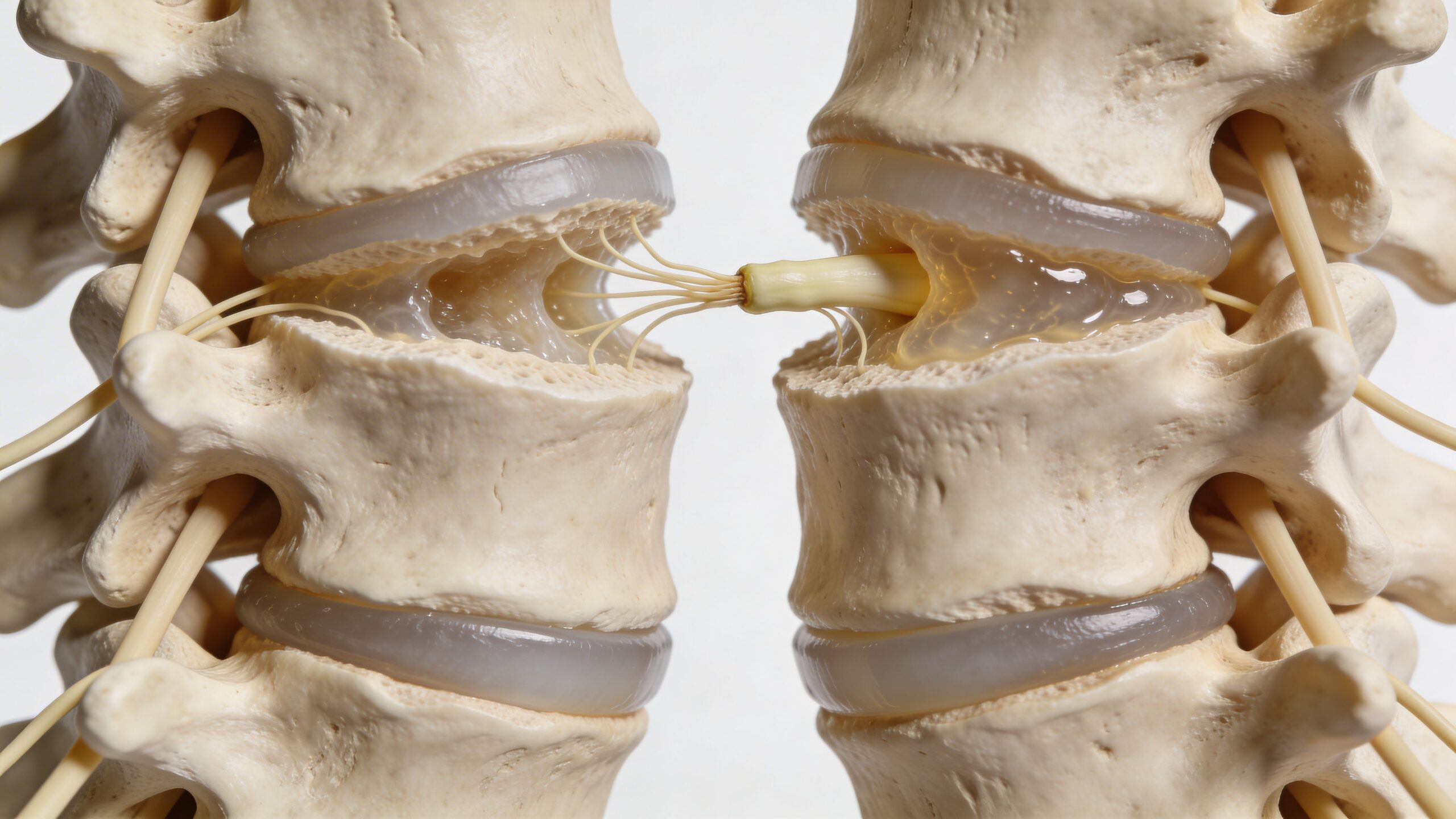
A herniated disc is often easier to understand with a clear image. Think of a spinal disc like a jelly donut between the bones in your spine. The outer layer holds things together. If a crash puts enough force through the spine, the inside can push outward or break through, pressing on nearby nerves.
That pressure is why a herniated disc is much more than a sore back.
Why car and truck crashes cause this injury
Rear-end wrecks, side-impact crashes, and truck collisions can force the body to move violently in ways the spine was not built to handle. The neck may snap forward and back. The lower back may compress and twist. Even a crash that leaves modest vehicle damage can leave a person with major spinal symptoms.
Once a disc presses on a nerve, the pain may radiate well beyond the spine itself. Some people feel burning into the shoulder or hand. Others get sciatica-like pain into the hip, leg, or foot. Numbness, weakness, and tingling can follow.
This is why “average settlement” websites confuse people
A lot of online content throws around national numbers as if they answer your case. They do not. One source notes that national verdict figures are often skewed by outliers and are not a reliable calculator, while Texas-focused ranges are often more practical: $15,000 to $30,000 for minor cases treated with physical therapy, $50,000 to $150,000 for moderate cases involving injections and lost work, and $250,000 or more for severe cases involving surgery or permanent damage (Texas-focused settlement discussion).
That same point matters in everyday life. A person in Houston with strong MRI findings, steady treatment, and clear liability may have a very different case from someone with limited coverage and inconsistent care.
If you want a fuller look at what a back claim may involve after a wreck, this overview of a back injury from auto accident can help frame the bigger picture.
Treatment choices affect both health and case value
There is no single best path for every patient. Some people improve with medication, rest, and physical therapy. Others need pain management, injections, or a surgical consult. If you are trying to understand care options, this guide on the best treatment for a herniated disc is a useful non-legal resource.
The key point is clear. The more serious and persistent the injury, the more important your documentation becomes.
A short visual explanation can also make the anatomy easier to follow:
Key takeaway: A herniated disc claim rises or falls on proof. The MRI matters. The symptoms matter. The treatment timeline matters.
Understanding Your Herniated Disc Settlement Value in Texas
Individuals asking about a settlement herniated disc claim often want one thing first. A realistic number.
The hard truth is that no honest lawyer can promise a payout on day one. Too many variables affect value, especially in Texas, where fault, policy limits, medical proof, and the type of treatment all shape the result.
Why Texas numbers matter more than national hype
National figures can be useful for context, but they often create false expectations. A large verdict from another state may involve unusually severe injuries, higher policy limits, or facts that do not match your case.
Texas claims are often shaped by practical constraints. The at-fault driver’s insurance may be too low. Liability may be disputed. Your own uninsured or underinsured coverage may become important. These issues can matter as much as the diagnosis itself.
A practical way to think about value
Texas-focused sources point to broad working ranges based on treatment level and severity. Minor cases treated with physical therapy often fall on the lower end. Cases involving injections, missed work, and prolonged symptoms tend to move higher. Surgery and permanent impairment usually push value much further.
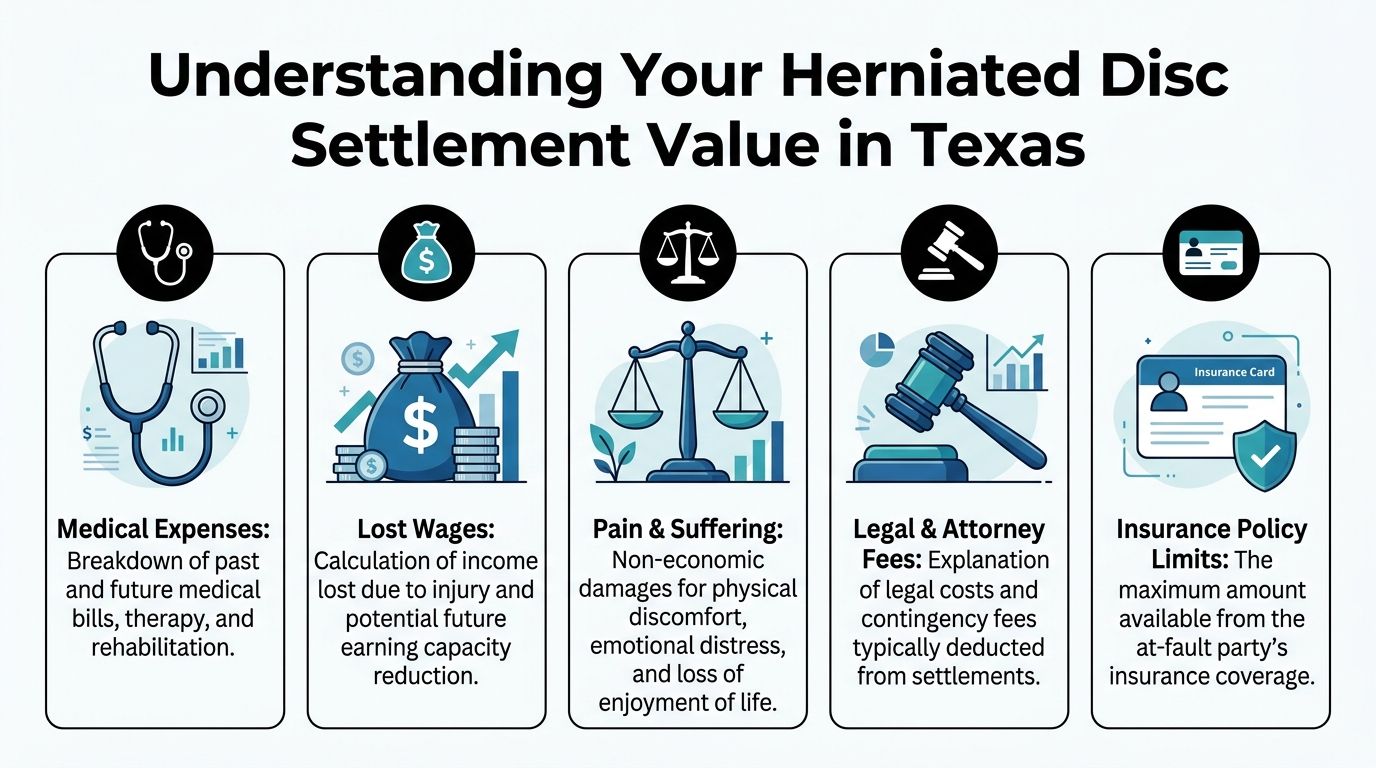
A fair valuation usually looks at several categories at once:
- Medical expenses: Past bills, ongoing treatment, rehabilitation, medication, and likely future care.
- Lost wages: Income already lost and any reduced earning ability going forward.
- Pain and suffering: Physical pain, sleep disruption, emotional strain, and loss of normal life.
- Insurance limits: The amount of available coverage can cap recovery even in a strong case.
- Case proof: MRI findings, physician opinions, and consistent treatment often separate strong cases from discounted ones.
If you want a general primer on how attorneys evaluate accident claims, this page on how to calculate car accident settlement is a helpful companion.
What people get wrong about valuation
The biggest mistake is assuming the diagnosis alone determines value. It does not.
Two people can both have a herniated disc and end up with very different outcomes. One may recover after conservative care and return to work. Another may need injections, face permanent lifting restrictions, and struggle to sit through a normal workday. Those are not the same cases.
Another mistake is focusing only on current medical bills. In spinal injury claims, future harm often matters just as much. If a doctor expects long-term pain management, future treatment, or ongoing work limits, that can significantly change settlement value.
Trade-offs in a Texas case
A strong case is not just “bad injury equals big money.” It is more like a balancing test.
Here are common trade-offs that affect value:
- Clear liability but low insurance limits: You may have a strong case, but available coverage may restrict recovery unless UM/UIM coverage applies.
- Severe symptoms but weak documentation: If treatment gaps exist or the MRI was delayed, the insurer may fight causation hard.
- Good MRI but mild daily impact: Objective imaging helps, but your damages still need to match the level of disruption.
- Pre-existing back issues but strong aggravation proof: These cases can still be valuable when the records clearly show the crash made things worse.
Practical takeaway: The right question is not “What is the average settlement?” The better question is “What evidence shows how this crash changed my life, and how much insurance is available to pay for it?”
A realistic Texas mindset
For injured people in Houston, Dallas, Austin, and San Antonio, realistic expectations are powerful. They help you avoid lowball offers, and they help you avoid getting misled by inflated online numbers that have little to do with your facts.
The best settlement analyses in these cases stay grounded in four things. Diagnosis. Treatment. Functional loss. Insurance coverage.
That approach is less flashy than an online calculator. It is also far more useful.
Key Factors That Drive Your Settlement Amount
Settlement value comes from specifics, not labels. “Herniated disc” is the starting point. The actual number depends on what the injury did to your body, your work, and your future.
One national verdict analysis reports an average jury verdict of about $360,000 for herniated disc injuries from car accidents, with median settlements ranging from $80,000 to $150,000. That same analysis shows how treatment level changes value: $20,000 to $75,000 for conservative care like physical therapy, $75,000 to $250,000 for epidural injections, $200,000 to $600,000 for single-level surgery, and over $1,000,000 for multi-level fusions (herniated disc settlements and verdicts).
Those figures are context, not guarantees. Still, they show the pattern clearly. More invasive treatment and more permanent harm usually mean higher case value.
Medical treatment often tells the story
Adjusters look closely at how your care progressed.
If your case involved physical therapy only, the insurer will usually argue the injury was real but limited. If your doctors escalated care to injections or surgery, that often signals a more serious injury with a greater long-term effect.
This is one reason treatment gaps can hurt. They give the defense room to argue that you improved, stopped hurting, or were not badly injured in the first place.
Permanency changes everything
Temporary pain and permanent limitations are not valued the same way.
If you continue to have numbness, weakness, reduced range of motion, or restrictions on lifting and sitting, your claim usually becomes more significant. Future medical care matters too. A case involving likely future treatment will often be worth more than one that resolved cleanly.
Lost wages are not just about missed days
Some clients lose a few weeks of work. Others can go back, but only with restrictions. Some cannot return to the same physical job at all.
That difference matters. A warehouse worker in Houston who can no longer lift safely may face a very different financial future than an office employee who can return with fewer adjustments. Both can have valid claims, but the wage-loss analysis will not be identical.
Pain and suffering are real damages
Spinal injuries affect more than a paycheck.
Pain can interrupt sleep, strain relationships, cancel travel, and take away routines that gave your life rhythm. If you cannot coach your kid’s team, sit through church, drive comfortably, or work through the day without severe discomfort, those losses belong in the claim.
Shared fault can reduce the outcome
Texas fault rules matter. If the insurance company can pin part of the blame on you, settlement value may drop.
This comes up after freeway crashes, lane-change disputes, and chain-reaction collisions. Even in a strong injury case, liability fights can reduce your negotiating position.
Here is a simple comparison of what tends to raise or lower value.
| Factor | What Increases Settlement Value | What Decreases Settlement Value |
|---|---|---|
| Medical treatment | Escalating care, injections, surgery, specialist follow-up | Minimal treatment, early discharge, long treatment gaps |
| Injury permanency | Ongoing symptoms, restrictions, future care needs | Full recovery with no lasting impairment |
| Lost income | Documented wage loss, reduced earning ability | No missed work or weak proof of income loss |
| Pain and suffering | Daily limitations, sleep disruption, reduced quality of life | Mild symptoms with little effect on routine activities |
| Liability | Clear fault on the other driver | Strong shared-fault arguments against you |
What works and what does not
Some patterns show up again and again in these claims.
What helps
- Consistent treatment: It creates a clean timeline from crash to diagnosis to recovery effort.
- Objective imaging: MRI findings give your claim medical weight.
- Detailed physician opinions: Doctors who explain causation and restrictions strengthen the case.
- Clear life impact: A pain journal, work records, and family observations make damages easier to see.
What hurts
- Accepting the first offer too fast: Early offers often come before the full value is known.
- Downplaying symptoms: Many people try to be tough. That can backfire in a legal claim.
- Stopping care without medical guidance: Insurers often use that as a defense theme.
- Relying on online calculators: They ignore facts that drive a Texas claim.
Practical takeaway: The strongest herniated disc claims are built, not guessed. Settlement value usually rises when the records show a clear diagnosis, escalating treatment, lasting impact, and little room for the insurer to dispute fault.
Texas Laws That Impact Your Herniated Disc Claim
Texas law shapes every injury case, including a settlement herniated disc claim. You can have a serious diagnosis and still weaken your case if you miss a deadline, mishandle fault issues, or fail to prove the crash worsened a pre-existing condition.
How long do you have to file a claim in Texas
Texas generally gives injured people two years to file a personal injury lawsuit. If you wait too long, the court can bar your case, even if your injury is legitimate.
That matters because herniated disc claims do not always become clear right away. Some people start with pain that seems manageable, then learn later that nerve symptoms and imaging show something much more serious.
Waiting too long creates another problem. Evidence gets harder to preserve. Witnesses disappear. Crash documentation becomes harder to obtain.
Comparative responsibility can reduce or block recovery
Texas follows a modified comparative fault rule. If you share responsibility, your recovery may be reduced. If your share of fault is too high, you may recover nothing.
A Houston freeway example shows how this plays out. Say another driver rear-ends you, but the defense argues you stopped suddenly or changed lanes unsafely. Even if your herniated disc is real, the insurer may still try to cut value by shifting blame.
If you want a plain-English explanation of that rule, this page on comparative fault definition is worth reading.
The eggshell skull doctrine protects people with prior conditions
Many injured Texans worry about one issue more than any other. “What if I already had back problems?”
Texas law does not let a negligent driver off the hook just because you were more vulnerable. One Texas-focused source explains that Texas courts apply the eggshell skull doctrine, meaning a defendant can be liable when a crash aggravates a pre-existing condition, particularly where medical proof ties the collision to the disc injury and resulting symptoms (Texas herniated disc settlement discussion).
That principle is important in everyday practice. Many adults already have some degree of wear, prior strain, or age-related changes in the spine. The question is often not whether your back was perfect before the wreck. The question is whether the crash made things worse.
Negligence still has to be proved
Texas is a fault-based state. That means you still need evidence that another driver, company, or party acted negligently.
That proof may come from:
- Police reports
- Vehicle damage photos
- Witness statements
- Traffic camera or dashcam footage
- Crash reconstruction in disputed cases
If the wreck involved a commercial vehicle, a truck crash lawyer Houston may also need to examine company records, driver logs, and maintenance issues. If the crash caused a fatal spine injury or complications, a wrongful death lawyer Texas may be needed for the family’s claim.
Key takeaway: Texas law can help you, especially when a crash worsens an old condition. But deadlines, fault disputes, and proof of negligence still matter from the start.
Building Your Case With the Right Evidence and Documentation
Insurance companies do not pay top value because you say you are in pain. They pay when the record makes it hard to argue otherwise.
That is especially true in a settlement herniated disc case. Disc injuries often trigger the same defense themes: pre-existing degeneration, delayed symptoms, too much treatment, not enough treatment, or “this would have happened anyway.”
The documents that matter most
Start with the records that tie the crash to the diagnosis.
- MRI or CT imaging: These are often the backbone of the claim because they show the disc injury objectively.
- Emergency room and doctor notes: Early complaints help establish the timeline.
- Specialist records: Orthopedic, pain management, or neurosurgical records often clarify severity and future care.
- Work records: Pay stubs, employer letters, and time-off documentation support wage loss.
- Billing records: Every out-of-pocket expense, co-pay, prescription cost, and therapy charge matters.
One source focused on proving causation explains that MRI and CT evidence is central in showing a trauma-related herniation and distinguishing it from degenerative issues. That same source notes that insurers may lowball cases when this evidence is missing or weak, while stronger documentation can support significantly higher outcomes in injection and surgery cases (herniated disc settlement calculator discussion).
Your own documentation can strengthen the file
Medical charts do not always capture daily life.
A simple pain journal can help show what the injury does to you. Short entries are enough. Note pain level, sleep problems, missed events, trouble driving, difficulty lifting, or numbness in the arm or leg.
Photos can help too. So can messages to your employer about missed work, calendars showing canceled activities, and notes from family members who see the difference in your routine.
If you need a practical system for keeping everything in one place, this guide on how to organize medical records at home is a helpful starting point.
What to gather right now
Here is a clean checklist for building your file:
Crash evidence
- Police report
- Photos of vehicles and scene
- Witness names and contact information
Medical proof
- Imaging reports
- Doctor narratives
- Therapy notes
- Medication list
Financial losses
- Pay records
- Tax documents if self-employed
- Receipts for travel, medications, and care costs
Daily impact evidence
- Pain journal
- Activity limitations
- Notes on sleep, mood, and family life
Practical tip: Do not rely on memory six months later. Save records as you go. The strongest files are built in real time.
What works better than arguing with the adjuster
People often think they need to “explain” their injury better to the insurance company. Usually, records do more than arguments.
A concise, organized file can be far more powerful than repeated calls with an adjuster. Objective imaging, treatment consistency, clear wage loss proof, and a credible symptom timeline give your attorney something solid to present and defend.
That is how strong claims get built. One document at a time.
How to Secure the Compensation You and Your Family Deserve
A herniated disc claim is rarely just about one doctor visit or one insurance check. It is about what the crash has done to your body, your income, your family life, and your future.
The best results usually come from patience, strong evidence, and a clear strategy. That means finishing the right treatment, documenting symptoms carefully, and refusing to let the insurance company define your case before the medical picture is clear.
When an offer is worth considering
A settlement deserves serious consideration when it accounts for all of your losses, not just the bills already on paper.
That includes:
- Past medical costs
- Reasonably expected future care
- Lost wages
- Reduced earning ability if your work has changed
- Pain and suffering
- The full effect on your daily life
If the at-fault driver has low limits, your own uninsured or underinsured coverage may matter more than you think. One Texas-focused source highlights the importance of documenting pre- and post-crash symptoms, avoiding treatment gaps, and pursuing UM/UIM coverage when available in cases with low insurance limits or pre-existing conditions (Texas herniated disc claims and UIM issues).
What usually leads to a better outcome
Claims tend to improve when injured people do a few things well.
- They get medical care early and follow through
- They keep records instead of guessing later
- They do not jump at the first offer
- They talk to a Texas personal injury lawyer before signing away their rights
This is true after a Houston car wreck, a serious SUV crash, or a commercial vehicle collision that calls for a Houston car accident attorney or truck crash lawyer Houston. It is also true for families talking with a wrongful death lawyer Texas after a fatal crash.
A fair settlement should help you move forward, not leave you paying for a serious spinal injury years after the case ends.
Recovery is possible. Legal help is available. And you do not have to figure this out alone.
If you are dealing with a settlement herniated disc claim after a Texas crash, the Law Office of Bryan Fagan, PLLC is available to help you understand your options in a free consultation. Whether you were hurt in a car wreck, truck collision, catastrophic injury case, or your family is facing a wrongful death claim, the firm can evaluate the evidence, explain what compensation may be available, and guide you through the next step with clarity and compassion.