A serious accident can change your life in seconds—but you don’t have to face the aftermath alone. When a car crash throws your world into chaos, even simple tasks like getting to work or a doctor's appointment can feel impossible. The first question that often comes to mind is a practical one: who pays for a rental car after an accident?
In Texas, the at-fault driver's insurance is ultimately responsible for this cost. However, getting them to pay promptly can feel like an uphill battle, especially while you're trying to recover from your injuries. At The Law Office of Bryan Fagan, we believe you deserve clear answers and a helping hand. This guide will walk you through your options and empower you to get the transportation you need.
Your Options for a Rental Car After a Texas Crash
Without your vehicle, daily life can become a significant challenge, adding another layer of stress you don't need. Understanding your options from the very beginning is the first step toward reclaiming your life.
In Texas, you generally have two main paths for getting into a rental car:
- File a third-party claim against the at-fault driver’s insurance. This is the standard route when the other driver's negligence is clear. Their liability insurance is required by Texas law to cover your “loss of use” damages, which includes a comparable rental vehicle while yours is being repaired.
- Use your own policy's rental reimbursement coverage. If fault is disputed or the other driver's insurer is dragging their feet, this is often the fastest way to get back on the road. You pay for this optional coverage as part of your premium, so it's there for you to use when you need it.
This decision tree shows the two main paths for securing a rental car after an accident.
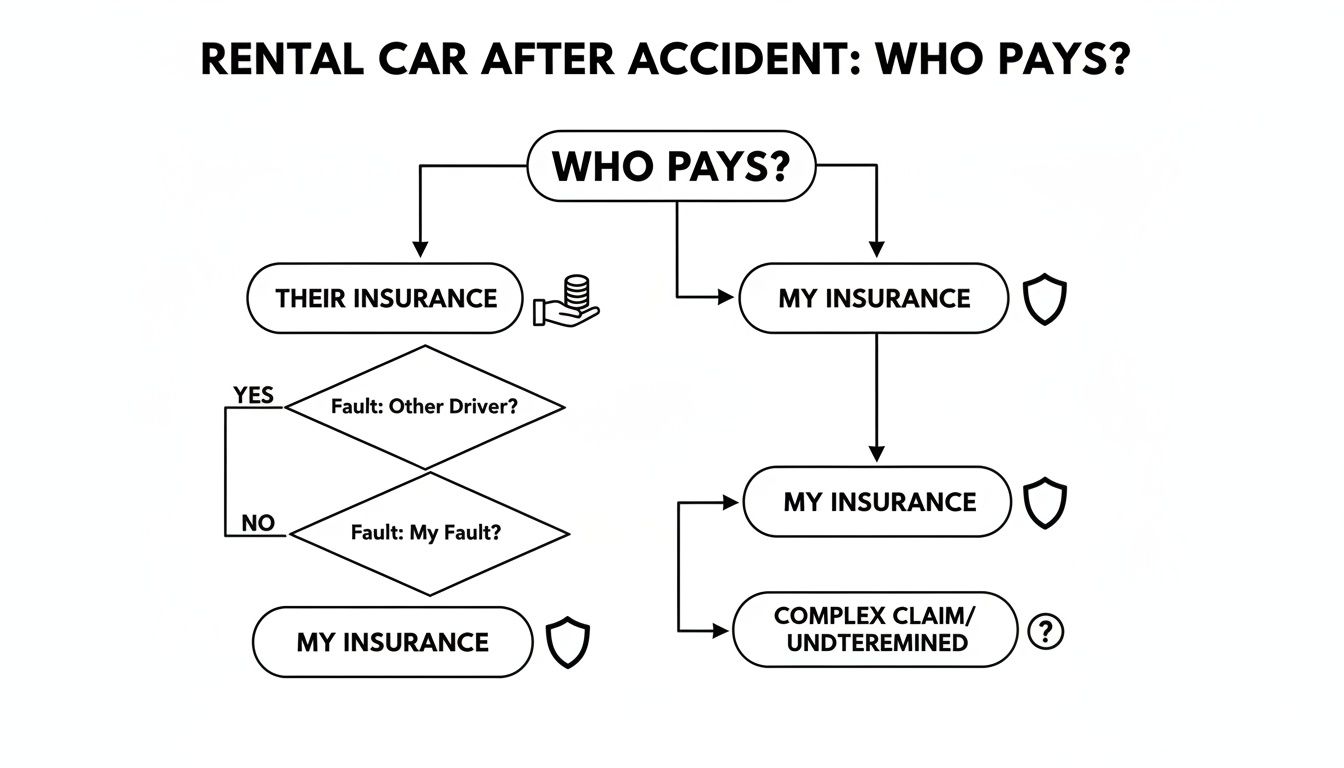
As you can see, the right choice often comes down to who was at fault and how quickly you need a vehicle.
This table breaks down your options for securing a rental car after a Texas accident, helping you decide which path is best for your situation.
Who Pays for Your Rental Car: Your Primary Options
| Payment Path | Who Pays Initially | Pros | Cons |
|---|---|---|---|
| At-Fault Driver's Insurance | The other driver's insurance company (in theory) | You have no out-of-pocket costs. The responsible party pays directly. | Can be very slow. The insurer may dispute fault or delay approval, leaving you stranded. |
| Your Own Insurance | You (reimbursed by your insurer up to policy limits) | Fast and reliable. You get a car right away without waiting for the other insurer. | You must have rental reimbursement coverage. You might have a daily limit or a maximum number of days. |
Ultimately, choosing the right path depends on your immediate needs and the specifics of your accident.
Choosing the Right Path Forward
Imagine a multi-car pileup on a Houston freeway where fault isn't immediately clear. Waiting for several insurance companies to determine who is to blame could leave you without transportation for weeks.
In a situation like that, using your own rental reimbursement coverage is almost always the smart move. Your insurer gets you into a car quickly and then deals with getting the money back from the at-fault party's insurance later on—a process called subrogation.
Your top priority is getting your life back to normal. While the at-fault driver’s insurance should pay, using your own coverage can provide immediate relief and let you sidestep frustrating delays.
When you're ready to pick up a vehicle, knowing where to find convenient car rental locations can make the process much smoother, whether you're working with your insurer or the other party’s.
To better understand all the insurance requirements involved, you can learn more about Texas liability insurance in our detailed guide. Making an informed decision here is key to ensuring you aren’t left paying out-of-pocket for a rental car because of someone else's mistake.
Making the At-Fault Driver’s Insurance Pay
When another driver’s negligence causes a crash, Texas law is very clear: their insurance company is responsible for making you whole. That responsibility includes covering the cost of a rental car while yours is out of commission. This process is called filing a "third-party claim."
However, what the law requires and what an insurance adjuster willingly offers can be two very different things. The adjuster's job is to protect their company's bottom line, and they often use tactics to delay or deny your rightful claim for a rental car after an accident.
Proving Fault and Demanding Your Rental
Getting the other driver's insurance to pay for your rental isn't automatic. You can't just make a phone call and expect a set of keys. You have to build a strong case that proves their client was at fault.
This means you need to be proactive and provide the adjuster with solid evidence. We recommend sending them:
- The official police report that clearly assigns fault to their driver.
- Photos and videos you took at the scene that show the crash and vehicle positions.
- Contact information for any witnesses who can back up your version of events.
Once you have this evidence, you can contact the claims adjuster with confidence and demand they cover your "loss of use." Under Texas law, you are entitled to a rental vehicle that is comparable to your own. If you drive a pickup truck for your contracting business, you do not have to accept a compact sedan that can't haul your equipment.
Practical Advice: Don’t let an adjuster pressure you into taking a smaller or cheaper vehicle. Politely but firmly insist on a comparable rental. Follow up every phone call with an email to create a paper trail of your request.
How Insurance Companies Try to Avoid Paying
Even with clear proof of fault, adjusters often resort to common delay tactics. They might tell you they need to "complete their investigation" or that they can't get ahold of their driver—all while you're left waiting without a car.
Another frequent strategy is to argue your car is still "drivable," even if it has serious damage. They may push you to wait until your vehicle is physically at the repair shop before they authorize a rental, adding days or even weeks of frustration. Knowing their goal is to save money helps you stand your ground. To learn more about navigating this process, you can explore our comprehensive guide on how to file a third-party claim in Texas.
Thankfully, repair times have been improving slightly. Recent data shows the average collision-related rental period was 15.1 days in Q2 2025, down a bit from the previous year. You can read more about these collision repair trends on Auto Rental News. While that’s good news for the industry, it doesn't help you when an insurer is fighting you from day one.
Using Your Own Insurance for a Faster Rental Car

Waiting for the at-fault driver’s insurance adjuster to approve your rental car can feel like an eternity. If they’re dragging their feet or disputing who’s responsible, you could be stuck without a vehicle for days, or even weeks.
In these situations, the fastest way back on the road is often through your own insurance policy. If you have rental reimbursement coverage, now is the time to use it. This is optional coverage you’ve been paying for, designed for exactly this kind of scenario, letting you get into a rental right away.
Understanding Your Rental Reimbursement Coverage
To know what you’re entitled to, you’ll need to look at your policy's declarations page. This document breaks down the specifics of your coverage, including what you have for a rental car. Your limits are usually shown in two ways:
- A per-day limit: This is the maximum your insurer will pay each day, typically around $30-$50.
- A per-accident or time limit: This sets the total number of days (like 30 days) or the maximum dollar amount (like $1,500) your policy will cover for a single claim.
Knowing these limits is more important than ever. With recent rental car shortages and price hikes, your daily limit might not stretch as far as it used to. You can discover insights about the car rental industry's challenges on Zippia.com to get a better sense of the current market.
Will Filing a Claim Raise My Rates?
Many drivers hesitate to use their own policy because they’re afraid their premiums will skyrocket. But here’s the good news: if the accident wasn’t your fault, making a claim for benefits you’ve paid for—like rental reimbursement or UM/UIM coverage—is unlikely to hurt your rates in Texas.
You paid for this coverage to be there when you need it. You shouldn't be penalized for using it when another driver's negligence caused the crash.
Your insurance company will go after the at-fault driver's insurer to get back every penny they spent on your claim. That includes the full cost of your rental and even your deductible. This process is called subrogation.
Subrogation is a powerful tool that works behind the scenes. It means you can use your own coverage to get immediate help without being left on the hook for the costs. It’s a smart move that gets you back on the road while ensuring the responsible party is ultimately held accountable.
And if the other driver has no insurance at all, it's critical to learn more about uninsured motorist coverage in our guide.
Navigating a Crash with an Uninsured Driver
It's one of the most frustrating moments after a crash: discovering the driver who hit you has no insurance. Your car is wrecked, you're hurt, and it feels like there’s no one to hold accountable for the mess they’ve created.
But you're not out of options. Your own insurance policy might just have the safety net you need.
This is exactly why you have Uninsured/Underinsured Motorist (UM/UIM) coverage. If you've opted for this on your policy, you can file a claim directly with your own insurance company to cover your losses—including the cost of a rental car after an accident.
How a UM/UIM Claim Covers Your Rental
Think of it this way: your UM/UIM policy steps into the shoes of the at-fault driver's insurance—the insurance that should have been there. When you file a claim for your vehicle's damage under this coverage, it can also pay for your temporary transportation needs.
This allows you to get a rental and get back on the road without having to chase down the uninsured driver for money, which is often a long and fruitless process.
In Texas, it's critical to know that UM/UIM Property Damage coverage includes a mandatory $250 deductible. This means you are responsible for the first $250 of your vehicle's repair costs. After that, your insurance pays the rest up to your policy limits. It’s a small amount to pay for the massive protection this coverage offers.
Practical Steps for Getting Your Rental
Even when you’re using your own policy, the process isn’t always immediate. It’s normal for your insurance company to take some time to investigate the crash and confirm the other driver was truly at fault and uninsured.
In these situations, the most practical approach is often to pay for a rental car out of your own pocket and keep meticulous records. Save every single receipt and a copy of your rental agreement.
Once your insurer approves the UM/UIM claim, you can submit all your receipts for reimbursement. This is where an experienced Houston car accident attorney becomes invaluable. We deal with insurance companies every day and know how to navigate the complexities of a UM/UIM claim. We push to make sure your insurer acts in good faith and repays you for all your rightful expenses without dragging their feet.
Our job is to make sure that being hit by an uninsured driver doesn’t leave you paying out-of-pocket for their mistake.
Why an Attorney Is Your Best Ally in an Accident Claim
Figuring out how to get a rental car after an accident is an important first step, but it’s often just the tip of the iceberg. The much bigger battle is ensuring you are fully compensated for all of your losses—from medical bills and lost wages to the physical pain and emotional trauma the crash inflicted on you and your family.
This is where having an experienced Texas personal injury lawyer in your corner can make all the difference.
Trying to handle an injury claim on your own means spending hours on the phone with insurance adjusters whose job is to minimize your payout. It means you’re left juggling endless paperwork, strict legal deadlines, and doctor’s appointments when you should be focused on one thing: getting better. When you hire an attorney, that entire burden shifts from your shoulders to ours.
Taking Over the Fight So You Can Recover
At The Law Office of Bryan Fagan, we immediately take over all stressful communications with the insurance companies. The moment you hire us, we notify them that you are represented, and they must direct every question, request, and offer to our firm. This puts an immediate stop to the constant calls and pressure tactics, giving you the peace of mind you deserve.
Our team gets to work right away to:
- Investigate the crash to gather undeniable proof of the other driver’s negligence.
- Handle all communication with insurance adjusters, body shops, and medical providers.
- Shut down delay tactics and fight back against the lowball settlement offers designed to make you give up.
For example, we represented a client who was seriously injured in a truck crash in Houston. He was facing a mountain of medical bills, and the trucking company's insurer was refusing to accept full responsibility. As his truck crash lawyer in Houston, we stepped in, hired accident reconstruction experts, and built a case that proved the truck driver was at fault. The insurer’s tone changed completely, and we secured a settlement that covered all his current and future needs.
Documenting the Full Value of Your Claim
A skilled attorney ensures that every single cost is properly documented and included in your demand for compensation. This goes far beyond just the repair estimate for your car. The true economic impact of a car accident is often staggering.
In 2019 alone, motor vehicle crashes in the U.S. were tied to $340 billion in economic costs. For an individual, those numbers are devastating. A single non-fatal disabling injury can cost an average of $162,000 over a lifetime. We make sure your claim reflects that total financial impact, including the rental car, future medical treatments, lost earning capacity, and your pain and suffering. You can read more about the staggering costs of car accidents on ddtampa.com.
We work on a contingency fee basis. This means you pay absolutely nothing unless we win your case. There are no upfront costs or hidden fees, so you can afford expert legal help when you need it most.
Bringing a lawyer into the picture early protects your rights and sends a clear signal to the insurance company that you are serious and will not be taken advantage of. Whether you need a Houston car accident attorney or a wrongful death lawyer in Texas, our team is here to fight for the best possible outcome for you and your family.
Common Questions About Rental Cars After a Wreck

Even when you have a plan for getting a rental, the questions don't stop. The process can be confusing, and insurance adjusters aren't always going to spell out your rights for you.
We understand. At The Law Office of Bryan Fagan, we have heard every question imaginable from our clients. Here are the straightforward answers to the most common questions we hear about getting a rental car after an accident in Texas.
How Long Can I Keep the Rental Car?
Texas law states you are entitled to a rental for a “reasonable” amount of time. What's considered "reasonable" is often a point of contention with insurance companies.
- If your vehicle is being repaired, you are entitled to keep the rental for the entire time your car is in the shop. This includes delays that aren't your fault, such as waiting for back-ordered parts.
- If your vehicle is a total loss, you can keep the rental until the insurance company makes a fair settlement offer for your totaled car.
If an adjuster tries to cut off your rental coverage early, don't just accept it. This is a classic insurance company tactic. An experienced attorney can intervene immediately to protect your right to transportation.
What if My Car Is Totaled?
When your vehicle's damage is severe, understanding what a total loss vehicle means is critical because it changes the rental car timeline. The insurer’s duty to pay for your rental ends the moment they make a settlement offer—not when you’ve bought a new car. You need to act fast.
What if the Insurance Company Offers a Tiny Car?
Under Texas law, the at-fault driver’s insurance must provide you with a “comparable” vehicle. You shouldn't be squeezed into an impractical compact car if your daily life depends on something bigger.
If you drive a three-row SUV to ferry your kids around or a work truck for your job, a tiny sedan is not a comparable substitute. You have every right to push back and demand a vehicle that actually fits your needs.
We always advise our clients to put their request for a comparable vehicle in writing. If the adjuster still refuses, you may need to rent the right vehicle yourself. We'll make sure that extra cost is added to your final demand for compensation.
Can I Get My Money Back if I Paid for a Rental Myself?
Yes, absolutely. If you had to pay for a rental out of your own pocket while liability was being sorted out, that expense becomes a legitimate part of your property damage claim.
It is absolutely crucial that you save every single receipt along with a copy of your rental agreement. Your lawyer will use this documentation to make sure every dollar you spent is included in the settlement demand we send to the at-fault insurer. We fight to get you fully reimbursed for expenses you only had because of someone else's negligence.
You Don't Have to Do This Alone
Navigating the aftermath of a car accident is overwhelming, but you don't have to face the insurance companies by yourself. The experienced and compassionate personal injury team at The Law Office of Bryan Fagan is here to provide the clarity, trust, and hope you need. We will handle the legal burdens so you can focus on what matters most: your recovery.
Recovery is possible, and legal help is available. We invite you to schedule a free, no-obligation consultation to discuss your rights and find out how we can help. Call us today or fill out our confidential contact form to get started.