A serious accident can change your life in seconds—but you don’t have to face it alone. When you’re injured and worried about the future, the last thing you should have to figure out is how to get medical care without insurance. Your top priority is seeing a doctor right away. In fact, federal law requires hospitals to provide emergency care whether you can pay or not. Your health always comes first.
Your First Steps After an Accident With No Insurance
Feeling overwhelmed after a serious crash is completely normal, but you're not in this alone. If you've been injured and don't have insurance, the thought of a massive hospital bill can be terrifying. But putting off a medical evaluation is one of the biggest mistakes you can make—for both your physical recovery and any future legal claim you might have.

Many severe injuries, like internal bleeding or concussions, don't show obvious symptoms right away. What might feel like simple soreness after a Houston freeway crash could actually be a sign of a much bigger problem. Going straight to the ER creates an official medical record that connects your injuries directly to the accident, which is crucial evidence if you need to hold the at-fault party accountable.
Your Rights at the Hospital
You have more rights in this situation than you probably realize. Thanks to a federal law called the Emergency Medical Treatment and Labor Act (EMTALA), any hospital that accepts Medicare must provide a proper medical screening to anyone who comes in with an emergency. This applies regardless of your citizenship, legal status, or ability to pay.
You cannot be turned away from an emergency room just because you don't have health insurance. The law prioritizes your immediate health and stabilization.
When you get to the hospital, be upfront about not having insurance. Let the registration staff know, and ask to speak with a hospital social worker or financial counselor. These professionals are there to help you figure out your options, which often include:
- Charity care programs for low-income patients.
- Government-funded programs, like emergency Medicaid.
- Sliding-scale payment plans that are adjusted based on your income.
Document Everything from the Start
While you're focusing on getting better, it's incredibly important to start documenting everything. Keep a folder—physical or digital—with every single bill, medical report, and piece of mail you get from the hospital. This paperwork becomes vital if someone else's negligence caused your accident. For a more complete checklist of what to do right away, our guide on what to do after a car accident breaks down the essential steps.
Remember, getting immediate medical care is about protecting your health first and your legal rights second. If a distracted driver in a commercial truck is responsible for your injuries, their insurance company will search for any excuse to deny your claim. A delay in seeing a doctor gives them the perfect opening to argue your injuries weren't that serious or were caused by something else entirely.
By going to the ER, you build the foundation for a strong personal injury claim. This first, critical step is what allows a skilled Houston car accident attorney to start fighting for the compensation you deserve to cover those very medical bills.
When you're in an accident, the adrenaline and confusion can make it tough to think straight. You know you need a doctor, but where do you go? Deciding between an emergency room (ER) and an urgent care clinic is a huge first step, one that will affect both your health and your finances, especially if you don't have insurance.
Think about a multi-car pileup on I-10 in Houston. You’ve been rear-ended, and a sharp pain is shooting through your neck and back. This is an ER situation, no question. Emergency rooms are built for life-threatening and severe injuries—things like head trauma, deep cuts, broken bones, or any kind of internal damage that can happen in a serious car accident. They have the CT scanners, MRIs, and specialized teams needed for complex, urgent diagnoses.
Urgent care centers, on the other hand, are for less severe problems like minor sprains or small cuts. They're a lot cheaper than an ER, but they simply aren't equipped to handle the kind of trauma you see in a vehicle collision. Going to the wrong place can mean a delayed diagnosis, or you'll just end up getting transferred to the hospital anyway, wasting precious time.
Understanding the Cost Difference
The price gap between the ER and urgent care is massive. An ER visit without insurance can easily run into thousands of dollars. An urgent care visit might just be a few hundred. That higher cost reflects the 24/7 availability of life-saving equipment and on-call specialists.
But let us be clear: you should never let the fear of cost stop you from going to the ER if you have a serious injury. Your health has to come first. Federal law protects your right to emergency care, and if someone else caused the crash, a personal injury claim can ultimately cover these expenses.
Speaking with Hospital Financial Counselors
Once you’ve been treated and are stable, it’s time to be proactive. Find a patient advocate, financial counselor, or hospital social worker. These people are your allies inside the hospital system; their entire job is to help you figure out a path forward.
When you sit down with them, you’re not just asking for a discount—you're looking into established assistance programs. Be ready to talk openly about your financial situation.
Your conversation with a financial counselor is a critical step in getting a handle on medical debt. Be upfront about your income and inability to pay the full sticker price. This honesty is what opens the door to programs designed for people in your exact situation.
To make that conversation as productive as possible, you need to come prepared.
Key Questions to Ask the Financial Counselor:
- "Do you have a financial assistance or charity care policy, and can I get a copy?"
- "What are the income qualifications for these programs?"
- "Can you help me see if I qualify for emergency Medicaid or other government aid?"
- "Do you offer any sliding-scale payment plans that are based on my income?"
- "Is there a discount available for uninsured patients who can pay in cash?"
Try to bring any documents that can verify your income, like recent pay stubs or tax forms. Proving your financial hardship is the key to unlocking these assistance options and dramatically cutting down your medical bills. Taking this step shows the hospital you're responsible and makes them more likely to work with you. A Houston car accident attorney can also give you guidance during this stressful time, making sure your rights are protected from day one.
Finding Affordable Ongoing Medical Care in Texas
Immediate medical attention after an accident is just the beginning. For many injuries you might suffer in a serious collision, especially with a commercial truck, the road to recovery is long. It often involves physical therapy, follow-up appointments with specialists, or even surgery. If you don’t have insurance, the thought of paying for this long-term care can be even more terrifying than the initial ER bill.
Thankfully, you are not without options. Texas has a network of resources specifically designed to provide affordable medical treatment to people who need it most.
Tapping into Community Health Resources
Your first stop for sustainable, long-term care should be community-based options. These facilities are the backbone of affordable healthcare for countless Texans.
Across the state, you'll find community health centers and Federally Qualified Health Centers (FQHCs). These are mission-driven organizations focused on providing high-quality, affordable care. Their biggest advantage is the sliding-scale fee structure, which adjusts what you pay based on your income and family size.
This means you pay what you can actually afford, making it possible to get consistent medical care without going into debt. These centers offer a huge range of services, from primary care check-ups to specialist visits, which is absolutely vital when you're managing complex injuries from a major truck accident.
The impact is massive. In 2023 alone, community health centers in the U.S. treated over 31 million people, a large number of whom were uninsured.
This infographic helps break down those initial choices for care, showing where to go for different types of injuries and how financial aid plays a role right from the start.
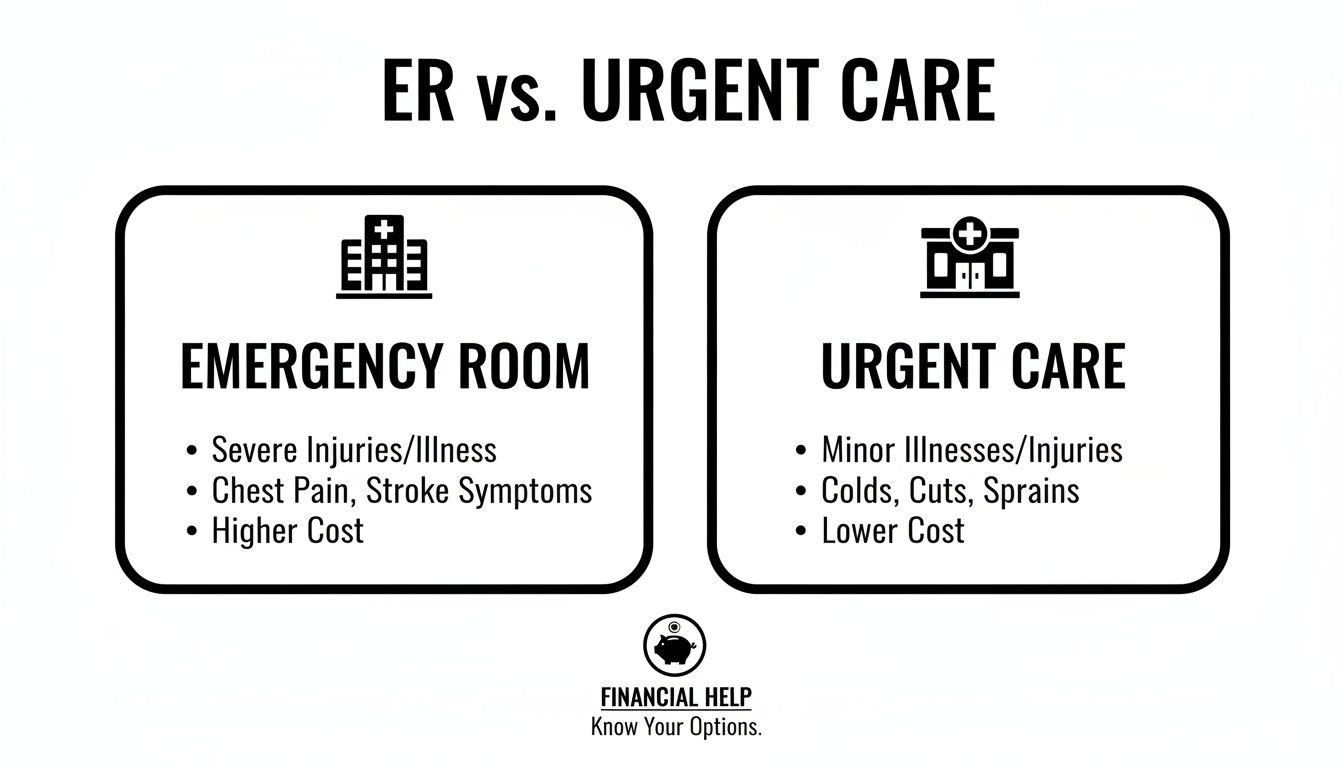
The takeaway here is simple: while urgent care is cheaper for minor issues, a trip to the ER is non-negotiable for serious accident injuries. Don't worry about the cost upfront—financial aid is a built-in part of the hospital system.
Understanding Hospital Financial Assistance
Beyond the emergency room, most Texas hospitals have strong financial assistance policies (FAPs), often called charity care. These programs are in place to reduce or even completely wipe out your medical bills if your income falls within certain guidelines. This isn't just a simple discount; it's a formal process designed to shield you from crushing medical debt.
But here's the catch: you have to apply for it. It won't happen automatically. The process usually involves a few key steps:
- Requesting the FAP Application: You can almost always get this from the hospital's billing department or by asking to speak with a financial counselor.
- Providing Proof of Income: You'll need to show documents like pay stubs, recent tax returns, or a letter from your employer.
- Detailing Your Household Size: The income limits are often based on the Federal Poverty Level and change depending on how many people are in your family.
Don’t assume you won't qualify. The income thresholds for hospital charity care can be surprisingly generous. It is always worth applying because even partial assistance can make a huge difference.
If you're out of work right now, figuring out your next steps is critical. Exploring health insurance options if you're unemployed can be a lifesaver for securing future care.
To give you a clearer picture of which path might be right for your ongoing treatment, here’s a quick comparison of the main options available to you.
Comparing Medical Care Options for the Uninsured in Texas
This table breaks down the typical costs, services, and eligibility for different healthcare facilities you can access in Texas after an accident.
| Healthcare Option | Best For | Typical Cost Structure | How to Access |
|---|---|---|---|
| Community Health Center/FQHC | Consistent, long-term primary care, follow-ups, and managing chronic conditions after an accident. | Sliding-scale fees based directly on your income and household size. | Search for FQHCs in your area and call to schedule a new patient appointment. |
| Hospital Financial Assistance | Reducing or eliminating large bills from a specific hospital for services like surgery or imaging. | Full or partial bill forgiveness based on income (often up to 200-400% of the Federal Poverty Level). | Contact the hospital’s billing office or a financial counselor to request an application. |
| Charity Clinics | Basic medical care, minor injuries, or short-term needs when other options aren't available. | Often free or requires a very small donation. | Search for local non-profit or faith-based clinics in your city. Availability can be limited. |
| Direct Primary Care (DPC) | People who need predictable, regular access to a primary doctor for a flat monthly fee. | A monthly membership fee (e.g., $50-$100) that covers most primary care services. | Research DPC providers in your area. This is a newer model but is growing in Texas. |
Ultimately, choosing the right option comes down to the specific nature of your injuries and your financial situation.
If your accident left you with a catastrophic injury, you might actually need to use a-combination of these resources. For example, you could apply for hospital financial assistance to cover a necessary surgery and then use a community health center for your follow-up physical therapy sessions. Trying to navigate these systems on your own can feel overwhelming, but a dedicated Texas personal injury lawyer can offer guidance and help you find the resources you need so you can focus on what matters most: healing.
How a Personal Injury Claim Can Cover Your Medical Bills
When you're hurt, out of work, and facing a mountain of medical bills without insurance, the legal system can feel like the last thing on your mind. But if someone else's carelessness caused your injuries, a personal injury claim might be the most powerful tool you have. It is how you can get the medical care you need right now and hold the responsible party accountable for the costs down the road.

At its core, Texas personal injury law operates on the principle of fairness: if someone’s negligence causes harm, they are responsible for the consequences. To hold the at-fault party accountable, your lawyer must show they had a duty to be careful, they failed in that duty, and their failure directly led to your injuries and financial losses. Texas also follows a comparative responsibility rule, meaning your compensation can be reduced by your percentage of fault, but you can still recover damages as long as you are not found to be 51% or more at fault.
For example, imagine you're driving on a Houston freeway when a commercial truck driver, distracted by their phone, veers into your lane and causes a serious wreck. That driver was negligent. A skilled truck crash lawyer Houston would investigate to hold them accountable, ensuring they are responsible for your medical treatment, lost income, and the pain you've been forced to endure.
How a Letter of Protection Gets You Medical Care Now
Knowing someone else should pay is one thing, but getting a doctor to see you today is another challenge entirely. This is where a critical legal tool called a Letter of Protection (LOP) becomes invaluable. An LOP is a formal agreement your attorney sends to your medical provider, whether it's a surgeon, a physical therapist, or a specialist.
It's essentially a promise. The letter guarantees the doctor that their bills will be paid directly from the funds we recover in your case, either from a settlement or a court verdict.
A Letter of Protection bridges the gap between your immediate need for medical care and your ability to pay. It allows you to access top-tier specialists and get necessary treatments without paying a single dollar upfront.
For many of our clients, an LOP is a complete game-changer. It means you can get that essential back surgery or start intensive rehab therapy immediately. Your doctors can focus entirely on your health, while we focus on making sure the responsible party pays for it.
The Role of an Attorney in Managing Your Recovery
Hiring a Texas personal injury lawyer does more than just secure a way to pay bills later; it gives you an advocate to manage the entire process. We step in to handle the endless phone calls and paperwork from insurance adjusters and medical billing offices so you can put all your energy into healing.
Our job involves several key phases:
- Investigating the Accident: We dig deep, gathering police reports, tracking down witnesses, and securing crucial evidence to build an undeniable case that proves who was at fault.
- Documenting Your Injuries: We work closely with your medical team to make sure every diagnosis, treatment, and future medical need is thoroughly documented and clearly linked to the accident.
- Negotiating with Insurers: Insurance companies are notorious for making quick, lowball offers to unrepresented victims. We know their tactics and fight back to demand the full and fair compensation you deserve.
If you're considering this path, a great next step is to understand how to file a personal injury claim. And when you're ready, knowing how to choose a personal injury attorney is one of the most important decisions you'll make. The right lawyer ensures you're not taken advantage of and that every legal option is used to protect your health and your financial future.
How Long Do You Have to File a Claim in Texas?
After a serious accident, it feels like the world stops. You’re in pain, the bills are piling up, and everything feels uncertain. It’s completely natural to want to hit pause and just breathe.
But when it comes to the law in Texas, time is a luxury you simply don't have. Acting fast isn't just about getting the medical care you need—it's about protecting your legal rights before they vanish.
The Texas Statute of Limitations
In Texas, there’s a strict deadline for filing a personal injury lawsuit, known as the statute of limitations. For most injury cases, you have just two years from the date of the accident to take legal action. For a wrongful death claim, the family also generally has two years from the date of their loved one’s passing.
That might sound like plenty of time, but when you're dealing with a severe injury and a complex case, those two years can fly by. If you miss this deadline, your case will almost certainly be thrown out of court. It doesn't matter how strong your evidence is or how badly you were hurt. Once that two-year window shuts, your right to seek compensation is gone forever.
This two-year clock starts ticking the very moment the accident happens. It's a critical reason to connect with an experienced Texas personal injury lawyer right away to make sure your rights are preserved.
Why Evidence Fades Fast
Beyond the legal deadline, there’s another urgent reason to act swiftly: evidence disappears. A strong personal injury claim is built on solid proof, and that proof is incredibly fragile. It starts to degrade almost immediately.
- Witness Memories Fade: Someone who saw the accident might remember every detail a week later. But a year from now? Key facts can become fuzzy or forgotten.
- Physical Evidence Disappears: Skid marks wash away in the next rainstorm. The other driver’s car might be repaired or sold, destroying crucial evidence forever.
- Video Footage Gets Wiped: Surveillance cameras on nearby businesses or traffic lights often overwrite their footage every few days or weeks.
Think about a crash on a busy Houston freeway with a commercial truck. A lawyer can immediately send a preservation letter, legally forcing the trucking company to save the truck’s black box data, the driver's logbooks, and maintenance records. If you wait, that critical information could be legally destroyed as part of their routine procedures.
Taking your own photos of the accident scene, your injuries, and the vehicles involved is one of the most powerful things you can do. You should also get a copy of the official police report as soon as it's ready. To get a better handle on the timeline, our article on how long after an accident you can claim an injury offers more detail.
While you focus on getting better, an attorney can get to work building the foundation of your case. It’s not about being aggressive—it’s about being smart and strategic to protect your family’s future. The need for care is universal; in the US, an estimated 28 million uninsured individuals relied on free clinics in 2023.
We Can Help You Find a Path Forward
Navigating the aftermath of a serious accident without insurance is a heavy, confusing burden, but you don’t have to carry it by yourself. The path to recovery can seem impossible, buried under a mountain of medical bills and legal questions. But with the right strategy and support, you can absolutely get the care you need and protect your future.
It really boils down to a few key things: always get medical attention right away, dig into every community resource you can find, and understand that a personal injury claim can be your most powerful tool for getting back on your feet. After a Houston freeway crash caused by someone else's negligence, your first priority is your health, but your long-term stability often depends on holding that at-fault party accountable.
Your Health Is Your Priority
The most important thing is your physical and emotional healing. Period. Trying to juggle doctors, hospitals, and insurance companies on your own adds an incredible amount of stress right when you should be focused on getting better. Letting an experienced legal team handle these complexities lifts that weight from your shoulders so you can breathe.
Recovery is possible, and you deserve a team that will fight for you every single step of the way. Our mission is to provide you with the resources and advocacy needed to rebuild your life.
Let Us Help You Take the Next Step
At The Law Office of Bryan Fagan, PLLC, we are here to help you find that path forward. We have helped countless Texans in your exact situation, connecting them with medical providers through Letters of Protection and fighting to secure the compensation they need to cover their bills, lost income, and everything in between. Whether you need a compassionate wrongful death lawyer Texas or a tough negotiator against a trucking company, our team is here for you.
You are not just another case number to us. We see the person, the family, and the future that’s at stake. We invite you to schedule a free, no-obligation consultation with an experienced Texas personal injury lawyer on our team. Let us listen to your story, answer your questions, and show you exactly how we can help.
Common Questions After an Accident in Texas
When you're hurt in an accident and don't have insurance, the questions can feel overwhelming. Here are some straightforward answers to the concerns we hear most often from people just like you across Texas. This should help you understand your immediate rights and options.
Will an Emergency Room Refuse to Treat Me if I Can’t Pay?
Absolutely not. A federal law called the Emergency Medical Treatment and Labor Act (EMTALA) requires any hospital that takes Medicare to give you a medical screening and treatment to stabilize your condition in an emergency.
This is the law of the land, and it applies to everyone, regardless of your insurance or ability to pay. They can't legally turn you away if you're facing a true medical emergency. You'll get a bill later, of course, but there are ways to handle that, which a Texas personal injury lawyer can definitely help you with.
What Exactly Is a Letter of Protection?
A Letter of Protection, or LOP, is one of the most important tools we use to help our clients. It's a formal agreement your attorney sends to your doctor or hospital. It basically serves as a guarantee that their bills will be paid directly out of any settlement or verdict you win in your case.
This simple document is a game-changer. It allows you to get the medical care you need right now—from critical surgeries to physical therapy—without paying a dime out of pocket while your case is moving forward. Our Houston car accident attorneys use LOPs all the time to make sure our clients get access to the best specialists without any delay.
The Driver Who Hit Me Was Uninsured. Now What?
This is a tough spot to be in, and unfortunately, it happens more than you'd think. But you aren't out of options. The first thing we look at is your own car insurance policy for Uninsured/Underinsured Motorist (UM/UIM) coverage. This is insurance you pay for specifically to protect you in this exact situation.
If you don't have UM/UIM coverage, the next step is to see if we can go after the at-fault driver's personal assets. An experienced lawyer will dig into every possible source of recovery and lay out the best path forward based on the unique facts of your case.
At The Law Office of Bryan Fagan, PLLC, we believe you should never have to decide between getting medical care and staying financially afloat after an accident that wasn't your fault. Let us handle the legal battle so you can focus on getting better. Schedule a free, no-strings-attached consultation with our team by visiting us at https://texaspersonalinjury.net.