A serious accident can change your life in seconds, but you don’t have to face it alone.
If you’re reading this after a crash, you may be dealing with pain, missed work, calls from insurance adjusters, and a lot of uncertainty. You may also be asking a very practical question: what kind of crash was this, and why does that matter?
It matters because different car crash types leave different evidence, cause different injuries, and raise different fault questions under Texas law. A rear-end collision on a Houston freeway is investigated differently from a T-bone wreck at a Dallas intersection. A rollover on a rural road raises different concerns than a multi-vehicle pile-up on I-35.
That doesn’t mean you need to become a crash expert overnight. It means you deserve clear information in plain English.
Your Life Changed in a Moment What Happens Next?
In the first hours after a wreck, many individuals aren’t thinking about legal rules. They’re thinking about pain, their car, their children, and whether life is about to get harder than it already is.
That’s normal.
Many injured drivers don’t realize that the type of collision often shapes the entire claim. It affects what evidence matters most, how insurance companies argue fault, and what medical records may become especially important later. If you were hit from behind, the focus may be on following distance, braking, and traffic flow. If you were struck in the side at an intersection, the case may turn on right of way, traffic signals, and witness accounts.
Texas personal injury law also puts fault at the center of the case. To recover compensation, you generally need to show that another person acted negligently and that their conduct caused your injuries. In some crashes, that’s straightforward. In others, fault is heavily disputed.
Practical rule: The sooner you understand how your crash happened, the easier it is to protect the evidence that can prove your claim.
You also need to know that Texas uses comparative responsibility. That means more than one person can share fault. If the insurance company says you contributed to the crash, that can affect what you recover. Texas also has a statute of limitations, which is the deadline for filing a lawsuit. In many Texas injury cases, that deadline is two years from the date of the accident.
If you lost a loved one, the legal issues can be even more serious. Families may need answers not only about injury claims, but also about a potential wrongful death case.
The good news is that once you break the problem into parts, it becomes easier to handle. Start with the crash type. Then look at injuries, fault, evidence, deadlines, and damages.
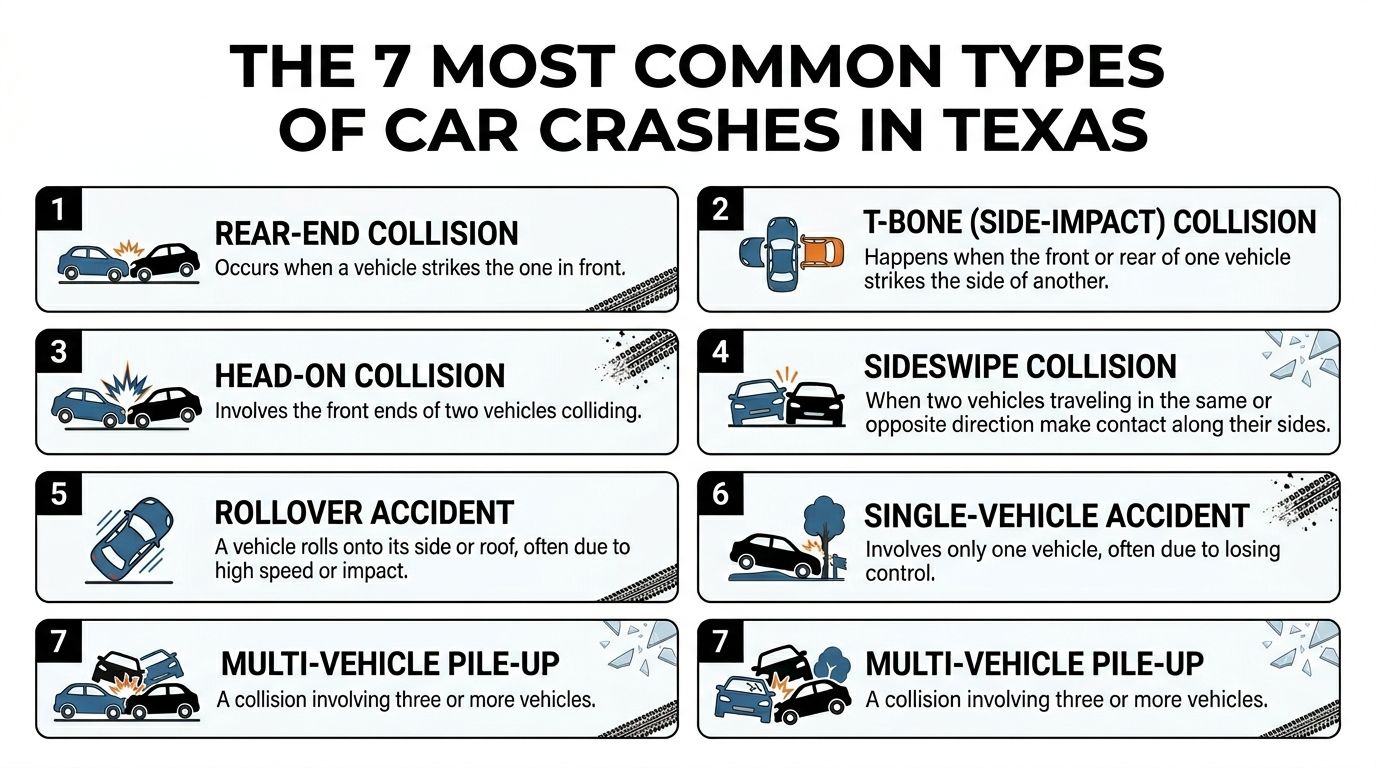
The 7 Most Common Types of Car Crashes in Texas
The roads in Texas include crowded city intersections, long rural highways, fast-moving feeder roads, and busy interstates. Those settings produce recurring crash patterns. Learning the basics gives you a clearer way to describe what happened and what may have caused it.
If you also want to compare crash patterns with common driving behaviors, this guide on causes of car accidents can help connect the mechanics of the wreck to the driver conduct behind it.
Rear-end collisions
A rear-end collision happens when one vehicle strikes the back of another. These crashes often happen in traffic, at stoplights, near exits, or anywhere drivers have to slow down quickly.
Some rear-end wrecks seem minor at first. Others involve enough force to push one car into another lane or into a second impact.
Head-on collisions
A head-on collision involves the front ends of vehicles crashing into each other. These crashes often happen when a driver crosses the center line, enters the wrong lane, or loses control on a curve.
They can also happen when one vehicle is moving and the other is nearly stopped. The defining feature is front-to-front impact.
T-bone side-impact collisions
A T-bone crash happens when the front or rear of one vehicle hits the side of another. These collisions commonly occur at intersections, especially when one driver fails to yield or enters against the light.
This is one of the car crash types that often leads to immediate disagreement about who had the right of way.
Rollover accidents
A rollover occurs when a vehicle tips onto its side or roof. Some rollovers happen after impact with another car. Others begin when a driver loses control, leaves the roadway, or strikes a curb, barrier, or soft shoulder.
SUVs and pickups can be involved in rollover scenarios because of their size and handling characteristics, though any vehicle can roll under the right conditions.
Sideswipe collisions
A sideswipe happens when two vehicles traveling near each other make contact along the sides. These crashes often occur during lane changes, merging, or drifting between lanes.
A sideswipe may begin as a brief scrape, but it can also force a driver into another lane, into a barrier, or into a secondary crash.
Multi-vehicle pile-ups
A multi-vehicle crash involves three or more vehicles. These wrecks often unfold in a chain reaction. One driver brakes hard or loses control, another driver can’t stop in time, and the impacts spread.
These crashes are common in heavy traffic and can become complicated quickly because several drivers, insurers, and witness accounts may be involved.
Hit-and-run accidents
A hit-and-run accident occurs when a driver causes a collision and leaves the scene without stopping to identify themselves or provide required information.
This can happen in parking lots, intersections, neighborhood streets, and high-speed roadways. The basic mechanics of the crash still matter, but identification becomes a separate issue.
A quick comparison
| Crash type | What it usually looks like |
|---|---|
| Rear-end | One vehicle strikes the back of another |
| Head-on | Fronts of vehicles collide |
| T-bone | Front or rear of one vehicle hits another vehicle’s side |
| Rollover | Vehicle flips onto side or roof |
| Sideswipe | Vehicles make side-to-side contact |
| Multi-vehicle | Three or more vehicles collide |
| Hit-and-run | Driver leaves after causing a crash |
Knowing which category fits your wreck helps you ask better questions. Where was the impact? Who had the right of way? What evidence will show it?
Connecting the Crash Type to Injuries and Fault
A crash is never just a crash. The direction of impact, the road layout, and the behavior of each driver all affect what injuries happen and how fault is proven.
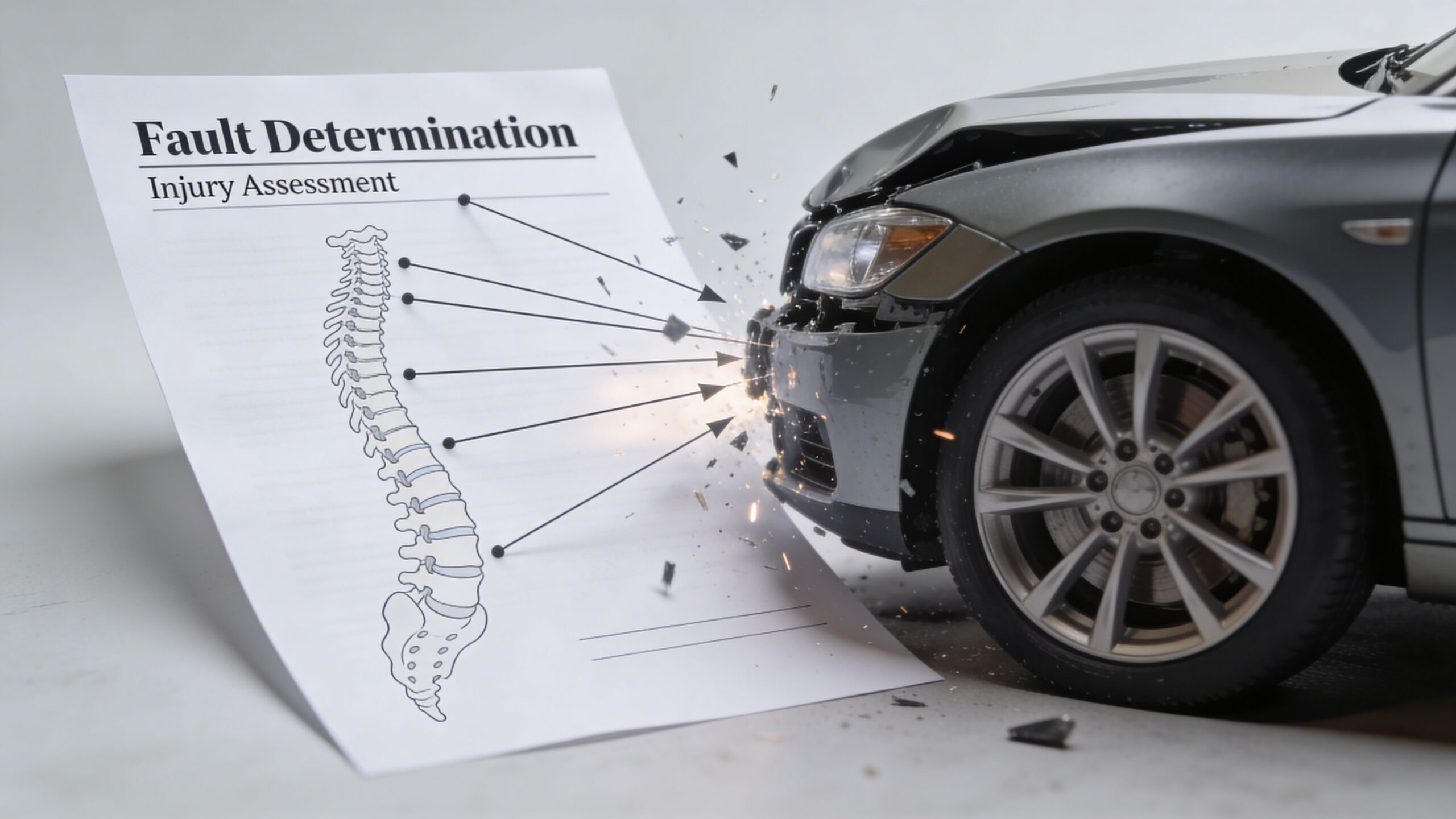
In Texas, fault usually comes back to negligence. Did a driver fail to use reasonable care? Did that failure cause the wreck? Then the evidence has to support the answer.
Texas also follows a comparative responsibility system. If both sides share blame, the claim doesn’t automatically disappear. But the amount you can recover may change based on how fault is assigned. If you want a plain-language overview, this explanation of comparative fault definition is a useful starting point.
Rear-end collisions and why timing matters
Rear-end collisions represent approximately 40% of all traffic accidents, and they frequently cause whiplash injuries even at low speeds. The sudden acceleration-deceleration forces can exceed 10g, which can overwhelm the cervical spine and lead to significant medical costs, according to this discussion of rear-end crash dynamics and injury forces.
That helps explain why a person may say, “It was only a bump,” yet wake up the next morning with severe neck pain, headaches, or shoulder stiffness.
In many rear-end claims, the trailing driver is often the focus because drivers are expected to maintain a safe following distance and control their speed. But these cases aren’t always automatic. Fault can become more complicated if:
- A lead driver stopped suddenly in an unusual way
- Multiple vehicles were involved, making the first impact hard to identify
- A mechanical issue interfered with steering or braking
- Road conditions changed quickly and both drivers responded poorly
Vehicle condition can matter more than people think. If the driver who caused the wreck had a known steering problem, maintenance records may become relevant. For readers trying to understand warning signs before a loss-of-control event, this guide on power steering problems gives a practical overview.
A Houston freeway example helps. If traffic slows near an interchange and the rear driver looks down at a phone, the claim may rely on braking marks, vehicle damage patterns, dash-cam footage, and the police report. If there’s an event data recorder, that may help show braking and speed before impact.
Head-on collisions and why causation is often direct
Head-on crashes often produce the clearest link between impact and severe injury. Common injuries may include brain trauma, spinal injuries, fractures, internal injuries, and long-term disability.
Fault usually turns on lane position and why a vehicle entered the wrong path. A lawyer may look at:
- Centerline evidence
- Skid marks or yaw marks
- Roadway gouges
- Black box data when available
- Witness statements about drifting, speeding, or wrong-way travel
In a rural Texas crash, for example, one key question may be whether a driver crossed into oncoming traffic because of distraction, fatigue, intoxication, or an unsafe attempt to pass.
These cases often carry large damages because the injuries tend to be serious and the medical treatment can continue for a long time.
T-bone crashes and the fight over right of way
Side-impact crashes create a different legal problem. The injury pattern is often severe because the side of a vehicle has less space between the point of impact and the occupant.
They also create some of the hardest liability disputes. Side-impact crashes create disproportionate injury severity and complex fault disputes, and insurance companies often contest fault in these cases, which makes evidence like traffic camera footage and police reports especially important under Texas law, as explained in this overview of side-impact collision liability issues.
In practical terms, that means a Dallas intersection crash may turn on details like:
- Which driver had the green light
- Whether a driver failed to yield on a turn
- What the crash report says about statements at the scene
- Whether nearby businesses or city cameras captured the impact
- Whether the damage pattern matches one driver’s version of events
A T-bone case can also involve passengers with serious injuries who had no role in causing the crash. Their claims may proceed even while the drivers argue over fault percentages.
In an intersection case, the question usually isn’t just “Who got hit?” It’s “Who had the legal right to be there first?”
Rollover accidents and hidden contributing factors
A rollover is chaotic. Occupants may suffer head injuries, crush injuries, fractures, neck trauma, or ejection-related harm if restraints fail or aren’t used.
Fault can point to driver behavior, but it can also expand beyond the driver. In some cases, the investigation may need to consider:
- Speed through a curve
- Overcorrection after leaving the roadway
- Road shoulder condition
- Another driver’s contact that triggered the rollover
- Possible product issues involving tires or vehicle stability
After a rollover outside San Antonio, for example, the first impression might be “single-car crash.” But if a witness says another vehicle forced the driver off the road, that changes the liability analysis.
Sideswipe collisions and lane-change evidence
Sideswipe crashes may look simple because the visible damage can run in a straight line along the doors or quarter panels. But legally, they often become credibility contests.
The main question is usually who moved into whose lane.
Important evidence may include:
- Lane markings and road design
- Mirror and blind-spot positioning
- Dash-cam footage
- Statements from nearby drivers
- Damage location on both vehicles
In a busy Houston lane-change crash, one driver may say, “I was already established in the lane.” The other may say the opposite. In that situation, vehicle positioning and independent witnesses can matter more than either driver’s opinion.
Injury-wise, sideswipes can cause neck and back injuries, shoulder trauma, and secondary impacts if one vehicle spins or hits a barrier.
Multi-vehicle pile-ups and shared fault
Pile-ups are among the most complex car crash types because they involve a chain of events instead of one clean moment. One person may start the sequence, but later drivers may also contribute by following too closely, speeding, or failing to react reasonably.
That matters under Texas comparative responsibility law.
A Central Texas example makes this easier to see. A driver brakes hard in congestion. The second car rear-ends that vehicle. A third SUV then strikes both. The legal questions include:
- Who caused the first impact
- Whether later drivers had enough time to avoid the crash
- Whether one driver’s speed made the damage worse
- Which injuries came from which impact
Medical proof matters here because a person may be hit more than once in a few seconds. The defense may argue that one impact, not another, caused the injury. Your records, imaging, and treating doctors’ opinions can become central.
Hit-and-run crashes and uninsured motorist issues
A hit-and-run case has two tracks. First, you still need to document how the crash happened. Second, you may need to identify the driver or make a claim under your own uninsured or underinsured coverage, depending on the facts and your policy.
If the fleeing driver is never found, evidence still matters. Try to preserve:
- Photos of debris and damage
- Any partial plate information
- Witness names
- Nearby surveillance footage
- Your immediate report to police
These cases can be frustrating because the injured person did nothing wrong and still has to fight to prove what happened.
The Four Elements of a Successful Texas Injury Claim
Every Texas car accident case comes back to one legal concept: negligence.
That word sounds technical, but the idea is simple. Someone failed to use reasonable care, and that failure caused harm. To recover damages, you generally need to prove four elements.
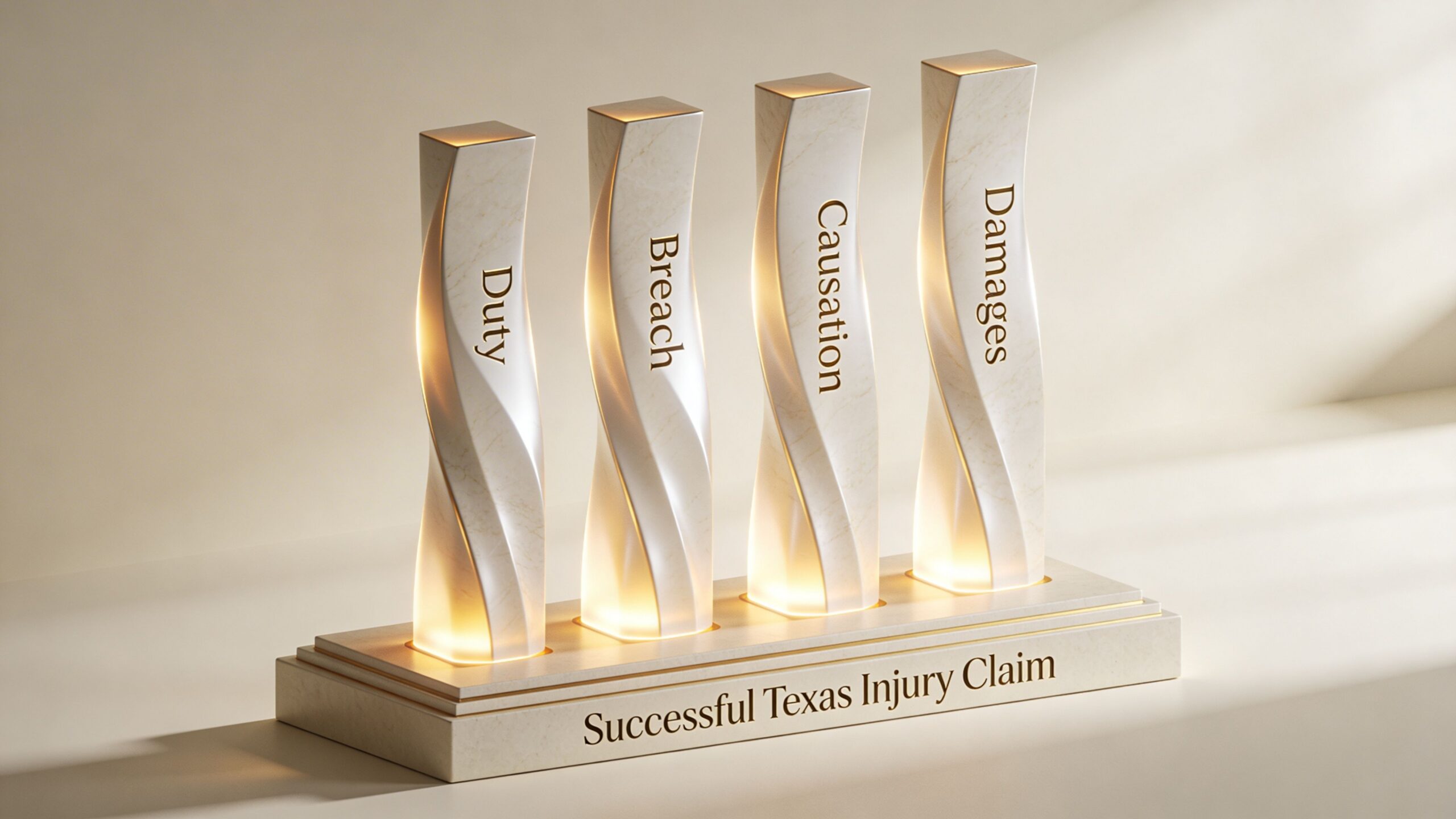
Duty
Every driver on a Texas road owes others a duty of care. That means driving with reasonable caution, obeying traffic laws, paying attention, yielding when required, and keeping the vehicle under control.
On I-35 in Austin, for example, every driver has a duty to watch traffic, maintain a safe distance, and avoid dangerous distractions.
Breach
A breach happens when a driver fails that duty.
That could mean texting while driving, speeding through stopped traffic, running a red light, making an unsafe lane change, or turning left without yielding. The act doesn’t need to be intentional. Carelessness is enough.
A side-impact case shows this clearly. Because T-bone crashes often involve serious injuries and disputed fault, proving breach may depend on traffic camera footage, the police report, and witness statements rather than assumptions about who “looks” responsible.
Causation
Causation means linking the driver’s breach to the crash and linking the crash to your injuries.
This sounds obvious, but insurance companies often attack this part of the case. They may argue that your pain came from a prior condition, that the collision was too minor to hurt you, or that a later event caused the problem.
That’s why timing matters. If you seek treatment promptly, follow medical advice, and consistently report your symptoms, it becomes easier to connect the injury to the wreck.
Evidence wins causation disputes: photos, medical records, imaging, repair records, and witness accounts often matter more than arguments alone.
Damages
Damages are the losses the crash caused.
These may include medical bills, future treatment, lost wages, reduced ability to work, physical pain, emotional suffering, and damage to daily life. In a fatal crash, surviving family members may also have a wrongful death claim.
One simple example
Take a common scenario. A driver in Austin looks at a text message while approaching slowed traffic.
- The driver had a duty to pay attention.
- Looking at the phone was a breach of that duty.
- That distraction caused a rear-end crash, which satisfies causation.
- The person hit suffers neck injuries, misses work, and needs treatment. Those are damages.
That’s the framework a Texas personal injury lawyer uses to build a claim.
When people want help with that process, they often speak with a Houston car accident attorney or another local lawyer who can gather records, preserve evidence, and deal with the insurer. The Law Office of Bryan Fagan, PLLC provides representation in Texas motor vehicle injury cases, including crash investigation, liability analysis, and insurance negotiations.
Understanding the Full Value of Your Claim
After a crash, the first settlement offer can sound like relief. For many people, it’s anything but. Early offers often focus on immediate bills while leaving out the full impact of the injury.
A serious wreck can affect your finances, your health, your family routine, and your ability to work. That’s why damages in a Texas injury case usually fall into more than one category.
Economic damages
These are the financial losses you can track with records.
They often include:
- Medical expenses such as emergency care, follow-up visits, therapy, medication, imaging, and future treatment
- Lost wages if you missed work during recovery
- Reduced earning capacity if your injuries affect the kind of work you can do going forward
- Property losses tied to the collision
If a crash leaves someone with lasting limitations, the value of the claim may be much greater than the first stack of hospital bills.
Non-economic damages
These losses are personal. They don’t come with a simple receipt, but they are real.
They may include physical pain, mental anguish, emotional distress, physical impairment, and loss of enjoyment of daily life. If you can’t sleep normally, drive without fear, pick up your child, or return to the routines that grounded your life, those losses matter.
A fair claim should reflect what the injury cost you as a person, not just what a provider charged on a statement.
When the crash is catastrophic
Some collisions raise the stakes immediately. Fatal crash trends show troubling growth in certain vehicle categories. Over the past decade, fatal crashes involving SUVs surged by 106.6%, and speeding was involved in 29% of all motor vehicle fatalities in 2023, according to this review of fatal crash trends by vehicle type.
In real life, that may mean a family faces permanent disability, a catastrophic injury claim, or the loss of a loved one. In those cases, a wrongful death lawyer Texas families trust may help pursue accountability and financial support after a preventable loss.
Punitive damages may also come up in limited cases involving especially dangerous conduct, such as a drunk driving crash. They are not available in every case, but they can become part of the analysis when the facts justify it.
You don’t have to calculate all of this on your own. But you should know enough to recognize when an insurer is valuing your case too narrowly.
Your Action Plan After a Texas Car Accident
The hours after a wreck are disorienting. A simple plan can protect both your health and your claim.
Start with safety and medical care
If you can, move to safety and call 911. Accept medical help if you need it.
Even if you think you’re “probably okay,” get evaluated soon. Some injuries show up later, especially after adrenaline wears off.
Document what you can
If it’s safe, gather basic evidence at the scene.
- Photograph the vehicles from several angles
- Capture the roadway including skid marks, debris, lane lines, and traffic signs
- Get witness contact information before people leave
- Note the time and place while it’s fresh in your mind
This is especially important in intersection and angle-collision cases. Angle collisions are the deadliest crash type and caused approximately 8,700 deaths in 2023, and in busy Texas urban areas they often involve multiple parties, making proportional responsibility a major issue, according to the National Safety Council’s overview of motor vehicle crash types and occupant fatalities.
Be careful with insurance conversations
Report the crash to your own insurer. Stick to the facts.
Don’t guess about speed, fault, or injuries. Don’t agree to a recorded statement for the other driver’s insurer before you understand your rights. Adjusters often contact people early, before the full medical picture is clear.
Watch the deadline
Texas has a two-year statute of limitations for many personal injury claims arising from car accidents. In general, that means you usually have two years from the date of the crash to file suit.
That doesn’t mean you should wait. Evidence can disappear much sooner. Camera footage gets erased. vehicles are repaired or totaled. Witness memories fade.
Know when to call a lawyer
You should strongly consider speaking with a lawyer if:
- You were seriously injured
- Fault is disputed
- A commercial vehicle was involved
- The insurer is blaming you
- A loved one died
- There were multiple vehicles or intersection issues
For a more detailed checklist, review this guide on what to do after a car accident.
If the wreck involved a delivery vehicle, company truck, or tractor-trailer, you may also need a truck crash lawyer Houston families and drivers can call for help with company records, driver logs, and commercial insurance issues.
You Don’t Have to Face This Alone We Can Help
When you understand the crash type, you’re already in a stronger position. You can ask better questions, preserve better evidence, and make better decisions about your next step.
That matters because intersection crashes are the most common crash type, accounting for 40% of all collisions in the U.S., and their severity is disproportionately high, making them a major source of serious injury and wrongful death claims, as noted in this review of intersection accident patterns and injury risk.
But knowledge alone doesn’t stop insurance companies from minimizing claims. It doesn’t gather traffic camera footage. It doesn’t interview witnesses or calculate future losses.
A Texas personal injury lawyer can do that work while you focus on healing. If your case involves a fatal collision, catastrophic injury, disputed fault, or a difficult insurer, legal support can make the process more manageable and more effective.
Recovery after a crash takes time. For many families, it also takes answers, accountability, and practical help. Those things are possible, and you don’t have to carry the whole burden by yourself.
If you were hurt in a crash and need clear guidance, contact the Law Office of Bryan Fagan, PLLC to schedule a free consultation. Whether your case involves a car wreck, truck collision, catastrophic injury, or a wrongful death claim, you can get straightforward answers about your rights, your options, and what to do next. Recovery is possible, and help is available.