A serious accident can change your life in seconds—but you don’t have to face it alone. You’re left with a wrecked vehicle, a growing pile of medical bills, and painful car accident back injuries that make every part of your life a struggle. If you've been hurt in a Texas crash, this guide will provide clear answers about your rights and your next steps toward recovery.
The Hidden Reality of Car Accident Back Injuries

In the shock and confusion right after a collision, you might not feel the true extent of your injuries. Adrenaline is a powerful painkiller, and it can easily trick you into thinking you're "okay." This is a huge risk with back injuries, which are some of the most common—and debilitating—consequences of any motor vehicle accident.
Many car accident back injuries don’t show up right away. That’s why it’s so important to watch for any hidden injury symptoms after a car accident, because what starts as a dull ache can turn into chronic, life-altering pain days or even weeks down the road.
Why Back Injuries Are So Common in Accidents
Your back is an incredibly complex system of bones, discs, muscles, and nerves. When a crash happens, your body gets thrown around with violent, unnatural force. It doesn't matter if it's a rear-end bump on Houston's I-610 Loop or a T-bone crash at a busy Dallas intersection—that sudden impact can twist, compress, or jolt your spine far beyond what it’s meant to handle.
This kind of trauma can cause a whole range of problems, each with its own symptoms and long-term effects. The table below outlines some of the most common back injuries we see in our practice.
Common Types of Back Injuries After a Car Crash
| Injury Type | Common Symptoms | Typical Cause in an Accident |
|---|---|---|
| Soft Tissue Injuries (Sprains/Strains) | Localized pain, stiffness, muscle spasms, limited range of motion. | The sudden jerking motion stretches or tears muscles and ligaments in the back. |
| Herniated or Bulging Discs | Radiating pain down the leg (sciatica), numbness, tingling, or weakness in limbs. | The force of impact causes the spinal discs that cushion vertebrae to rupture or slip out of place, pressing on nerves. |
| Vertebral Fractures | Severe, sharp pain that worsens with movement; possible numbness or weakness if the spinal cord is affected. | A high-force impact, like in a head-on or rollover crash, can crack or shatter the bones of the spine. |
| Spinal Cord Injuries | Loss of sensation, paralysis (partial or complete), loss of bowel/bladder control, extreme pain or pressure. | Severe fractures or direct trauma to the spinal cord, often resulting in catastrophic, life-long impairment. |
Understanding the potential for these injuries is the first step toward protecting yourself. For instance, a seemingly minor rear-end collision might cause a lumbar sprain that feels like simple soreness. But without a proper diagnosis and treatment plan, it could easily spiral into debilitating chronic pain that keeps you from working, providing for your family, or just enjoying your life.
If you have any back pain, numbness, tingling, or stiffness after an accident, you must see a doctor immediately. It’s not just for your health—it creates an official record that connects your injuries directly to the crash. This is critical evidence for any personal injury claim. You don't have to carry this weight alone.
Critical First Steps to Protect Your Health and Legal Rights
The moments right after a car crash are a chaotic blur. Shock and adrenaline take over, and it's tough to think clearly. But what you do in these first few hours and days is absolutely crucial, affecting both your physical recovery and your right to fair compensation.
Your Health is Priority Number One
Even if you think you’re fine, get a medical evaluation right away. The adrenaline pumping through your body after a collision can easily mask serious car accident back injuries. Things like herniated discs or soft tissue damage often don't show up for hours or even days.
Waiting to see a doctor is a huge mistake. Not only does it put your health on the line, but it also hands the insurance company a ready-made excuse to argue your injuries weren't caused by the crash at all.
Document Everything at the Scene
If you’re physically able, start gathering evidence immediately. Your phone is the most important tool you have right now. Take photos and videos of everything you possibly can.
- Vehicle Damage: Get close-ups and wide shots of all cars involved, making sure to capture the points of impact clearly.
- The Surrounding Area: Snap photos of traffic lights, stop signs, any skid marks on the pavement, and scattered debris from the wreck.
- Your Injuries: Photograph any visible cuts, bruises, or swelling. This is your initial proof of the physical harm you’ve suffered.
Get the contact and insurance details from the other driver, but watch what you say. Never apologize or admit fault. A simple, well-meaning "I'm sorry" can be twisted and used against you by an insurance adjuster. Politely refuse to give them a recorded statement until you’ve spoken with a lawyer.
Real-World Example: After a Houston freeway crash, our client took photos of the other car's bald tires. This evidence helped us prove the other driver was negligent for failing to maintain their vehicle, strengthening the case significantly.
Report the Accident and Gather Information
Always call the police, no matter how minor the crash seems. An official police report is a critical piece of evidence that provides an objective, third-party account of what happened. This report will note the officer’s observations, diagrams, and any tickets they issued.
If there are any witnesses, get their names and phone numbers. An independent bystander's account can be incredibly powerful, especially if the other driver tries to change their story later. For a more complete checklist, see our detailed guide on what to do after a car accident.
Focus on Your Long-Term Recovery
That first trip to the ER or urgent care is just the start. Back and spine injuries demand consistent, careful management to head off long-term problems. Following your doctor's treatment plan to the letter is absolutely vital for your health and the strength of your legal claim.
Beyond the initial treatment, it's important to understand the recovery process itself. You can find valuable information on how to take care of yourself after a spine or neck injury from trusted health resources. Taking these proactive steps not only aids your healing but also shows you are actively working to get better—a key element in any personal injury claim.
Understanding Texas Law for Your Back Injury Claim
After a car wreck in Texas, you're not just dealing with a painful back injury. You’re also thrown into a complex legal system that can feel overwhelming when you’re just trying to heal. Knowing your rights is the first real step toward getting the compensation you're owed.
At its heart, Texas is an "at-fault" state. It’s a straightforward concept: the person who caused the accident through their carelessness is responsible for paying for the damage they created. Legally, this all comes down to a single idea: negligence.
Proving Negligence in a Back Injury Case
To have a successful claim, you and your lawyer have to show the other driver was negligent. It sounds complicated, but it breaks down into proving four things:
- Duty: Every driver on a Texas road has a legal responsibility to drive safely and follow traffic laws.
- Breach: The other driver failed in that duty. Maybe they were texting, speeding, or blew through a red light.
- Causation: Their mistake is the direct reason the accident happened and why your back is now injured.
- Damages: You’ve suffered real losses because of the injury—things like medical bills, time off work, and physical pain.
These are the simple but crucial things you need to do at the scene to start building that foundation for your case.
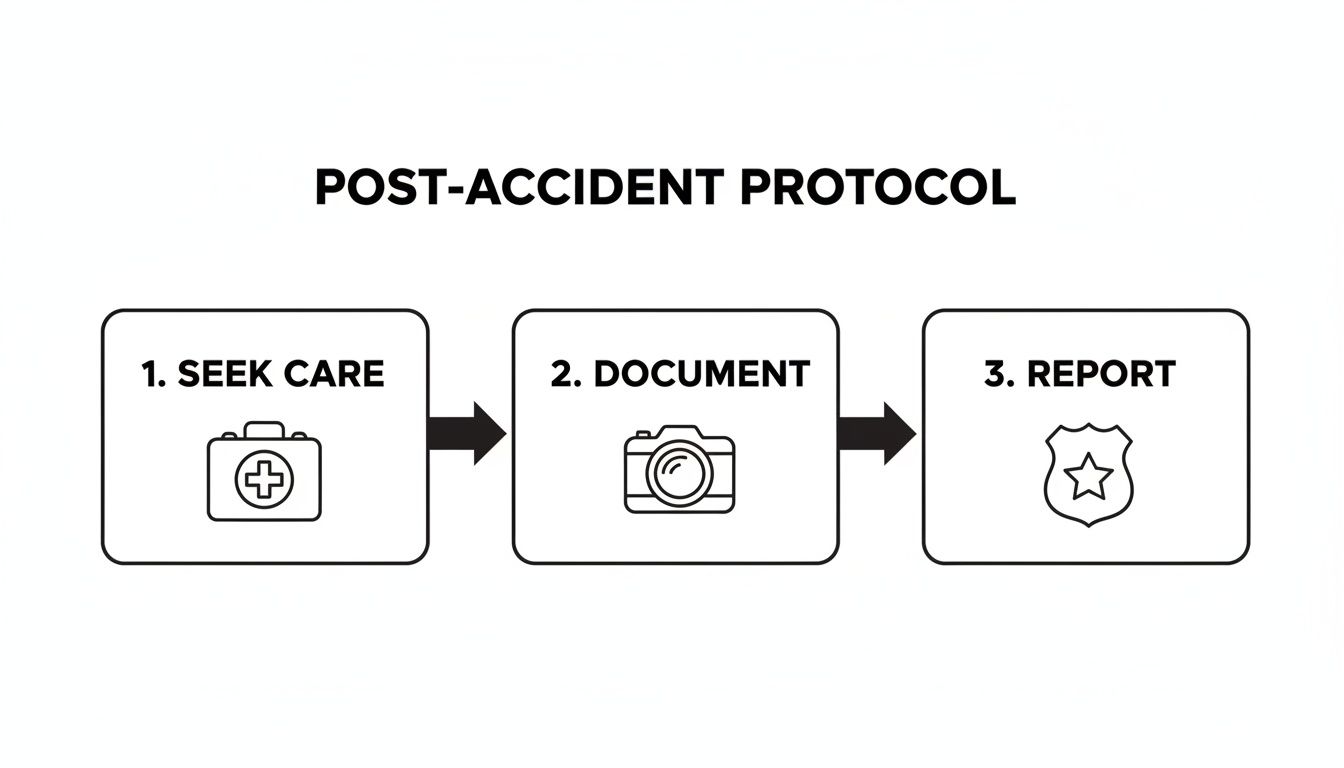
Following these steps—getting medical care, documenting everything, and reporting the crash—gives your attorney the solid evidence needed to fight for you.
What if I Was Partially at Fault? Understanding Comparative Responsibility
Accidents aren't always black and white. Sometimes, a crash has more than one cause. Texas law has a system for this called modified comparative responsibility, also known as the "51% Bar Rule."
This rule is pretty simple: you can still get compensation, but only if your share of the blame is less than 51%. If you are found to be 51% or more responsible, you get nothing.
If you are partially at fault, your final payment is just reduced by your percentage of blame. So, if a jury awards you $100,000 but decides you were 10% at fault for the crash, your award would be cut by $10,000, leaving you with $90,000. Insurance adjusters love to use this rule to shift as much blame as possible onto you to lower their payout.
How Long Do You Have to File a Claim in Texas?
Of all the legal rules, this is the one you absolutely cannot ignore: the statute of limitations. In Texas, you typically have only two years from the date of your car accident to file a lawsuit.
If you miss this two-year deadline, the court will almost certainly dismiss your case, and you will lose your right to seek compensation forever—no matter how severe your back injury is or how clear the other driver's fault was.
This isn't a soft deadline. It's a hard stop. Evidence gets lost, witnesses' memories fade, and your legal rights simply expire. Don't wait until the last minute.
You can learn more about the specifics and a few rare exceptions in our guide on the statute of limitations for Texas car accidents. The best thing you can do is contact a Texas personal injury lawyer right away to make sure every deadline is met and your case is protected from day one.
How to Prove the Full Value of Your Back Injury Claim

When an insurance adjuster looks at your back injury claim, they see numbers on a spreadsheet. But you see your life—the constant pain, the missed paychecks, and the nagging uncertainty about what comes next. Proving what your claim is really worth means forcing them to see the whole picture, which is always much bigger than just the first hospital bill.
In Texas, the compensation you can fight for falls into two buckets: economic damages and non-economic damages. You have to build a strong case for both to get a fair settlement that actually covers everything you've lost.
Accounting for Every Penny of Economic Damages
Economic damages are the tangible financial losses you’ve racked up because of your car accident. These are the bills piling up on your kitchen table and the income that’s no longer hitting your bank account.
To build an undeniable case, you need to track every single cost.
Medical Bills (Past and Future): This is the bedrock of your claim. Save every single receipt, bill, and explanation of benefits tied to your medical care. This means everything—the ambulance ride, ER visit, MRI scans, specialist appointments, prescriptions, and physical therapy sessions.
Lost Wages and Income: Every hour of work you miss because of pain, doctor’s visits, or recovery is a quantifiable loss. Keep a detailed log of your missed shifts and get a letter from your HR department confirming your pay rate and the time you’ve lost.
Lost Earning Capacity: This is one of the most important—and most frequently missed—parts of a claim. If that back injury stops you from going back to your old job or limits the kind of work you can do for the rest of your life, you deserve to be compensated for that diminished earning potential.
Imagine a San Antonio construction worker who suffers a herniated disc in a rear-end collision. He’s not just facing the cost of surgery; he may never be able to lift heavy materials again. His ability to earn a living in his trade has been permanently damaged, and that future loss must be calculated and proven.
Proving the Intangible Costs of Your Injury
Non-economic damages are just as real as medical bills, but they don't come with a neat invoice. These are the deep, personal losses that have completely upended your quality of life. In Texas, these are a major part of any serious back injury claim.
- Pain and Suffering: This is compensation for the physical pain, chronic discomfort, and emotional toll the injury has caused.
- Physical Impairment: This addresses losing the ability to do things you once did without a second thought, like playing with your kids, going to the gym, or working in your garden.
- Mental Anguish: A serious back injury and the chronic pain that follows often bring on anxiety, depression, and sleepless nights.
- Loss of Enjoyment of Life: This covers your inability to engage in the hobbies and activities that brought you happiness before the crash.
Proving these damages means you have to tell your story in a compelling way. One of the best tools for this is a daily pain journal. Write down your pain levels, the struggles you face with simple tasks, and the emotional impact the injury is having on you and your family. If you're unsure where to start, you can learn more about how our firm helps clients prove pain and suffering in Texas.
By carefully documenting both your financial and human damages, you build a case that shows the true, full value of what was taken from you. It's this detailed proof that forces an insurance company to stop with the lowball offers and start negotiating a fair settlement that honors everything you've been through.
Why You Should Partner with a Texas Personal Injury Lawyer

Trying to heal from painful car accident back injuries is a full-time job. Going to battle with an insurance company at the same time can feel overwhelming, if not impossible. This is a fight you simply shouldn't have to take on by yourself.
Partnering with an experienced Texas personal injury lawyer does more than just level the playing field—it allows you to pour all your energy into what truly matters: getting better.
How a Lawyer Protects You from Insurance Company Tactics
After a crash, the other driver's insurance adjuster might seem friendly, even helpful. But it's critical to remember who they work for. Their primary job is to protect their company's profits, and that almost always means paying you as little as they possibly can.
They'll often push for a recorded statement, hoping you'll say something they can twist to assign you blame or minimize your injuries. A quick, lowball settlement offer is another classic move. An adjuster might present a check, counting on you being desperate for cash and unaware of your claim's true value—especially when it comes to future medical care.
An insurance company's first offer is rarely their best. It's a test to see if you understand what your claim is actually worth, including all future medical costs, lost income, and your pain and suffering.
An experienced lawyer has seen these strategies countless times. For instance, if you were hit in Houston, a skilled Houston car accident attorney will immediately take over all communication with the insurer. This not only stops the calls and protects you from saying something that could harm your case, but it also sends a clear message: you won't be bullied.
When to Call a Lawyer After a Car Accident
While a minor fender bender might not need legal intervention, some situations make hiring an attorney absolutely crucial for protecting your rights and your future. You should call a lawyer right away if:
- Your back injuries are severe or may require surgery. The more serious the injury, the higher the financial stakes. An attorney works to ensure you're compensated for long-term care, not just the initial ER bill.
- The other driver is disputing who was at fault. If they're trying to blame you, a lawyer can immediately start gathering evidence like police reports and witness interviews to establish the truth.
- The insurance company makes a low settlement offer or denies your claim. This is a red flag that you need a professional to step in and fight for the fair compensation you're owed.
- You've suffered a life-altering injury. For catastrophic harm, like what often happens in a major truck crash, a dedicated truck crash lawyer Houston or a catastrophic injury lawyer is essential to securing your family’s financial stability. Sadly, if a loved one was lost, you should speak with a wrongful death lawyer Texas as soon as possible.
Legal Help is Accessible and Risk-Free
Many people hesitate to call a lawyer because they worry about the cost. This is a common misconception. Most reputable personal injury firms, including The Law Office of Bryan Fagan, PLLC, operate on a contingency fee basis.
What does that mean for you? You pay absolutely nothing upfront. We cover all the expenses of investigating your accident and building a powerful case. You only pay our fee if and when we win a settlement or verdict for you. This model ensures that everyone, regardless of their financial situation, can have access to justice.
A serious accident can change your life in an instant, but you don't have to navigate the aftermath alone. Recovery is your priority, and having an experienced legal team in your corner can make all the difference. We’re here to provide clarity, trust, and hope. To find out how we can help, schedule a free, no-obligation consultation with us today.
Frequently Asked Questions About Texas Back Injury Claims
After a serious car crash, your mind is probably racing with questions. It’s a confusing and overwhelming time, and you need clear answers. We’ve heard these same questions from countless clients over the years, and we want to provide some straightforward guidance to help you understand your next steps.
How Long Do I Have to File a Back Injury Claim in Texas?
Texas law sets a strict deadline to file a personal injury lawsuit, known as the statute of limitations. You generally have two years from the date of the car accident.
While there are a few very rare exceptions, it's incredibly risky to assume one will apply to your situation. If you miss this deadline, you will almost certainly lose your right to recover any compensation, no matter how severe your back injury is. Evidence gets lost and memories fade, which is why it's so important to act quickly to protect your legal rights.
What if My Back Pain Appeared Days After the Crash?
This happens all the time. The shock and adrenaline that flood your system during a traumatic event like a car wreck are powerful pain-maskers. They can easily hide the initial symptoms of serious injuries, especially soft tissue damage like a herniated disc or whiplash.
It is absolutely crucial to get a full medical evaluation the moment you feel any pain, stiffness, or other symptoms. Creating a medical record that officially documents your delayed symptoms and connects them to the accident is one of the most powerful steps you can take.
Insurance companies love to argue that pain showing up days later must be from something else. An experienced Houston car accident attorney knows this tactic well and understands how to use medical evidence to prove the direct link between the collision and your injuries.
Can I Still Get Compensation if I Was Partially at Fault?
Yes, in most cases, you can. Texas operates under a legal principle called the modified comparative fault rule, also known as the 51% bar rule.
This rule means you can still recover damages from the other driver as long as you are not found to be 51% or more to blame for the crash. However, your final compensation will be reduced by your percentage of fault. For example, if a jury awards you $100,000 for your back injury claim but finds you were 20% at fault, your award would be reduced by $20,000, and you would receive $80,000.
How Much Is My Back Injury Claim Worth?
There's no simple formula or average settlement amount because every single case is different. The true value of your claim will depend on a number of unique factors, including:
- The severity and permanence of your injury (e.g., a lumbar sprain versus a spinal cord injury).
- The total cost of all your medical treatment, both past and future, such as surgery or ongoing physical therapy.
- The total amount of lost wages from the time you've had to miss work.
- Your loss of future earning capacity if you can no longer do your job or must take a lower-paying one.
- The impact on your quality of life, often called pain and suffering.
A minor back strain that heals in a few weeks might result in a claim worth a few thousand dollars. On the other hand, a catastrophic injury from a devastating truck crash that requires lifelong medical care could be worth millions. A skilled Texas personal injury lawyer will meticulously investigate every detail to calculate the full and fair value of everything you've lost.
A serious back injury can make you feel powerless, but you don’t have to go through this alone. The compassionate attorneys at The Law Office of Bryan Fagan, PLLC are here to fight for you and help you get the resources you need to rebuild your life. We'll handle the entire legal battle so you can put all your energy into healing.
Recovery is possible, and the right legal help is just a call away. To discuss your case with an experienced Texas personal injury attorney, you can schedule a free, no-obligation consultation by visiting our website at https://texaspersonalinjury.net.