A serious accident can change your life in seconds — but you don’t have to face it alone. The first formal step toward getting the compensation you deserve often begins with writing a personal injury demand letter. Think of this document as the opening move that officially presents your case to the at-fault party’s insurance company and gets settlement talks started.
Your First Step Toward Fair Compensation

After a crash in Texas, the road to recovery can feel overwhelming. You’re juggling doctor’s appointments, watching bills pile up, and facing a great deal of uncertainty. Drafting a personal injury demand letter is a powerful action you can take to start regaining control. This isn’t just a simple note; it’s a formal legal document with a clear, critical purpose.
This letter is your official notice to the insurance company that you are seeking payment for the harm their insured driver caused. It’s your chance to lay out a clear, organized, and compelling argument for why you are owed a fair settlement.
The Power of a Well-Crafted Demand Letter
A strong demand letter sets the entire tone for the negotiation process. It immediately shows the insurance adjuster you are serious and have organized the evidence to back up your claim. For them, this letter is the first detailed look they will get at your side of the story.
A comprehensive letter needs to achieve a few key goals:
- Establish Fault: It must clearly explain how the other party’s negligence led to the accident and your injuries—a cornerstone of Texas personal injury law.
- Detail Your Losses: It should provide a complete accounting of all your damages, from medical bills and lost income to your physical pain and emotional distress.
- Present Your Demand: It states a specific, justifiable dollar amount you’re seeking to settle the claim, which officially kicks off the negotiation phase.
For instance, after a Houston freeway crash, your demand letter needs to connect the other driver’s reckless lane change directly to your injuries and every single financial loss that followed. The better you tell that story, the stronger your position becomes.
By clearly laying out the facts, the law, and the full extent of your damages, a demand letter forces the insurance company to take your claim seriously from the very beginning.
Why This Letter Is Your Starting Point
The demand letter is a critical step that comes long before filing a lawsuit. In fact, the vast majority of personal injury cases in Texas are resolved through a settlement and never see the inside of a courtroom. This makes the demand letter one of the most important documents you’ll prepare.
It’s the foundation your entire claim is built on. It tells the insurer you know your rights and are ready to fight for them. While this guide will walk you through the specifics, understanding how to file a personal injury claim can give you even more context and confidence.
At The Law Office of Bryan Fagan, PLLC, we help accident victims across Texas craft persuasive demand letters that get results. If you’re feeling overwhelmed, remember you don’t have to do this alone. We’re here to offer clarity, support, and the experienced legal guidance you need.
Your recovery is our priority. To discuss your case with a dedicated Texas personal injury lawyer, contact us today for a free, no-obligation consultation.
Building the Foundation for Your Demand Letter
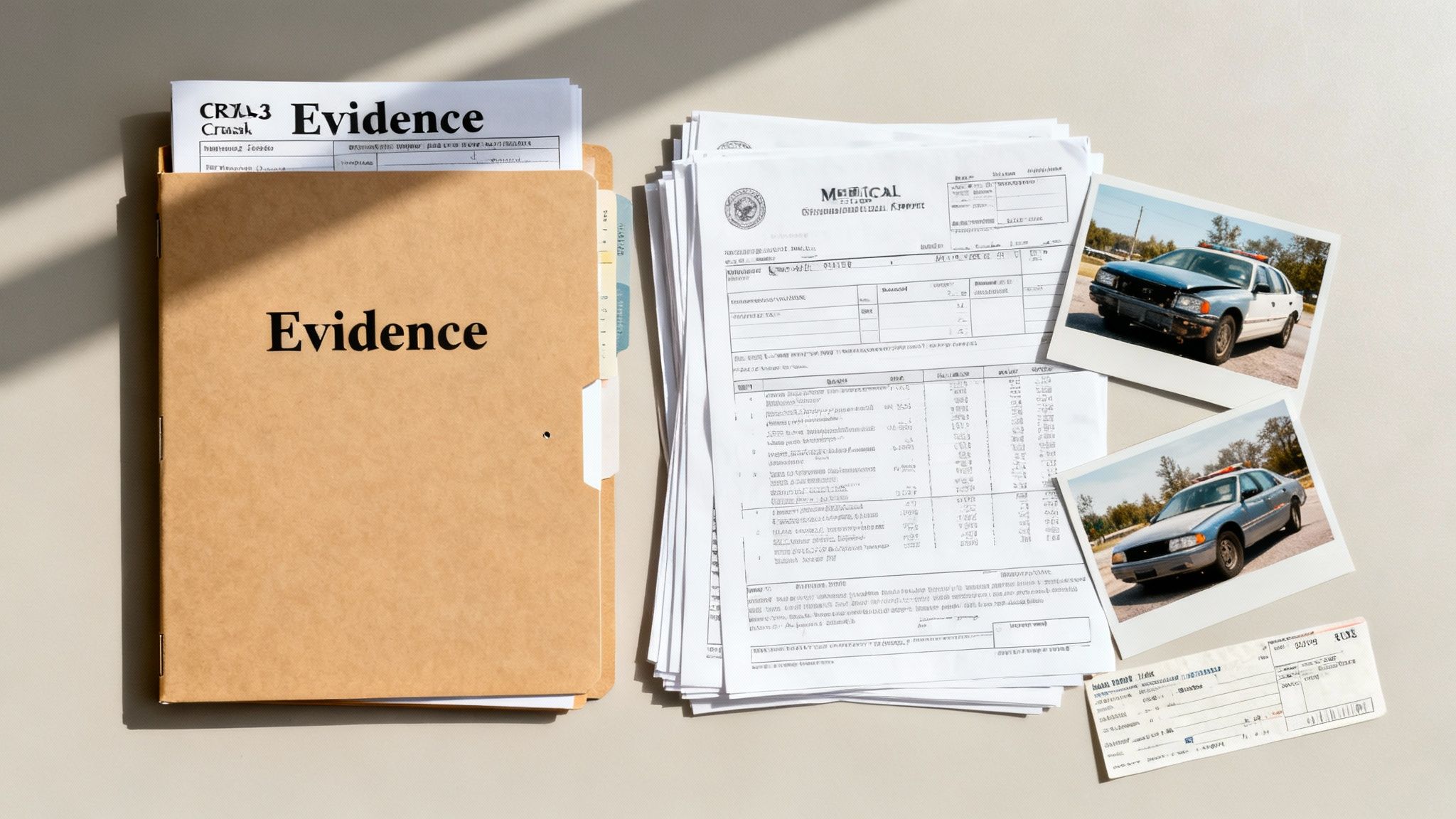
Before you can think about writing a demand letter, you have to lay the groundwork. An insurance adjuster isn’t just going to take your word for it—a demand without proof is just an opinion. But a demand backed by a mountain of solid evidence? That’s a powerful tool that forces them to sit up and take you seriously.
Think of it like building a case file, piece by piece. Your job is to gather every single document that tells the complete story of the accident and everything that happened afterward. This evidence is the bedrock of your claim, proving not just what happened, but the full, devastating impact it’s had on your life.
The Essential Evidence Checklist
While every personal injury case has its own unique details, there are certain documents you will almost always need to build a strong claim here in Texas. Your goal is to leave absolutely no room for the insurance company to question the other party’s fault or the true extent of your losses.
Here’s what you should start tracking down right away:
- The Texas Peace Officer’s Crash Report (CR-3): This is the official police report from the accident. It contains the officer’s initial assessment of who was at fault, contact details for any witnesses, and even a diagram of the crash scene.
- Photographs and Videos: Visuals are incredibly persuasive. Gather any photos or videos you have from the scene—they should show the vehicle damage, road conditions, traffic signs, and most importantly, any visible injuries you suffered.
- Witness Contact Information: If anyone saw what happened, their account can be a game-changer. Make sure you have their full names and phone numbers.
This initial batch of evidence establishes the core facts of the accident and serves as your starting point.
Documenting Your Medical Journey and Financial Losses
Once you have the evidence from the scene secured, your focus needs to shift to proving your damages. This means meticulously tracking every single medical and financial hit you’ve taken because of your injury.
Let’s say you suffered a serious injury in a truck crash on I-10 just outside of Houston. The paper trail is going to be extensive. You’ll need every hospital bill, every surgeon’s report, every physical therapy record, and every prescription receipt. Each document you add strengthens your claim.
Key Financial Documents to Collect:
- All Medical Bills and Records: This isn’t just the big stuff. It includes everything from the ambulance ride and ER visit to ongoing physical therapy, specialist appointments, and any estimates for future medical care.
- Proof of Lost Wages: Gather recent pay stubs to show what you were earning before the accident. You’ll also need a formal letter from your employer confirming the exact dates you were out of work and your rate of pay.
- Property Damage Estimates: Get professional repair estimates for your vehicle. Don’t forget any other personal items that were damaged in the crash, like a laptop or phone.
A powerful demand letter is absolutely critical because the vast majority of personal injury cases—around 95%—are settled before ever seeing a courtroom. This document is often the key to your financial recovery.
The Significance of a Thorough File
The strength of your demand letter is directly tied to the quality and organization of your evidence. Consider this: nearly 400,000 personal injury claims are filed in the U.S. each year. A well-supported demand is your first and best chance to stand out and secure a fair settlement. You can read more about these personal injury law statistics to get a better sense of the landscape.
Pulling all of this together can feel like a full-time job, especially when you should be focused on healing. And if you have lost a family member and are pursuing a wrongful death claim, the emotional weight makes this task feel impossible.
You don’t have to do this on your own. A dedicated truck crash lawyer Houston can take this entire burden off your shoulders, handling the evidence gathering and making sure your case is built on a rock-solid foundation from day one.
Calculating the True Value of Your Injury Claim
Putting a dollar figure on your pain, your stress, and the life you had before the accident is easily one of the toughest parts of drafting a demand letter. It can feel unnatural to translate suffering into a number. But this calculation is absolutely critical for getting the financial support you need to truly recover.
Under Texas law, you can seek compensation for a wide range of losses. These are generally broken down into two main categories. Understanding these is the first step to arriving at a settlement figure that’s both fair and justified. The goal here is to account for every single way the accident has impacted your life—from the obvious medical bills to the less tangible, but very real, emotional damage.
Tallying Your Economic Damages
Economic damages are the foundation of your claim’s value. These are the tangible, out-of-pocket financial hits you’ve taken, and you can prove them with receipts, invoices, and other hard documentation. Think of this part as the straightforward math.
Your calculation needs to include a detailed list of every cost you’ve already paid and what you expect to pay in the future. Don’t make the mistake of only adding up the bills you have in hand. You have to forecast the complete financial impact for your entire recovery journey.
Common Economic Damages to Include:
- Medical Expenses: This is everything—the ambulance ride, the ER visit, surgeries, hospital stays, prescriptions, physical therapy, and any other treatment.
- Future Medical Care: If your doctor says you’ll need more treatment, another surgery, or long-term care, those projected costs must be part of your demand.
- Lost Wages: Add up every single dollar of income you lost because you couldn’t work. Pay stubs and a letter from your employer will back this up.
- Loss of Earning Capacity: This is a big one. If your injuries stop you from returning to your old job or limit your ability to earn a living in the future, that loss must be calculated.
- Property Damage: This is usually the cost to repair or replace your vehicle, but it also includes any other personal items destroyed in the wreck, like a laptop or phone.
One of the most critical mistakes people make is sending a demand letter before they fully grasp the long-term costs of their injury. You only get one shot to settle your claim, so you have to account for all future needs right from the start.
Valuing Your Non-Economic Damages
While economic damages are about what came out of your wallet, non-economic damages are about what the accident stole from your quality of life. These losses are intangible and much harder to pin a number on, but they are just as real and compensable under Texas law. For a deeper look, check out our detailed guide on the different types of damages in a Texas personal injury claim.
This is where the math gets more nuanced. How do you put a price tag on chronic pain, sleepless nights, or not being able to pick up your children? This is where experience really matters. Attorneys and insurance adjusters often use methods like the “multiplier method” to assign a value. This involves totaling your economic damages and multiplying that number by a figure—usually between 1.5 and 5—depending on the severity of your injuries and how profoundly they’ve impacted your life.
For example, a catastrophic injury from a commercial truck accident will demand a much higher multiplier than a minor sprain from a fender bender.
Let’s break down these two categories a bit more clearly.
Understanding Your Personal Injury Damages in Texas
| Type of Damage | What It Covers | Common Examples |
|---|---|---|
| Economic Damages | These are the direct, verifiable financial losses you have incurred or will incur because of the injury. |
|
| Non-Economic Damages | These are the intangible, non-monetary losses related to your quality of life and emotional well-being. |
|
It’s important to remember that the emotional toll is a real, compensable part of your claim. Seeking support like ICBC counselling after an accident isn’t just a step toward healing; it also helps demonstrate the genuine mental and emotional impact the accident has had on you.
The personal injury legal market in the U.S. is a massive financial landscape, valued somewhere between $53 billion and $61.3 billion annually. With car accidents making up 52% of all personal injury cases, demand letters are a cornerstone of this process. While the average payout for a minor injury claim might be around $26,501, serious crashes often lead to settlements well into the six figures. This is exactly why a precise and thorough damage calculation is so vital to your success.
Arriving at that final number—one that’s both fair to you and strategically sound—takes skill. Ask for too little, and you leave money on the table that you’re rightfully owed. Ask for an unreasonably high amount, and the insurance company might not take you seriously. This is where the guidance of a skilled Texas personal injury lawyer can make all the difference.
How to Structure a Compelling Demand Letter
You’ve gathered your evidence and tallied up the damages. Now it’s time to put it all together into a powerful, persuasive document. A professional, well-organized letter makes it easy for an insurance adjuster to follow your logic, grasp the severity of what you’ve been through, and understand why your settlement figure is justified.
Think of each section as a building block. You’re leading the adjuster step-by-step through the facts, leaving no room for doubt about their client’s liability or the extent of your suffering.
The Introduction: Your Opening Statement
Your letter should start with a clear, concise introduction. This section sets the stage and gives the adjuster the basic information they need to find your file and understand why you’re writing. This isn’t the place for emotion—it’s about professionalism and facts.
- State your full name.
- Include the date of the accident.
- Name their insured party (the person at fault).
- Provide the claim number if you have one.
- Clearly state that this letter is a formal demand for settlement for the injuries and damages you sustained.
The Narrative: Recreating the Accident
Here, you tell the story of what happened. Your goal is to paint a vivid, factual picture of the accident from your point of view, showing exactly how the other party’s negligence caused the crash. Lean on the evidence you’ve collected, like the police report and witness statements, to build a solid narrative.
For example: “On the afternoon of May 15th, I was driving westbound on the Katy Freeway in Houston, traveling within the speed limit in the center lane. Your insured, Mr. Smith, made an abrupt and unsignaled lane change from the right lane directly into my path, causing a violent collision.” This kind of specific, factual language is far more effective than vague or emotional descriptions.
This infographic shows how your documented damages form the basis of your total demand.
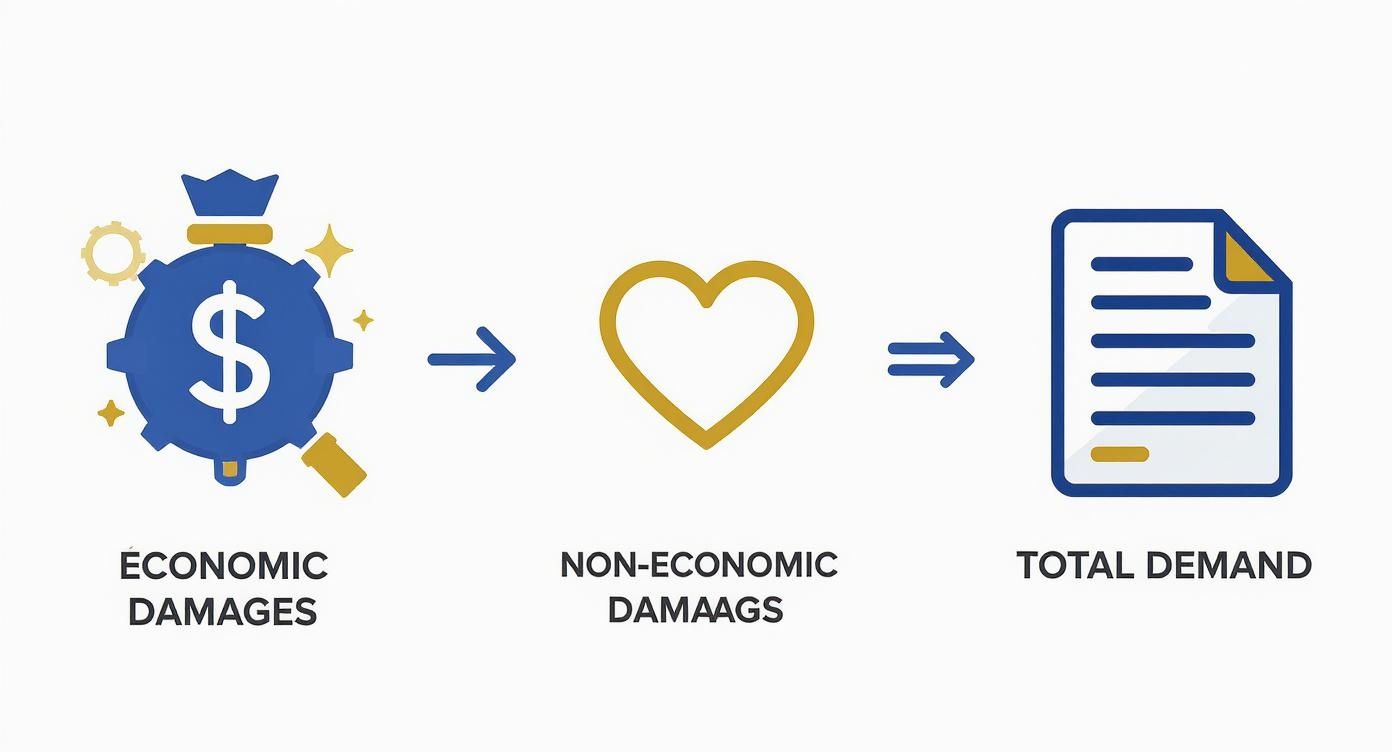
This visual flow makes it clear to an adjuster that your final demand is a thoughtful calculation based on real losses, not just an arbitrary number.
Establishing Liability Under Texas Law
After describing the accident, you must explicitly connect the other driver’s actions to the legal concept of negligence. This is a critical part of writing a demand letter for personal injury in Texas. You need to show that their insured had a duty to drive safely, breached that duty, and that this breach directly caused your injuries.
You can do this by referencing specific traffic laws they broke. For instance: “Mr. Smith’s failure to signal and ensure the lane was clear before moving constitutes a violation of the Texas Transportation Code and is clear evidence of negligence.” This shows the adjuster you’re not just guessing—you understand the legal basis for your claim.
Your demand letter is your first, best chance to frame the narrative. It’s not just a request for money; it’s a legal argument that shows the insurance company you are prepared, organized, and serious about getting a fair outcome.
Describing Your Injuries and Medical Treatment
This section details the human cost of the accident. Be thorough. Describe every single injury you sustained, from major fractures to the persistent ache of soft tissue damage. Explain all the medical treatment you’ve received—hospital stays, surgeries, physical therapy sessions, and medications.
It’s also crucial to describe how these injuries have affected your daily life. Talk about the physical pain, the emotional distress, and the activities you can no longer enjoy. This context helps justify your demand for non-economic damages, like pain and suffering. This is especially vital in cases involving a catastrophic injury, where the life-altering consequences must be made crystal clear.
The Final Demand for a Specific Amount
Finally, you get to the bottom line: your total settlement demand. This should be a single, specific dollar amount that represents the sum of your economic and non-economic damages. You can briefly itemize the major damage categories (e.g., medical bills, lost wages, pain and suffering) to show the adjuster how you arrived at your number. Conclude by giving them a reasonable deadline to respond—30 days is typical—and let them know you’re prepared to discuss the claim further.
Crafting this letter is a demanding task, especially when you should be focused on your recovery. A seasoned Houston car accident attorney can handle this entire process, ensuring your demand letter is professional, persuasive, and positioned for the best possible result.
If you are ready to take this step but don’t want to face the insurance company alone, The Law Office of Bryan Fagan, PLLC is here to help. Contact us for a free consultation to discuss your case and learn how we can fight for the compensation you deserve.
Critical Mistakes That Can Weaken Your Claim
Putting together a demand letter is a high-stakes moment in your personal injury claim. Even a small, unintentional mistake can give the insurance company the ammunition it needs to drastically reduce your settlement offer.
Remember, insurance adjusters are trained to scrutinize every word. They know exactly what to look for, and they will use any weakness they find to devalue your case. Steering clear of these common pitfalls is one of the most important things you can do to protect your right to fair compensation.
One of the worst mistakes you can make is accidentally admitting even a tiny bit of fault. Here in Texas, we operate under a rule called comparative responsibility, also known as the 51% bar. This means your final settlement amount is reduced by whatever percentage of fault you’re assigned. If they decide you were 51% or more to blame, you get nothing. Zero.
A simple remark like, “I guess I should have seen them coming,” can be twisted by an adjuster to pin more of the blame on you, directly shrinking the check you receive.
The Danger of Speaking Too Soon or Saying Too Much
Right after an accident, it’s common for the other driver’s insurance adjuster to call and ask for a recorded statement. It is almost never a good idea to agree to this without talking to a lawyer first. Practical advice for accident victims is to politely decline until you have legal representation.
You’re likely in pain, perhaps on medication, or simply not remembering every detail with perfect clarity. Any small inconsistency between that recorded statement and the evidence that comes out later can be used to attack your credibility.
It’s also a huge mistake to downplay your injuries. We have a natural tendency to be polite and say, “I’m doing okay,” or “It’s not so bad,” when asked how we feel. An adjuster will make a note of that statement and later use it to argue your injuries weren’t as severe as your medical records prove. You can get more practical tips on these conversations in our guide on how to deal with insurance adjusters.
Miscalculating Your Demand and Missing Your Deadline
Demanding an unrealistic number can completely derail negotiations before they even start. If you throw out a wildly inflated figure with no evidence to back it up, the adjuster may decide you are not serious and refuse to negotiate in good faith.
On the flip side, if you send your demand letter before you’ve reached Maximum Medical Improvement (MMI), you run the risk of asking for far too little. This could leave you paying for future surgeries, therapies, and other medical needs completely out of your own pocket.
But the single most devastating mistake is missing the deadline to file a lawsuit. Under the Texas statute of limitations, you generally have only two years from the date of the accident to file. If you miss that window, you lose your right to seek compensation forever.
While the vast majority of cases—between 95% and 96%—settle out of court, the demand letter is what kicks off this entire process. With nearly 409,000 personal injury claims filed each year in the U.S., a strong, well-supported letter is your best tool for securing a fair outcome.
When to Call a Lawyer After an Accident
While you can write a demand letter on your own, some situations are just too complex and high-stakes to handle without professional legal help. Trying to navigate these cases alone can put your entire financial future on the line.
You should call an experienced Texas personal injury lawyer immediately if:
- Your injuries are severe and will require long-term or lifelong care.
- You are pursuing a wrongful death claim after losing a loved one.
- The accident involved a commercial vehicle, like a semi-truck, which brings in complex federal regulations and corporate legal teams.
- The insurance company is denying liability or blaming you for the accident.
- You’ve received a lowball offer that doesn’t even come close to covering your medical bills.
If any of these sound like your situation, the risk of going it alone is just too great. The Law Office of Bryan Fagan, PLLC is here to help you avoid these costly mistakes. We invite you to schedule a free, no-obligation consultation to talk about your case and make sure your rights are fully protected.
How Long Do You Have to File a Claim in Texas?
When you’re navigating a personal injury claim, it’s completely normal to have a lot of questions. The whole process can feel overwhelming, and sometimes, just getting straight answers is the best way to regain a sense of control. Here are some of the most common questions we hear from clients about personal injury demand letters in Texas.
What Happens After I Send the Demand Letter?
Once your demand letter lands on the insurance adjuster’s desk, they will begin their own review. They will read through your account of what happened, comb through the evidence you sent, and almost certainly call their own insured driver to get their side of the story.
After they’ve done their homework, the adjuster will usually do one of three things:
- Accept your demand: This almost never happens right away.
- Make a counteroffer: This is the most likely response and it officially kicks off the negotiation phase.
- Deny your claim: This will happen if they’ve decided their driver holds zero liability for the crash.
Don’t be discouraged if their first counteroffer is extremely low. It’s a classic negotiation tactic designed to see if you’ll back down easily. An experienced attorney knows this game well and will handle all the back-and-forth, working to close the gap between their lowball number and the fair compensation you actually deserve.
Can I Still Send a Demand Letter if I Was Partially at Fault?
Yes, you absolutely can—but trying to do this without a lawyer is very risky. Texas law follows a principle called comparative responsibility, often called the “51% bar rule.” What this means is you can still recover money for your injuries as long as you weren’t 51% or more to blame for the accident.
But there’s a catch. Whatever compensation you’re awarded will be reduced by your percentage of fault. For example, if you were found to be 20% at fault for a pileup on a Houston freeway, your final award would be slashed by 20%. Insurance adjusters are masters at twisting your words to pin more of the blame on you. This is precisely why you need a Houston car accident attorney handling all communications in any case where fault might be shared.
When Is the Right Time to Send a Demand Letter?
Patience is key. You should never send a demand letter until you’ve reached what’s called Maximum Medical Improvement (MMI). This is the point where your doctors confirm your condition has stabilized as much as it’s going to, and no further treatment is expected to improve it.
Sending your demand too soon is a huge mistake. If you haven’t reached MMI, you can’t possibly know the final tally of your medical bills, whether you’ll need future surgeries, or how these injuries will truly affect your ability to earn a living down the road. Rushing it means you could settle for a fraction of what your claim is actually worth. While you always need to keep Texas’s two-year statute of limitations in mind, it’s far better to be thorough than to be short-changed.
The road to getting the compensation you’re owed can feel complicated, but you don’t have to walk it alone. At The Law Office of Bryan Fagan, PLLC, our team of Texas personal injury lawyers is ready to answer your questions and manage every detail of your claim. From drafting a rock-solid demand letter to fighting for you in court, we are here to offer you clarity, trust, and hope.
We want you to know that recovery is possible, and legal help is available. Schedule your free, no-obligation consultation today. Contact us online or give us a call to take the next step with confidence.