A serious accident can change your life in seconds—but you don’t have to face it alone. After a crash that wasn't your fault, you're not just dealing with vehicle repairs; you're facing a hidden financial loss that many people overlook. A diminished value claim is how you demand compensation for the drop in your car's resale value after it's been repaired. Even with the best bodywork, a vehicle with an accident history is simply worth less than one with a clean record. You have the right to get that money back.
Your Car Is Repaired, But It's Not Worth the Same
After a major crash on a Houston freeway, your first thought is getting your life back on track. You get your car fixed, and it looks and drives just like it did before. But there's an invisible kind of damage that sticks around: a permanent hit to its market value.
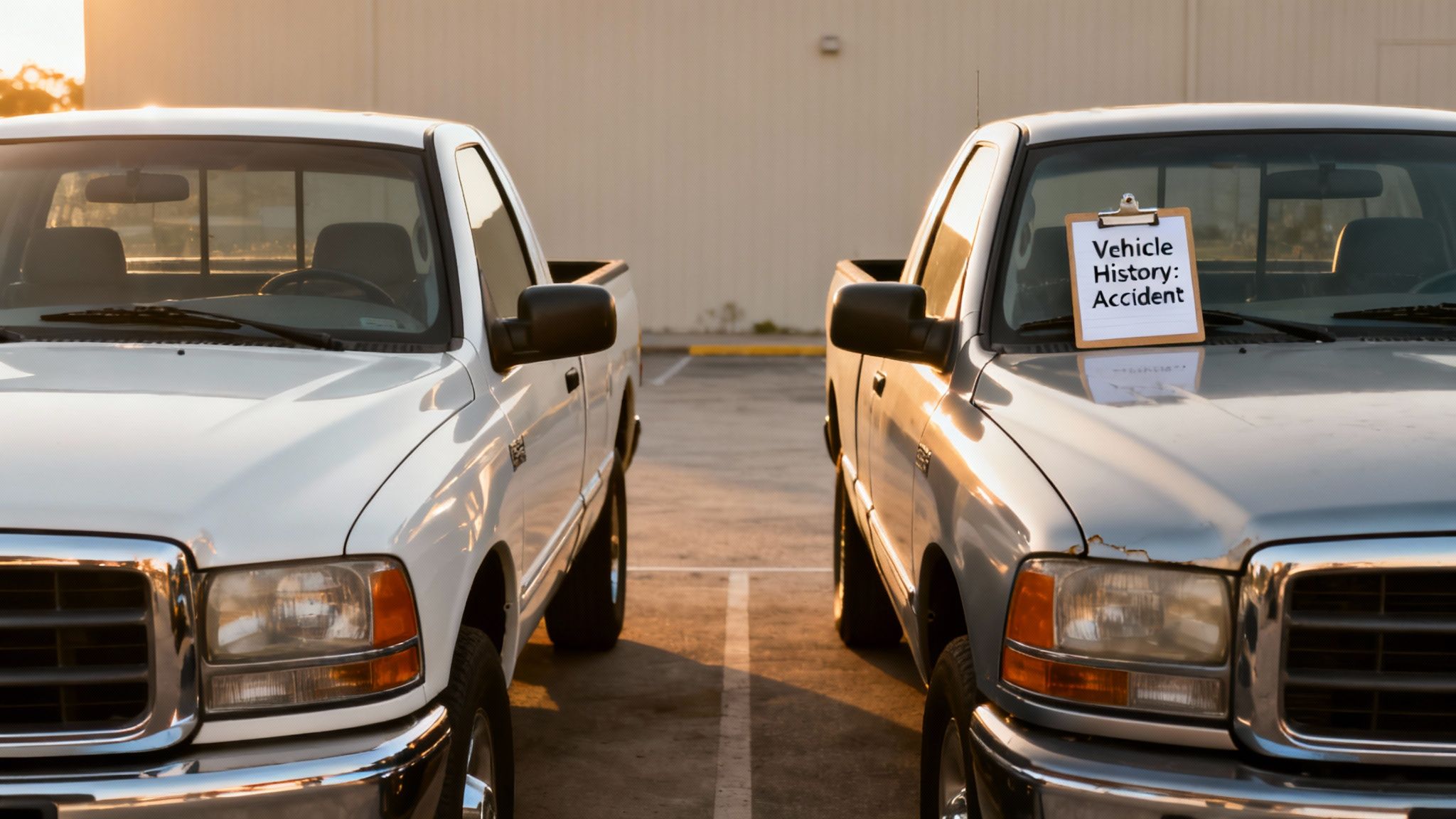
Think about it this way. Imagine two identical used trucks are for sale. One has a clean vehicle history, but the other’s report shows a major collision on I-45. Even if the repairs were flawless, which one do you think a buyer would pay more for? The one without the accident history, every single time. That difference in price is its diminished value.
Understanding Your Financial Loss
This isn't just an abstract idea; it's a real financial injury you've suffered because another driver was negligent. In Texas, the law holds that the at-fault driver is responsible for making you whole again—and that includes compensating you for this loss in your car's value. This is based on the legal principle of negligence, where one party's failure to act with reasonable care causes harm to another.
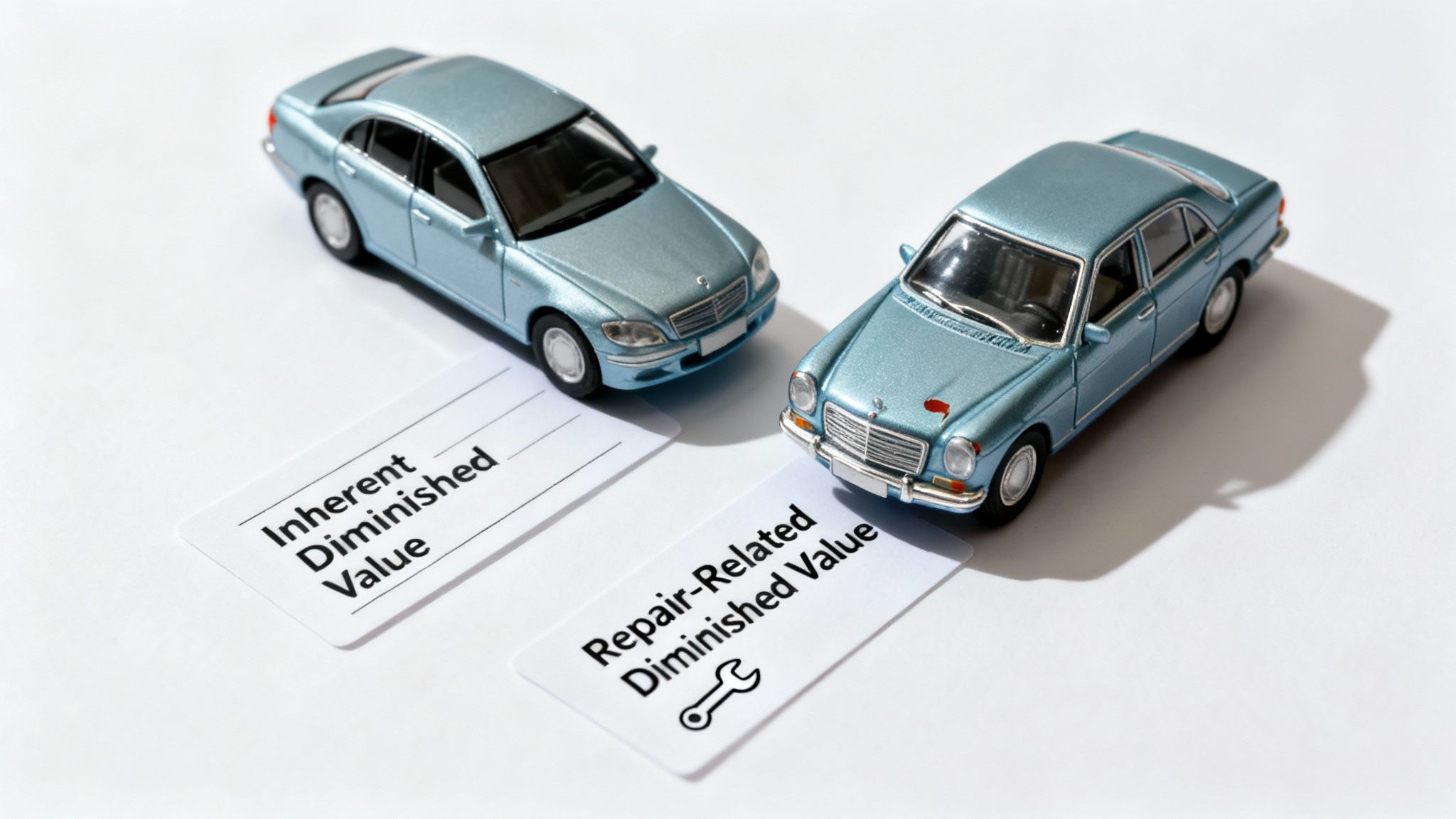
Diminished value claims exist because a vehicle that’s been in a wreck almost always sells for less than one that hasn't. Industry experts call this loss inherent diminished value. It’s the stigma that attaches to a car simply because an accident now shows up on its history report, no matter how good the repairs were.
To help you grasp the essentials, here’s a quick breakdown of what goes into one of these claims.
Core Concepts of a Diminished Value Claim
| Concept | What It Means for Your Claim |
|---|---|
| Inherent Diminished Value | This is the automatic loss in value because the vehicle now has an accident history. It's the most common type of claim. |
| Repair-Related Diminished Value | This occurs when the repairs themselves are subpar, using mismatched paint, non-OEM parts, or leaving structural issues. |
| Market Stigma | The general perception among buyers that a previously damaged vehicle is less reliable or desirable, regardless of repair quality. |
| At-Fault Party | In Texas, which is a fault state, you must file a diminished value claim against the at-fault driver's insurance, not your own. |
Understanding these points is the first step toward getting the full compensation you are owed.
The core principle is simple: You should not have to bear the long-term financial burden of an accident someone else caused. A diminished value claim is one of the key types of damages you can pursue to make yourself whole again.
Of course, the quality of the repairs plays a role, too. Using high-quality, certified components like CAPA certified parts can help minimize any repair-related value loss. But even perfect repairs rarely wipe out the inherent loss from the accident itself. An experienced Texas personal injury lawyer knows how to prove this loss and will fight to get you the full compensation you deserve.
The Different Types of Diminished Value Explained
To build a strong case and get the compensation you're owed, it helps to know exactly what kind of financial loss you're trying to recover. While "diminished value" might sound like a single, simple concept, it actually breaks down into a few distinct categories. Figuring out which ones apply to your car is the first step toward a successful claim.
The biggest and most common one is inherent diminished value. This is the automatic drop in your car's resale value that happens the second an accident hits its permanent record. Even if a body shop performs flawless, factory-perfect repairs, the simple fact that it's been in a wreck makes it less desirable to future buyers.
Think about it from a buyer's perspective. Given two identical cars, one with a clean history and one that's been in a collision, which one would you choose? Or, at the very least, which one would you expect a discount on? That discount is the inherent value your car has lost, and the at-fault driver's insurance is responsible for paying you for it.
Inherent Diminished Value
Here's a real-world example: let's imagine a Dallas commuter whose nearly new SUV gets rear-ended on the highway. The body shop does a fantastic job, and the vehicle looks and drives like it did before the crash. But when the owner decides to trade it in a year later, the dealership's offer is $4,000 less than the book value, specifically because of the accident on the vehicle history report. That $4,000 gap is the inherent diminished value.
Repair-Related Diminished Value
The second type we often see is repair-related diminished value. This loss piles on when the repair work itself is subpar, making your vehicle worth even less. This happens more often than people realize, especially when an insurance adjuster pressures the shop to use the cheapest parts and methods.
Common problems that cause repair-related diminished value include:
- Mismatched Paint: The new paint job is just a shade off, creating a blotchy or two-toned appearance that's impossible to ignore.
- Aftermarket Parts: The shop uses cheap, non-original parts that don't fit quite right or are made from lower-quality materials.
- Unresolved Structural Damage: The car's frame was never restored to its exact factory specifications, leading to persistent alignment problems and uneven tire wear.
- Noticeable Blemishes: You can spot where body filler was used, or you notice that the gaps between body panels are now uneven.
If your vehicle suffers from both inherent diminished value and shoddy repairs, the total loss can be substantial. It's crucial to document the accident history and any flaws in the bodywork to build the strongest possible claim for all the value you've lost.
A skilled Houston car accident attorney can help you identify which types of diminished value apply to your situation. We partner with trusted, independent appraisers to accurately calculate your total loss and make sure the insurance company doesn't get away with ignoring any part of what they owe you. You shouldn't be left footing the bill for someone else's mistake.
How Insurance Companies Try to Undervalue Your Claim
After a wreck, it's easy to assume the at-fault driver's insurance company will do the right thing. But you have to remember their primary goal isn't fairness—it's protecting their bottom line. That often means paying you as little as legally possible for your diminished value claim. Knowing their playbook is the first step to protecting your rights.
Insurance adjusters are professional negotiators. They handle claims like yours all day, every day. They know most people have never gone through this process and might jump at the first low offer just to be done with the whole ordeal. That’s why you absolutely must understand your car’s true loss in value before you even start talking numbers. You can find out more about navigating these tricky conversations in our guide on how to deal with insurance adjusters.
The Flawed "17c Formula"
One of the most common tricks up their sleeve is a bogus calculation called the "17c Formula." This formula, named after an old Georgia court case, is specifically designed to spit out an artificially low diminished value number. It starts with a maximum loss amount and then applies random caps and modifiers that have nothing to do with the real-world car market here in Texas.
The 17c Formula is a joke among legitimate appraisers and attorneys. It’s a tool built for one purpose: to serve the insurer's interests, not to make you whole again.
This method completely ignores the things that actually matter, like your car's specific make and model, how severe the structural damage was, or what buyers in your local market are actually willing to pay for a vehicle with an accident history. Any sharp Houston car accident attorney will spot the use of this unfair formula from a mile away and immediately shut it down.
The Right Way to Calculate Your Loss
The only legitimate way to figure out your vehicle’s diminished value is with a comprehensive appraisal from a certified, independent expert. Unlike the insurance company's made-up formula, a real appraiser does a deep-dive analysis.
This expert will:
- Pinpoint the fair market value of your vehicle before the crash happened.
- Get under the hood and thoroughly inspect the quality of the repairs once the body shop is finished.
- Analyze actual market data for similar cars sold right here in Texas.
- Give you a certified report that breaks down the exact dollar amount your car has lost in value.
The valuation methods for these claims can be all over the place, and insurers love to use formulas that just so happen to favor them. Because there isn't one single mandated approach, getting an expert appraisal based on hard market data is your best weapon. It's critical to understand that valuation practices can differ substantially across the industry. An independent report gives you the solid proof you need to reject their lowball offer and demand every penny you’re truly owed.
How Do You Prove a Diminished Value Claim in Texas?
Filing a successful diminished value claim isn't just about telling the insurance company they owe you money; it's about proving it with cold, hard facts. The at-fault driver's insurance company isn’t going to take your word for it. You have to build a rock-solid case that clearly documents every dollar your vehicle has lost in value because of their driver's mistake.
Think of it like a lawyer preparing for trial. You don't just walk into court with a good story; you walk in with a stack of undeniable evidence. Every document you gather is another brick in the foundation of your claim, strengthening your position for the negotiation to come.
Your Evidence Checklist: What to Do After an Accident
Start collecting these documents right away after an accident. Keep everything organized in one place—it'll make the whole process smoother and send a clear message to the insurance adjuster that you mean business.
- The Official Police Report: This is ground zero. The police report is critical because it officially identifies the at-fault driver, which is the cornerstone of any third-party claim in Texas.
- Photographs (Before and After): You need clear, detailed photos of the damage right after the crash. But don't stop there. Take pictures of the finished repairs, too, especially if you notice anything off, like paint that doesn't quite match or panels that aren't perfectly aligned.
- All Repair Documentation: This means every single piece of paper from the body shop. Get copies of the initial estimates, the final itemized invoice, and a complete list of parts used. Pay attention to whether they used OEM (original) or cheaper aftermarket parts.
- Vehicle Maintenance Records: A car with a spotless service history is worth more than one that's been neglected. Your maintenance records prove your vehicle was in prime condition before the wreck, establishing a higher starting value.
While these documents are essential, they only tell part of the story. They set the stage, but they don't actually prove the dollar amount of your loss. For that, you need your key piece of evidence.
The Ace Up Your Sleeve: An Expert Appraisal
The single most powerful tool in your arsenal is a professional diminished value report from a certified, independent appraiser. This isn't just someone's opinion; it's an expert valuation backed by real-world market data.
A good appraiser provides an unbiased, data-driven analysis comparing your car's value before the accident to its value after repairs. They dig into actual sales data for similar vehicles right here in Texas, factor in the severity of the damage, and produce a credible, defensible number that adjusters—and courts—have to take seriously.
Trying to file a claim without this expert report is like going into a negotiation unarmed. It gives the insurance company the perfect excuse to dismiss your claim outright or hit you with an insulting lowball offer they know you can't properly fight.
At The Law Office of Bryan Fagan, we take this same evidence-first approach with all our cases, from complex truck accident claims to serious car wreck lawsuits. We know from experience that a case built on solid proof is a case that wins.
Navigating the Claims Process with the At-Fault Insurer
Dealing with the other driver’s insurance company can be intimidating. Their adjusters are professional negotiators, and their primary goal is simple: protect their company’s bottom line by paying you as little as they can get away with. This is exactly why your preparation and solid evidence are so critical—they become your best defense.
In Texas, you have to file your diminished value claim against the insurance policy of the driver who caused the crash. This is what’s known as a third-party claim. You aren’t going through your own insurance for this; you are making a direct demand for compensation from the party responsible for your financial loss. The whole process kicks off when you formally present your case to them.
Submitting Your Demand
Your first big move is to send the insurance adjuster a formal demand letter. Think of this less like a simple note and more like a professional, evidence-backed package. It should include your expert appraisal report and every piece of supporting documentation you’ve gathered. This letter makes it crystal clear how much diminished value you're claiming and lays out the proof for why you're owed that amount.
From that point forward, every conversation you have with the adjuster is a negotiation. You should fully expect them to push back, question your appraiser's report, or hit you with a lowball offer right out of the gate. It is absolutely vital that you never give a recorded statement to the at-fault driver's insurer without talking to a Texas personal injury lawyer first. They can easily twist your words and use them against you to devalue or deny your claim.
This visual guide breaks down the essential steps to prepare and submit your claim effectively.
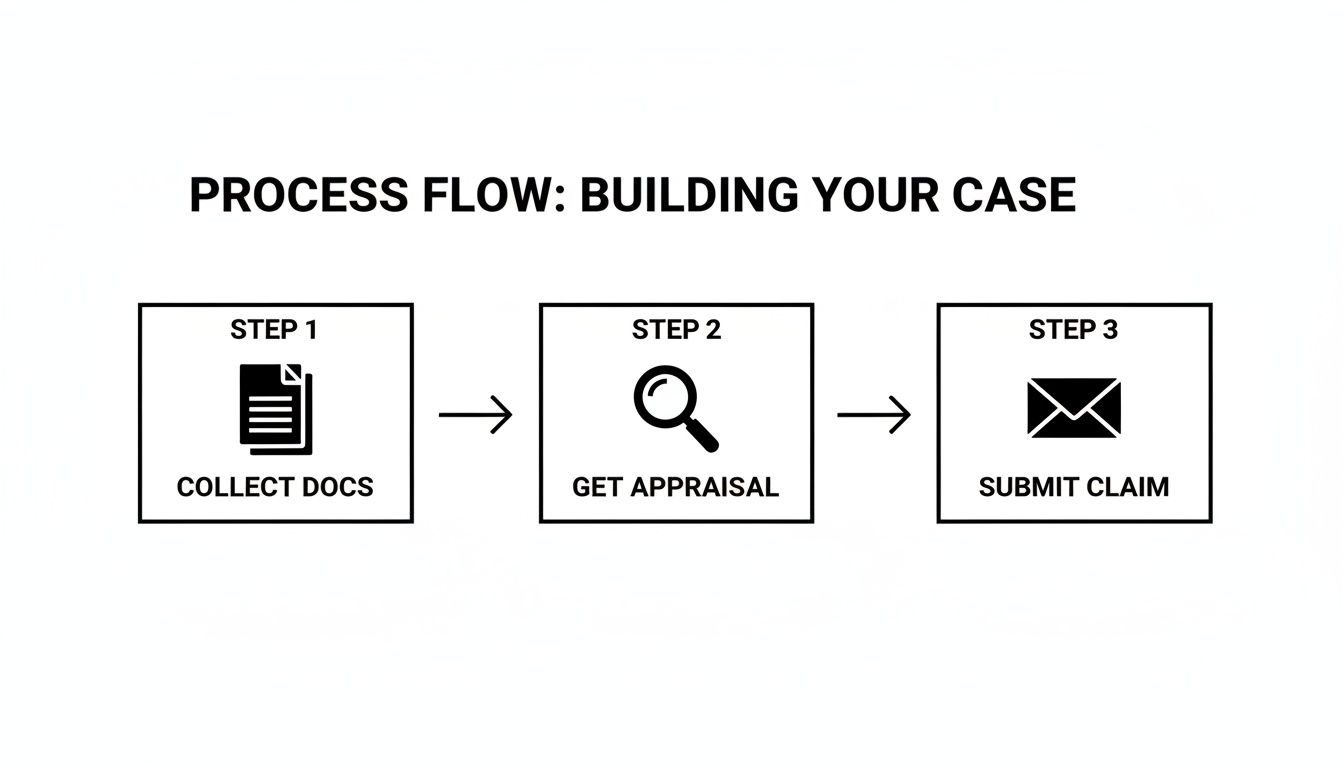
Following a structured process like this ensures you present a rock-solid claim that adjusters have no choice but to take seriously.
How Long Do You Have to File a Claim in Texas?
After a car accident, the clock starts ticking against you. The Texas statute of limitations generally gives you just two years from the date of the wreck to file a lawsuit for property damage, and that includes diminished value. If you let that deadline pass, you lose your right to recover a single penny—forever.
Insurance companies know this and sometimes use stall tactics, hoping you’ll either get frustrated and give up or run out of time. Moving quickly and with purpose is the only way to protect your rights. A bad claims experience can have a huge financial fallout; recent research shows that up to $170 billion in premiums could be at risk globally over the next five years due to poor claims handling, causing unhappy claimants to switch insurers. You can learn more about these insurance industry findings to see why it's in their interest to handle claims fairly.
An experienced lawyer can shield you from these delay tactics and push back hard against unfair settlement offers. We handle the stressful negotiations so you can focus on moving forward.
Hiring a Houston personal injury attorney sends a clear message that you won’t be pushed around. We can take over all communication with the insurer, shut down their lowball offers with strong legal arguments, and, if they refuse to be fair, file a lawsuit to demand the full compensation you are owed.
Why You Need a Houston Car Accident Attorney on Your Side
While it might seem like a simple property damage issue, a diminished value claim rarely happens in a vacuum. More often than not, it's just one piece of a much larger, more serious accident case involving injuries or even the loss of a loved one. Understanding when to call a lawyer is absolutely critical for protecting your financial recovery.
If you were also physically injured in the crash, the stakes are immediately higher. Trying to juggle your medical recovery while fighting an insurance company over your car's lost value is an overwhelming burden. You need an advocate who can manage every single aspect of your case, from your personal injuries to the diminished value of your vehicle.
When to Call a Lawyer After an Accident
Hiring an experienced Houston car accident attorney becomes necessary the moment the insurer refuses to be fair. Insurance companies have teams of adjusters and lawyers whose entire job is to minimize payouts. They are counting on you not knowing the law or having the resources to fight back effectively.
You should call a lawyer if:
- You were injured in the accident. Your personal injury claim is the top priority, and a lawyer will make sure your property damage claim is handled correctly alongside it.
- The insurance company denies your claim. A denial is not the final word. We can challenge their reasoning and force them to reconsider with strong, compelling evidence.
- The insurer makes a lowball offer. Adjusters often start with an insulting offer, hoping you’ll get frustrated and just take it. We know what your claim is truly worth and will negotiate aggressively for that full amount.
An experienced attorney understands the tactics insurance companies use to undervalue your losses. We handle all negotiations, compile the necessary evidence, and file a lawsuit if needed, shielding you from stress so you can focus on healing.
Facing a powerful insurance corporation alone can feel hopeless, but you don't have to go through it by yourself. You can learn more about when it makes sense to hire legal representation in our detailed guide. We are here to stand up for your rights and ensure you receive full and fair compensation for all of your losses, whether you need a car accident lawyer, a truck crash lawyer Houston, or a wrongful death lawyer Texas.
Common Questions About Texas Diminished Value Claims
A serious accident can change your life in seconds—and leave you with a mountain of questions about your rights and what comes next. It's a confusing, stressful time. Below, we've answered some of the most common questions our team hears from people trying to pick up the pieces after a car crash in Texas.
Can I Make a Diminished Value Claim Against My Own Insurance Policy?
This is a big one, and the answer is almost always no. In Texas, your standard auto policy is a contract to get your car repaired back to its pre-crash condition. It's not a contract to pay you for the hit its market value takes.
That financial loss—the diminished value—has to be recovered from the person whose negligence caused the damage in the first place. This means you have to file what's called a "third-party" claim directly against the at-fault driver's liability insurance.
How Much Money Can I Expect From a Claim?
There’s really no single average amount, because every single car and every single crash is unique. The final number boils down to specific details like your vehicle’s make, model, age, mileage, and what kind of shape it was in before the accident.
The severity of the damage is also a huge factor. For example, a newer luxury SUV with frame damage from a Houston truck crash is going to lose a lot more value than an older sedan with a few cosmetic dings. The only way to pin down an accurate number for your specific situation is with a professional appraisal.
Should I Hire a Lawyer for Just a Diminished Value Claim?
If your diminished value claim is significant and the insurance company is digging in its heels and refusing to be fair, then yes—hiring an attorney is a very smart move. A lawyer who knows how to fight these claims can often secure a much higher settlement than you could ever get on your own.
But here’s the most important part: if you were also physically injured in the accident, having a lawyer becomes absolutely essential. An experienced Texas personal injury lawyer will manage both your personal injury and property damage claims together. This ensures you get full compensation for all of your losses, from your medical bills to your car’s lost value.
The aftermath of an accident is overwhelming, but you don't have to navigate the complex claims process by yourself. At The Law Office of Bryan Fagan, PLLC, we fight to protect your rights and recover every dollar you are owed.
If you are struggling with an insurance company after a Texas car accident, contact us for a free, no-obligation consultation to understand your options. Recovery is possible, and we are here to help you achieve it.