A serious accident can change your life in seconds—but you don’t have to face it alone. The chaos and confusion after a crash can be overwhelming, but the steps you take in the first few minutes and hours are critical to protecting your health and your right to fair compensation.
Knowing what to do can make all the difference for your physical and financial recovery. This guide will walk you through the process, offering the clarity and practical advice you need during this difficult time.
Your Immediate Steps After a Texas Car Accident
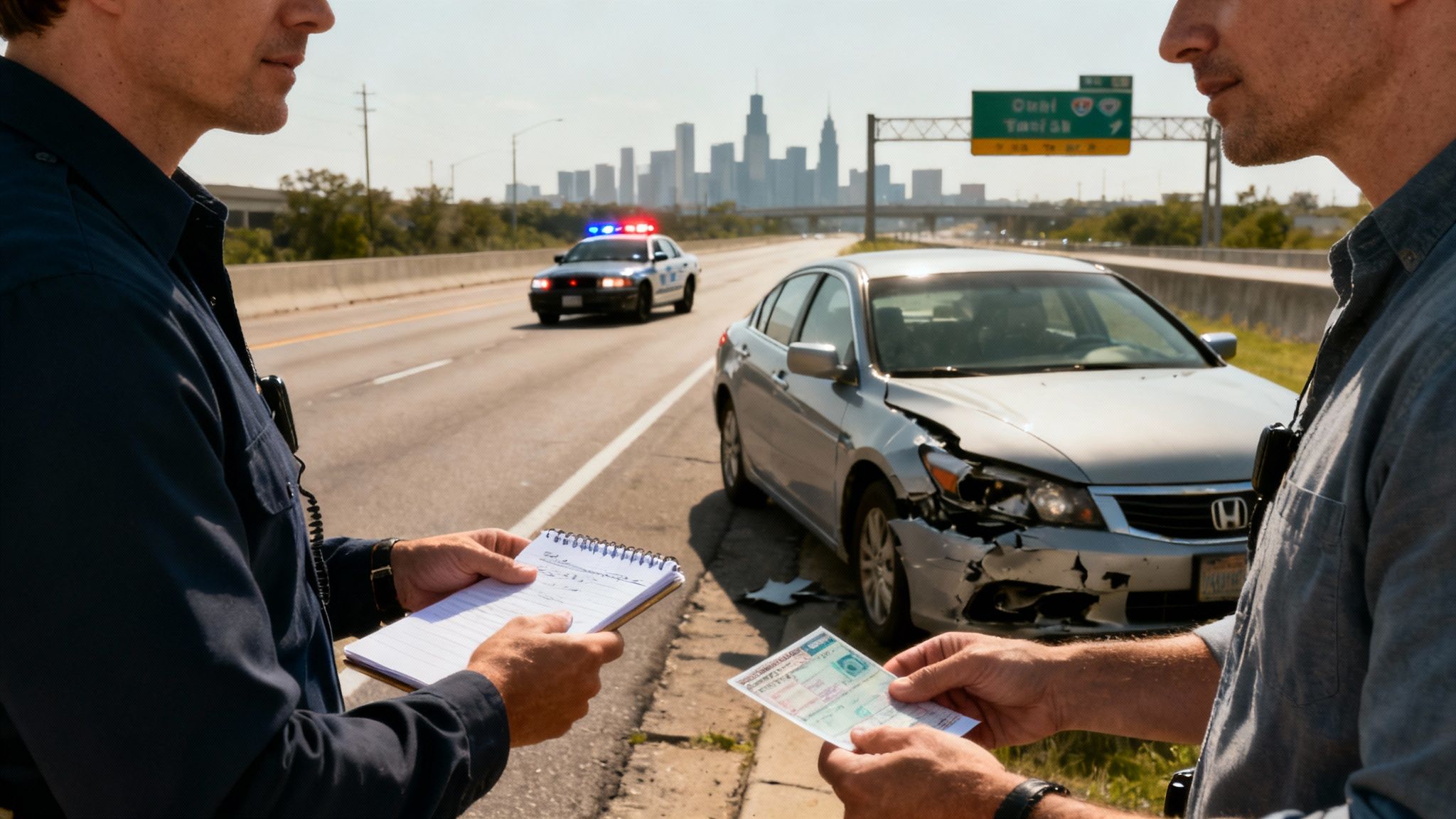
Prioritize Safety and Call for Help
Your first priority is always safety. If you are able, move your vehicle to the shoulder or a safe location to prevent another collision. Turn on your hazard lights immediately.
Next, check on yourself and your passengers. Even if you believe your injuries are minor, call 911 immediately. An official police report is one of the most important pieces of evidence for your claim, and paramedics can provide essential medical care on the scene.
Interact Carefully with Law Enforcement and the Other Driver
When the police arrive, provide a clear, factual account of what you remember. Do not guess, speculate, or accept blame. A simple phrase like "I'm sorry" can be twisted by insurance companies into an admission of fault, even if you were just being polite.
You are required to exchange information with the other driver. Remain calm and polite, but be direct. Make sure you get:
- Full Name and Contact Information: Their phone number and address.
- Insurance Company and Policy Number: The easiest way is to take a picture of their insurance card.
- Driver's License and License Plate Number: Snap a photo of these as well.
- Vehicle Information: Note the make, model, and color of their car.
That is all you need to share. Avoid debating who was at fault. Exchange the necessary information and let the police conduct their investigation.
The Critical Need for Immediate Medical Attention
After a crash, your body is flooded with adrenaline, which can mask serious injuries like whiplash, internal bleeding, or a concussion. You might not feel the full extent of your injuries for hours or even days.
This is why seeing a doctor right away is non-negotiable, for two important reasons.
First, it protects your health. A doctor can diagnose and begin treating injuries before they worsen. Second, it creates an official medical record that directly links your injuries to the accident. Without this documentation, an insurance adjuster will almost certainly argue that your injuries came from another incident, which could completely derail your claim.
Key Takeaway: Never tell anyone at the scene—not the police, not the other driver—that you're "fine" or "not hurt." The best response is to say you will be seeking a medical evaluation to be sure.
Why You Must Obtain the Police Report
The police report is the official, objective account of what happened. It is filled with details that will become the backbone of your claim, including:
- The officer’s initial assessment of who was at fault.
- Diagrams of the accident scene.
- Statements from both drivers and any witnesses.
- Any traffic citations that were issued.
Before the officer leaves the scene, be sure to get their name, badge number, and the police report number. You will need this information to obtain a copy later.
Navigating these initial moments is overwhelming, especially when you are hurt and shaken. For a more detailed breakdown, our guide on what to do after a car accident offers further advice. You can also consult this resource about the first steps after an accident. Taking these correct initial actions helps lay the groundwork for everything that follows.
Gathering Evidence to Build Your Strongest Claim
After the initial shock of a crash wears off, your focus should shift to building the strongest possible case for your car accident claim. This starts with gathering solid evidence.
The quality of the proof you collect in the hours, days, and weeks after the accident often separates a fair settlement from an inadequate one. Insurance companies are businesses, and their goal is to pay out as little as possible. Strong, clear proof is your most effective tool against their tactics.
Documenting the Scene and Damage
The foundation of a strong claim begins right at the scene. While the police report is a key piece of the puzzle, the photos you take with your phone can be even more powerful.
For example, after a Houston freeway crash where a distracted driver runs a red light and T-bones your car, the police report might only note basic damage. Your photos can tell the full story.
Your phone is your most important tool right after an accident. Be methodical with your pictures.
- Vehicle Positions: Get shots of where both cars ended up before they are moved. This is crucial for showing the point of impact and the force of the collision.
- Property Damage: Get close-up photos of the damage to your car and the other vehicle from every possible angle.
- The Bigger Picture: Pan out to capture the entire scene. Photograph any skid marks, debris on the road, traffic signals, and nearby road signs. This context is invaluable for accident reconstruction experts working to prove the other driver was negligent.
- Visible Injuries: If you have cuts, bruises, or scrapes, document them immediately. Continue taking photos over the next few days and weeks as they heal or change.
This visual evidence makes it incredibly difficult for the other driver to change their story later. It creates a clear, undeniable record of what happened.
The Power of a Personal Injury Journal
Some of the most significant damages in an injury claim are not visible on a medical bill or repair estimate. This is where keeping a personal journal becomes invaluable for proving your non-economic damages—what the law calls "pain and suffering." This is more than a diary; it is a detailed log of how the accident has impacted your daily life.
Keeping a detailed journal is one of the most effective ways to show an insurance adjuster the true human cost of an accident. It translates your pain into a language they understand—evidence.
Take a few minutes each day to write down notes. What was your pain level on a scale of 1 to 10? Were you unable to sleep through the night again? Did you have to miss your child's soccer game because you couldn't stand on the sidelines? These specific, human details paint a vivid picture of your suffering and are essential when your attorney calculates the full value of your claim.
Creating a Financial Paper Trail
While your journal tracks your physical and emotional recovery, you also need to create a meticulous financial record. The burden is on you to prove every dollar the accident has cost you. Get a folder or a box and start keeping everything related to the crash.
This includes:
- All Medical Bills: Every doctor's co-pay, prescription receipt, physical therapy bill, and hospital statement.
- Proof of Lost Wages: Gather your pay stubs and ask your HR department for a letter detailing the exact hours and income you've lost because of the accident.
- Out-of-Pocket Expenses: Don't forget the small things. Keep receipts for gas for driving to medical appointments, over-the-counter medication, or medical equipment like crutches.
This detailed documentation is the bedrock of your claim. Whether you were in a minor fender-bender or a catastrophic wreck involving a commercial truck that requires a truck crash lawyer Houston, this evidence forces an insurance company to take your claim seriously.
Navigating the Complex Insurance Claim Process
After you've handled the immediate aftermath and gathered initial evidence, it’s time to navigate the world of insurance claims. This can be intimidating. You are dealing with large companies whose business model is built on minimizing payouts, and their adjusters are trained professionals. Knowing how to communicate with them is critical to protecting your right to fair compensation.
You will generally need to report the accident to two insurance companies: your own and the one covering the at-fault driver. Most policies require you to notify your insurer promptly, so don't delay. When you make these calls, keep it simple and stick to the facts—your name, policy number, and the basic details of when and where the crash happened. Do not volunteer extra information or speculate about the cause.
What to Say to an Insurance Adjuster
Soon after the accident, an adjuster from the other driver’s insurance company will likely call you. They are skilled negotiators, and their job is to find any reason to devalue or deny your claim.
Keep these principles in mind:
- Stick to basic info: Only confirm your name, address, and the vehicle you drive.
- Don't discuss your injuries: A simple, "I'm receiving medical treatment," is all you need to say. Never say you feel "fine" or "okay," as this can be used against you later if your injuries prove to be more serious.
- Just say no to a recorded statement: You are not legally required to give a recorded statement to the at-fault driver's insurer. Politely but firmly decline until you have spoken with an experienced Houston car accident attorney.
An adjuster may sound friendly and concerned, but every question is designed to find holes in your story or get you to admit some level of fault. Be cautious.
Understanding Different Types of Claims
The type of claim you file depends on the circumstances of the wreck. Knowing which path to take is key.
For example, if you were rear-ended on I-45 in Houston, you would file a third-party liability claim against the other driver's insurance. This is a direct claim seeking payment for your medical bills, lost income, and vehicle damage from their policy.
But what if the driver who hit you flees the scene? Or what if, like many drivers in Texas, they have no insurance or a policy that won’t cover your medical bills? This is where your own policy comes in. You would file a claim under your Uninsured/Underinsured Motorist (UM/UIM) coverage. This is an incredibly important part of your insurance that protects you when the person who caused the crash cannot pay.
Be wary of a quick settlement offer. It is almost never a fair one. Insurers often dangle a lowball offer early, hoping you will take the cash before you realize the true cost of your injuries and future medical care.
With around six million car accidents occurring in the U.S. each year, insurance companies have perfected their claims-handling strategies—usually to their own benefit. You can find more insights about these national accident trends to understand the larger landscape.
This infographic breaks down the essential evidence you need to start building your claim.
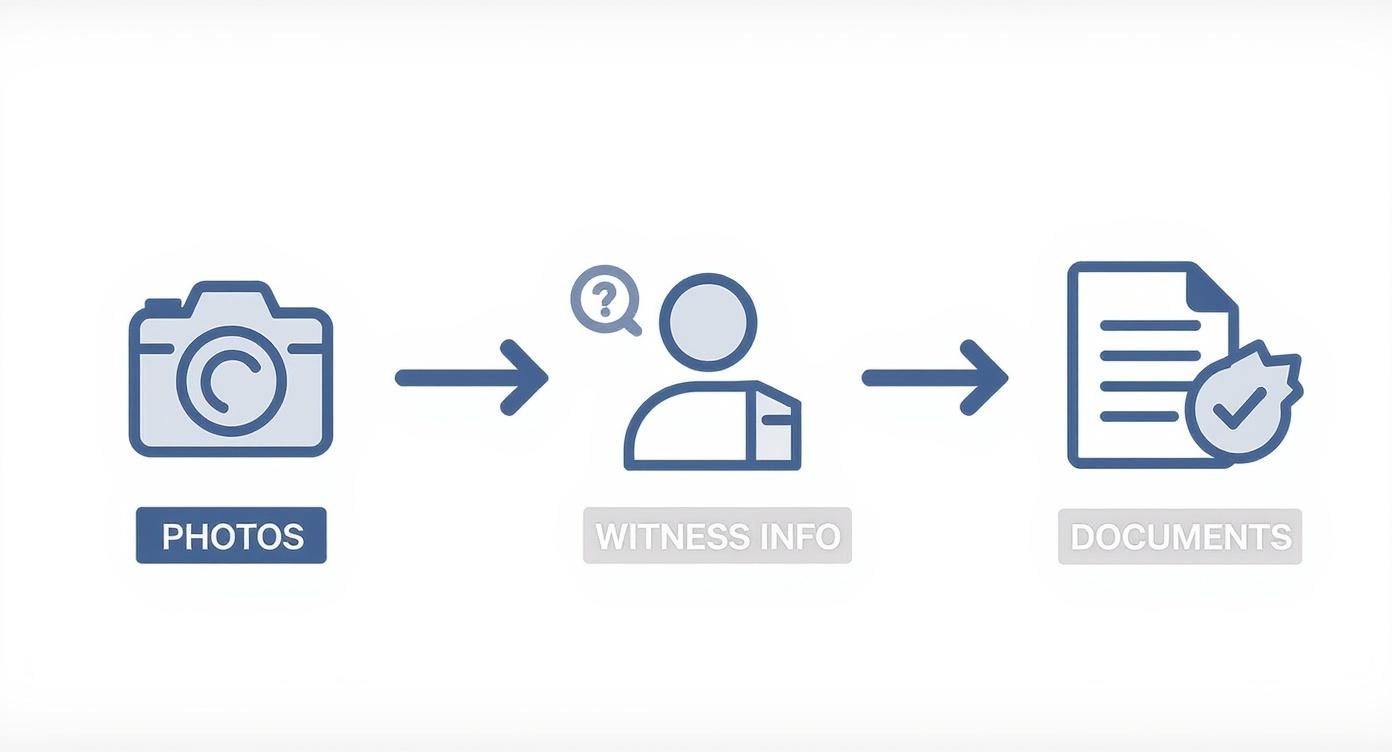
Every piece of evidence here—photos, witness contacts, the police report—is a brick in the foundation of a strong claim. Having this ready makes it much harder for an adjuster to dispute the facts.
To help keep you organized, we've put together a checklist to guide you through the process.
Your Insurance Claim Checklist
This checklist breaks down the essential steps to make sure you have everything in order when you're ready to file your claim.
| Step | Action Required | Key Tip |
|---|---|---|
| 1. Initial Report | Notify your own insurance company of the accident as soon as possible. | Have your policy number, date, time, and location of the crash ready. Stick to the basic facts. |
| 2. Document Everything | Gather the police report, photos/videos from the scene, and witness contact information. | Keep all documents in a dedicated folder, either physical or digital, for easy access. |
| 3. Track Medical Care | Keep a detailed record of all doctor visits, treatments, medications, and related expenses. | Ask for copies of all medical records and bills. Note how your injuries impact your daily life. |
| 4. Contact At-Fault Insurer | Initiate a third-party claim with the at-fault driver’s insurance company. | Provide only essential information. Politely decline any request for a recorded statement. |
| 5. Submit Proof of Losses | Prepare and submit documentation for medical bills, lost wages, and property damage estimates. | Get a letter from your employer confirming missed work and lost income. |
| 6. Review Settlement Offer | Carefully review any settlement offer with a legal professional before accepting. | The first offer is almost always too low. Don’t sign anything without getting legal advice. |
Following these steps can help you stay in control and present a clear, organized case to the insurer.
The claims process can feel like a battle, but you do not have to fight it alone. Whether it’s a minor collision or a catastrophic accident that requires a wrongful death lawyer in Texas, getting professional guidance can make all the difference.
Understanding Texas Law and Your Legal Rights
Navigating the aftermath of a car accident involves more than just dealing with insurance adjusters. It requires an understanding of the Texas laws that will govern your claim.
This knowledge is your power. It protects you and ensures you are treated fairly when you are most vulnerable. Understanding your rights is the first step toward taking back control of your life.
How Texas Determines Fault in an Accident (Negligence)
Texas is an "at-fault" state, a critical concept that forms the foundation of every car accident claim. Simply put, it means the person who caused the accident is legally responsible for the damages. This is based on the legal principle of negligence.
To receive compensation, you must prove the other driver was negligent. This means showing four things:
- The other driver had a duty to drive safely.
- They breached that duty through a careless act (like texting while driving or speeding).
- This breach directly caused the accident.
- You suffered injuries and other damages as a result.
For instance, after a Houston freeway crash, proving negligence might involve using evidence—the police report, witness statements, and traffic camera footage—to show the other driver made an unsafe lane change and caused the collision. The entire process of filing a personal injury claim hinges on proving this negligence.
What Is Proportionate Responsibility? (Comparative Fault)
What happens if the insurance company claims you were also partially to blame? Texas law has a specific rule for this called Proportionate Responsibility, also known as modified comparative fault.
Under this rule, you can still recover damages as long as your share of the fault is 50% or less. However, your final compensation will be reduced by your percentage of fault.
Real-World Example: Imagine a jury awards you $100,000 for your injuries after a wreck on a Dallas freeway. But they also determine you were 10% at fault because one of your brake lights was out. In Texas, your award is reduced by that 10%, so you would receive $90,000. If the jury found you were 51% or more at fault, you would receive nothing under Texas law.
Insurance adjusters often use this rule to shift blame onto victims to reduce what they have to pay. This is a key reason why having an experienced Texas personal injury lawyer is so important.
How Long Do You Have to File a Claim in Texas? (Statute of Limitations)
Texas has a strict deadline for filing a lawsuit after a car accident, known as the statute of limitations. For most personal injury cases, you have just two years from the date of the crash to file your lawsuit.
Two years may sound like a long time, but it passes quickly when you are focused on medical treatments and recovery. Building a strong case takes time—evidence must be gathered, experts may need to be consulted, and negotiations with the insurance company can be lengthy.
If you miss this two-year deadline, the court will almost certainly dismiss your case. You will lose your right to seek any compensation forever, no matter how clear the other driver's fault was.
These Texas laws will directly shape your case. Understanding them is the first step, but having a legal advocate who knows how to apply them to your specific situation is what truly levels the playing field.
When You Need a Houston Car Accident Attorney

While you may be able to handle a minor fender-bender on your own, many accidents are too complex and high-stakes to navigate alone. A serious crash can change your life in an instant, but you don't have to face the aftermath by yourself.
Knowing when to call a lawyer is one of the most important decisions you can make. Insurance companies have teams of professionals working to protect their profits, not to ensure you are paid what you deserve. Legal help levels the playing field.
Red Flags That Signal You Need an Attorney
Certain situations should be an immediate sign that it's time to seek professional legal advice. If you are facing any of these scenarios, your right to fair compensation is at serious risk without an experienced advocate fighting for you.
- Serious or Catastrophic Injuries: If the wreck caused major injuries like broken bones, a spinal cord injury, or a traumatic brain injury, the financial stakes are enormous. These cases require a deep understanding of future medical costs and long-term care needs.
- The Insurance Company Denies Your Claim: A flat-out denial is a clear signal that the insurer will not cooperate. They may try to blame you for the accident or claim your injuries are unrelated to the crash.
- The Settlement Offer is Too Low: The first offer is almost always a lowball amount that is a fraction of your claim's true value. If it doesn't even cover your existing medical bills, they are trying to settle your claim for far less than it's worth.
- A Loved One Was Lost: If the accident resulted in a fatality, you may have a wrongful death claim. These are among the most emotionally and legally complex cases, and you need a compassionate and skilled wrongful death lawyer Texas to seek justice for your family.
- A Commercial Truck Was Involved: Collisions with 18-wheelers are not simple car wrecks. They involve complex federal regulations, multiple liable parties, and aggressive corporate legal teams. You absolutely need a specialized truck crash lawyer Houston who understands this specific area of law.
Key Insight: The moment an insurance adjuster disputes fault, questions the severity of your injuries, or delays your claim, they are showing their strategy. That's your cue to bring in a professional.
How a Lawyer Strengthens Your Claim
Hiring an experienced Houston car accident attorney provides more than just an advisor; it gives you a champion who takes the entire burden of the claims process off your shoulders. This frees you to focus on what matters most—your recovery.
Your legal team will get to work right away:
- Handling All Communications: We take over every call and email with the insurance companies. You will not have to deal with adjusters trying to twist your words or pressure you into an unfair settlement.
- Conducting a Thorough Investigation: We dig deeper than the initial police report. Our team gathers crucial evidence, interviews witnesses, and can bring in accident reconstruction experts to prove exactly how the other driver's negligence caused your injuries.
- Accurately Valuing Your Claim: We consult with medical and financial experts to calculate the full, true value of your damages. This includes not just your current bills, but also future medical treatments, lost earning capacity, and the immense pain and suffering you have endured.
If your car accident claim requires legal representation, exploring resources for finding a car accident law firm can be a valuable next step. For a deeper understanding of the specific situations that warrant legal action, you can learn more about when to hire a personal injury lawyer in our detailed guide.
Common Questions About Filing a Car Accident Claim
After a crash, your head is likely filled with questions. It's completely normal. You are dealing with injuries, a damaged vehicle, and the stress of what comes next. Here are clear answers to the questions we hear most often from people in your situation.
How Long Do I Have to File a Car Accident Claim in Texas?
This is one of the most critical questions. In Texas, the statute of limitations gives you two years from the date of the accident to file a lawsuit for your personal injuries.
Two years may seem like a long time, but it disappears quickly when you are focused on doctor's appointments and recovery. Waiting is a serious mistake. Evidence can be lost, witnesses' memories can fade, and if you miss that two-year deadline, the court will almost certainly dismiss your case forever.
What if the At-Fault Driver Has No Insurance?
It is an infuriating and all-too-common scenario in Texas. The driver who hit you was negligent, and you discover they have no insurance—or only the minimum coverage, which won't cover your bills. You still have options.
This is where your own Uninsured/Underinsured Motorist (UM/UIM) coverage is so important. If you have this coverage, you can file a claim with your own insurance company. Your insurer essentially steps into the shoes of the at-fault driver's insurance and covers your losses, including:
- Medical bills (current and future)
- Lost income
- Pain and suffering
A good Texas personal injury lawyer can review your policy, confirm your UM/UIM limits, and manage the entire claim for you. This is crucial because even your own insurance company may try to pay less than you deserve.
Should I Accept the First Settlement Offer?
No. The insurance adjuster's first offer is almost never fair. It is a business tactic designed to close your case for the lowest amount possible before you understand the full extent of your damages.
That first offer is just a starting point for negotiation—not the final amount. It is a lowball number that often ignores your future medical needs, the full impact of your lost wages, and the true value of your pain and suffering.
If you accept that quick payment, you will sign away your right to seek any more money for this accident. Before considering any offer, you need a complete picture of your long-term medical outlook. It is always best to have an experienced Houston car accident attorney review any offer to ensure it is fair.
How Much Does It Cost to Hire a Personal Injury Lawyer?
We understand that the last thing you need right now is another bill. That is why at The Law Office of Bryan Fagan, PLLC, we handle all personal injury cases on a contingency fee basis.
What does this mean for you?
You pay no upfront fees. We cover all the costs needed to investigate your accident and build a strong case. Our fee is a percentage of the compensation we recover for you, either through a settlement or a court award. It’s as simple as this: if we don't win your case, you do not owe us a dime. This removes the financial risk from your shoulders, allowing you to focus on healing while we focus on fighting for you.
A serious accident can turn your world upside down, but you do not have to fight the insurance companies alone. Recovery is possible, and legal help is available. The dedicated team at The Law Office of Bryan Fagan, PLLC is here to answer your questions and handle the legal battle so you can focus on your recovery.
Schedule your free, no-obligation consultation today. Let's talk about how we can help you move forward. Visit us at https://texaspersonalinjury.net.