A serious car accident can change your life in seconds — but you don’t have to face it alone. There’s no magic number for what a car accident settlement is worth, but most minor injury cases here in Texas tend to settle for somewhere between $10,000 and $25,000. On the other hand, claims involving severe or life-altering injuries can climb into the hundreds of thousands or even millions of dollars.
A Realistic Look at Car Accident Settlements in Texas
Whether you were in a pile-up on a Houston freeway or a collision on a quiet rural road, one of the first questions you’ll have is about compensation. You’re suddenly dealing with a mountain of medical bills, time off work, and significant pain—it's only natural to wonder what kind of financial recovery is possible. Getting a handle on what goes into a typical settlement is the first step toward getting your life back on track.
While averages can give you a ballpark idea, they never tell the whole story. Your situation is unique, and the real value of your claim will come down to the specific details of what happened to you.
Understanding the Numbers
Looking at national data can give us a general starting point. For example, some sources say the average settlement for a car accident with injuries is around $30,416. But these figures can be misleading because they lump everything together. A minor fender-bender that results in whiplash might settle for $10,000, while a crash that causes a traumatic brain injury could be worth millions. You can find more on national settlement statistics from Consumer Shield.
Here in Texas, the numbers are just as varied. You might see a median settlement figure around $12,281, but then an average that soars to over $800,000. Why the huge gap? It’s because a handful of multi-million-dollar jury verdicts from truly devastating injury cases pull that average way up.
The most important thing to remember is this: Averages are just a benchmark. The true value of your claim isn't based on some national statistic—it's based on the actual damages you have suffered.
At The Law Office of Bryan Fagan, PLLC, our focus is on calculating the full and fair value of your specific case. A skilled Houston car accident attorney will dig into every detail to make sure your settlement truly reflects what you need to recover and move forward.
Key Factors That Determine Your Settlement Amount
Figuring out how a settlement is calculated can feel overwhelming, especially while you are trying to heal. While no two cases are exactly alike, insurance companies and personal injury lawyers look at a specific set of factors to figure out what your claim is really worth. It's not a number pulled out of thin air; it’s a detailed calculation based on the real losses you’ve suffered.
Think of it as building a house. The foundation is made of solid, documented financial losses—the bills you can actually hold in your hand. Everything else gets built on top of that.
This chart gives you a general idea of how settlement ranges can look based on how severe the accident was.
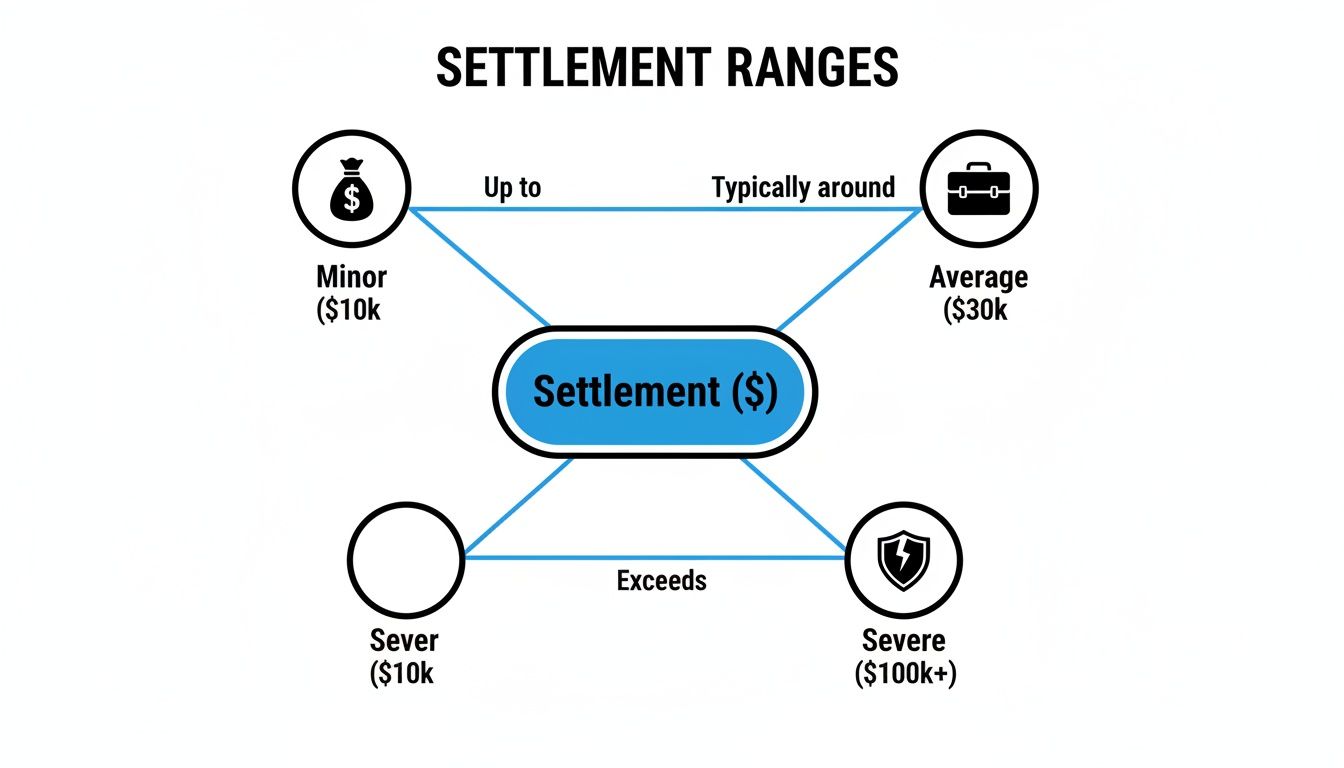
As you can see, the value jumps significantly from a minor fender-bender to a catastrophic crash. This is exactly why documenting the full extent of your injuries and losses is so critical.
Economic Damages: The Foundation Of Your Claim
The most straightforward part of any settlement calculation comes down to economic damages. These are the tangible, verifiable financial losses you’ve incurred because of the accident. A strong case is always built on meticulous documentation of these costs.
Key economic damages include:
- Medical Expenses: This covers every single medical cost tied to the crash, from the initial ambulance ride and ER visit to surgeries, physical therapy, prescription drugs, and any future medical care you'll need.
- Lost Wages: If your injuries kept you from working, you deserve to be compensated for the income you lost. This includes not just your salary but also any bonuses, commissions, or overtime you would have earned.
- Future Lost Earning Capacity: For severe injuries that permanently change your ability to work or force you into a lower-paying job, your settlement must account for this long-term financial hit.
- Property Damage: This is the cost to repair or replace your vehicle and any other personal property, like a laptop or phone, that was destroyed in the collision.
It’s crucial to gather every bill, receipt, and pay stub. This evidence forms the undeniable financial foundation that a lawyer will use to build your case and negotiate with the insurance company on your behalf.
Non-Economic Damages: Valuing Your Human Losses
Beyond the clear-cut financial costs, a car accident takes a huge human toll. Non-economic damages are designed to compensate you for these intangible but very real losses that completely disrupt your quality of life.
While these damages don't come with a price tag, they are a critical part of a fair settlement.
Your pain, your trauma, and the disruption to your life have value under Texas law. A fair settlement must acknowledge the full human cost of the accident, not just the financial one.
These damages often include compensation for:
- Pain and Suffering: This is for the physical pain, discomfort, and general suffering you have to endure because of your injuries.
- Mental Anguish: Accidents can cause serious emotional distress, including anxiety, depression, fear, and even post-traumatic stress disorder (PTSD).
- Loss of Enjoyment of Life: This addresses your inability to do the hobbies, activities, or daily routines that brought you joy before the crash.
- Physical Impairment or Disfigurement: If the accident left you with a permanent disability, scarring, or other physical disfigurement, this must be factored into your compensation.
Calculating non-economic damages is more subjective, and it’s where the experience of a skilled Texas personal injury lawyer truly matters. They know how to present evidence of your suffering—through medical records, expert testimony, and even personal journals—to argue for a value that truly reflects what you've been through. To get a better handle on the different types of compensation available, you can learn about the types of damages in a Texas personal injury claim in our detailed guide.
The Role Of Insurance Policy Limits
A major factor that can put a ceiling on your settlement amount is the at-fault driver's insurance policy limit. In Texas, drivers are only required to carry a minimum of $30,000 in liability coverage per injured person. If your damages are far more than that, getting full compensation can become much more challenging.
This is why having your own Uninsured/Underinsured Motorist (UIM) coverage is so incredibly important. It can provide a vital safety net when the other driver’s insurance isn’t enough. An experienced attorney knows how to explore every possible source of compensation to make sure you aren’t left paying out of pocket for someone else’s mistake.
How Texas Law Shapes Your Car Accident Claim
The final value of your settlement isn’t just about adding up your injuries and expenses. It’s also heavily shaped by specific Texas laws—the rules that insurance companies must follow. A deep understanding of these laws is one of the most powerful tools a Houston car accident attorney can use to protect your rights.
Two laws, in particular, can make or break your ability to recover compensation: the state’s rule on shared fault and the deadline for filing a claim.
How Long Do You Have to File a Claim in Texas?
The most critical law you need to know is the statute of limitations. This is a legal countdown clock that dictates how long you have to file a lawsuit after being injured.
In Texas, you generally have just two years from the date of the car accident to file your claim.
This deadline is unforgiving. If you miss it, you will almost certainly lose your right to seek compensation, no matter how severe your injuries are or how obvious the other driver's fault was. This is one of the biggest reasons you should never wait to speak with a lawyer.
Waiting not only puts you at risk of missing the deadline but also makes building a strong case much harder. Evidence disappears. Witness memories fade. Surveillance footage gets erased. If you're worried about this deadline, you should read our guide on how long after an accident you can claim an injury in Texas.
What is Modified Comparative Fault in Texas?
Insurance companies often try to argue that you, the injured person, were also partially at fault for the accident. Texas handles this with a system called modified comparative fault, or proportionate responsibility. The rule is simple, but its impact on your settlement is huge:
- You can recover damages as long as you are 50% or less at fault for the crash.
- Your final settlement will be reduced by your percentage of fault.
- If you are found to be 51% or more at fault, you get nothing. You are barred from recovering any compensation.
For example, after a Houston freeway crash, your total damages are calculated at $100,000. If the insurance adjuster successfully argues you were 20% at fault because you glanced at your GPS, your potential award drops by that 20%—leaving you with just $80,000. This is exactly why fighting back against unfair blame is so critical.
That 51% bar is a harsh reality in Texas personal injury law. It makes proving the other driver’s negligence—and defending you from claims of fault—the absolute top priority for your legal team.
Navigating these Texas-specific laws is not something you should have to do while trying to heal. A skilled Texas personal injury lawyer knows these rules inside and out and will act fast to preserve evidence, meet every deadline, and build a case designed to get you the maximum recovery allowed under state law.
Understanding the Settlement Timeline and Process
Waiting for a settlement after a car accident is incredibly stressful. You're trying to heal, get back to work, and pay bills that are piling up, all while navigating a legal process that can feel like it's moving at a crawl. We understand. Knowing what to expect—and why things take time—can take a huge weight off your shoulders.
Think of it as building a house. You can't rush the foundation, or the whole thing will crumble. It's the same with a personal injury claim. A rushed process almost always ends with you accepting a lowball offer from an insurance company that's just trying to close your file.

The Key Stages of a Car Accident Claim
While no two accidents are exactly alike, most claims follow a predictable path. When you have an experienced attorney managing this for you, you can focus 100% on your recovery while we handle every detail.
Here’s a look at how it typically unfolds:
-
Investigation and Evidence Gathering: This is where it all starts. Our team gets to work immediately, collecting police reports, tracking down witnesses, grabbing photos of the scene and vehicle damage, and securing any traffic camera footage. Our goal is to build an ironclad case showing exactly what happened and who was at fault.
-
Medical Treatment and Documentation: As you attend doctor's appointments and get the care you need, we're gathering every single medical record. It is vital to wait until you’ve reached what’s called Maximum Medical Improvement (MMI). That’s the point where your doctor confirms your condition is stable and won't get any better. Only then can we know the true cost of your injuries.
-
Calculating Damages and Sending a Demand Letter: Once we have the full picture of your losses, we draft a detailed demand letter. This isn't just a request for money; it's a formal legal document sent to the insurance company that lays out the facts, proves the other driver’s liability, and demands a specific amount to cover every penny of your damages.
-
Negotiation with the Insurance Company: The insurance adjuster’s job is to save their company money, so they will almost never accept our initial demand. They'll come back with a counteroffer, usually a very low one. This kicks off the negotiation phase, where your attorney fights back with evidence and legal arguments to force them to the table with a fair number.
-
Filing a Lawsuit (Litigation): If the insurance company refuses to be reasonable, we file a lawsuit. This sounds intimidating, but it doesn't mean you're headed to trial. In fact, around 95% of personal injury cases settle before ever seeing a courtroom. Filing a lawsuit is often the move that finally gets the insurer to negotiate seriously.
Why Patience Is a Virtue in Settlement Negotiations
It’s completely understandable to want to take the first offer you get just to have it all be over. But that's almost always a huge mistake that leaves a lot of money on the table. The timeline for a claim is directly tied to its value—a complex case with catastrophic injuries will take longer, but it will also result in a much higher settlement.
The length of time to reach a settlement is not a sign of a problem; it's a sign that your case is being handled thoroughly to ensure you receive full and fair compensation for everything you have lost.
The timeline to settle a car accident claim can significantly affect the final amount, with most cases resolving in 12 to 36 months. A simple fender-bender might be done in a few months, but a case involving broken bones or a TBI could easily take 24-36 months as we gather all the medical evidence and figure out the cost of future care.
For a deeper dive into these timelines, you can explore our guide on how long it takes to settle a car accident claim. Behind the scenes, the efficiency of administrative work, like automated claims processing, also helps move things along. Ultimately, taking the time to do it right ensures that your long-term needs are covered, leading to a payout that truly reflects what you've been through.
Common Mistakes That Can Reduce Your Settlement
After a crash, you’re dealing with a whirlwind of pain, stress, and confusion. It’s an incredibly vulnerable time, and insurance companies know it. Their goal is to protect their bottom line by paying you as little as they can. Even one small, seemingly innocent misstep can cost you thousands.
Knowing what not to do is just as important as knowing what to do. Steering clear of these common traps will help protect the true value of your claim and give you a fighting chance at a fair settlement that actually covers your needs.

Delaying Medical Treatment
One of the biggest mistakes you can make is putting off a trip to the doctor. Right after a crash, adrenaline can easily mask serious pain—you might think you’re completely fine. But failing to get immediate medical attention gives the insurance adjuster a weapon to use against you.
They will argue that if you were really hurt, you would have gone straight to the ER. Any delay, even just a day or two, creates doubt. It gives them the opening they need to claim your injuries aren't that severe or, worse, that they were caused by something else entirely. Seeking prompt medical care creates a clear record that links your injuries directly to the accident.
Giving a Recorded Statement Without a Lawyer
The other driver’s insurance adjuster will likely call you soon after the accident. They’ll sound friendly and helpful, often asking for a quick recorded statement to "speed up the claims process." Do not agree to this.
Adjusters are trained to ask leading questions designed to get you to say something that harms your case. You are under no legal obligation to give them a recorded statement. Remember, anything you say can and will be used to minimize your injuries or shift the blame onto you.
A simple offhand comment like "I'm doing okay" can be twisted to mean your injuries are minor. An uncertain answer about the moments before impact can be spun as an admission of fault. Always let your Houston car accident attorney handle all communications with the other driver's insurance company.
Posting on Social Media
In today's world, it’s second nature to share updates with friends and family online. But after an accident, your social media profiles become a goldmine for insurance investigators who are actively digging for reasons to deny your claim or reduce your settlement offer.
Here’s how easily this can backfire:
- Posting Photos: That picture of you smiling at a family cookout? They’ll use it to argue you aren't in as much pain as you’ve claimed.
- Checking In: Checking in at a restaurant or a friend’s house can be framed as "proof" that you aren’t suffering a loss of enjoyment of life.
- Commenting on the Crash: Discussing any detail of the accident online can create inconsistencies with your official statements, which they will exploit.
The safest approach is to stop posting on all social media until your case is resolved. Do not assume your privacy settings will protect you—they are not foolproof.
These are simple mistakes to make, but they can have devastating consequences for your financial recovery. An experienced Texas personal injury lawyer can guide you through this process, helping you avoid these pitfalls and protecting your right to full and fair compensation.
How a Texas Personal Injury Lawyer Maximizes Your Recovery
After a serious crash, it can feel like you are facing a giant alone. On one side, you’re trying to recover from your injuries. On the other, the insurance company has a team of adjusters and lawyers whose only job is to pay you as little as possible.
Trying to take them on by yourself is an unfair fight. This is where a skilled Texas personal injury lawyer from The Law Office of Bryan Fagan, PLLC comes in to even the odds.
Our job is to take the entire weight off your shoulders so you can focus on what matters—getting better. From day one, we launch an independent investigation into the accident, gathering evidence like witness statements and security footage before it disappears. We handle every phone call, email, and piece of paperwork, shielding you from the pressure tactics of insurance adjusters.
Building Your Strongest Case
The most critical step we take is calculating the true value of your claim. This goes far beyond just adding up your current medical bills. We collaborate with medical experts and financial planners to project the long-term costs of your recovery.
This includes things like:
- Future surgeries you might need
- Ongoing physical therapy and rehabilitation
- Lost wages if your ability to work is permanently impacted
A demand letter from our firm isn't just a number on a page. It’s a meticulously documented legal argument that clearly establishes the other party’s negligence and the total compensation you are owed under Texas law.
This thorough preparation is our biggest advantage during negotiations. Insurance adjusters know we are fully prepared to take your case to trial if they refuse to make a fair offer. That willingness to fight is often what it takes to get a settlement that truly covers your needs.
Hiring an experienced attorney isn't about looking for a fight; it’s about making sure you have a powerful advocate in your corner who knows how to finish one. You deserve a settlement that secures your future, not just one that closes a file for the insurance company.
Comprehensive Support for Every Situation
Our firm's experience isn't limited to car accidents. We have a deep well of experience fighting for families whose lives have been turned upside down by a catastrophic event. Whether you're dealing with a commercial vehicle collision or the loss of a family member, we are here for you.
- If you or a loved one are coping with the aftermath of a devastating collision, our dedicated catastrophic injury attorneys are here to help.
- For families grieving an unimaginable loss, our compassionate wrongful death lawyers can provide the guidance needed to seek justice.
- If your accident involved a large commercial vehicle, a dedicated truck crash lawyer Houston from our team can navigate the complex federal regulations involved.
You don’t have to walk this road alone. Having professional legal representation is a powerful tool for your recovery. The Law Office of Bryan Fagan, PLLC is ready to stand up and fight for the full compensation you rightfully deserve.
Frequently Asked Questions About Car Accident Settlements
Even after getting a clearer picture of how settlements work, it's completely normal to still have questions. Here are straightforward answers to the most common concerns we hear from accident victims and their families across Texas.
Do I Have To Pay Taxes On My Car Accident Settlement In Texas?
For the most part, you won't. The IRS does not treat compensation for physical injuries or sickness as taxable income. This means the money you get for your medical bills, lost wages, and pain and suffering is generally tax-free.
There are a few exceptions. If a portion of your settlement is for punitive damages (which are rare) or for emotional distress that isn't directly tied to a physical injury, that part might be taxable. It’s always smart to discuss this with a financial advisor.
Will I Have To Go To Court To Get A Settlement?
It’s highly unlikely. The vast majority of personal injury cases—around 95%—are settled out of court through negotiations between your lawyer and the insurance company.
Filing a lawsuit is often a necessary strategic step that motivates the insurance company to make a fair offer, but it rarely means a trial is coming. Our goal is always to get you the maximum compensation as efficiently as possible, which usually happens without ever setting foot inside a courtroom.
What If The At-Fault Driver Has No Insurance?
This is an incredibly frustrating situation, but you still have options. This is exactly why Uninsured/Underinsured Motorist (UIM) coverage is so important to have on your own policy. If you have UIM coverage, your lawyer can file a claim directly with your own insurance company to cover your damages.
If you don't have UIM coverage, getting compensation is tougher. It may involve suing the at-fault driver directly and trying to collect from their personal assets. A Houston car accident attorney will explore every possible avenue to ensure you aren't left holding the bag for someone else's mistake.
A serious accident can change your life in seconds — but you don’t have to face it alone. At The Law Office of Bryan Fagan, PLLC, our team is here to give you the clarity, support, and aggressive representation you need to get your future back on track. We take on the fight so you can focus on what matters most: your recovery.
Recovery is possible, and legal help is available. Call us for a free, no-pressure consultation to talk about your case and learn how we can help you get the compensation you deserve.
Schedule Your Free Consultation at The Law Office of Bryan Fagan, PLLC