A serious accident can change your life in seconds—but you don’t have to face it alone. In Texas, filing a car accident claim involves a series of crucial steps, and it all starts the moment the crash happens. Your actions at the scene lay the foundation for a strong claim, setting the stage for recovering the compensation you need for medical bills, lost wages, and your recovery.
Critical Actions to Take Immediately After a Crash
The moments after a car wreck are chaotic and disorienting. What you do next, however, can make a huge difference in your physical and financial future. Your absolute first priority is always safety. If you can, move your vehicle out of the flow of traffic, switch on your hazard lights, and check on everyone involved.
Ensuring Safety and Calling for Help
Once you've assessed the immediate danger, your very next move should be to call 911. This is vital, even for a collision that seems minor at first glance. An official police report provides an objective account of what happened, which becomes a powerful piece of evidence when you file your claim. Paramedics can also evaluate you on the spot, as the rush of adrenaline can easily hide serious injuries like whiplash or internal trauma.
It's also critical to protect yourself legally. It’s a natural human reaction to want to apologize, but you should never admit fault or say things like "I'm sorry" at the scene. Insurance companies can twist these simple statements into an admission of guilt, potentially wrecking your ability to recover compensation, even if the other driver was clearly at fault.
Gathering Essential Evidence on Scene
While you wait for help to arrive, and only if you are physically able to, start gathering evidence. This is your one chance to document the scene exactly as it was. The information you collect right here will form the backbone of a successful claim.
Try to focus on capturing these key details:
- Photographs and Videos: Use your smartphone to take plenty of pictures from multiple angles. Document the damage to all vehicles, any skid marks on the road, traffic signals, weather conditions, and visible injuries you or your passengers have.
- Information Exchange: Get the other driver's full name, contact information, driver's license number, and their insurance policy details. Don't forget to also jot down the make, model, and license plate number of their vehicle.
- Witness Contacts: Independent witnesses can be incredibly helpful. If anyone saw the crash happen, politely ask for their name and phone number. Their account can help clear up disputed facts, especially in a confusing situation like a pileup on a Houston freeway.
Our experienced attorneys often see cases where a client assumed the police report would capture everything. Taking your own photos and getting witness information puts you in control of the evidence and makes sure crucial details aren't overlooked.
This flowchart breaks down the key priorities to focus on in the immediate aftermath.
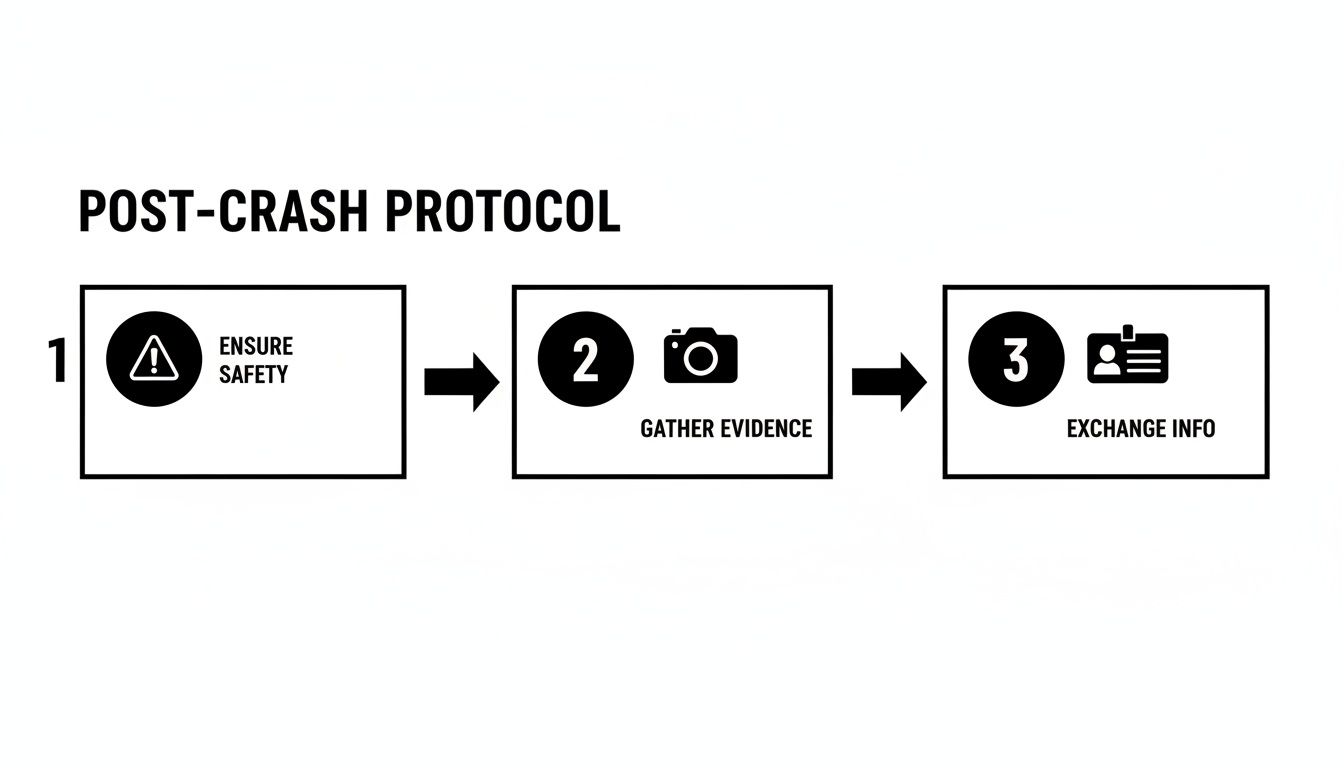
This visual is a great reminder that securing the scene, documenting what happened, and exchanging information are the foundational steps to protecting your rights.
Following a structured approach during such a stressful time can feel overwhelming, but these steps are designed to protect you. For a more detailed checklist, you can learn more about what to do after a car accident in Texas in our dedicated guide. By taking these initial actions, you create a solid starting point for your claim and begin the path toward getting back on your feet.
Navigating Texas Laws That Impact Your Claim

To secure the compensation you deserve, you have to understand the rules of the game. After a crash, you’re not just up against an insurance adjuster; you're operating within a very specific set of Texas laws that will absolutely shape the outcome of your claim. Knowing these rules is the only way to make smart decisions and protect your financial recovery.
At the heart of any Texas car wreck claim is the concept of negligence. It’s a legal term, but it’s simple: someone failed to act with reasonable care, and their carelessness hurt you. For example, after a Houston freeway crash, proving that the other driver was texting instead of watching the road is the bedrock of your entire case.
How Fault is Determined in Texas: Comparative Responsibility
Texas uses a "modified comparative fault" system, which is also called proportionate responsibility. You need to get familiar with this concept because it directly controls how much money you can actually get. In short, it means you can still recover damages even if you were partially to blame for the accident.
But there's a huge catch—the 51% bar.
- If you are found 50% or less at fault, you can still get paid, but your final award is cut by your percentage of blame.
- If you are found 51% or more at fault, you are legally barred from recovering a single penny.
Let's say you're in a wreck on a Dallas highway. The other driver blew through a stop sign, but you were going a few miles over the speed limit. A jury might decide you were 20% responsible. If your total damages were $100,000, your award would be slashed by 20%, leaving you with $80,000. This is precisely why you should never admit fault at the scene and why getting an experienced Texas personal injury lawyer is so critical.
An insurance adjuster’s job is to pin as much blame on you as possible to shrink or deny their payout. They are masters at using this 51% rule against victims.
How Long Do You Have to File a Claim in Texas? The Statute of Limitations
In Texas, the clock starts ticking the moment a crash happens. You have a strict deadline to take legal action called the statute of limitations. For most personal injury claims, that deadline is just two years from the date of the accident.
Two years might sound like a long time, but it flies by when you're dealing with doctor's appointments, surgeries, and trying to heal. Waiting too long is a catastrophic mistake. Evidence vanishes—security camera footage gets erased, witnesses’ memories fade, and physical proof from the scene disappears. If you try to file a lawsuit after that two-year window slams shut, the court will almost certainly throw your case out, leaving you with no way to get compensated.
Acting quickly allows your attorney to lock down crucial evidence and build the strongest possible case for you.
Understanding the Damages You Can Claim
When you file a car accident claim in Texas, you can demand compensation for a wide range of losses. In legal terms, these are called "damages," and they fall into two main buckets:
- Economic Damages: These are the straightforward financial losses with a clear price tag. They cover things like all your medical bills (past and future), lost wages from being out of work, a loss of earning capacity if your injuries limit your career, and the cost to repair or replace your vehicle.
- Non-Economic Damages: These are for the intangible, but very real, harm you've suffered. They don't come with a receipt but are just as devastating. This includes physical pain and suffering, mental anguish, permanent disfigurement or scarring, and the loss of your ability to enjoy life's activities.
A skilled Houston car accident attorney is an expert at calculating and documenting both types of damages to make sure your claim reflects the full, devastating impact the crash has had on every part of your life.
Picture a rainy night in San Antonio: a drunk driver swerves into your lane, causing a multi-car pileup that leaves you with broken bones and your family terrified. Road crashes cause immense tragedy, but the claims landscape presents its own challenges. While claims volumes have fallen since 2019, the severity and stakes for each case are rising, partly because modern vehicles are more complex to repair. In Texas, this is compounded by a 5% spike in uninsured/underinsured motorist claims since early 2024. As your legal advocate at the Law Office of Bryan Fagan, PLLC, we know filing a car accident claim isn't just paperwork—it's your path to justice. You can review the latest NHTSA traffic fatality estimates and learn more about these trends.
Initiating Your Insurance Claim the Right Way
After a car wreck, you’re suddenly dealing with a lot. On top of everything else, you'll probably have to communicate with two different insurance companies: your own and the one covering the at-fault driver. Kicking off the filing a car accident claim process isn't just about making a phone call; it's about being strategic from the very first conversation. What you say—and what you don't say—can make a huge difference in your final settlement.
First things first, you need to notify your own insurance company. Even if you were clearly not at fault, most policies require you to report any accident in a timely manner. Keep it simple and stick to the undisputed facts: the date, time, location, and who was involved. This isn't the time to guess about who was to blame or to downplay how you're feeling.
At the same time, you'll need to open a claim with the other driver’s insurance company. This is called a "third-party claim," and it’s how you'll pursue compensation for your vehicle damage, medical bills, and other losses. This is also your first introduction to their insurance adjuster—a professional whose primary job is to protect their employer’s profits by paying out as little as possible.
Communicating with Insurance Adjusters
It won't be long before you get a call from an adjuster. They'll probably sound friendly, concerned, and eager to help, but you have to remember their goal. Every conversation needs to be handled with caution and preparation.
Here are a few things to keep in mind for that initial call:
- Stick to the Basics: Give them your name, the date of the crash, and where it happened. Don't offer up any extra details or theories about how the crash occurred.
- Decline a Recorded Statement: You will almost certainly be asked to give a recorded statement. You are not legally required to do this. Politely decline until you've had a chance to speak with an attorney. Recorded statements are a tool adjusters use to find inconsistencies or get you to say something they can twist to weaken your claim.
- Be Vague About Your Injuries: When the adjuster asks how you are, the best response is something simple like, "I'm still getting medical treatment." You truly don't know the full extent of your injuries right after a crash. Downplaying them now gives the insurer ammunition to argue they aren't serious later.
Adjusters are trained negotiators. They use specific questioning techniques to get you to say things that can weaken your case. A simple "I'm sorry" or "I think I'm okay" can be twisted into an admission of fault or evidence of minor injuries.
Navigating these calls is a tricky balance. For a deeper dive into protecting yourself, check out our guide on how to deal with insurance adjusters.
Building Your Comprehensive Damages Package
Your story is important, but a successful claim is built on proof. You need to assemble a comprehensive "damages package" that shows the insurance company exactly what you've lost. This means gathering and organizing every piece of paper that validates your claim.
Think of it as building an undeniable record of your financial, physical, and emotional losses. The better your documentation, the more difficult it is for the insurance company to lowball you or deny your claim. If you're curious about the insurer's perspective, this guide on understanding claims processing offers some useful insights into what they're looking for.
To get you started, we've put together a checklist of the essential documents you'll need.
Essential Documents for Your Texas Car Accident Claim
Use this checklist to gather the key documents and evidence needed to support your insurance claim and prove the full extent of your damages.
| Document or Evidence Type | Why It's Important | Where to Get It |
|---|---|---|
| Official Police Report | Provides a neutral, third-party account of the crash and often contains an initial assessment of fault. | The law enforcement agency that responded to the scene (e.g., local police or Texas DPS). |
| Medical Records & Bills | Documents every injury, diagnosis, and treatment, linking them directly to the accident and proving costs. | Every provider you see: hospitals, doctor's offices, physical therapists, pharmacies, etc. |
| Proof of Lost Wages | Shows the income you lost because you were unable to work, a key part of your economic damages. | Request a letter from your employer's HR department detailing your pay rate and missed time. |
| Vehicle Repair Estimates | Establishes the cost to repair your car or, if it's a total loss, helps determine its replacement value. | At least two different reputable auto body shops. |
| Photos and Videos | Creates a visual record of vehicle damage, your injuries, and the accident scene that can be very compelling. | Your smartphone at the scene, or from witness phones. |
| Witness Statements | Corroborates your account of how the accident happened, adding credibility to your claim. | Get contact information from anyone who saw the crash at the scene. |
By methodically collecting these documents, you lay a strong foundation for your claim. You're no longer just telling the insurance company what you're owed—you're showing them with concrete proof.
Negotiating a Fair Settlement with Insurers

Here's a frustrating but predictable part of the process: the first settlement offer from the insurance company is almost always a lowball. You’re hurt, your life has been turned upside down, and now you’re looking at a number that doesn't even begin to cover your losses. This isn't an accident—it's their opening move.
Insurance adjusters are trained professionals, and their job is to protect their company’s bottom line. The goal is simple: close your claim for as little money as possible. They know accident victims are often stressed, in pain, and worried about bills piling up. They use that pressure to their advantage, hoping you’ll take a quick, inadequate payout just to be done with it.
You don't have to accept it. The key to getting what you deserve is understanding their tactics and knowing the real value of your claim.
Understanding How Your Claim is Valued
To push back against a low offer, you first need to know what your case is actually worth. A fair settlement isn't just about covering the medical bills you have right now. It must account for every single loss you have suffered—and will continue to suffer—because of the other driver’s carelessness.
This calculation involves two main types of damages:
- Economic Damages: These are the tangible, out-of-pocket financial losses. This includes all your medical treatments, prescription costs, physical therapy, lost income from missing work, and even your future lost earning capacity if your injuries will affect your career long-term.
- Non-Economic Damages: This category is about the profound, non-financial impact the crash has had on your life. It’s compensation for your physical pain, emotional distress, mental anguish, scarring or disfigurement, and the loss of your ability to enjoy life as you once did.
An experienced Houston car accident attorney knows how to meticulously document both kinds of damages to build a powerful, evidence-backed case that shows the full scope of your suffering.
Crafting a Powerful Demand Letter
Once you have a clear picture of your total damages, the next move is to formally present your case with a demand letter. This is much more than just a request for payment. It's a professional, detailed argument that lays out the facts, proves the other party’s liability, and provides comprehensive evidence of your losses.
A strong demand letter will:
- Clearly state the facts of what happened.
- Explain why the other driver is legally at fault.
- Detail all your injuries and the medical treatment you've received.
- Provide an itemized list of all economic and non-economic damages.
- Attach supporting documents like the police report, medical bills, and proof of lost wages.
This letter sets the tone for negotiations. It signals to the insurer that you are serious and have a well-supported claim.
A common tactic adjusters use is to claim your injuries were from a "pre-existing condition." A well-prepared demand letter shuts this down by including medical opinions that directly link your current pain and suffering to the trauma of the accident.
Imagine you're driving home in Houston when a distracted driver rear-ends you. This happens to Texas families every single day. In fact, total loss claims are surging—in 2025, they are projected to make up 22.6% of all U.S. auto losses. This is partly because used car values have dropped, so insurers are quicker to "total" a car rather than pay for expensive repairs. For Texans driving trucks and SUVs, this can mean a fast settlement offer that doesn't reflect your vehicle's true replacement cost. Never sign anything without understanding the real numbers.
Trying to handle these negotiations alone is draining and intimidating. Insurers have teams of lawyers on their side, and you should, too. Our firm has years of experience pushing back against lowball offers and fighting for what our clients are owed. You can learn more about the back-and-forth in our guide on how to negotiate a personal injury settlement. Having a seasoned negotiator in your corner levels the playing field and sends a clear message: you will not be taken advantage of.
Knowing When You Need a Personal Injury Lawyer

Sure, you can probably handle a minor fender-bender with no injuries on your own. But many car accidents create complications that can put your entire financial future at risk. Knowing the red flags is the key to protecting yourself.
If you’re facing any of the situations below, it’s a clear sign you need an experienced personal injury lawyer in your corner. An attorney completely levels the playing field. They become your advocate, managing every communication, digging for evidence, and fighting to get you the full compensation you deserve from powerful insurance companies.
When the Injuries Are Serious
The most obvious sign you need legal help is when an accident causes significant injuries. This isn't just a few bumps and bruises—we're talking about any harm that requires hospitalization, surgery, or long-term physical therapy. It’s especially true if the crash results in a permanent disability.
These are what we call catastrophic injury claims, and they involve massive medical bills and future care costs that have to be calculated perfectly.
Imagine someone is rear-ended on a Houston freeway and suffers a spinal cord injury. The lifetime cost of care can easily run into the millions. An insurance company’s first offer won't even scratch the surface. A skilled attorney brings in medical and financial experts to build a case that accounts for every single future need.
When Fault Is Disputed
Here’s a hard truth: insurance companies will seize any opportunity to shift the blame. If the other driver denies responsibility or the insurer tries to use Texas's comparative responsibility rule to pin a percentage of the blame on you, it's time to call a lawyer. Don't wait.
An attorney can launch an independent investigation to prove what really happened. This isn't just about filing paperwork; it's about actively building your case by:
- Hiring accident reconstruction experts to analyze the crash dynamics.
- Finding and interviewing witnesses who saw the collision.
- Securing traffic camera footage or surveillance video that police might have missed.
Without this kind of professional support, you risk having your claim unfairly reduced or denied completely, all based on a false narrative the insurer created to save money.
When a Commercial Vehicle Is Involved
Accidents involving commercial trucks, delivery vans, or any company car are a whole different ballgame. They're far more complex than a standard wreck. These cases often involve multiple at-fault parties, from the driver to the trucking company, their maintenance crews, and various insurance carriers.
A dedicated truck crash lawyer in Houston understands the complex federal regulations that govern the trucking industry. They know how to uncover evidence of negligence, like driver fatigue from falsified logbooks or a history of improper vehicle maintenance.
Picture an Austin commuter on I-35 getting hit by an 18-wheeler. The stakes are incredibly high, especially as recent auto insurance trends show bodily injury severity soaring by 9.2% year-over-year. A good lawyer can pursue claims against the company’s much larger commercial policy and ensure you don’t get stuck holding the bag. You can learn more about the latest U.S. auto insurance trends and statistics.
At The Law Office of Bryan Fagan, PLLC, we operate on a contingency fee basis. This means you pay absolutely no attorney’s fees unless we win your case. This promise removes the financial barrier, allowing everyone to access top-tier legal representation when they need it most.
If an accident tragically results in the loss of a loved one, you should immediately contact a wrongful death lawyer in Texas. These are emotionally devastating cases with unique legal complexities that require compassionate and experienced guidance.
Ultimately, if you feel overwhelmed, uncertain, or that the insurance company isn't treating you fairly, that's your sign. You don’t have to fight this battle alone. A free consultation can provide clarity and empower you to take the right next steps.
Common Questions After a Texas Car Accident
After a serious wreck, your head is probably spinning with questions. That's completely normal. The path to getting your life back on track can feel confusing, but getting straight answers is the first step toward taking back control.
Here are some of the most common questions we hear from our clients, along with the no-nonsense answers you need right now.
How Much Is My Car Accident Claim Worth?
This is usually the first question on everyone's mind, and the honest answer is: it depends. There’s no magic formula or online calculator that can give you an accurate number because every single case is different.
The true value of your claim is based on the total impact the crash has had on your life. This isn't just about the bills you can see; it's about everything you've lost.
To figure out a fair value, we dig deep and calculate everything, including:
- All Medical Expenses: From the first ambulance ride and ER visit to surgeries, physical therapy, and any medical care you’ll need down the road.
- Lost Income and Earning Capacity: We document every dollar of lost wages from time missed at work. If your injuries have permanently impacted your ability to do your job, we calculate that future loss, too.
- Pain and Suffering: This is compensation for the very real physical pain and emotional trauma you've been forced to endure.
- Property Damage: This covers the cost to get your vehicle repaired or replaced, along with any other personal items destroyed in the collision.
An insurance adjuster’s first offer will almost never cover the full extent of these damages. Don't fall for it.
Do I Have to Go to Court?
Most people picture a dramatic courtroom battle when they think about filing a claim, but that’s rarely how it plays out. The truth is, the overwhelming majority of personal injury claims—well over 90%—are settled out of court through skilled negotiation.
Our goal is always to get you a fair settlement without the time and stress of a trial. But make no mistake: if the insurance company refuses to play fair and make a reasonable offer, we are always prepared to take them to court and fight for what you're owed. Often, just filing the lawsuit is what it takes to get the insurer to start negotiating seriously.
What if the Other Driver Was Uninsured?
It’s a terrifying scenario, but it happens all the time here in Texas, which has a high rate of uninsured drivers. If you get hit by someone with no insurance—or not enough to cover your bills—you are not out of luck.
This is exactly why you have Uninsured/Underinsured Motorist (UM/UIM) coverage. It’s a part of your own auto policy that you pay for, designed to protect you in this exact situation. You can file a claim with your own insurance company to cover your medical bills, lost wages, and other losses.
But be warned: even though it's your insurance company, their goal is still to pay out as little as possible. A Texas personal injury lawyer can step in to make sure they treat you fairly and honor the policy you paid for.
How Long Will My Case Take?
The timeline for a car accident claim can vary dramatically. A simple case with clear fault and minor injuries might be wrapped up in a few months. On the other hand, a complex case involving life-altering injuries or a fight over who was at fault could easily take a year or more.
The single biggest factor that dictates the timeline is your medical recovery. We never rush to settle a claim until you have reached what doctors call "maximum medical improvement." This means your treatment is complete, and we have a clear picture of what your future medical needs and limitations will look like.
Taking a quick settlement before your treatment is finished is one of the worst mistakes you can make. It can leave you on the hook for future medical bills with no way to get them covered. Patience is critical to getting the full compensation you need to truly recover.
A serious accident can change your life in seconds—but you don’t have to face it alone. Recovery is possible, and having an expert legal team in your corner can make all the difference.
If you have more questions or you’re ready to talk about your case, the compassionate attorneys at The Law Office of Bryan Fagan, PLLC are here to listen.
Schedule Your Free Consultation with The Law Office of Bryan Fagan, PLLC